Law of the Accumulation and Breakdown,
Henryk Grossman 1929
2. The Law of Capitalist Breakdown
Is there a theory of breakdown in Marx?
Even if Marx did not actually leave us a concise
description of the law of breakdown in any specific passage
he did specify all the elements required for such a
description. It is possible to develop the law as a natural
consequence of the capitalist accumulation process on the
basis of the law of value, so much so that its lucidity
will dispose of the need for any further proofs.
Is it correct that the term ‘theory of
breakdown’ stems from Bernstein, not Marx? Is it true
that Marx nowhere ever spoke of a crisis that would sound
the death knell of capitalism, that ‘Marx uttered not
a single word that might be interpreted in this
sense’, that this ‘stupid idea’ was
smuggled into Marx by the revisionists? (Kautsky, 1908, p.
608) To be sure, Marx himself referred only to the
breakdown and not to the theory of breakdown, just as he
did not write about a theory of value or a theory of wages,
but only developed the laws of value and of wages. So if we
are entitled to speak of a Marxist theory of value or
theory of wages, we have as much right to speak of
Marx’s theory of breakdown.
In the section on the law of the tendency of the rate of
profit to fall in the course of accumulation where Marx
shows how the accumulation of capital proceeds not in
relation to the level of the rate of profit, but in
relation to its mass, he says, ‘This process would
soon bring about the collapse of capitalist production if
it were not for counteracting tendencies which have a
continuous decentralising effect alongside the centripetal
one’ (1959, p. 246). So Marx observes that the
centripetal forces of accumulation would bring about the
breakdown of capitalist production, were it not for the
simultaneous operation of counteracting tendencies.
However, the operation of these counteracting tendencies
does not do away with the action of the original tendency
towards breakdown: the latter does not cease to exist. So
Marx’s statement is only intended to explain why this
tendency towards breakdown does not enforce itself
‘soon’. To deny this is to distort the clear
sense of Marx’s words.
However it is scarcely a matter of words which
‘might be interpreted in this sense’, and so
on. Where the mere interpretation of words leads to is
quite obvious from the directions in which Kautsky drags
Marx’s theory. For us the question is: suppose
initially we abstract from the counteracting tendencies
that Marx speaks of, how and in what way can accumulation
bring about the breakdown of capitalist production? This is
the problem we have to solve.
Preliminary methodological remarks
We have to show how, as a result of causes which stem
from the economic process itself, the capitalist process of
reproduction necessarily takes the form of cyclical and
therefore periodically recurring movements of expansion and
decline and how finally it leads to the breakdown of the
capitalist system. However if the investigation is to be
fruitful and to lead to exact results, we shall have to
choose a method that can ensure this exactness.
What should we regard as the characteristic, determining
condition of the reproductive cycle? Lederer identifies
this as the price movements in the course of the business
cycle: in periods of expansion commodity prices, including
the price of labour power, rise; in periods of crisis and
depression they fall. Therefore his way of posing the
question is the following: how is a general increase of
prices possible in periods of expansion? Expansions in the
volume of production such as characterise periods of boom
are, according to Lederer, only possible due to price
increases. Therefore price increases are what he has to
explain first. Lederer sees the creation of additional
credit as the sole impulse behind price increases.
Consequently he attributes to this factor the major role in
determining the shape of the business cycle.
Spiethoff’s explanation is quite different:
‘An increase in capital investments forms the true
hallmark and causal factor of every boom’ (1925, p.
13). Here not one word is said about price increases and we
could just as well choose a whole series of other forces as
our basic indicators without moving one step further in
explaining the problem. For the question is not one of
which appearances are characteristic or typical of the
business cycle, but which are necessary to it in the sense
that they condition it. That price increases generally
occur during an upswing does not mean that they are
necessarily connected with it. If like Lederer, we were to
assume that upswings presuppose rising prices we would be
totally stumped by the American booms which were sometimes
characterised by falling prices. That a wrong
starting-point has been chosen is obvious. Both rising
prices and expanded outlays on production are in themselves
matters of indifference to the capitalist entrepreneur.
The capitalist process of production has a dual
character. It is a labour process for the production of
commodities, or products, and it is at the same time a
valorisation process for obtaining surplus value or
profits. Only the latter process forms the essential
driving force of capitalist production, whereas the
production of use values is for the entrepreneur only a
means to an end, a necessary evil. The entrepreneur will
only continue production and extend it further if it
enables him to enlarge his profits. Expanded outlays on
production, or accumulation, are only a function of
valorisation, of the magnitude of profits. If profits are
expanding production will be expanded, if valorisation
fails production will be cut. Furthermore, both situations
are compatible with constant, falling or rising prices.
Of these three possible price situations the assumption
of constant prices is the one most appropriate to theory,
in the sense that it is the simplest case and a starting
point from which the other two more complicated cases can
be examined later. The assumption of constant prices thus
forms a methodologically valid theoretical fiction with a
purely provisional character; it is, so to speak, a
coordinate system within economics, a stable reference
point that makes possible exact measurement of quantitative
variations in profitability in the course of production and
accumulation.
The basic question we have to clarify is how are profits
affected by the accumulation of capital and vice versa. Do
profits remain constant in the course of accumulation, do
they grow or do they decline? The problem boils down to an
exact determination of variations in surplus value in the
course of accumulation. In answering this question we also
clarify the cyclical movements or conjunctural oscillations
that define the process of accumulation.
These considerations underlie Marx’s analysis:
‘Since the production of exchange value — the
increase of exchange value — is the immediate aim of
capitalist production, it is important to know how to
measure it’ (1972, p. 34). In order to establish
whether an advanced capital value has grown during its
circuit or by how much it has grown in the course of
accumulation, we must compare the final magnitude with the
initial magnitude. This comparison, which forms the basis
of any rational capitalist calculation, is only possible
because — in the form of costs of production and
prices of the end product — value exists under
capitalism as an objectively ascertainable independent
magnitude. As something which is objectively ascertainable
on the market, value constitutes both the basis of
capitalist calculation and its form of appearance. Its
explanation is thus the starting-point of any theoretical
analysis.
From the very beginnings of free capitalism attempts
were made to grasp the independent character of value
— its aspect as an objective, external entity —
in numerical terms. H Sieveking tells us that ‘the
rational approach to economics was enormously speeded up by
the introduction of book-keeping’ (1921, p. 96). The
ability to calculate the yield on a sum of values
originally invested is a vital condition for the existence
of capital:
as value in motion, whether in the
sphere
of production or in either phase of the sphere of
circulation capital exists ideally only in the form of
money of account, primarily in the mind of the producer of
commodities, the capitalist producer of commodities. This
movement is fixed and controlled by book-keeping, which
includes the determination of prices, or the calculation of
the prices of commodities. The movement of production,
especially of the production of surplus value ... is thus
symbolically reflected in imagination. (Marx, 1956, p.
136)
Through prices the fluctuations of a given capital value
in the course of its circuit become expressed in money,
which serves as measure of value required for accounting.
And with respect to this measure of value Marx proceeds
from the assumption, which is purely fictitious and which
forms the basis of his analysis, that the value of money is
constant. At first sight this appears to be all the more
surprising in the sense that, in his polemic with
Ricardo’s ‘invariable measure of value’,
Marx emphasised that gold can only serve as a measure of
value because its own value is variable. In reality the
values of all commodities, including gold, are variable.
But science needs invariable measures: ‘the interest
in comparing the value of commodities in different
historical periods is, indeed, not an economic interest as
such, but an academic interest’ (Marx, 1972, p.
133).
From historical surveys of the development of
thermometry we know that a reliable measure of heat
variations was established through the fundamental work of
Amonton, with the discovery of two fundamental points
(boiling-point and the absolute null point of water) for
any liquid used as the measure of heat variations. This
alone could establish the constant reference points with
which it became possible to compare the variable states of
heat (Mach, 1900, p. 8).
There are no such constant reference points for gold as
the measure of value. So an exact measure of the value
fluctuations of commodities would be impossible. On the one
hand changes in the value of the money commodity may differ
from the changes in the value of individual commodity
types. In this case we have no exact measure to ascertain
how far, say, the rising prices of a given commodity have
been caused through changes in its own value and how far
through changes in the value of the money commodity. In
this case, suppose we were studying variations in the
magnitude of surplus value; then, with a variable value of
money, it would be difficult to tell whether a given
increment in value (or price) was not something merely
apparent and caused purely by changes in the value of
money:
In all these examples there would,
however, have been no actual change in the magnitude of
capital value, and only in the money expression of the same
value and the same surplus value ... there is, therefore,
but the appearance of a change in the magnitude of the
employed capital. (Marx, 1959, pp. 139-40)
Alternatively the value of money vanes in the same
proportion as the values of other commodities, for instance
due to general changes in productivity — a limiting
case that is scarcely possible in reality. In that case
there would have been enormous absolute changes in the real
relations of production and wealth, but these actual
changes would be invisible on the surface, because the
relative proportions of individual commodity values would
remain the same. The price index would not register the
actual changes in productivity.
Thus it was entirely valid for Marx to substitute the
‘power of abstraction’ for the missing constant
reference points, so falling into line with Galileo’s
principle: ‘measure whatever is measurable, and make
the non-measurable measurable’. For instance to
ascertain the impact of changes in productivity on the
formation of value and surplus value, Marx is forced to
introduce the assumption that the value of money is
constant. This assumption is therefore a methodological
postulate that equips Marx with an exact measure for
ascertaining variations in the value of industrial capital
during its circuit. It is an assumption underlying all
three volumes of Capital.
The variability of the measure of value, or of money, is
only one of the causes of price changes. Such changes can
just as well stem from causes that lie on the commodity
side of the exchange relation. Here we should distinguish
two cases. Either these variations of price are, from a
social point of view, consequences of actual changes in
value. (This is the case that preoccupies Marx initially,
and it is these changes he wants to measure.) Or these
variations of price represent deviations of prices from
values, which do not in any case affect the total social
mass of value because price increases in one sector of
society correspond to price reductions in another.
The specific task that Marx set himself of measuring as
exactly as possible increases in value over and above the
initial magnitude of the advanced capital, forced him to
exclude price changes of the latter sort. Price
fluctuations that represent deviations from value are the
result of changing configurations of supply and demand. Now
if one proceeds from the assumption that supply and demand
coincide then prices will coincide with values. Motivated
by specific methodological considerations, Marx starts off
his analysis with the assumption that supply and demand
coincide. He assumes a state of equilibrium with respect to
supply and demand, both on the commodity market and on the
labour market, in order to be able to cover the more
complicated cases later. Hence whenever production is
expanded it is presupposed that this occurs proportionally
in all the spheres so that the equilibrium is not
destroyed. The reverse case, where production expands
disproportionally, is taken up later.
Variations analysed at later stages are likewise exactly
measurable only due to the simplifying assumptions that
define this hypothesised state of equilibrium, which is not
only directly reflected in the reproduction schemes but
which forms the starting-point of the analysis as its
coordinate system. Marx’s Capital has a
mathematical-quantitative character. Only these
methodological devices allow an exact analysis of the
accumulation process.’[1]
Can accumulation proceed indefinitely without halts in
the process of reproduction? To say ‘yes’ and
to regard this as something self-evident without
undertaking an actual analysis is to misunderstand the
question completely. For instance professor Kroll argues
that if commodities were exchanged at equilibrium prices,
where supply equals demand, then there would be no
conjunctural oscillations. He supposes that any decline in
profitability is because wages are too high (Kroll, 1926,
p. 214). But why were they not too high previously? What
can ‘too high’ mean when we have no basis of
comparison in the form of a ‘normal case’ such
as represented by the reproduction scheme? If all the
elements are variable, then the influence of any individual
factor is impossible to assess. The causal relation that
Kroll observes between the level of wages and falling
profitability is not something we can presuppose; it has to
be demonstrated. Therefore a scientific analysis is in
principle bound to take as its starting point the case
where wages are held constant in the course of
accumulation, and it has to find out whether in such cases
profits do not fall in the course of accumulation. If they
do, then it would be a logically exact proof that falling
profitability, or crises, bear no causal connection with
the level of wages but are a function of the accumulation
of capital. The assumption of equilibrium, or of constant
prices, is nothing but the method of variation applied to
the problem of the business cycle in a form that excludes
from the analysis all oscillations produced by changes in
the volume of credit, prices, etc; it studies only the
impact of the accumulation of capital, on quantitative
changes in surplus value.
This is the assumption behind Marx’s analysis of
the crisis; ‘The general conditions of crises, in so
far as they are independent of price fluctuations ... must
be explicable from the general conditions of capitalist
production’ (1969, p. 515). According to Marx crises
can result from price fluctuations. But they were of no
concern to him. Marx takes as the object of his analysis
‘capital in general’; he is concerned only with
those crises that stem from the nature of capital as such,
from the essence of capitalist production. However this
essence is only penetrable when we abstract from
competition and thus confine ourselves to ‘the
examination of capital in general, in which prices of
commodities are assumed to be identical with the values of
the commodities’ (p. 515). This identity of price and
value is in turn only possible if the apparatus of
production is assumed to be in a state o~ equilibrium. Marx
makes an assumption of this sort. The same holds for
credit. Credit crises are possible and do occur. But the
question is, are crises necessarily connected with the.
movement of credit? Hence on methodological grounds we must
first exclude credit and then see whether crises are
possible. Marx says:
In investigating why the general
possibility of crisis turns into a real crisis, in
investigating the conditions of crisis, it is therefore
quite superfluous to concern oneself with the forms of
crisis which arise out of money as means of payment [credit
— HG]). This is precisely why economists like to
suggest that this obvious form is the cause of crises. (pp.
514-5)
Once we have shown that even in a state of equilibrium,
where prices and credit are ignored, crises are not only
possible but inherent, then we have proved that there is no
intrinsic connection between the movement of prices and
credit on the one hand and crises on the other; ‘that
is to say, crises are possible without credit’ (p.
514).
Bourgeois economists try to explain the movement of
market prices by competition or the changing relations of
supply and demand. But why does competition exist? This
question they do not pose. Competition becomes some
mysterious quality that one simply assumes or submits to
without exploring its causes. ‘Competition exists
only in industry’, Sternberg tells us, ‘because
the law of rising returns is fully valid for industry, or
individual entrepreneurs struggle to control the market by
cheapening their commodities’ (Sternberg, 1926, p.
2). But why should they struggle to control the market, why
should there not be outlets for the ‘rising
returns’ of industry? This is not something logically
necessary or obvious, and simply to assume it is to start
off by presupposing what has to be proved. With this
mystical force which has been left unexplained, he then
tries to explain all other phenomena.
Marx was perfectly right in saying that
‘competition has to shoulder the responsibility of
explaining all the meaningless ideas of the economists,
whereas it should be the economists who explain
competition’ (1959, p. 866). In fact:
a scientific analysis of competition is
not possible, before we have a conception of the inner
nature of capital, just as the apparent motions of the
heavenly bodies are not intelligible to any but him, who is
acquainted with their real motions, motions which are not
directly perceptible by the senses. (Marx, 1954, p.
300)
But how do we grasp the inner nature of capital?
Marx’s answer is, since individual capitalists
‘confront one another only as commodity owners, and
everyone seeks to sell his commodity as dearly as
possible... the inner law enforces itself only through
their competition, their mutual pressure upon each other,
whereby the deviations are mutually cancelled’ (1959,
p. 880). So in reality the inner law of capitalism enforces
itself through the mutual cancellation of deviations of
supply and demand, which only means that it is through this
process that the mechanism preserves its equilibrium.
The inner law only works itself out in reality through
the constant deviation of prices from values. But in order
to gain a theoretical perception of the law of value
itself, we have to assume it as already realised, that is,
we abstract from all deviations from the law. This does not
mean that competition is discarded; rather it is conceived
in its latent state, as a special case where its two
opposing forces are in equilibrium. Only this ‘normal
case’ draws out the various economic categories
— value, wages, profit, ground-rent, interest —
in their pure form, as independent categories. This is the
starting point of Marx’s analysis. He states:
let us assume that the component value
of
the commodity product, which is formed in every sphere of
production by the addition of a new quantity of labour ...
always splits into constant proportions of wages profit and
rent, so that the wage actually paid always directly
coincides with the value of labour-power, the profit
actually realised with the portion of the total surplus
value which falls to the share of each independently
functioning part of the total capital by virtue of the
average rate of profit, and the actual rent is always
limited by the bounds within which ground rent on this
basis is normally confined. In a word, let us assume that
the division of the socially produced values and the
regulation of the prices of production take place on a
capitalist basis, but with competition eliminated. (1959,
pp. 869—70)
Starting from this methodological basis is it possible
to ask - what is the impact of the accumulation of capital
on the process of reproduction? Can the equilibrium which
is presupposed be sustained in the long run or do new
moments emerge in the course of accumulation which have a
disruptive effect on it?
The equilibrium theory of the neo-harmonists
In approaching this problem I shall refrain from
constructing any scheme~ of my own and demonstrate the real
facts through Bauer’s reproduction scheme (see Table
2.1). In Chapter 1 we saw the neo-harmonists Hilferding,
Bauer and others join the company of Tugan-Baranovsky in
reproducing a version of JB Say’s old proportionality
theory in order to prove that capitalism contains unlimited
possibilities of development.
No doubt, as an answer to Luxemburg’s theory, the
reproduction scheme constructed by Bauer represents a
distinct progress over all earlier. attempts of this kind.
Bauer succeeded in constructing a reproduction scheme
which, apart from some mistakes, matches all the formal
requirements that one could impose on a schematic model of
this sort.[2]
Bauer’s scheme shows none of the defects that
Luxemburg ascribed t the reproduction scheme of Marx. First
it takes account of incessant technological advances and
incorporates this in the form of an ever-increasing organic
composition of capital. Consequently what Luxemburg calls
the ‘cornerstone of Marxist theory’ is
preserved. Second, it avoids Luxemburg’s criticism
that ‘there is no obvious rule in this accumulation
or consumption’, for Bauer’s scheme does
specify rules to which accumulation must correspond —
constant capital grows twice as fast as variable capital -
the former by ten per cent, the latter by five per cent per
annum. Third although capitalist consumption increases
absolutely, increases in productivity and the mass of
surplus value allow a progressively greater portion of the
surplus value to be earmarked for the purposes of
accumulation. Fourth, Bauer’s scheme preserves the
symmetry between Departments I and II required by
Luxemburg. In Marx’s scheme Department I always
accumulates half its surplus value, whereas accumulation in
Department II is anarchic and jerky. In Bauer’s
scheme both departments annually devote the same percentage
of surplus value to accumulation. Finally the rate of
profit behaves according to the Marxist law of its
tendential fall. No wonder Luxemburg herself preferred the
cautious warning:
Naturally I shall not let myself be drawn into a
discussion of Bauer’s tabulated calculations. His
position and his critique of my book depend mainly on the
theory of population which he counterposes to my ideas as
the basis of accumulation, and which in itself really has
nothing to do with any mathematical models. (1972, p.
90)
Table 2.1: Bauer’s reproduction scheme
|
|
Year
|
Dept
|
c
|
v
|
k
|
ac
|
av
|
AV
|
k/s
|
as+av/s
|
|
1
|
One
|
120,000 +
|
50,000 +
|
37,500 +
|
10,000 +
|
2,500 =
|
220,000
|
|
|
| |
Two
|
80,000 +
|
50,000 +
|
37,500 +
|
10,000 +
|
2,500 =
|
1800,000
|
|
|
| |
|
200000 +
|
100 000 +
|
75000 +
|
20000 +
|
5000 =
|
400 000
|
75.00%
|
25.00%
|
|
2
|
One
|
134 666 +
|
53667 +
|
39740 +
|
11 244 +
|
2683 =
|
242 000
|
|
|
| |
Two
|
85334 +
|
51 333 +
|
38010 +
|
10756 +
|
2567 =
|
188000
|
|
|
| |
|
220000 +
|
105000 +
|
77750 +
|
22000 +
|
5250 =
|
430000
|
74.05%
|
25.95%
|
|
3
|
One
|
151048 +
|
57567 +
|
42070 +
|
12638 +
|
2868 =
|
266200
|
|
|
| |
Two
|
90952 +
|
52674 +
|
38469 +
|
11562 +
|
2643 =
|
196300
|
|
|
| |
|
242 000 +
|
110250 +
|
80539 +
|
24200 +
|
5511 =
|
462 500
|
73.04%
|
26.96%
|
|
4
|
One
|
169124
|
61738
|
44465
|
14186
|
3087
|
292600
|
|
|
| |
Two
|
96876
|
54024
|
38909
|
12414
|
2701
|
204924
|
|
|
| |
|
266 000
|
115762
|
83374
|
26600
|
5788
|
497 524
|
72.02%
|
27.98%
|
|
 (rate
of profit) (rate
of profit)
|
Key:
c= constant capital
v= variable capital
k= capitalist’s consumption (personal)
ac =
accumulated as constant capital
av =
accumulated as variable capital
AV= value of annual product
s= surplus value (= k +ac
+av)
|
| |
Year %
1. 33.3
2. 32.6
3. 31.3
4. 30.3
|
The critique that I shall make of Bauer’s scheme
starts from a quite different perspective from
Luxemburg’s (see Table 2.1). I shall show that
Bauer’s scheme reflects and can reflect only the
value side of the reproduction process. In this sense it
cannot describe the real process of accumulation in terms
of value and use value. Secondly Bauer’s mistake lies
in his supposing that the scheme is somehow an illustration
of the actual processes in capitalism, and in forgetting
the simplifications that go together with it. But these
shortcomings do not reduce the value of Bauer’s
scheme. As long as we examine the process of reproduction
initially from the value side alone.
The conditions and tasks of schematic analysis
In the following sections I propose to accept
Bauer’s assumptions completely. But the problem is
not simply to explain crises — the periodic
expansions and contractions of the business cycle under
capitalism — and their causes but also to find out
what are the general tendencies of development of the
accumulation of capital. Initially we make the favourable
assumption that accumulation proceeds on the basis of
dynamic equilibrium of the kind reflected in Bauer’s
scheme.
On this assumption Luxemburg’s criticism that
‘the question of markets does not even exist for
Bauer’ although periodic crises ‘obviously stem
from disproportions between production, that is the supply
of commodities, and market, that is demand for
commodities’ (1972, p. 121) becomes meaningless and
untenable. For Marx worked out the problem of accumulation
and the whole analysis of Capital Volume One on the
conscious assumption that commodities sell at value, which
is only possible when supply and demand coincide. Marx
studied the tendencies of accumulation in abstraction from
all disturbances arising out of disproportions between
supply and demand Such disturbances are phenomena of
competition that help us to explain deviations from the
‘trend line’ of capitalism, but not this trend
line itself.
For Marx these phenomena are the ‘illusory
appearances of competition’ and for that reason he
abstracts from the movement of competition when
investigating the general tendencies. Once these general
tendencies~ have been established it is an easy task to
explain the periodic deviation~ from the basic line of
development, or the periodic crises. In this sense the
Marxist theory of accumulation and breakdown is at the same
time. theory of crises.
With Bauer we shall assume a productive mechanism in
which constant capital amounts to 200 000 and variable
capital to 100 000. The other assumptions are that: 120 000
of this constant capital is apportioned to Department I
(means of production) and 80 000 to Department II (means of
consumption); that the variable capital is equally divided
between both spheres; that the constant capital expands by
10 per cent a year and the variable capital by 5 per cent;
that the rate of surplus value is 100 per cent and that in
any given year the rate of accumulation is equal in the two
departments.
Proceeding from these assumptions, Bauer has constructed
a reproduction scheme which in his view manifests perfect
equilibrium year after year despite annual accumulation of
capital and despite the fact that there are no
non-capitalist markets in which the surplus value might be
realised. With this scheme Bauer thinks he has established
‘a perfect basis for tackling the problem raised by
Luxemburg’ (1913, p. 838). He rejects her theory of
the crucial role of the non-capitalist countries in the
realisation of surplus value; surplus value can be realised
entirely within capitalism. As long as the expansion of
capital is proportional to the growth of population —
for the given levels of productivity — the capitalist
mechanism creates its own market. As for the question
whether the accumulation of capital encounters insuperable
limits, Bauer’s answer is no:
This condition of equilibrium between
accumulation and the growth of population can only be
maintained, however, if the rate of accumulation rises
sufficiently fast to enable the variable capital to expand
as rapidly as population despite the rising organic
composition of capital. (p. 869)
But can the rate of accumulation proceed so fast? Bauer
does not pose this decisive question even once. He simply
took the basic point at issue as something self-evident, as
if the speed with which the rate of accumulation rises
depended solely on the will of the capitalists. From his
position it followed that capitalism would be destroyed not
through any objective limits on the growth of accumulation
but by the political struggle of the working class. The
masses would be drawn to socialism only through
painstaking, day-to-day educational work. Socialism can
only be the product of their conscious will.
Tugan-Baranovsky showed some time back that a conception
of this sort means giving up the materialist conception of
history. If capitalism really could develop the productive
forces of society without hindrance, the discontent of the
working class would lack any psychological basis. He
pointed out that if we hope for the downfall of capitalism
purely in terms of the political struggle of the masses
trained in socialism, then ‘the centre of gravity of
the entire argument is shifted from economics to
consciousness’ (1904, p. 274). Rosa Luxemburg wrote
in similar terms some twelve years later:
If we assume, with the
‘experts’, the economic infinity of capitalist
accumulation, then the vital foundation on which socialism
rests will disappear. We then take refuge in the mist of
pre-Marxist systems and schools which attempted to deduce
socialism solely on the basis of the ‘injustice and
evils of today’s world and the revolutionary
determination of the working classes. (1972, p. 76)
Why was classical economy alarmed by the fall in the
rate of profit despite an expanding mass of profit?
In Bauer’s scheme the portion of surplus value
reserved for the individual consumption of the capitalists
(k) represents a continuously declining percentage of
surplus value. But it grows absolutely despite increasing
accumulation from year to year, thereby providing the
motive that drives capitalists to expand production. We
might imagine that Bauer’s harmonist conclusions are
confirmed by his table. The percentage fall in the rate of
profit is of no concern because the absolute mass of profit
can and does grow as long as the total capital expands more
rapidly than the rate of profit falls. As Marx states:
the same development of the social
productive power of labour expresses itself with the
progress of capitalist production on the one hand in a
tendency of the rate of profit to fall progressively and,
on the other, in a constant growth of the absolute mass of
the appropriated surplus value, or profit. (1959, p.
223)
And:
The number of labourers employed by
capital, hence the absolute mass of the labour set in
motion by it, and therefore the absolute mass of surplus
labour absorbed by it, the mass of the surplus value
produced by it, and therefore the absolute mass of the
profit produced by it, can consequently increase,
and increase progressively, in spite of the progressive
drop in the rate of profit. And this not only can
be
so. Aside from temporary fluctuations it must be
so,
on the basis of capitalist production. (1959, p. 218)
If this is so, however, the question arises — why
should the capitalist be so worried if the rate of profit
falls as long as the absolute mass of his profit grows? To
ensure this growth all he needs to do is to accumulate
industriously; accumulate at a rate that exceeds the fall
in the rate of profit. Moreover why was classical economy
dominated by a deep sense of disquiet, of real
‘terror’ before the falling rate of profit? Why
is it a veritable ‘day of judgement’ for the
bourgeoisie (Marx, 1969, p. 544), why were Ricardo’s
followers in ‘dread of this pernicious
tendency’ (p. 541), why does Marx say that ‘his
law is of great importance to capitalist production’
(1959, p. 213), why does he say that the law of the falling
rate of profit ‘hangs ominously over bourgeois
production’ (1969, p. 541) when, in contrast, vulgar
economists ‘pointed self-consolingly to the
increasing mass of profit’ (Marx 1959, p. 223)? The
existing Marxist literature has no answer to any of these
questions.
In other words is the falling rate of profit a real
threat to capitalism? Bauer’s scheme appears to show
the opposite. By the end of year four both the fund for
accumulation and the fund for capitalist consumption have
grown absolutely. And yet, precisely with Bauer’s
scheme it will be shown that there are economic limits on
accumulation, that Bauer’s harmonist conclusions
about the possibilities of unlimited development represent
a banal delusion.
The views of classical economists on the future of
capitalism (D Ricardo and J S Mill)
Marx’s theory represented only the final stage of
a fairly long development. It was directly linked to the
theory of the classical economists and absorbed specific
elements from the latter in a modified and deepened form.
Ricardo had already reached the conclusion that due to the
rising costs of basic means of subsistence the
‘natural tendency of profits then is to fall’
(1984, p. 71). Because profit is the motive behind capital
the:
motive for accumulation will diminish
with every diminution of profit, and will cease altogether
when their [the capitalists] profits are so low as not to
afford them an adequate compensation for their trouble and
the risk they must necessarily encounter in employing their
capital productively. (p. 73)
Ricardo viewed the distant future of capitalism with a
sense of apprehension, stating that ‘if our progress
should become more slow; if we should attain the stationary
state, from which I trust we are yet far distant, then will
the pernicious nature of these laws become more manifest
and alarming’ (p. 63).
The roots of Ricardo’s theory of breakdown are
discernible in the imperfect valorisation of capital that
defines advanced stages of accumulation. The actual
phenomenon, the tendency for the rate of profit to fall,
was correctly perceived by Ricardo but he explained it in
terms of a natural process rooted in the declining
productivity of agriculture. Marx had only to replace this
natural basis with a social one intrinsic to the specific
nature of capitalism.
The theory of breakdown acquired a more developed form
in the work of J S Mill despite the several distortions
produced by his false theories of wages (the wage fund
theory) and ground rent, his erroneous views on the
relation of fixed capital to the level of the rate of
profit, and by his general lack of clarity about the
decisively important role of profit for the existence of
capitalism. Mill viewed the ‘stationary state’
as the general direction of the advance of modern society
but, unlike Ricardo, he contemplated the tendency with a
sense of equanimity: ‘I cannot regard the stationary
state of capital and wealth with the unaffected aversion so
generally manifested towards it by political economists of
the old school’ (Mill, 1970, p. 113). His standpoint
was one of a petty-bourgeois reformism that sought to
appease capital with the idea that a stationary state of
capital would in no sense jeopardise the general progress
of ‘human improvements’. In his utopianism Mill
seems to have forgotten that the accumulation of capital is
an essential condition of capitalist production, that the
capitalists have not the least interest in human
improvements; they are interested only in the level of
profitability. In this respect Ricardo and his school
showed a more correct understanding of the vital conditions
of capitalism than Mill himself.
However if we ignore these obviously essential points we
have to concede that Mill showed a far clearer insight into
the breakdown tendency and its causes, as well as into many
of its counteracting moments. Mill’s central argument
is that if capital continued to accumulate at its existing
rate and no circumstances intervened to raise its profits,
only a short time would be needed for the latter to fall to
the minimum. The expansion of capital would then soon reach
its ultimate limit (pp. 94—7). A general overstocking
of the market would occur. To Mill the basic difficulty was
not the lack of markets but the lack of investing
opportunities.
Counteracting circumstances can to some extent displace
or postpone this ultimate limit. Among such circumstances
Mill lists: 1) worsening conditions for workers, 2)
devaluation or destruction of capital, 3) improvements in
technology, 4) foreign trade that procures cheaper supplies
of raw materials and means of subsistence, 5) export of
capital to the colonies or to foreign countries. We shall
go into these circumstances in more detail later.
A comparison between the sections in Capital Volume
Three on the tendency of the rate of profit to fall and the
theory of breakdown developed by Mill shows that Marx
linked up his own theory to the one proposed by Mill. Even
if Marx gave it a much deeper foundation and made it
consistent with his law of value, Mill’s seminal role
is indisputable. In its external structure it shows the
same logical construction one finds in Ricardo and in Marx.
Marx also tackles the problem in two stages - first the
tendency towards breakdown, then the counteracting
tendencies — and refers to the fact that the process
of capital accumulation ‘would soon bring about the
collapse of capitalist production if it were not for
counteracting tendencies, which have a continuous
decentralising effect alongside the centripetal one’
(1959, p. 246). Marx mentions all the counteracting
tendencies adduced by Mill, even if he adds some others and
to some extent ascribes a different theoretical meaning to
them.
The Marxist theory of accumulation and breakdown
If we are going to discuss the tendencies of development
of a system, in this case — along with Bauer —
the tendency of accumulation to adjust to the growth of
population, then it is not enough simply to look at one or
two years. We have to view the development of the system
over a much longer span of time. Bauer did not do this. He
restricted his calculations to just four cycles of
production. This is the source of his mistakes.[3]The problem is
precisely whether
accumulation under the conditions postulated by Bauer is
possible in the long run. If Bauer had followed through
the development of his system over a sufficiently long
time-span he would have found, soon enough, that his
system necessarily breaks down.
If we follow Bauer’s system into year 36, holding
firm to all the conditions postulated by him, we see that
the portion of surplus value reserved for capitalist
consumption (k) which amounts to 86213 in the fifth
year and grows over the following years, can only expand up
to a definite high-point. After this it must necessarily
decline because it is swallowed up by the portion of
surplus value required for capitalisation.
The failure of valorisation due to
overaccumulation
Despite the fall in the rate of profit accumulation
proceeds at an accelerated tempo because the scope of
accumulation expands not in proportion to the level of
profitability, but in proportion to the weight of the
already accumulated capital: ‘beyond certain limits a
large capital with a small rate of profit accumulates
faster than a small capital with a large rate of
profit’ (Marx, 1959, pp. 250-l).[4]
Table 2.2: Bauer’s reproduction
scheme continued
|
|
Year
|
c
|
v
|
k
|
ac
|
a
|
AV
|
k/s
|
a/s
|
|
5
|
292600 +
|
121500 +
|
86213 +
|
29260 +
|
6077 =
|
535700
|
70.9%
|
29.1%
|
|
6
|
321860 +
|
127627 +
|
89060+
|
32186 +
|
6381 =
|
577114
|
69.7%
|
30.3%
|
|
7
|
354046 +
|
134008 +
|
91904+
|
35404 +
|
6700 =
|
622062
|
68.6%
|
31.4%
|
|
8
|
389450 +
|
140708 +
|
94728+
|
38945 +
|
7035 =
|
670866
|
67.35%
|
32.7%
|
|
9
|
428395 +
|
147743 +
|
97517+
|
42839 +
|
7387 =
|
723881
|
66.0%
|
34.0%
|
|
10
|
471234 +
|
155130 +
|
100251+
|
47123 +
|
7756 =
|
781494
|
64.63%
|
35.37
|
| |
|
|
|
|
|
|
|
|
|
20
|
1222252 +
|
252961 +
|
117832+
|
122225 +
|
12634 =
|
1727634
|
46.6%
|
53.4%
|
|
21
|
1344477 +
|
265325 +
|
117612+
|
134447 +
|
13266 =
|
1875127
|
44.3%
|
55.7%
|
| |
|
|
|
|
|
|
|
|
|
25
|
1968446 +
|
322503 +
|
109534+
|
196844 +
|
16125 =
|
2613452
|
33.9%
|
66.1%
|
| |
|
|
|
|
|
|
|
|
|
34
|
4641489 +
|
500304 +
|
11141+
|
464148 +
|
25015 =
|
5642097
|
0.45%
|
99.55%
|
|
35
|
5105637 +
|
525319 +
|
0
|
510563 +
|
l4756*=
|
6156275
|
0
|
104.61%(!)
|
|
36a
|
Capital
available: 5616200
|
Population available: 551584
|
|
Required:26265,
Deficient: 11509
|
|
|
|
|
36b
|
Capital in operation:
|
Active population:
|
|
|
|
|
|
|
| |
5499015
|
540075
|
0
|
540075
|
0
|
6696350
|
0
|
109.35%(!)
|
|
36c
|
Surplus capital:
|
Reserve army:
|
|
Required: 5616200
|
Required: 27003
|
|
|
|
| |
117185
|
11509
|
|
Deficit: 21545
|
Deficit: 27003
|
|
|
|
|
|
|
|
|
|
|
|
|
|
|
 (rate
of profit) (rate
of profit)
|
|
| |
Year
%
5
29.3
6
28.4
7
27.4
8
26.5
34
9.7
35
9.3
36
8.7
|
|
|
|
We can see that after ten years the original capital
expands from a value of 300 000 to 681 243, or by 227 per
cent, despite a continuous fall in the rate of profit. In
the second decade the rate of expansion of capital amounts
to 236 per cent, although the rate of profit falls even
further from 24.7 per cent to 16.4 per cent. Finally in the
third decade the accumulation of capital proceeds still
faster, with a decennial increase of 243 per cent, when the
rate of profit is even lower. So Bauer’s scheme is a
case of a declining rate of profit coupled with accelerated
accumulation. The constant capital grows rapidly, it rises
from 50 per cent of the total product in the first year to
82.9 per cent of the annual product by year 35. Capitalist
consumption (k) reaches a peak in year 20 and from
the following year on declines both relatively and
absolutely. In year 34 it reaches its lowest level only to
disappear completely in year 35.
It follows that the system must break down. The
capitalist class has nothing left for its own personal
consumption because all existing means of subsistence have
to be devoted to accumulation. In spite of this there is
still a deficit of 11 509 on the accumulated variable
capital (av) required to
reproduce the
system for a further year. In year 35 Department Two
produces consumer goods to a total value of 540 075
whereas, on Bauer’s assumption of a 5 per
cent
increase in population, 551 584 of variable capital is
required.
Bauer’s assumptions cannot be sustained any
further, the system breaks down. From year 35 on any
further accumulation of capital under the conditions
postulated would be quite meaningless. The capitalist would
be wasting effort over the management of a productive
system whose fruits are entirely absorbed by the share of
workers.
If this state persisted it would mean a destruction of
the capitalist mechanism, its economic end. For the class
of entrepreneurs, accumulation would not only be
meaningless, it would be objectively impossible because the
overaccumulated capital would lie idle, would not be able
to function, would fail to yield any profits: ‘there
would be a steep and sudden fall in the general rate of
profit’ (Marx, 1959, p. 251).
This fall in the rate of profit at the stage of
overaccumulation is different from the fall at early stages
of the accumulation of capital. A falling rate of profit is
a permanent symptom of the progress of accumulation through
all its stages, but at the initial stages of accumulation
it goes together with an expanding mass of profits and
expanded capitalist consumption. Beyond certain limits
however, the failing rate of profit is accompanied by a
fall in the surplus value earmarked for capitalist
consumption (in our scheme this appears in year 21) and
soon afterwards of the portions of surplus value destined
for accumulation. ‘The fall in the rate of profit
would then be accompanied by an absolute decrease in the
mass of profit ... And the reduced mass of profit would
have to be calculated on an increased total capital’
(Marx, 1959, p. 252).
This Marxist theory of the economic cycle which sees the
growing valorisation of social capital as the determining
cause of accumulation — of the upswing — and
its imperfect valorisation as the cause of the downturn
into crisis has been fully confirmed by recent empirical
studies. W C Mitchell (1927) has shown for the United
States, J Lescure (1910) for France, and Stamp (1918) for
Great Britain, that in periods of boom profits show an
uninterrupted rise, whereas in periods of crisis the level
of profitability declines. However, the agreement is at a
purely factual level. Lescure supposes that reductions in
profitability are due to shifts in commodity prices and
prime costs. He overlooks the fact that profitability
depends on the magnitude of capital, that is, on the
relationship between the rate of increase of profits and
that of capital. Overaccumulation is possible, and at a
specific stage of accumulation inevitable, even for a given
level of commodity prices and a given level of prime costs.
Further expansion of production can become unprofitable
even if the level of profits remains the same, indeed even
if it rises. To understand these complicated relationships
it is not enough simply to observe the movement of prices.
A more sophisticated method is required, and here the
assumption of constant prices for all elements of cost is
crucial to the exactness of the investigation. Variations
in costs (means of production, wages, interest) only
encourage or constrain phases of boom or stagnation, they
do not actually produce these phases themselves.
The formation of the reserve army of labour and of idle
capital due to overaccumulation
Imperfect valorisation due to overaccumulation is,
however, only one side of the accumulation process; we have
to look at its second side. Imperfect valorisation due to
overaccumulation means that capital grows faster than the
surplus value extortable from the given population, or that
the working population is too small in relation to the
swollen capital. But soon overaccumulation leads to the
opposite tendency.
Towards the closing stages of the business cycle the
mass of profits (s), and therefore also its
accumulated constant (ac)
and variable
(av) portions, contract so
sharply that
the additional capital is no longer sufficient to keep
accumulation going on the previous basis. It is therefore
no longer sufficient to enable the process of accumulation
to absorb the annual increase in population. Thus in year
35 the rate of accumulation requires a level of 510 563
ac + 26 265 av
= 536
828. But the available mass of surplus value totals only
525 319. The rate of accumulation required to sustain the
scheme is 104.6 per cent of the available surplus value; a
logical contradiction and impossible in reality.
From this point onwards valorisation no longer suffices
to enable accumulation to proceed in step with the growth
of population. Accumulation has become too small, which
means that a reserve army is inevitably formed and grows
larger year by year. Given our analysis of the reproduction
process in terms of a schematic model whose presupposition
is dynamic equilibrium, there can, by definition, be no
surplus population or reserve army of labour. The latter
emerges only at an advanced stage of accumulation and as
its product The assumption which is made initially can no
longer be sustained and is violated. The extension of
Bauer’s scheme shows that in year 35 there are 11 509
unemployed workers who form a reserve army.
In addition, because only a part of the working
population now enters the process of production, only a
part of the additional constant capital (510 563
ac) is required for buying
means of
production. The active population of 540 075 requires a
total constant capital of 5499015; the result is that 117
185 represents a surplus capital with no investment
possibilities.
The scheme is a lucid exposition of the condition Marx
had in mind when he called the corresponding section of
Capital Volume Three ‘Excess Capital and
Excess Population’ (pp. 250—9).
Overaccumulation, or imperfect valorisation, ensues because
the population base is too small. And yet there is
overpopulation, a reserve army. We cannot speak of a
logical contradiction here. ‘The so-called plethora
of capital’, Marx writes:
always applies essentially to a plethora
of capital for which the fall in the rate of profit is not
compensated through the mass of profit ... This plethora of
capital arises from the same causes as those which call
forth relative overpopulation, and is, therefore, a
phenomenon supplementing the latter, although they stand at
opposite poles — unemployed capital at one pole, and
unemployed worker population at the other. (1959, p.
251)
And a few pages later:
It is no contradiction that this
overproduction of capital is accompanied by more or less
considerable relative overpopulation. The circumstances
which increased the productiveness of labour, augmented the
mass of produced commodities, expanded markets, accelerated
accumulation of capital both in terms of its mass and its
value, and lowered the rate of profit — these same
circumstances have also created, and continuously create, a
relative overpopulation, an overpopulation of labourers not
employed by the surplus capital owing to the low degree of
exploitation at which alone they could be employed, or at
least owing to the low rate of profit they would yield at
the given degree of exploitation. (p. 256)[5]
A classic illustration is the United States today (March
1928) where, together with a superfluity of capital,
shortage of investment opportunities and massive
speculation in real estate and shares, there is a surplus
working population of 4 million unemployed workers. This
not because too much surplus value has been produced but
because in relation to the accumulated mass of capital too
little surplus value is available.
The fact that the means of production, and the
productiveness of labour, increase more rapidly than the
productive population, expresses itself, therefore,
capitalistically in the inverse form that the labouring
population always increases more rapidly than the
conditions under which capital can employ this increase for
its own self-expansion (Marx, 1954, p. 604).
We must be careful to distinguish the formation of the
reserve army due to a crisis of valorisation from the
‘setting free’ of workers through machinery.
The displacement of workers by machinery, which Marx
describes in the empirical part of Capital Volume
One (Chapter 15, ‘Machinery and Modem
Industry’), is a technical fact produced by the
growth of M relative to L and
as such is not
a specifically capitalist phenomenon. All technological
advance rests on the fact that labour becomes more
productive, that it is economised — or set free
— in relation to a given product. That machinery sets
free labour is an incontrovertible fact that needs no
proof; it belongs to the very concept of machinery as a
labour saving means of production. This process of the
setting free of workers will occur in any mode of
production, including the planned economy of socialism.
From this it follows that Marx could not possibly have
deduced the breakdown of capitalism from this technical
fact. In Chapter 25 of Capital Volume One, where
Marx derives the general law of capitalist accumulation,
the setting free of the worker through the introduction of
machinery is not mentioned. Here what Marx emphasises are
not the changes in the technical composition of capital
(ML) but changes in the organic composition of
capital (c:v): ‘The most important factor
in
this inquiry is the composition of capital and the changes
it undergoes in the course of the process of
accumulation’ (Marx, 1954, p. 574). Marx adds that:
‘Wherever I refer to the composition of capital,
without further qualification, its organic composition is
always understood’ (p. 574).
The technical composition forms only one aspect of the
organic composition; the latter is something more. It is
the value composition of capital as it is determined by,
and reflects, changes in the technical composition.
Consequently Marx converts the technical side of the labour
process, the relation M:L, into a value relation,
c.v. Under capitalism, the means of production
M and L figure as components of
capital, as
values, and they have to be valorised, that is, yield a
profit.
The valorisation process, and not the technical process
of production, is the characteristic driving force of
capitalism. Wherever valorisation falters the production
process is interrupted, even if from the standpoint of the
satisfaction of needs production as a technical process may
be desirable and necessary. The existing literature has
totally ignored the fact that the process of setting free
labour that Marx describes in the chapter on accumulation,
and which is reflected in the formation of the reserve
army, is not rooted in the technical fact of the
introduction of machinery, but in the imperfect
valorisation of capital specific to advanced stages of
accumulation. It is a cause that flows strictly from the
specifically capitalist form of production. Workers are
made redundant not because they are displaced by machinery,
but because, at a specific level of the accumulation of
capital, profits become too small and consequently it does
not pay to purchase new machinery and soon. Profits are
insufficient to cover these purchases anyway.
The portion of surplus value destined for accumulation
as additional constant capital (ac)
increases so rapidly that it devours a progressively larger
share of surplus value. It devours the portion reserved for
capitalist consumption (k), swallows up a large
part
of the portion reserved for additional variable capital
(av) and is still not
sufficient to
continue the expansion of constant capital at the
postulated rate of 10 per cent a year. In year 1 the
accumulated constant capital (ac)
amounts
to 20 per cent of the disposable surplus value of 100 000.
By year 35 it climbs to 510 563, or to over 97 per cent of
the disposable surplus value. Full employment requires a
residue of surplus value amounting to 26 265. But only 14
756 survives as a residue to cover wages. For the
capitalists’ consumption nothing remains. The
disposable mass of surplus value does not suffice to secure
the valorisation of the swollen capital. Because 11 509
workers remain unemployed in the following year, the
expanded capital now operates on a reduced valorisation
base.
Long before this final point is reached, already from
year 21 onwards when capitalist consumption begins to
decline absolutely, accumulation will have lost all meaning
for the capitalist. Each further advance in accumulation
means a further absolute reduction in capitalist
consumption. The vital importance of capitalist consumption
to the continued existence of capitalism is evident only at
this point. For accumulation to occur, surplus value must
be deployable in a threefold direction and must be divided
into three corresponding fractions:
i)
additional constant capital (ac)
ii)
additional
variable capital (av) or
additional means
of subsistence for workers
iii)
a consumption
fund for the capitalists (k)
Each of these three fractions is equally essential to
the further expansion of production on a capitalist basis.
If the available surplus value could cover only the first
two, accumulation would be impossible. For the question
necessarily arises — why do capitalists accumulate?
To provide additional employment to workers? From the point
of view of capitalists that would make no sense once they
themselves get nothing out of employing more workers.
From the point of view of the distribution of income,
such a mode of production would end up losing its private
capitalist character. Once the k portion of surplus
value vanishes, surplus value in the specific sense of an
income obtained without labour would have disappeared. The
other two fractions of surplus value, the additional
constant capital (ac) and
the additional
variable capital (av),
retain their
character of surplus value only so long as they are means
for the production of the consumption fund of the
capitalist class. Once this portion disappears, not an atom
of unpaid labour falls to the share of the capitalists. For
the entire variable capital falls to the share of the
working class, once the means of production have been
replaced out of it. Surplus value in the sense of unpaid
labour, of surplus labour over and above the time required
to produce essential means of subsistence, would have
vanished. All means of consumption would now form necessary
means of consumption. So it follows that the k
portion is an essential characteristic condition of the
accumulation of capital.
The vacuous and scholastic manner in which Luxemburg
argues is apparent now. Contemptuously she dismisses this
element from her analysis:
And yet, the growing consumption of the
capitalists can certainly not be regarded as the ultimate
purpose of accumulation; on the contrary, there is no
accumulation in as much as this consumption takes place and
increases; the personal consumption of the capitalists must
be regarded as simple reproduction. (1968, p. 334)
Luxemburg does not bother to explain how under simple
reproduction the consumption of the capitalists can
actually grow in the long run. Regarding the purpose of
accumulation Marx tells us that the aim of the entire
process ‘does not by any means exclude increasing
consumption on the part of the capitalist as his surplus
value ... increases; on the contrary, it emphatically
includes it’ (1956, p. 70). But to Luxemburg
accumulation only seems to make sense if the consumption of
capitalist commodities is left to the non-capitalist
countries. This belongs completely in the tradition of
mercantilism:
we find that certain exponents of the
mercantile system ... deliver lengthy sermons to the effect
that the individual capitalist should consume only as much
as the labourer, that the nation of capitalists should
leave the consumption of their own commodities, and the
consumption process in general, to the other, less
intelligent nations. (Marx, 1956, p. 60)
Obviously Marx had anticipated the whole of
Luxemburg’s theory.
We should not suppose, however, that the capitalist
simply waits passively until the entire k portion
has been swallowed up. Long before any such time (at latest
from in the scheme when the k portion begins to
decline absolutely) he will do his utmost to halt the
tendency. In order to do this he must either cut the wages
of the working class or cease to observe the conditions
postulated for accumulation, that is, the condition that
constant capital must expand by 10 per cent annually to
absorb the annual increase in the working population at the
given technological level. This would mean that from now on
accumulation would proceed at a slower rate, say 9.5 or 8
per cent. The tempo of accumulation would have to be slowed
down, and that, too, permanently and to an increasing
degree. In that case accumulation would fail to keep step
with the growth of the population. Fewer machines and so on
would be required or installed, and this only means that
the productive forces would be constrained from
developing.
It also follows that from this point in time on a
growing reserve army would necessarily form. The slowing
down of accumulation and the formation of the industrial
reserve army must necessarily follow even if wages are
assumed to be constant throughout this period. At any rate,
it would not be the result of an increase in wages, as
Bauer supposes.
Marx’s theory of breakdown is also a theory of
crises
The Marxist theory of accumulation described here
comprises not only a theory of breakdown but also a theory
of crises. Previous writings on Marx could not come to
terms with the essence of his theory due to their lack of
understanding of the method that underlies Marx’s
analysis and the structure of his magnum opus. The
objection has repeatedly been made that, despite its
crucial role in his system, Marx nowhere ever produced a
comprehensive description of his theory of crisis, that he
made scattered conflicting attempts at an explanation in
various passages of the book. This objection rests on a
crude misunderstanding. The object of Marx’s analysis
is not crisis, but the capitalist process of reproduction
in its totality. Given his method of investigation Marx
examines the unending circuit of capital and its functions
through all the phases of the process of reproduction.
Expressed in a formula this would mean:
Circuit one: 
Circuit two: 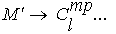 etc
etc
Analysing each of the phases of capital in its circuit
as money capital, productive capital and commodity capital,
Marx asks: what impact do they have on the process of
production, can this process advance smoothly, or does the
normal course of reproduction encounter disruptions in its
various phases? If so what sort of obstacles, and what are
the factors that hinder the reproduction process in a given
phase?
One consequence of this method of investigation is that
Marx is compelled to return to the problem of crises at
various places in his work, in order to assess the specific
impact of each of the individual factors that come into
play in the different phases of the circuit. A systematic
description of the role of all these factors will have to
be reserved for my major study. Given the specific object
of this investigation I shall examine the impact of one
factor alone, even if it is the decisively important one -
the accumulation of capital from the standpoint of crises.
I shall be looking at the effects of the fact that a given
capital which began its first circuit as M (money
capital), opens up its second circuit as M’
(expanded money capital).
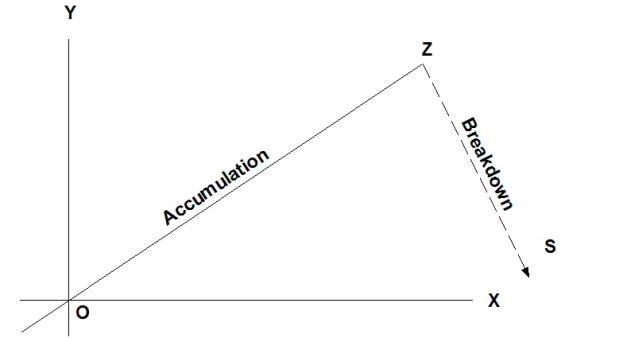
Figure 1
I have shown that as long as no counteracting or
modifying tendencies intervene, the effects are such that
from certain exactly determinable level of capital
accumulation they have to lead to a breakdown of the
system. In the coordinate system OX and OY
(Figure 1), if the line OX represents a condition
of
‘normal valorisation’ and OZ
the line of
accumulation in accordance with this equilibrium condition,
then the crisis of valorisation can be expressed as a
deviation of the line of accumulation in the direction ZS.
This would be the tendency towards breakdown, the basic
tendency of the system or its ‘trend’.
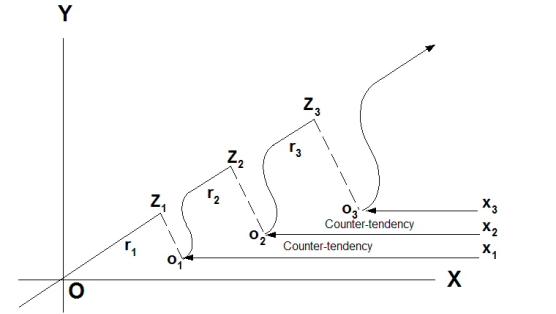
Figure 2
Let us suppose that in our coordinate system the
breakdown sets in at point z1(Figure
2)
and manifests itself in the form of an enormous devaluation
of capital whose overaccumulation starts at
r1(this is represented
graphically by the
punctuated line z1
—
o1).
In that case the
overaccumulated capital will be reduced back to the
magnitude required for its normal valorisation, and the
system will be brought back to a new state of equilibrium
at the higher level o1
—
z1.
We know that in Marx’s conception crises are
simply a healing process of the system, a form in which
equilibrium is again re-established, even if forcibly and
with huge losses. From the standpoint of capital every
crisis is a ‘crisis of purification’. Soon the
accumulation process picks up again, on an expanded basis,
and within certain limits (for instance,
o1—r2)
it
can proceed without any disruption of equilibrium. But
‘beyond certain limits’, from point
r2on, the accumulated capital
again grows
too large. The mass of surplus value starts to decline,
valorisation begins to slacken until finally, at point
z2, it evaporates completely
in the way
described earlier. The breakdown sets in again and is
followed by devaluation of capital,
z2—o2,
and
so on.
If we can show that due to various counteracting
tendencies the unfettered operation of the breakdown
tendency is repeatedly constrained and interrupted (at
points z1, z2,
z3 ... ) then the breakdown
tendency will
not work itself out completely and is, therefore, no longer
describable in terms of an uninterrupted straight line
ZS. Instead it will break up into a series of
fragmented lines (O
—z1—o1,
o1—z2—o2,
o2—z3—o3...)
all tending to the same final point. In this way the
breakdown tendency, as the fundamental tendency of
capitalism, splits up into a series of apparently
independent cycles which are only the form of its constant,
periodic reassertion. Marx’s theory of breakdown is
thus the necessary basis and presupposition of his theory
of crisis, because according to Marx crises are only the
form in which the breakdown tendency is temporarily
interrupted and restrained from realising itself
completely. In this sense every crisis is a passing
deviation from the trend of capitalism.
Despite the periodic interruptions that repeatedly
defuse the tendency towards breakdown, the mechanism as a
whole tends relentlessly towards its final end with the
general process of accumulation. As the accumulation of
capital grows absolutely, the valorisation of this expanded
capital becomes progressively more difficult. Once these
countertendencies are themselves defused or simply cease to
operate, the breakdown tendency gains the upper hand and
asserts, itself in the absolute form as the final
crisis.[6]
An anti-critical interlude
The passing of booms and the turn to depression is
frequently explained in terms of a series of factors that
push costs of production up, reduce profitability and
dampen business activity. This is the view of G Cassel who
gets stuck at the surface level and cannot grasp the deeper
connections, the essence underlying the appearances. It is
obvious that increases in costs of production do threaten
profitability and can intensify the crisis. But this factor
only accelerates the formation of a crisis, it does not
produce the crisis itself.
The methodological significance of the analysis proposed
here is that it forestalls any such attempt to displace the
problem or to drive it into secondary issues. Interest and
its fluctuations are excluded from the analysis; we are
concerned with a total surplus value that has not yet split
into its several portions. Rising prices are likewise
excluded; by assumption commodities sell at value. The same
is true of the commodity labour power; by assumption
workers receive only the value of their labour power in the
course of accumulation. And in spite of all this the
process of capital accumulation grinds to a halt. The
crisis ensues. Its formation is thus independent of the
various price movements.
The real problem, the essence of the appearances,
emerges in its pure form only through abstraction from all
these subsidiary moments. The accumulation of capital is
too large — there is absolute overaccumulation
—because valorisation is insufficient. Is such a
description only correct from a purely abstract logical
point of view; is it reconcilable with the facts of
experience? Does the accumulation process really come to an
end due to overaccumulation of capital? Cassel assures us
that even in the final stages of the business cycle there
is never a superfluity of fixed capital (1923, p. 579).
There is no overaccumulation of capital but rather a
capital shortage, an insufficient supply of capital. So
does our theory of accumulation contradict the facts of
experience?
Cassel argues that the origin of crises lies in a
‘wrong calculation’ by businessmen of the
future state of the capital market or of the supply of
savings that will be forthcoming to match their investment
schedules. Apart from the purely psychological character of
this theory, it simply obscures matters. The supply of
capital is too small. But what capital is Cassel talking
about? Obviously not about the already accumulated and
functioning capital. Since he refers to a future supply of
savings, he can only be meaning the additional capital that
has still to be accumulated and which is symbolised in the
scheme by the magnitudes ac
and
av.
What is the source of the supply of this capital? Why is
there a shortage of this capital? Instead of pursuing the
formation of this capital to its birthplace — the
sphere of production — Cassel gets bogged down in the
sphere of circulation. Before it is saved it has to be
produced. It is produced by the workers and appropriated by
the capitalist as surplus value. This future capital forms
only a portion of the surplus value, the portion that is
not consumed but destined for accumulation. To say that
this additional capital is increasingly in short supply as
accumulation progresses only means that in the course of
accumulation the primordial source of this capital, surplus
value, becomes progressively more scarce, too small, in
relation to the already accumulated mass of capital. If the
mass of surplus value is too small then so is the portion
destined for purposes of accumulation.
Cassel simply mixes up concepts. He speaks of a capital
shortage, an insufficient supply of capital. In the
language of the banker everything is capital. But Cassel is
not talking about capital, but about a part of surplus
value that still has to be accumulated, a part that
represents capital only potentially and becomes capital
only through its function in the valorisation process. So
really there is not a shortage of capital, but a shortage
of surplus value. In contrast, there is an overaccumulation
of the already functioning capital. Overproduction of
capital and imperfect valorisation are correlative concepts
each of which determines the other.
A capital that fails to fulfil its function of
valorisation ceases to be capital; hence its devaluation.
The devaluation of capital is here a necessary, logical
consequence of its insufficient valorisation. it is
otherwise with Cassel. He too refers to a ‘sudden
devaluation of fixed capital’ due to capital
shortage. He speaks of devaluation because in reality such
a phenomenon exists, and theory must take some stand in
relation to it. But Cassel cannot account for the fact of
devaluation in terms of his theory. It bears no logically
necessary connection with it. From Cassel’s theory of
crises it is in fact impossible to derive an explanation of
the devaluation of capital. Given his subjective theory of
prices how can capital be ‘devalued’ if it is
in short supply? On the other hand, in Marx’s theory
imperfect valorisation and devaluation of the original
capital stand in a close logical connection.
A definitive answer to the question raised by Diehl is
also possible only now. He asked if there was any necessary
relationship between Marx’s theory of value and
surplus value and socialism. He argued no, despite
conceding that profit, ground-rent, etc. are rooted in the
surplus value extorted from workers. But no socialist
conclusions necessarily follow as long as we suppose that
surplus value is indispensable to technical and economic
progress.
What a fantastic misunderstanding. Surely it is not a
question of moral assessment of surplus value but of the
variations in its magnitude that decide what civilising
role it plays. As the possibility of valorisation
disappears surplus value ceases to play any such role; it
ceases to develop the productive forces of society and
capitalism must necessarily make way for a higher form of
production. Marx showed that given its dynamic basis in the
law of value, capital accumulation runs up against definite
limits, that is, it bears a transitory character because in
the long run the surplus value does not suffice for the
valorisation of c and v.
Oppenheimer is one of the sharpest and best known recent
critics of Marx’s law of accumulation. He says:
‘Honestly speaking it can no longer be disputed that
... Marx’s law of capitalist accumulation and his
deduction of the reserve army are logically erroneous and
that therefore his definition of the tendency of capitalist
development is false’ (1923, p. 1098). But
Oppenheimer’s mistakes are strikingly obvious when we
compare what he means by the Marxist theory of accumulation
with the one presented here. The elegant deductions
characteristic of a sharp thinker fail completely here.
He vacillates in his characterisation of the theory of
accumulation. Sometimes he sees it purely as a product of
Hegel’s dialectic of contradiction: ‘The
solution Marx proposed flowed from his application of the
“dialectical method” (Oppenheimer, 1919, p.
115). According to him the theory of breakdown, which he
agrees is the ‘pillar of Marx’s whole economics
and sociology’ (p. 137), flows not from an analysis
of capitalism but from an application of Hegel’s
dialectical method. But elsewhere Oppenheimer states that
the problem Marx was concerned with was not resolvable
purely by deduction. Marx’s theory of the inevitable
growth of a reserve army was, according to Oppenheimer,
based on a purely empirical ‘impression’ that
he gained from a study of British capitalism (Oppenheimer,
1903, p. 56). Yet the Marxist theory of accumulation was
established by way of a deduction which he calls ‘an
imposing deduction’ (1919, p. 144), a ‘gigantic
effort’ (p. 146), a ‘solution attempted in the
grand style’ (p. 135). All of this only shows that
Oppenheimer has overlooked the real content of Marx’s
theory.
The imperfect valorisation of the accumulated capital,
in Marx the decisive phenomenon that destroys the
capitalist mechanism from the inside, is not mentioned by
Oppenheimer even once. Instead Oppenheimer brings in two
elements that have nothing to do with Marx’s theory
of accumulation.[7]
The first is ‘that machinery sets free
workers’ (1919, p. 137). 1 have already drawn out the
difference between the displacement of workers by machinery
and their being set free in the very process of
accumulation. Oppenheimer confuses these phenomena.
Machinery displaces the worker. Hence Marx supposedly
argues that the productive process creates ‘a chronic
relative overpopulation’, which leads to a permanent
oversupply of labour power that pins wages down to the
minimum.
The process of setting free that Marx discusses in the
chapter on accumulation is something quite different from
displacement by machinery. Its cause is the accumulation of
capital; that is, insufficient valorisation at a definite,
advanced stage of accumulation. Down to this point the
number of workers grows absolutely: ‘With the growth
of the total capital, its variable constituent or the
labour incorporated in it, also does increase’ (Marx,
1954, p. 590). But with accumulation it increases ‘in
a constantly diminishing proportion’ (p. 590) until
at a specific level of accumulation its growth ceases
completely and turns into ‘a relatively redundant
working population, i.e., a population of a greater extent
than suffices for the average needs of the self expansion
of capital, and therefore of surplus population’ (p.
590).
Oppenheimer misses the point completely because he
ignores the basic difference between the technical labour
process and the capitalist valorisation process. Machinery
in relation to labour power (M:L) and constant
capital in relation to variable (c:v) represent two
absolutely different categories and to confuse them is to
end up in serious mistakes. It was from the ‘social
form’ and not from the technical application of the
real means of production that Marx deduced the necessary
end of the accumulation process.
Oppenheimer’s interpretation of the theory of the
reserve army in the sense of a chronic overpopulation is
quite false. What prevails instead is the law of the
alternative attraction and repulsion of workers, so that
the absolute number of workers who find employment and are
later thrown off can, and does, increase: ‘in all
spheres, the increase of the variable part of capital, and
therefore of the number of labourers employed by it, is
always connected with violent fluctuations and transitory
production of a surplus population’ (Marx, 1954, pp.
590—1). So it is not a question of chronic
overpopulation, as Oppenheimer supposes, but of the
periodic reforming and reabsorption of the reserve army
within the production cycle: ‘The course
characteristic of modern industry, namely, a decennial
cycle depends on the constant formation, the greater or
less absorption, and the re-formation of the industrial
reserve army or surplus population’ (Marx, 1954, pp.
592—3). It follows that the absolute number of
workers can grow and indeed must grow if accumulation or
expanded reproduction is to occur.
The second so-called premise of Marx’s deduction
is the classical wages fund theory (Oppenheimer, 1919, p.
138). According to Oppenheimer, Marx ‘took over this
theory in its decisive aspects’ (p. 141). ‘The
classical theory derived all prices from
supply—demand relations, and resolved the problem of
wages, i.e., of the price of labour on the same
basis’ (p. 138).
So Marx is supposed to have resolved the problem of
wages in terms of supply and demand. I have shown the
complete untenability of this view elsewhere (Grossman,
1926, p. 180). Marx’s theory of wages is only a
special case of the theory of value applied to the
commodity labour power. Just as in value theory the
determination of the magnitude of value proceeds quite
independently of competition, or supply and demand, the
same is true for Marx’s theory of wages.
In Marx the wage is determined by the reproduction costs
or value of labour power which is independent of
competition. Because Oppenheimer fails to understand this
determination of wages in terms of value, the factor which,
according to Marx, exerts an upward pressure on real wages
in the course of capitalist development — namely, the
growing intensity of labour - likewise escapes him. This is
why he can arrive at the patently false conclusion that in
the Marxist system wages ‘can never rise above their
lowest point’ (1919, p. 149).
Since Oppenheimer’s description of Marx’s
theory of wages as a wage fund theory is absolutely false,
the criticisms he develops of Marx’s theory of
accumulation from this particular aspect also crumble. To
demonstrate the inevitable formation of a reserve army Marx
hardly needed to refer to supply and demand relations. In
his system the reserve army of labour is a result of the
process of reproduction at a late stage of accumulation
not, as Oppenheimer supposes, a permanent precondition for
the reproduction of the capital relationship. Given the
nature of Marx’s simplifying assumptions, the reserve
army can be deduced as a necessary consequence of
‘accumulation or of the development of wealth on a
capitalist basis’ (1954, p. 592). Once it has come
into being this surplus population ‘becomes,
conversely, the lever of capitalist accumulation, nay, a
condition of existence of the capitalist mode of
production’ (p. 592).
The existence of the reserve army is a vital condition
for empirically given capitalism, but not by way of
reproducing the capital relationship so much as to make
possible sudden expansions of production, because:
‘In all such cases, there must be the possibility of
throwing great masses of men suddenly on the decisive
points without injury to the scale of production in other
spheres. Overpopulation supplies these masses’ (p.
592). Initially, however, Marx takes as the object of his
analysis not this empirically real capitalism with its
sudden expansions, but the ideal trajectory of capitalist
production, and so he is perfectly justified in excluding
the reserve army from his analysis in the initial
stages.
Now we come to Oppenheimer’s description of
Marx’s ‘proof procedure’. What is the
basic meaning of Chapter 25 of Capital Volume One
on
‘the general law of capitalist accumulation’?
Oppenheimer takes it to mean that the existence of a
reserve army is a crucial precondition of the reproduction
of the capitalist relationship. This is completely wrong.
The existence of capital itself — of the separation
of the worker from the means of production — is quite
sufficient for the reproduction of the capitalist
relationship. A reserve army is not crucial in this
respect.
Oppenheimer is preoccupied with the problem of the
setting free of workers through machinery and misses the
basic point in Chapter 25. His myopic concentration on
machinery precludes him from ever tackling the problem of
insufficient valorisation due to accumulation. He deals
with the latter only in passing, and even then entirely
from the standpoint of the subjective experience of the
individual capitalist. Again Oppenheimer overlooks the fact
that Marx does not directly analyse empirical reality; in
the chapter on accumulation the object of his analysis is
surplus value and its variations of magnitude, whereas
reality only confronts us with the individual parts into
which surplus value splits up (interest, profit, rent,
commercial profit, etc). Surplus value is only a
theoretical form of totalising these individual parts that
confront us in reality.
Marx’s proof procedure has the character of a
deduction. With respect to deductions of this nature
Oppenheimer makes an excellent comment ‘Any appeal to
experience is quite inadmissible. A deduction is not
validated because its results conform to experience’
(1919, p. 150). But in his critique of Marx’s
deduction Oppenheimer appeals precisely to experience. Marx
has to deduce a specific phenomenon, the imperfect
valorisation of the total social capital, from the very
conditions of accumulation. Against Marx’s
demonstration that in the course of accumulation the
shortage of surplus value brings accumulation to a
standstill, Oppenheimer replies that ‘experience
teaches us that as interest declines accumulation proceeds
all the more vehemently’ (p. 149). Oppenheimer
equates the shortage of surplus value, or imperfect
valorisation, with a declining rate of interest. The rate
of interest may decline to any level, but not surplus
value. Interest is only an individualised portion of
profit. Thus if interest falls, the entrepreneur’s
profit rises.
Suppose interest were to fall due to an oversupply of
loan capital. What would be the result? Loan capital would
flow into production, and the money capitalist would be
transformed into an industrial capitalist. All that would
result is a redistribution of capital. The matter is quite
different when we look at the total surplus value, and
total social capital. Once surplus value declines below
certain exactly calculable limits capital accumulation
necessarily breaks down, due to the defective valorisation
of capital. The result would be an extraordinary
devaluation of capital. Oppenheimer presents matters as if
accumulation and its scale depend solely on the good will
and psychology of the saver. He ignores the objective
conditions — the magnitude of the disposable surplus
value — which determine the limits of the scale of
accumulation. Oppenheimer knows no such limits to the
accumulation of capital. He supposes that workers displaced
by machinery can be reabsorbed as long as accumulation is
sufficiently rapid.
Oppenheimer overlooks the essential question —
that for a given size of population and rate of surplus
value is the requisite scale and tempo of accumulation
possible in the long run? I would say ‘no’ and
I have tried to demonstrate this exactly as is possible
within the limits of deduction. Oppenheimer cites three
possible forms through which the accumulation of capital
can compensate for the retrenchments.
i)
Partial
compensation where there is more retrenchment in certain
industries than redeployment in others.
ii)
Full
compensation where retrenchment and redeployment are
equal.
iii)
Overcompensation where redeployment is greater.
Oppenheimer then asks:
Which of these three cases is the actual
one? This problem cannot be resolved through more
deduction: it is an equation with several unknowns. It can
only be solved with figures: one would have to compare the
number of unemployed at different points in time. (1903, p.
56)
He adds that there was hardly any statistical data
available to Marx to decide the question. As neither
deduction nor empirical proof was possible he was left with
an impression that the reserve army tends to increase.
So according to Oppenheimer the fundamental law of the
Marxist system was an illicit generalisation of vague
empirical impressions. The entire argument is untenable.
Marx’s theory of breakdown was neither a
generalisation from purely empirical observations nor an
elaboration of Hegel’s dialectic of contradiction. It
was derived through deduction as a self-evident consequence
of the accumulation of capital on the basis of the law of
value. Oppenheimer’s statement that the problem is
not soluble by deduction is contradicted by the fact that I
have used a concrete numerical example to provide an actual
solution and, as we shall see, this is also possible
mathematically. As far as empirical relationships are
concerned there may very well be a difficulty of an
equation with several unknowns. But no such difficulty
exists for theory. Through the simple procedure of making
certain assumptions theory can transform all unknown
variables into known quantities which are also
measurable.
The scheme developed earlier proceeds from a state of
equilibrium where despite a rising organic composition of
capital, the retrenchment of workers is cancelled by their
redeployment. And yet this state is only possible for a
certain period of time. At a certain point accumulation
becomes impossible on the basis assumed because it runs up
against limits to valorisation; Oppenheimer’s second
case is transformed into his first case. At this late stage
of accumulation the retrenchment of workers dominates over
their redeployment not due to the action of machinery, but
due to imperfect valorisation. The available surplus value
does not suffice to keep accumulation going on the
necessary scale.
Oppenheimer abstains from presenting any deductive
counterproof against Marx and relies purely on empirical
facts. But Oppenheimer himself knows that we cannot arrive
at a theory through simple experience. Marx could quite
easily agree that from time to time overcompensation has
occurred in industry. But this would not in the least
affect the Marxist law of accumulation and breakdown.
Indeed additional labour power is a necessary constitutive
part of the very concept of accumulation. The entire system
is constructed on the notion of surplus value, on the
greatest possible intensive and extensive exploitation of
labour power. By its very nature capital strives to employ
the largest number of workers. Marx himself notes that, on
the whole, the number of workers employed in industry grows
not only absolutely but as a ratio of the total population.
As the population base expands the upper limits of capital
accumulation are pushed back. This is one form in which the
breakdown tendency is defused and postponed to the future
(See Chapter 3, section 13). Nevertheless it follows from
the law of accumulation that for a given size of working
population capital accumulation encounters insuperable
limits, beyond which any further accumulation is
pointless.
Naturally the internal consequences of accumulation are
always interrupted and neutralised by modifying
circumstances. Hence the periodic, cyclical alteration of
phases of expansion and breakdown. However if we abstract
from the alternating attraction and repulsion of workers in
the course of the industrial cycle, and follow through only
the secular tendency of development, we shall have to
conclude that in the initial stage of capital accumulation
population was, on the whole, too large in relation to the
existing scale of accumulation. Hence Malthus and
Malthusianism. In the late stage of accumulation the
inverse relationship dominates. In relation to the enormous
accumulation of capital, population — the base for
valorisation — becomes increasingly smaller. Hence
the sharpening tensions in the advanced capitalist
countries in the course of accumulation, the increasing
role of capital exports, the ever more brutal expansionist
tendencies of capital to secure the largest possible
reserves of human labour power. But here capitalism runs
into obstacles. The world is already divided up. The
economic displacement of large masses of people encounters
difficulties. And so the very tendencies that defuse the
breakdown are themselves defused, and the breakdown
intensifies.
K Muhs’s critique of Marx (1927) shows not the
slightest trace of originality. He simply draws together
the arguments developed by others. Like them he ignores the
decisively important passages of Capital Volume
Three on the falling rate of profit. With Oppenheimer
he agrees that Marx’s theory of accumulation has an
empirical basis. This is then criticised empirically. The
superficiality of this method is perfectly obvious. Totally
incapable of mobilising a single theoretical argument to
launch a frontal attack on the law of accumulation, Muhs
tries to finish off the theory through an
empirico-statistical detour. The expansion of population in
industrialised countries is supposed to refute the theory
that workers are set free in the course of accumulation.
But theory? There is not the least trace of any theory in
Muhs.
On the other hand the process of breakdown described
above should not be confused either with the limits to
accumulation that Bauer talks about. So as not to be taken
for an apologist of capital, Bauer claims that he has
discovered a limit to the accumulation of capital. This
limit is set by: (i) the proportionality between the two
departments of the reproduction scheme and (ii) the rate of
growth of population at a given level of productivity.
Variable capital has to be accumulated in a specific
proportion to increases in population. This prescribes the
limits to the growth of constant capital since there is
likewise a specific proportionality between constant and
variable capital. The proportionality c:v is the
limit Bauer discusses. If the constant capital expands at a
faster rate than that required in terms of its proportional
relation to variable capital the result will be
overaccumulation of capital. A slower rate means
underaccumulation.
Crises arise only because the necessary proportionality
between accumulation and population is not maintained. As
long as accumulation proceeds within these limits, it can
advance indefinitely under the assumptions made. Bauer
speaks of ‘overaccumulation’. But this occurs
only because the conditions specified by him are violated.
In fact he argues that these conditions can be maintained
even in the long run and the very mechanism of capital
ensures that all disturbances of equilibrium are
automatically corrected: ‘Like underaccumulation,
overaccumulation is only a passing phase of the industrial
cycle’ (Bauer, 1913, p. 870).
In my description the process is totally different. I
have shown that even if all conditions of proportionality
are maintained and accumulation occurs within the limits
imposed by population, the further preservation of these
limits is objectively impossible. The system of production
described in Bauer’s own scheme has to breakdown or
the conditions specified for the system have to be
violated. Beyond a definite point of time the system cannot
survive at the postulated rate of surplus value of 100 per
cent. There is a growing shortage of surplus value and,
under the given conditions, a continuous overaccumulation.
the only alternative is to violate the conditions
postulated. Wages have to be cut in order to push the rate
of surplus value even higher. This cut in wages would not
be a purely temporary phenomenon that vanishes once
equilibrium is re-established; it will have to be
continuous. After year 36 either wages have to be cut
continually and periodically or a reserve army must come
into being.
This would not be one of those periodic crises within
the system that Bauer refers to, for a crisis of this sort
could always be surmounted by adjusting the scale of the
productive apparatus to the available population. Here
there is no more room for adjustments. The proportionality
conditions required by Bauer have been preserved throughout
and still after year 35 a crisis, a tendency towards
breakdown, sets in. The real dynamic of the capitalist
system is quite different from what Bauer supposes. He
maintains that capitalism is characterised by a
‘tendency for the accumulation of capital to adjust
to the growth of population’ (p. 871). I have shown
the opposite — there is a tendency towards an
absolute overaccumulation of capital that outstrips the
limits imposed by population.
The same hold for Tugan-Baranovsky. He believes that
If social production were organised
according to a plan, if those in charge of it had a perfect
knowledge of demand and the power to shift labour and
capital freely from one branch of production to another,
the supply of commodities would never exceed the demand
(Tugan-Baranovsky, 1901, p. 33).
Bauer’s scheme represents precisely this kind of
planned, organised production in which the managers know
all they need to about demand and have the power to adapt
production to demand. In spite of this a tendency towards
breakdown emerges, valorisation declines absolutely and a
reserve army forms. This only shows that the problem is not
whether there is a surplus of commodities or not. In fact
we have assumed a state of equilibrium where, by
definition, there can be no unsaleable residue of
commodities. Yet still the system must break down. The real
problem lies in the valorisation of capital; there is not
enough surplus value to continue accumulation at the
postulated rate. Hence the catastrophe.
Obviously, as Lenin correctly remarks, there are no
absolutely hopeless situations. In the description I have
proposed the breakdown does not necessarily have to work
itself out directly. Its absolute realisation may be
interrupted by counteracting tendencies. In that case the
absolute breakdown would be converted into a temporary
crisis, after which the accumulation process picks up again
on a new basis. In other words the valorisation of the
overaccumulated capital can be met through capital exports
to countries at a lower stage of accumulation. Or a sharp
devaluation of the constant capital during the crisis might
improve the prospects for valorisation. Or wage cuts could
have the same effect in terms of warding off the
catastrophe. But quite apart from the fact that all these
situations violate the assumptions postulated in
Bauer’s scheme, these solutions would have a purely
temporary impact. Restored accumulation will again generate
the very same phenomena of overaccumulation and imperfect
valorisation.
The logical and mathematical basis of the law of
breakdown
In year 1 of Bauer’s reproduction scheme the
amount due for capitalisation constitutes 25 per cent of a
surplus value of 100 000 (20 000 ac
+ 5
000 av, = 25 000). In year 2
the
capitalised component increases to 25.95 per cent of an
expanded surplus value of 105 000(22 000
ac + 5 250 aj,
= 27
250). [The actual ratio should be 25.95 per cent — J
Banaji]. Under these conditions the reservoir of surplus
value is progressively exhausted and the accumulated
capital can only be valorised at an increasingly
unfavourable rate. After some time the reservoir dries up
completely — the quotas due for capitalisation turn
out to be far in excess of the available mass of surplus
value even though notionally they are only fractions of
this surplus value. This is the contradiction; at the
hypothesised rate of accumulation the mass of surplus value
is no longer sufficient. The breakdown of the system is the
inevitable consequence.
Apart from the arithmetical and logical proofs that we
have been given already, mathematicians may prefer the
following more general form of presentation which avoids
the purely arbitrary values of a concrete numerical
example.
Meaning of the symbols
c = constant capital. Initial value =
c0.Value
after j years =
cj.
v = variable capital. Initial value =
v0. Value
after j years =
vj
s = rate of surplus value (written as a
percentage of v)
ac = rate of
accumulation of constant
capital c
av = rate of
accumulation of variable
capital v
k = consumption share of the capitalists
S =mass of surplus value = 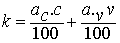
Ω = organic composition of capital, or
c:v
j = number of years
Further let  ;
;

The formula
After j years, at the assumed rate of
accumulation ac, the
constant capital
c reaches the level
cj=c0.rj.
At the
assumed rate of accumulation av,
the
variable capital vreaches the level
vj=v0.wj.
The year after (j + 1) accumulation is continued as usual,
according to the formula:

whence
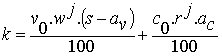
For k to be greater than 0, it is necessary that
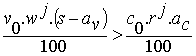

The timing of the absolute crisis is given by the point
at which the consumption share of the entrepreneur vanishes
completely, long after it has already started to decline.
This means:
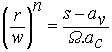
whence
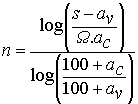
This is a real number as long as s>
av,. But this is what we assume anyway
throughout our investigation.
Starting from time-point n, the mass of
surplus
value S is not sufficient to ensure the
valorisation
of c and v under the conditions
postulated.
Discussion of the formula
The number of years n down to the absolute
crisis
thus depends on four conditions:
i)
The
level of the organic composition Ω. The
higher
this is the smaller the number of years. The crisis is
accelerated.
ii)
The rate
of accumulation of the constant capital
ac, which works in the same
direction as
the level of the organic composition of capital.
iii)
The rate of
accumulation of the variable capital av,
which can work in either direction, sharpening the crisis
or defusing it, and whose impact is therefore
ambivalent.
iv)
The level of the
rate of surplus value s which has a defusing
impact,
that is, the greater is s, the greater is the
number
of years n, so that the breakdown tendency is
postponed.
The accumulation process could be continued if the
earlier assumptions were modified:
i)
the
rate of accumulation ac is
reduced, and
the tempo of accumulation slowed down;
ii)
the
constant capital is devalued which again reduces the rate
of accumulation ac;
iii)
labour power is
devalued, hence wages cut, so that the rate of accumulation
of variable capital av, is
reduced and
the rate of surplus value s enhanced;
iv)
finally, capital
is exported, so that again the rate of accumulation
ac, is reduced.
These four major cases allow us to deduce all the
variations that are actually to be found in reality and
which impart to the capitalist mode of production a certain
elasticity.
In reality we find that once the given level of
valorisation collapses and the accumulation process
stagnates, sooner or later counteracting tendencies come
into play. The capitalist attempts to restore the
valorisation of his capital. In the crisis capital is
devalued and this is followed by a reorganisation and
concentration process in which the rate of profit is
increased through higher productivity and rationalisation;
the same effect is achieved through direct wage cuts. We
shall get to know these counteracting tendencies a bit more
in Chapter 3.
Through the impact of these processes the breakdown
tendency is interrupted, accumulation can restart on a new
level, and the absolute collapse is transformed into a
temporary crisis. This is the simple explanation of what
Spiethoff falsely regards as Marx’s confusion of the
long-term and general tendencies that drive towards
breakdown with conjunctural shifts of a short-term
character.
The crisis is therefore, from the standpoint of
capitalist production, a healing process through which the
valorisation of capital is restored; ‘crises are
always but momentary and forcible solutions of the existing
contradictions. They are violent eruptions which for a
while restore the disturbed equilibrium’ (Marx, 1959,
p. 249). By its very nature the duration of this process of
recovery is indeterminable. Whereas the time-span of
accumulation can be calculated down to its maximal point
z - so that the length of the upswing is determinate
- an exact determination of the length of the crisis is not
possible. By one means or another the entrepreneur strives
to restore valorisation until sooner or later he succeeds
in doing so. The crisis is only a more or less prolonged
interval between two phases of accumulation.
Once counteracting tendencies come into play, the
assumptions under which the analysis was worked out
necessarily change. A modification to these assumptions
along the lines suggested above would mean that for a
period of time the process continues on a new basis, up
until a new absolute crisis which can be exactly determined
under the new set of assumptions and calculated according
to the same formula. The crisis can likewise be surmounted
by changing the conditions postulated yet again —for
instance if the entrepreneur enforces a renewed cut in
wages. Yet quite apart from the fact that a wage cut would
disrupt the initial assumption of the expansion of variable
capital corresponding to increases in the working
population, the further continuation of accumulation would
still prove untenable after a certain lapse of time.
Despite the cut in wages it would again run up against the
limits of valorisation and thus necessitate further wage
cuts, and so on and so forth.
These underlying connections enable us to draw out the
true meaning of Marx’s statement that it lies in the
essence of capitalism to push wages not simply down to the
minimum necessary for subsistence, but even lower than this
minimum:
The zero of their [the
labourers’]
cost is therefore a limit in a mathematical sense, always
beyond reach, although we can always approximate more and
more nearly to it. The constant tendency of capital is to
force the cost of labour back towards this zero. (1954, p.
562)
Later Marx states that
The greater the social wealth, the
functioning capital, the extent and energy of its growth,
and, therefore, also the absolute mass of the proletariat
and the productiveness of its labour, the greater is the
industrial reserve army. The same causes which develop the
expansive power of capital, develop also the labour power
at its disposal. The relative mass of the industrial
reserve army increases therefore with the potential energy
of wealth. But the greater this reserve army in proportion
to the active labour army... the greater is official
pauperism. This is the absolute general law of
capitalist accumulation. Like all other laws it is
modified in its workings by many circumstances, the
analysis of which does not concern us here. (p. 603)
Marx goes on to argue that ‘in proportion as
capital accumulates, the lot of the labourer, be his
payment high or low, must grow worse’ (p. 604).
People have tried to challenge this absolutely necessary
general tendency which is inherent in pure capitalism by
reference to the actual level of real wages in this or that
period. As if Marx ever denied that it was possible for
real wages to increase in specific phases of capitalist
accumulation. The fact remains that at a late stage of
accumulation this general tendency towards the depression
of real wages emerges inexorably from the very process of
capital accumulation on the basis of a rising organic
composition. It follows that this tendency can be delayed
for some time; it can be slowed down by the action of
specific counteracting tendencies, but it cannot be
abolished. Abstracting from such purely temporary phases,
we see that from a certain point of accumulation onwards
wages must decline continuously under pure capitalism,
despite any initial increases. After this point the tempo
of accumulation and technological advance slows down and
the reserve army grows.
Obviously such a process cannot last indefinitely. A
continuous deterioration of wages is only possible
theoretically; it is a purely abstract possibility. In
reality the constant devaluation of labour power
accomplished by continual cuts in wages runs up against
insuperable barriers. Every major cut in its conditions of
life would inevitably drive the working class to rebellion.
In this way, and through the very mechanism that is
internal to it, the capitalist system moves incessantly
towards its final end, dominated by the ‘law of
entropy of capitalist accumulation’.
Why the Marxist theory of accumulation and breakdown
was misunderstood
There are specific reasons why the compelling logic of
Marx’s theory of accumulation was never followed
through consistently to its proper conclusion, even by
Marxists themselves. From his correspondence it is possible
to see how painful it was for Marx to find that even in
party circles in Germany there was an almost unbelievable
indifference to Capital. The immaturity of the
German workers’ movement of that time corresponds
better to Lassalle’s pamphlets than to the massive
and brilliant structure of Marx’s theory. Even the
leading thinkers of the workers’ movement were
incapable of grasping the decisive aspects of Marx’s
theory. It is quite typical that W Liebknecht in 1868
requested Engels ‘to clarify where the real
difference lies between Marx and Lassalle’. So it is
not difficult to understand why, as M Beer tells us today,
that
down to 1882 and for some years
afterwards, there was practically no trace of Marxism in
Germany. The writings of Lassalle, the recollections of
1848 and French literature formed the real sources from
which the movement drew for its theories, ideas and
feelings. Many socialists had been trained by Rodbertus or
Duhring, others were at best acquainted with the
publications of the International Working Men’s
Association, and still others founded their demands on
appeals to morality and humanity. Kautsky was the first to
get through, little by little, with his popularisation of
Marx’s ideas. (1923, p. 77)
Precisely when the publication of Marx’s
Capital was finally complete with the appearance of
Volume Three, the rapid flowering of German
capitalism doomed any deeper understanding of Marx’s
theory. The general feeling was that Marx’s theory
flatly contradicted the real tendencies of capitalism. Far
from any further deepening of Marxist theory, it was an
epoch characterised by a drift away from it. It was this
period of vigorous capital accumulation (1890—1913)
that gave birth to revisionism and to those notions of an
unfettered, equilibrated capitalism which would recur later
even in the writings of the official spokesmen of theory,
like Hilferding and Bauer. The case of Hilferding shows how
deeply the fear of catastrophe characteristic of bourgeois
economists penetrated into this tendency of Marxism.
In historical retrospect such an attitude to
Marx’s Capital is understandable. The
great
popularity of the book was initially due to the parts which
describe the immediate process of production within the
factory. Its description of the labour process, which is
simultaneously a process of producing value and surplus
value, focused sharply on the position of the working class
and its exploitation by capital and made the day-to-day
class struggle something entirely comprehensible. So
Volume One became the ‘bible’ of
the
working class for decades to come.
Those parts of the work which describe the historical
tendencies of capital accumulation suffered an entirely
different fate. However brilliantly they handled the
question of capitalist breakdown, they were doomed to
remain unintelligible. Capitalism had still to reach a
maturity where the question of breakdown and the problem of
realising socialism could possess an immediate reality.
Marx was so far ahead of his own time that these portions
of his work were bound to remain incomprehensible at first,
and in this sense Marx’s own life work only went to
confirm even further the truth of the materialist
conception of history.
Two whole generations had to pass, following the
appearance of Capital. before the general advance
of
accumulation ripened capitalism to its present imperialist
stage and generated the conflicts that would find an
ephemeral solution in the massive convulsions of war. Only
now did the question of achieving socialism gradually
descend from the nebulous world of the socialist programme
to the reality of day-to-day practice. Today we turn to
Capital in search of answers to questions that are
no longer purely academic, no longer simply problems of
theory, but problems rooted in the needs of daily life. The
historical situation has changed and this change tears
aside the veils that concealed entire words and meanings
from previous generations. The time has come for a
reconstruction of Marx’s theory of breakdown.
‘Rate of profit’ and ‘mass of
profit’ have entirely different meanings for theory,
despite the close connection between them. Several writers
like Charasoff, Boudin and others felt that the central
point of Marx’s theory was contained here. But they
could not demonstrate the necessary breakdown of capitalism
because they confined their attention to the fall in the
rate of profit. Breakdown cannot be derived from this. How
could a percentage, a pure number such as the rate of
profit produce the breakdown of a real system? Table 2
showed that the capitalist system can survive despite the
fall in the rate of profit and that the final breakdown in
year 35 has nothing to do with the falling rate of profit
as such. We cannot explain why in year 34, with a rate of
profit of 9.7 per cent, the system survives and why in the
next year, with a rate of profit of 9.3 per cent, it breaks
down. An explanation is only possible when we relate the
breakdown not to the rate of profit, but to its mass:
‘accumulation depends not only on the rate of profit
but on the amount of profit’ (Marx, 1969, p.
536).
If we accept the view of Sombart and Bauer that value in
Marx is in no sense a real phenomenon but merely an idea, a
‘mental fact’ or an aid to thought, then the
breakdown of capitalism due to a relative decline in the
mass of profits (a decline in the rate of profit is simply
the external expression of this fact) becomes an
inexplicable mystery. Ideas can scarcely destroy a real
system. This is why Sombart and Bauer could never come to
terms with the Marxian theory of breakdown. But matters are
quite different if value and therefore the mass of profit
is conceived as a real magnitude. In this case the system
has to break down due to a relative fall in the mass of
profit, even if the latter can increase, or does increase,
absolutely. A falling rate of profit is thus only an index
that reveals the relative fall in the mass of profit. The
falling rate of profit is, moreover, only important for
Marx in so far as it is identical with a relative decline
in the mass of surplus value.
Only in this sense is it possible to state that with a
falling rate of profit the system breaks down. The rate of
profit falls because the mass of profit declines
relatively: ‘The drop in the rate of profit ...
expresses the falling relation of surplus value to advanced
total capital’ (Marx, 1959, p. 214). It is this
relative decline in the mass of profits (or of surplus
value) conceived as a real magnitude that accounts for the
‘conflict between the expansion of production and
production of surplus value’ (p. 247). Beyond a
certain limit to accumulation there is too little surplus
value to secure the normal valorisation of the constantly
expanding capital.
The factors of the breakdown and the business
cycle
Writers like O Morgenstern (1928) simply reject the
notion that there are any regular or systematic economic
fluctuations. They ascribe to crises a purely contingent
character in the sense that phases of expansion and decline
succeed one another purely accidentally. H Dietzel saw
purely random fluctuations of the harvest as the basic
determinant of conjunctural oscillations (1909).
Bohm-Bawerk thought a theory of the economic cycle could
only form the concluding chapter of a logically complete
economic theory. In that case, when it asserts that a
theory of economic cycles is impossible, bourgeois
economics only ends by confessing the bankruptcy of its own
economic science.
No representative of bourgeois economics could give even
a moderately exact causal explanation of the periodicity of
crises. At best they could give only a partial explanation
of this or that phase of the economic cycle. This failure
to account for the periodicity of crises obviously also
removes any theoretical basis for establishing the length
of the individual phases or the amplitude of the cyclical
movements.
When it comes down to determining the span of the
individual phases commentators have plunged straight into
empiricism. The fantastic uproar created recently by the
‘exact’ results attained by the various
business cycle schools only goes to hide the state of
theoretical bankruptcy and hopeless empiricism that lurks
behind the mathematical disguises of these schools. In the
United States observations led to the conclusion that there
has been a tendency for the phases of the cycle to become
shorter. In contrast Tugan-Baranovsky, from his own survey
of the British data, came to the conclusion that the
cyclical crises have become more prolonged (1901, p. 166).
The ‘debate on method’ fought out over the last
four decades between the historical and the deductive
schools, regarding the way a theory is constructed, has
simply passed over bourgeois economists without any deeper
traces.
Today, in the field of business cycle studies, the
hopeless empiricism of the historical school of Schmoller
is again dominant. What was the old historical school if
not an attempt to establish a preparatory basis for the
construction of theories in the form of the richest
possible historical evidence? The whole orientation of the
modern business schools in the United States and Europe is
characterised by the compilation of data of this kind, with
only this difference, that the data is perhaps more
contemporary. The basic concern of all their work is the
selection of appropriate indicators. If in America these
relate chiefly to circulation, prices, markets, in Germany
production is also considered. Yet the basic point is that
in either case causal explanation is displaced by
description. Bourgeois economics is today tired of theory.
A Lowe is therefore quite right in saying that:
‘Basically over the last decade business cycle theory
has not advanced a single step forward’ (1926, p.
166).[8]
Yet even among Marxists there is no less confusion in
this field. Marx referred to the factors that prolonged or
abbreviate the length of the cycle, and for his period
assumed that ‘in the essential branches of modern
industry this life-cycle now averages ten years. However,
we are not concerned here with the exact figure’
(1956, pp. 188—9). The amplitude of the cyclical
movements, or of the varying phases of the industrial cycle
could be greater or smaller. Yet this would not abolish the
periodicity of the movement.
Kautsky feels that despite his basic disagreement with
Tugan-Baranovsky’s theory of crisis, he agrees with
him on several points. One of these is
‘Tugan-Baranovsky’s remarks on the causes that
determine the periodicity of crises’(1901, p. 133).
That this is logically untenable should be obvious. How can
one disagree with a theory of crisis and yet accept the
causes of periodicity proposed by this theory? And what is
Tugan-Baranovsky’s epoch-making discovery which
impressed Kautsky so much?
Like Tugan I would identify the fitful
international expansion of railways as one the basic
factors behind the alternation of prosperity and crisis. In
the nineteenth century the expansion of the world market
and the extension of the railways went hand in hand. (p.
137)
This is how Kautsky distorted and vulgarised the Marxian
theory of crisis. It is quite natural that Lederer then
supposed that the labour theory of value is quite incapable
of tackling dynamic phenomena and that apart from
Luxemburg’s theory ‘the whole question of booms
and slumps can only be viewed as one of
disproportionality.’ (1925, p. 359)
Lederer argues that
Within the labour theory of value crises
are explained either in terms of the contradiction between
increases in productivity and the lagging capacity of the
market, or from a wrong distribution of means of production
in the individual spheres. But if these are really the
causes of crisis there is no reason why an understanding of
these causes should not eliminate crises altogether.
Moreover, the periodic character of the crisis is not
explained by these theories. (p. 360)
In other words given a labour theory of value we end up
either with an underconsumption theory or with a
disproportionality theory, and neither of these can account
for periodicity.[9]
I have shown that given the labour theory of value
Marx’s theory of accumulation does lead to a theory
of breakdown and crises, but for quite different reasons to
those listed by Lederer. The theory of overaccumulation
explains why the reproduction process necessarily takes a
cyclical form and it is the only theory that allows us to
establish the length of the individual phases of the
cycle.[10]
Given the method underlying this book, the procedure by
which we seek to establish the duration of the phases
cannot be an empirical or a statistical one. Even if a firm
statistical relationship could be established between
certain economic phenomena and the duration of the cycle,
this would not by itself show the logically necessary
character of the relationship. By means of statistics one
can never show why variations in one factor should
necessarily cause variations in another. Hayek is quite
right in saying that empirically ascertainable
relationships among economic facts remain theoretically
problematic as long as they are not reducible to underlying
patterns ‘whose logically necessary character emerges
independently of their statistical determination’
(1928, p. 251). He goes on to state that
As with any economic theory there are
basically only two criteria of validity for a theory of
business cycles. Such a theory has to be deducible in a
logically rigorous way, from the basic principles of the
given system of theory, and secondly, it has to be able to
generate a purely deductive explanation of the various
phenomena one actually observes in the course of the cycle.
(p. 252)
Obviously this also holds for the duration of its
specific phases. Therefore in the following I want to
derive the amplitude of cyclical movements in a purely
deductive manner, as a necessary consequence of the basic
elements of the mechanism of reproduction.
The formula proposed earlier gives an exact
specification of the factors that determine the duration of
the phase of expansion; the length of the phase can be
calculated under the conditions specified in the scheme,
even if in actual reality the pure movement of this scheme
is intersected by circumstances of the most varied kind. I
shall use Bauer’s reproduction scheme to show how the
length of the phase of expansion is abbreviated or
prolonged depending on the variations of these factors.
First, if Bauer had assumed a higher initial organic
composition of capital (for instance, 200 000 c +25
000 v) and thus a smaller reservoir of surplus
value, the system would break down much earlier because the
consumption of the capitalists, the k portion, would
already start declining from year 1. This is shown in Table
2.3:
Table 2.3
|
|
Year
|
c
|
v
|
k
|
ac
|
av
|
|
|
l
|
200000 +
|
25000 +
|
3750 +
|
20000 +
|
1250 =
|
250000
|
|
2
|
220000 +
|
26250 +
|
2938 +
|
22000 +
|
1312 =
|
272500
|
|
3
|
242000 +
|
27562 +
|
1 984 +
|
24200 +
|
1378 =
|
297 124
|
|
4
|
266000 +
|
28940 +
|
893 +
|
26600 +
|
1447 =
|
323880
|
|
5
|
292600 +
|
30387 +
|
0 +
|
29260 +
|
1519 =
|
|
| |
|
|
|
Deficit = 392
|
|
With a higher organic composition the system has to
break down earlier, in year 5. Either the surplus
value due for capitalisation will show a deficit or the
rate of surplus value, and thus the degree of exploitation,
has to be increased — wages have to be cut.
Thus the level of the organic composition of capital has
enormous significance for the breakdown tendency and
explains why Marx should have said, at the very start of
the chapter on the general law of capitalist accumulation,
that the ‘most important factor in this inquiry is
the composition of capital and the changes it undergoes in
the course of the process of accumulation’ (1954, p.
574).
Secondly an increase in this rate of accumulation of
constant capital will likewise accelerate the breakdown.
Table 2.4 assumes the rate of accumulation of constant
capital (ac) to be 20 per cent instead of 10 per
cent.
Table 2.4
|
|
Year
|
c
|
v
|
k
|
ac
|
av
|
|
|
l
|
200000 +
|
100000 +
|
55000 +
|
40000 +
|
5000 =
|
400000
|
|
2
|
240000 +
|
105000 +
|
51750 +
|
48000 +
|
5250 =
|
450000
|
|
|
|
|
|
|
|
|
|
7
|
597196 +
|
134008 +
|
7870 +
|
119438 +
|
6700 =
|
865220
|
|
8
|
716634 +
|
140078 +
|
0+
|
143326 +
|
0 =
|
|
If the rate of accumulation were doubled to 20 per cent
the breakdown would follow in year 8. Already by this year
the additional constant capital required would be larger
than the total surplus value available. Nothing would be
left for additions to variable capital (a’)
or
for capitalist consumption.
So far we have looked at the rate of accumulation of
constant capital purely from the side of its value
magnitude. But what would this factor mean if we were to
look at it not from its value aspect, but from the aspect
of its natural form or its material content? It represents
the means of production which are necessary for expanding
the productive apparatus. Now what influence does the
physical and ‘moral’ life cycle of this element
have on the course of accumulation? Sismondi had already
claimed that crises are closely connected with the life
cycle of fixed capital:
It has been remarked that the violent
shocks by which manufacturing industry is convulsed
nowadays are related to the rapidity with which scientific
discoveries are following one another ... Not only are the
values of existing commodities thereby diminished, but the
entire fixed capital and all the machinery ... is rendered
useless. (Grossman, 1924, p. 45)
However no one before Marx explained what exactly the
connection was. The reproduction scheme has so far assumed,
for the sake of simplification, that the life cycle of
fixed capital equals one period of reproduction; that fixed
capital is completely used up in each cycle of production
and therefore has to be renewed from the year’s
product. This assumption has a merely fictitious character
and it has to be modified. It is more realistic to suppose
that the fixed component of constant capital operates over
several cycles of production and does not need to be
renewed annually. Its participation in the production of
value and surplus value is extended over several years. In
this case even if the value of the fixed capital is
transferred to the product in a smaller annual rate of
depreciation, it nevertheless helps in creating a growing
mass of value, and therefore of surplus value, in
proportion to its actual durability. The valorisation of
the given capital is thereby improved, so that the
breakdown tendency is weakened — the duration of the
phase of expansion is prolonged. Because technological
improvements progressively consolidate the physical
durability of fixed capital, we have here a factor that
tends to prolong the business cycle.
The ‘moral’ depreciation of fixed capital
had precisely the opposite effect. By shortening the time
during which the fixed capital functions and thereby
reducing the total mass of value and surplus value which it
forms, it only makes the valorisation of the given capital
worse and cuts short the period of accumulation, or the
upswing. About this Marx says:
As the magnitude of the value and the
durability of the applied fixed capital develop with the
general development of the capitalist mode of production,
the lifetime of industry and of industrial capital
lengthens in each particular field of investment to a
period of many years
Whereas the development of fixed capital
extends this life on the one hand it is shortened on the
other by the continuous revolution in the means of
production, which likewise incessantly gains momentum with
the development of the capitalist mode of production. This
involves a change in the means of production and the
necessity of their constant replacement, on account of
moral depreciation, long before they expire physically. One
may assume that in the essential branches of modern
industry this life-cycle now averages ten years. However we
are not concerned here with the exact figure. This much is
evident: the cycle of interconnected turnovers embracing a
number of years, in which is held fast by its fixed
constituent part, furnishes a material basis for the
periodic crises. During this cycle business undergoes
successive periods of depression, medium activity,
precipitancy, crisis. (1956, pp. 188—9)
Thirdly an increase in the accumulation of variable
capital has the same effect as the rate of accumulation of
constant capital if the population remains constant or
grows at the assumed rate of 5 per cent. On this
assumption variable capital can accumulate more rapidly
than it does in the scheme only if wages are rising from
one year to the next. Consequently annual increases in
variable capital stem from two causes: (i) because the
number of workers is growing; (ii) because wages are
rising. Under the circumstances higher wages mean a fall in
the rate of surplus value. Suppose the working population
increases by 5 per cent every year, whereas wages rise by
20 per cent. Other conditions being equal, we get the
result shown in Table 2.5:
Table 2.5
|
|
Year
|
c
|
v
|
k
|
ac
|
av
|
|
|
1
|
200000 +
|
100000 +
|
20000 +
|
26000 +
|
54000 =
|
400000
|
|
2
|
220000 +
|
105000 +
|
22000 +
|
32300 +
|
50700 =
|
430000
|
|
|
|
|
|
|
|
|
|
5
|
292600 +
|
121550 +
|
29260 +
|
53151 +
|
39139 =
|
535700
|
|
|
|
|
|
|
|
|
|
11
|
518357 +
|
162886 +
|
51835 +
|
105236 +
|
5815 =
|
1154791
|
|
12
|
570192 +
|
171030 +
|
57019 +
|
115497 +
|
0 =
|
|
|
13
|
627211 +
|
179581 +
|
172516 = Deficit 1486
|
|
|
An increase in the rate of accumulation of variable
capital accelerates the breakdown enormously. If wages were
to rise by 20 per cent there would be a shortage of surplus
value by year 12.
This case where the rate of accumulation of variable
capital rises simply because wages are increasing, while
the rate of growth of population remains constant at 5 per
cent, must be distinguished from the case where the rate
rises because the population itself is expanding at over 5
per cent. If all other conditions are the same such an
expansion of the valorisation base would necessarily weaken
the breakdown tendency. If the working population grows by
8 per cent a year, and consequently the mass of surplus
value grows at 8 per cent, then under the conditions
assumed in Table 2.4 the breakdown would be postponed by
one year, as shown in Table 2.6.
Table 2.6
|
|
Year
|
c
|
v
|
k
|
ac
|
av
|
|
|
l
|
200000 +
|
100000 +
|
52000 +
|
40000 +
|
8000 =
|
400000
|
|
2
|
240000 +
|
108000 +
|
51360 +
|
48000 +
|
8640 =
|
456000
|
|
|
|
|
|
|
|
|
|
7
|
597196 +
|
158685 +
|
26553 +
|
119438 +
|
12694 =
|
914566
|
|
8
|
716634 +
|
171379 +
|
14334 +
|
143326 +
|
13709 =
|
1059392
|
|
9
|
859960 +
|
185088 +
|
0+
|
171992 +
|
14806
|
|
|
|
|
|
|
186798 = Deficit 1710
|
|
Fourthly, a higher rate of surplus value will slow down
the breakdown tendency. Table 2.7 shows the result with a
lower rate — it will be speeded up based on a rate of
accumulation of constant capital of 20 per cent, variable
capital of 5 per cent, and the rate of surplus value only
50 per cent.
Table 2.7
|
|
Year
|
c
|
v
|
k
|
ac
|
av
|
|
|
l
|
200000 +
|
100000 +
|
5000 +
|
40000 +
|
5000 =
|
350000
|
|
2
|
240000 +
|
105000 +
|
0 +
|
48000 +
|
5250
|
|
|
|
|
|
|
53250 = Deficit 750
|
|
In this example the extremely rapid onset of breakdown
is due to the coupling of a higher rate of accumulation
with a lower rate of surplus value. Conversely the
breakdown would be postponed if the rate of surplus value
were, for example, 150 per cent.
In short, the duration of the upswing or the point at
which the breakdown, and thus the downturn into crisis,
intervenes is a function of four variable but compatible
elements: the level of the organic composition of capital;
the rate of surplus value; the rate of accumulation of
constant capital, and the rate of accumulation of variable
capital.
Crises and the theory of underconsumption
Once we have grasped the causes of the boom it becomes
possible to explain a series of empirical phenomena which
the existing theories of crisis explain only inadequately.
It is said that inflation creates an
‘artificial’ boom. But what is artificial about
a boom of this kind? How is a so-called artificial boom
different from a real one? For instance if the
underconsumption of the masses is the basic cause of crises
then inflation should occasion a massive crisis because
wages will lag behind commodity prices; real wages will
fall and the underconsumption of the working class will
increase sharply. But if inflation means an upswing in the
economic cycle this only shows that the underconsumption of
the masses cannot be a sufficient explanation of crises.
According to this inflationist theory the appearance of a
boom is something quite self-evident - as real wages fall
the rate of profit rises and valorisation is improved.
The necessity of the cyclical process has already been
shown despite the abstraction from any consideration of
variations in commodity prices, wages and the rate of
interest. In fact their movements are only a consequence of
the underlying cyclical movements. Therefore to presuppose
them is to fall into the error of logical circularity.
We started by assuming complete equilibrium where,
despite a continuously rising technological level, the
accumulation of capital can keep the entire working
population employed. In this state, defined by proportional
increases in capital and labour power, accumulation can
proceed without any changes in the structure of prices. I
have shown that even assuming these favourable conditions,
there must come a point at which accumulation necessarily
breaks down.
However, a proportional accumulation of this kind is
quite unrealistic. The capitalist mechanism contains no
regulator that could consciously adapt the scale of
accumulation to the requisite state of equilibrium. The
actual scale of accumulation will tend to deviate from the
equilibrium positions specified in the reproduction scheme.
The magnitude of accumulation depends on how much of the
surplus value is accumulated as constant and variable
capital and how much goes into the personal consumption of
the capitalist.
In principle two cases are possible: accumulation may
either surpass the equilibrium level or fall short of it.
In practice however, only the second case is possible in
which only a part of the surplus value is earmarked for
purposes of accumulation — for instance, constant
capital grows by just 5 per cent a year instead of the 10
per cent assumed by the scheme. In that case not all of the
new workers will be absorbed into the productive process
and a reserve army will be formed year by year. Part of the
remaining, uncapitalised surplus value will enter
capitalist consumption. The remainder will be kept in
reserve for investment purposes in the form of loan
capital.
So far we have taken the total social capital that is
productively absorbed into the process of reproduction as a
single unit and assumed that the industrial capitalist
deploys his own capital. This assumption is purely
fictitious and only justifiable methodologically for
purposes of simplification. It excludes the monied
capitalist or rentier from the scope of the analysis:
‘If all capital were in the hands of the industrial
capitalists there would be no such thing as interest and
the rate of interest’ (Marx, 1959, p. 377). But
interest exists and our fictitious assumption therefore has
to be dropped. In reality only a minor proportion of
capitalists operate exclusively with their own capital. The
‘majority of industrial capitalists, even if in
different numerical proportions, work with their own and
borrowed capital’ (p. 376). Therefore credit in the
sense of the portion of surplus value that is saved has to
be reintroduced into the analysis. The abstract
reproduction scheme is thus enriched by a further empirical
moment and the analysis comes a step closer to actual
reality.
Marx states that:
For the productive capitalist who works
on borrowed capital, the gross profit falls into two parts
— the interest, which he is to pay the lender, and
the surplus over and above the interest, which makes up his
own share of the profit. (1959, pp. 372—3)
It follows that the magnitude of the profit that
actually falls to the industrial capital ‘is
determined by the interest, since this is fixed by the
general rate of interest ... and assumed to be given
beforehand, before the process of production begins’
(p. 373). Even if there is no law which determines this
general rate of interest there is still an ‘average
level’ of the rate of interest corresponding to an
equilibrium state of production in a given country at a
given period of time. When the productive apparatus is in
this state of equilibrium, the entire social surplus value
will be used for accumulation, in so far as it is not
personally consumed. Yet one group of capitalists - monied
capitalists and rentiers - do not function directly in the
productive process; they transfer their capital to
capitalists who do. The interest that this group receives
from its capital can be regarded as a ‘normal
interest’ determined by the number of these
capitalists, the size of their capital and so on.
However, we are not dealing with a case of equilibrium
but one in which part of the surplus value due for
accumulation cannot find productive employment. This
loanable portion of capital, which is neither consumed nor
directly capitalised, but appears in the money market in
search of investment, stimulates business activity by
depressing the rate of interest below its ‘normal
level’ in the sense just defined. Accumulation is
thus speeded up. Marx states that ‘the expansion of
the actual process of accumulation is promoted by the fact
that the low interest... increases that portion of the
profit which is transformed into profit of
enterprise’ (1959, p. 495).
An analogous process occurs on the labour market.
Originally the entire working population was absorbed into
the process of production whereas now, in the case where
the constant capital expands at a lower than equilibrium
rate, a reserve army begins to form. This in turn depresses
the level of wages and again stimulates business activity.
The rate of surplus value exceeds 100 per cent because of
both factors and the growing profitability on capital
produced by a cheapening of the elements of production
accelerates the tempo of accumulation. The rate of
accumulation would again approximate to its equilibrium
rate. Table 2.8 shows that even if we were to assume that
constant capital expands at the low rate of 5 per cent a
year, the available loan capital would tend to run dry in
the course of accumulation.
Table 2.8
|
|
Year
|
c
|
v
|
reserve army
|
k*
|
L
|
ac
|
av
|
|
l
|
200000 +
|
25000 +
|
0 +
|
2500 +
|
12444 +
|
10000 +
|
56
|
|
2
|
210000 +
|
25056 +
|
1194 +
|
2505 +
|
11994 +
|
10500 +
|
57
|
|
3
|
220000 +
|
25113 +
|
2449 +
|
2115 +
|
11516 +
|
11025 +
|
61
|
|
|
|
|
|
|
|
|
|
|
7
|
268018 +
|
24842 +
|
7974 +
|
2484 +
|
9211 +
|
13201 +
|
38
|
|
8
|
281219 +
|
24880 +
|
9576 +
|
2488 +
|
8386 +
|
14060 +
|
0
|
| |
|
* k = 10 per cent of the annual surplus
value (s = k + L = ac
+ aj)
|
If on the other hand, increased profitability forces up
the rate of accumulation of constant capital to over 5 per
cent the mass of loan capital would dry up sooner. Suppose
that starting from a rate of expansion of 5 per
cent
the constant capital grows by an additional 2 per cent
every year (5 per cent in the second year, seven in the
third, nine in the fourth...) while all other conditions
are equal.
Table 2.9
|
|
Year
|
c
|
v
|
reserve army
|
k*
|
ac
|
av
|
L
|
|
l
|
200000 +
|
25000 +
|
0 +
|
2500 +
|
10000 +
|
56 +
|
12444
|
|
2
|
210000 +
|
25056 +
|
1194 +
|
2505 +
|
14700 +
|
535 +
|
7316
|
|
|
|
|
|
|
|
|
19760
|
|
3
|
224700 +
|
25591 +
|
1917 +
|
2559 +
|
20223 +
|
1056 +
|
1753
|
|
|
|
|
|
|
|
|
21513
|
|
4
|
244923 +
|
26647 +
|
2293 +
|
2664 +
|
26941 +
|
1565 +
|
-4523
|
|
|
|
|
|
|
|
|
16990
|
|
5
|
271864 +
|
28212 +
|
2175 +
|
2821 +
|
35320 +
|
2238 +
|
-12167
|
|
|
|
|
|
|
|
|
4823
|
|
6
|
307184 +
|
30450 +
|
1456 +
|
3045 +
|
44077 +
|
2477 +
|
-19245
|
|
|
|
|
|
|
|
|
-14426
|
|
7
|
(253361) +
|
(32927) +
|
(74) +
|
0
|
|
|
|
Table 2.9 shows that the course of accumulation breaks
up into two distinct phases. In the first, extending over
three years, there is a growing mass of loan capital which
reaches its maximum point at the end of the third year.
Obviously this expansion of loan capital depresses the rate
of interest below its normal level and incites the
capitalist to expand the scale of production further. The
fourth year is the turning point. Due to accumulation the
scale of production reaches a level where there is not
enough surplus value to valorise the accumulated capital.
The accumulation fund (ac +
av) shows a deficit of 4 523
which is
initially covered by borrowings. This in turn reduces the
total mass of available loan capital. Such reductions
persist until in the sixth year the loan is completely
exhausted. Year 6 is the starting point of the crisis
because there is not enough surplus value to continue
accumulation, even after borrowings. This means that the
already functioning capital has been overaccumulated
— there is too much of it. Marx characterises the
process in the following way:
The interest now rises to its average
level. It reaches its maximum again as soon as the new
crisis sets in. Credit suddenly stops then, payments are
suspended, the reproduction process is paralysed ... a
superabundance of idle industrial capital appears side by
side with an almost absolute absence of loan capital. On
the whole, then, the movement of loan capital, as expressed
in the rate of interest, is in the opposite direction to
that of industrial capital.(1959, pp. 488—9)
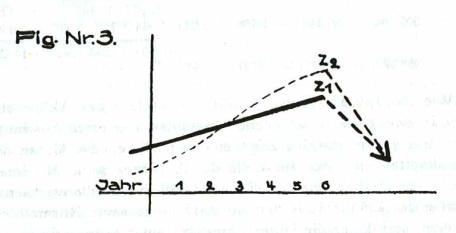
Figure 3
Underaccumulation expands the volume of loan capital and
thereby depresses the rate of interest and enhances the
rate of profit. An abnormal upswing follows. Figure 3 shows
that the upswing is not a simple straight line but takes
the shape of a curve that rises steeply upwards from a low
start. The gradual pace of accumulation at the start of
this upswing increases progressively under the stimulus of
a low rate of interest. When the reserves of loan capital
have run dry, accumulation comes to a standstill, or the
crisis starts.
A similar movement is discernible on the labour market.
Underaccumulation — which is what we are assuming
— means that unused labour powers are available. The
depression of wages below the value of labour power
enhances the rate of profit. This incites capital to extend
the scale of production and because the first half of the
expansion phase is characterised by a growing reserve army,
this impulse is even more powerful. But the number of
unemployed starts to decline and wages begin to rise.
It follows that through the introduction of credit into
the analysis the process of accumulation acquires a more
realistic character. But no new moments are introduced in
terms of our basic explanation of the industrial cycle and
of the causes of crisis. If we view the expansion phase as
a whole we return to the methodological starting point of
the analysis, in the sense that the converse deviations of
the rate of interest or of wages cancel out one another to
yield an average or normal level.
As against Bauer I have shown that the very mechanism of
accumulation leads to an overaccumulation of capital and
thus to crisis. Even a cut in wages can only proceed within
definite insuperable limits. Thus accumulation necessarily
comes to a standstill or the system collapses. At the
moment of crisis capital — in the form of the
portions of surplus value previously destined for
accumulation — are excluded from the process of
production. Absolute overproduction begins as unsold stocks
accumulate. Money capital in search of investment can no
longer be applied profitably in production and turns to the
stock exchange.
The activity of the stock exchange is insuperably bound
up with the movement of interest on the money-market
‘the price of these securities rises and falls
inversely as the rate of interest’ (Marx, 1959, p.
467). As the rate of interest jerks upward at the start of
every crisis the price of these securities registers a
precipitous fall: ‘when the money market is tight
these securities will fall in price for two reasons: first,
because the rate of interest rises, and secondly, because
they are thrown on the market in large quantities in order
to convert them into cash’ (p. 467).
The depreciation of securities in times of crisis
initiates a massive drive for speculation which is why the
end of the crisis, or the phase of depression, goes
together with feverish activity on the stock exchange. At
Z point (Figure 3) there is overaccumulation, a
shortage of investment opportunities, in short, large
amounts of disposable capital. This capital turns to the
exchange. Lederer’s argument that ‘even in
times of depression savings find investment’ (1925,
p. 377) ignores the purely illusory character of this
investment. From the banker’s point of view the stock
exchange might be as profitable as any other type of
investment. But investments on the stock exchange create
neither value nor surplus value. Capital simply shifts
according to the stock market quotations. After its
dramatic rise during the crisis the rate of interest falls
in the depression and the early stages of the period of
expansion and so the value of securities start
appreciating: ‘As soon as the storm is over, this
paper again rises to its former level’ (Marx, 1959,
pp. 467—8). In this way its ‘depreciation in
times of crisis serves as a potent means of centralising
fortunes’ (p. 468). Some pages later Marx states:
Gains and losses through fluctuations in
the price of these titles of ownership, and their
centralisation in the hands of the railway kings, etc.,
become, by their very nature, more and more a matter of
gamble, which appears to take the place of labour as the
original method of acquiring capital wealth. (p. 478)
This completes the causal chain. Starting from the
sphere of production I have shown that the very laws of
capitalist accumulation impart to accumulation a cyclical
form and this cyclical movement impinges on the sphere of
circulation (money market and stock exchange). The former
is the independent variable, the latter the dependent
variable. Once counteracting tendencies begin to operate
and valorisation of productive capital is again restored a
further period of accumulation sets in. The rate of profit
climbs upwards. As soon as it exceeds the income of fixed
interest securities money is again channelled from the
stock exchange back into the sphere of production. The rate
of interest starts rising and with the gradual fall in the
price of securities they are transferred to the
‘public’ which only looks for a long term
investment. But this ‘long-term’ lasts only
down to the next crisis or the next wave of speculative
buying. Throughout all this there is a growing
centralisation of money wealth which in turn accounts for
the increasing power of finance capital.
The elasticity of accumulation
Luxemburg criticises Marx’s scheme of expanded
reproduction in the following terms: ‘The limits of
this expansion are each time determined in advance by the
amount of surplus value which is to be capitalised in any
given case’ (1968, p. 330). She goes on to state
that:
The diagram thus precludes the expansion
of production by leaps and bounds. It only allows of a
gradual expansion which keeps strictly in step with the
formation of surplus value ... For the same reason, the
diagram presumes an accumulation which affects both
departments equally and therefore all branches of
capitalist production. It precludes expansion of the demand
by leaps and bounds just as much as it prevents a one-sided
or precocious development of individual branches of
capitalist production. Thus the diagram assumes a movement
of the aggregate capital which flies in the face of the
actual course of capitalist development. (p. 342)
This criticism has generated a whole school. A series of
Marxist writers have repeated Luxemburg’s objections
assuring us that Lenin was the first to formulate the law
of the uneven development of capitalism. Evgeny Varga tells
us that in ‘Capital Marx did not give a
purely
economic foundation to the law of the uneven development of
capitalism. He took the totality of phenomena as his
starting point’ (1926, ‘Der
uberimperialismus’, p. 246). Apparently ‘Lenin
was the first to propose the law of uneven
development’ (p. 248). Likewise Nikolai Bukharin
refers to the ‘Leninist law of the unevenness of
capitalist development’ (1926, p. 9). As always
Sternberg blindly follows whatever Luxemburg has to say:
‘in a rigid schema of exchange under pure capitalism
the sporadic development of individual industries would be
inconceivable’(1926, p. 153).
The falsehood of this view is perfectly obvious. Marx
ridiculed the harmonist theory of a balanced proportional
accumulation in all spheres of production. If this sort of
accumulation were possible crises would not exist. This is
why Marx says:
there would be no overproduction, if
demand and supply corresponded to each other, if the
capital were distributed in such proportions in all spheres
of production, that the production of one article involved
the consumption of the other, and thus its own consumption.
There would be no overproduction, if there were no
overproduction. Since, however, capitalist production can
allow itself free rein only in certain spheres, under
certain conditions, there would be no capitalist production
at all if it had to develop simultaneously and
evenly in all spheres. (1969, p. 532)
Luxemburg’s criticisms could only have arisen
through a failure to grasp the basic aspects of
Marx’s methodological procedure. Marx’s
reproduction scheme represents the average line of
accumulation, that is the ideal normal trajectory in which
accumulation occurs proportionally in both departments. In
reality there are deviations from this average line
—Marx himself repeatedly draws attention to the
elastic power of capital —but these deviations are
only explicable in terms of the average line.
Luxemburg’s mistake is that a model that represents
only the ideal trajectory in a range of possibilities is
taken for an exact description of the actual trajectory of
capital.
The same is true of Bauer. He imagines that the
magnitudes of his production scheme are the only possible
form in which the process of production can advance without
breaks. For each year of production in Bauer’s scheme
it would be possible to generate a series of variants, each
of which would represent a distinct configuration of the
departmental distribution of capital without altering the
scale of total social production. For the given social
scale of production various equilibrium positions are
conceivable. For instance accumulation may be totally
confined to Department I, in which case for several
years it would show a powerful development by leaps and
bounds, while Department!! simply stagnates.
Nothing is more characteristic of Luxemburg’s
scholasticism than the way she criticises Marx’s
reproduction schemes. Where Marx analyses a case of
proportional accumulation Luxemburg objects that he
‘precludes the expansion of production by leaps and
bounds’. Yet if Marx proceeds to the opposite case,
she says:
Marx enables accumulation to continue by
broadening the basis of production in Department I.
Accumulation in Department II appears only as a condition
and consequence of accumulation in Department I …
Department I retains the initiative all the time,
Department II being merely a passive follower. Thus the
capitalists of Department II are only allowed to accumulate
just as much as ... is needed for the accumulation of
Department I. (p. 122).
This only shows how completely Luxemburg has
misunderstood the significance of Marx’s
methodological procedure. For who could ensure that
accumulation takes place proportionally in the two
departments? No such regulator exists under capitalism or
can exist. It follows that proportional accumulation is a
purely ideal case; a fiction that could actually prevail
only accidentally. As a rule the actual process of
accumulation is quite unequal in the various branches.
The restricted development of productive forces under
capitalism
If the capitalist system inevitably breaks down due to
the relative decline in the mass of profit we can
understand why Marx ascribed such enormous importance to
the tendential fall in the rate of profit, which is simply
the expression of this breakdown. It is also clear what it
means to say: ‘The real barrier of
capitalist
production is capital itself. It is that capital
and
its self expansion appear as the starting and closing
point, the motive and purpose of production’ (Marx,
1959, p. 250).
Marx criticises Ricardo for confusing the production of
use values with the production of value, the labour process
with the valorisation process:
‘He cannot therefore admit that the bourgeois mode
of production contains within itself a barrier to the free
development of productive forces, a barrier which comes to
the surface in crises’ (1969, pp. 527—8). From
a purely technological aspect, as a labour process for the
production of use values, nothing could impede the
expansion of the forces of production. This expansion
encounters a barrier in the shape of the valorisation
process, the fact that the elements of production figure as
capital which must be valorised. If profit disappears the
labour process is interrupted. The greatest possible
valorisation forms the specific aim of the capitalist
process of production.
The barrier to the development of the forces of
production of capitalism is of a twofold nature. In the
first place the level of technological perfection
attainable under capitalism is far lower than it could
otherwise be from a social standpoint. Marx was the first
to show that under capitalism there is far less scope for
the application of improved means of production. From the
standpoint of capital what matters is economies in the use
of paid labour, and not labour as such. For example, if the
production of a commodity costs society 10 hours of labour
time, it would make use of any machine that could economise
on the labour time — even if 9.5 hours were still
needed to produce that commodity. But if a capitalist pays
the worker the equivalent of say, 5 hours of labour, he
will only find the use of machinery to his advantage if it
costs him less than 5 hours.
Quite apart from Asia and Africa, there are large parts
of eastern and south-eastern Europe today where living
labour is so cheap that it does not pay the capitalist to
use machinery. Thus although human labour could be replaced
by machinery it is in fact massively wasted. Even in the
more advanced capitalist countries like Germany and the
United States advanced technology is confined to a
relatively small group of capitalists, next to whom there
is a large mass of technically backward enterprises which
squander human labour by using outdated machinery and
manual labour. Even the best technology that is used is not
identical with the best that is available. Of course a
fantastic number of inventions and patents are bought up by
the cartels and trusts, but they do not use them until
forced to do so under the pressure of competition.
Secondly competition entails an enormous squandering of
the productive forces through the struggle for sales
outlets, the overproduction of commodities on one side and
unemployment on the other. According to R Liefmann
‘this competitive struggle ... is terribly
uneconomical, and often represents a huge waste of
capital’ (1918, p. 50). But are things any better in
the epoch of monopoly capitalism? Liefmann argues that as
far as cartels are concerned we cannot speak of a conscious
regulation of production based on foresight. In fact it
turns out that while ‘cartel formation gives a
powerful impetus to expanding the scale of production of
the enterprise ... the cartels often find the greatest
difficulties in disposing of the enormously expanded
production.’ Liefmann maintained that ‘As a
rule they [the cartels] have no means of preventing an
excessive expansion of enterprises’ (pp.
69—70). Liefmann refers to the ‘huge
overcapitalisation’ that characterises the
cartels.
After the War underutilisation of capacity became a
general phenomenon in the leading capitalist countries.
This is the celebrated ‘regulation’ of
production by the cartels and trusts — not a planned
calculation and distribution of production according to
needs, but restrictions on the utilisation of productive
capacity in order to push up the level of prices and
profits. Marx states that:
capitalist production meets in the
development of its productive forces a barrier which has
nothing to do with the production of wealth as such; and
this peculiar barrier testifies to the limitations and to
the merely historical, transitory character of the
capitalist mode of production; testifies that for the
production of wealth, it is not an absolute mode, moreover,
that at a certain stage it rather conflicts with its
further development. (1959, p. 242)
After 1815 English capitalism revolutionised her
industry through technological changes in iron production
starting with the puddling process. But as the accumulation
of capital advanced the rate of technological progress
slowed down in Britain. In 1856 the Englishman Bessemer
reported the discovery of a new process that was destined
to revolutionise the metal working industries and to
replace the dominance of iron by steel. But for 20 years
Britain ignored the discovery of the Bessemer process and
stuck to the puddling process until the competition of
Germany, France and Belgium forced her to take it over and
refine it. This was repeated again when in 1879 Thomas
discovered the basic process named after him. Britain
received the finding with pure indifference and let
foreigners buy it until, in three years, it revolutionised
all the plants on the Continent. The British monopoly was a
thing of the past as the leadership in iron and steel
production gradually passed into other hands.
At the end of the nineteenth century we find the same
picture in the field of electrical technology. British
capitalism simply ignored it at a time when there was
practically no city in Germany which did not have its
‘electricity society’. By 1906 G
Schulze-Gaevernitz could refer to the ‘technological
conservatism’ of Britain and list a whole series of
industries like iron and steel, machine building,
shipbuilding, chemicals and others in which America and
Germany had either displaced or were threatening British
dominance. However Schulze-Gaevernitz does not accept
economic causes as the explanation of British conservatism
and prefers to trace this to ‘processes of spiritual
decay’ (1906, p.212). But if so why did the
progressive, in fact revolutionary, character of British
economic development change so completely in a few decades?
I have shown that under capitalism, at a definite level of
the accumulation of capital, technological development has
to slow down because the valorisation of capital can no
longer sustain it.
This way of posing the problem shows that it is
misleading to speak about the stagnation of productive
forces under capitalism in general. This is precisely why
Kautsky can deny the possibility of an economic breakdown
of capitalism, because in his understanding capitalism has
proved its capacity to develop the forces of production.
But the problem is not one of some abstract capitalism
outside space and time but of the actual development of
particular historical capitalist countries, each of which
lies at a specific stage of capital accumulation. It is a
fact that the oldest capitalist country of Europe, which
for more than a century played the leading role in industry
and which had the greatest accumulation of capital prior to
the War, ‘has lost its dominance to other nations in
several of the most important industries’
(Schulze-Gaevernitz, 1906, p. 334). The technological
stagnation of Britain and her loss of industrial leadership
were rooted in the faltering of her rate of accumulation
due to the already huge accumulation of capital.
Once the accumulation of capital increases in countries
like Germany and America, there too the process of
valorisation will necessarily run into limits that will
slow down their technological advance. The law of
accumulation expounded above explains the phenomenon
already noted by Adam Smith that in the younger countries
at an early stage of capitalist development the tempo of
accumulation is more rapid than in the wealthier, advanced
capitalist countries.
Lenin was right in saying that highly developed
capitalism is characterised by an inherent ‘tendency
to stagnation and decay’. But Lenin linked this
tendency to the growth of monopolies. That there is such a
connection is indisputable, but a mere statement is not
enough. After all one is not dealing simply with phenomena
of stagnation. The very same British capitalism that has
reached a state of decay economically, shows an extremely
aggressive character in other aspects. It is this
aggressive character or unusual energy that gives to it the
peculiar stamp of so-called ‘imperialism’.
Imperialism is characterised both by stagnation and by
aggressiveness. These tendencies have to be explained in
their unity; if monopolisation causes stagnation, then how
can we explain the aggressive character of imperialism? In
fact both phenomena are ultimately rooted in the tendency
towards breakdown, in imperfect valorisation due to
overaccumulation. The growth of monopoly is a means of
enhancing profitability by raising prices and, in this
sense, it is only a surface appearance whose inner
structure is insufficient valorisation linked to capital
accumulation.
The aggressive character of imperialism likewise
necessarily flows from a crisis of valorisation.
Imperialism is a striving to restore the valorisation of
capital at any cost, to weaken or eliminate the breakdown
tendency. This explains its aggressive policies at home (an
intensified attack on the working class) and abroad (a
drive to transform foreign nations into tributaries). This
is the hidden basis of the bourgeois rentier state, of the
parasitic character of capitalism at an advanced stage of
accumulation. Because the valorisation of capital fails in
countries at a given, higher stage of accumulation, the
tribute that flows in from abroad assumes ever increasing
importance. Parasitism becomes a method of prolonging the
life of capitalism.
The opposition between capitalism and its forces of
production is an opposition between value and use value,
between the tendency to an unlimited production of use
value and a production of values constrained by the limits
to valorisation. Marx writes:
The contradiction to put it in a very
general way, consists in that the capitalist mode of
production involves a tendency towards absolute development
of the productive forces, regardless of the value and
surplus value it contains ... while, on the other hand, its
aim is to preserve the value of the existing capital and
promote its self expansion to the highest limit. (1959, p.
249)
Capital accomplishes this twofold objective through
technological advance; by the development of a
progressively higher organic composition of capital which,
however, entails the consequences we know already:
The methods by which it accomplishes
this
include the fall of the rate of profit, depreciation of the
existing capital and development of the productive forces
of labour at the expense of already created productive
forces ... The periodical depreciation of existing capital
... disturbs the given conditions, within which the process
of circulation and reproduction of capital takes place, and
is therefore accompanied by sudden stoppages and crises in
the production process. (Marx, 1959, p. 249)
Surveying the process as a whole we get the following
picture. The accumulation process is a movement that
proceeds through the opposition between use value and
value. From the use value aspect the forces of production
are developed absolutely ruthlessly. This accumulation of
use values (which is simultaneously an accumulation of
values) leads to a fall in the rate of profit, which in
turn means that valorisation of the advanced capital is no
longer possible at the given rate. This means a crisis, a
devaluation of the existing capital. Yet this reanimates
the accumulation of capital from its value side: ‘The
accumulation of capital in terms of value is slowed down by
the falling rate of profit, only to hasten still more the
accumulation of use values, while this, in its turn, adds
new momentum to accumulation in terms of value’
(Marx, 1959, p. 250). The entire process moves by fits and
starts, through crises and their attendant devaluation of
capital, so that the forces of production find their limit
in the possibilities of valorisation. Marx writes:
The limits within which the preservation
and self expansion of the value of capital resting on the
expropriation and pauperisation of the great mass of
producers can alone move — these limits come
continually into conflict with the methods of production
employed by capital for its purposes, which drive
development of the social productivity of labour. The means
—unconditional development of the productive forces
of society — comes continually into conflict with the
limited purpose, the self expansion of the existing
capital. The capitalist mode of production is, for this
reason, a historical means of developing the material
forces of production and creating an appropriate world
market and is at the same time a continual conflict between
this its historical task and its own corresponding
relations of social production. (1959, p. 250)
Similarly in a passage some pages later Marx writes:
Here the capitalist mode of production
is
beset with another contradiction. Its historical mission is
unconstrained development in geometrical progression of the
productivity of human labour. It goes back on its mission
whenever, as here, it checks the development of
productivity. It thus demonstrates again that it is
becoming senile and that it is more and more outlived
itself. (p. 262)
The ideas developed here were already proposed in
Capital Volume One in a more general form. But in
these passages from Volume Three Marx shows
concretely — through an analysis of the capitalist
process of accumulation — that capitalism, though
historically necessary for the expansion of productivity,
becomes in the course of time a fetter on this
expansion.
The Marxist theory of imperfect valorisation
Let us suppose with Luxemburg that capitalism is not the
exclusively prevalent mode of production but has to rely on
a non-capitalist sector. In that case, on the periphery of
Bauer’s scheme there are non-capitalist markets that
buy up the surplus value produced capitalistically within
the scheme, but otherwise unsaleable. Let us suppose that
only after this transaction is the surplus value
convertible into a usable natural form and earmarked for
accumulation in the capitalist country. In short we assume
that Bauer’s scheme now represents an accumulation
whose elements have returned from the non-capitalist
countries after being realised there. But what follows?
Even if the surplus value were realised in the
non-capitalist countries the breakdown of capitalism would
still be inevitable due to the causes mentioned.
This only shows that Luxemburg’s entire hypothesis
is totally irrelevant to the problem concerned and
therefore quite superfluous. Whether surplus value is
realised internally or in a non-capitalist sector has no
bearing either on the life span of capitalism or on the
timing and inevitability of its final collapse. In both
cases the breakdown would be inevitable and its timing
would be the same. This flows from the fact of capitalist
accumulation on the basis of a progressively rising organic
composition of capital; from the fact that c grows
faster than v. The question of where the surplus
value is realised is quite irrelevant. All that matters is
the magnitude of the surplus value.
The first two decades of discussions around Marx were
dominated by the idea of the breakdown of capitalism. Then,
around the turn of the century, Tugan-Baranovsky came up
with his theory of a possible unlimited development of
capitalism. He was soon followed by Hilferding and Bauer
and finally Kautsky. So it was entirely natural that
Luxemburg should defend the fundamental conception of the
inevitable breakdown of capitalism against the distortions
of Marx’s epigones. But instead of testing
Marx’s reproduction scheme within the framework of
his total system and especially of the theory of
accumulation, instead of asking what role it plays
methodologically in the structure of his theory, instead of
analysing the schema of accumulation down to its ultimate
conclusion, Luxemburg was unconsciously influenced by them.
She came around to believing that Marx’s schemes
really do allow for an unlimited accumulation:
We are running in circles, quite in
accordance with the theory of Tugan-Baranovsky. Considered
in isolation, Marx’s diagram does indeed permit of
such an interpretation since he himself explicitly states
time and again that he aims at presenting the process of
accumulation of the aggregate capital in a society
consisting solely of capitalists and workers. (Luxemburg,
1968, pp. 330—1)
Luxemburg was of the opinion that Marx ‘does not
go any further into the question of accumulation than to
devise a few models and suggest an analysis. This is where
my critique begins’ (1972, p. 48).
We could scarcely imagine a worse distortion of
Marx’s methodological principles. Because Luxemburg
took the schemes as implying the possibility of unfettered
accumulation she was forced to abandon them in order to
salvage the notion of breakdown flowing from Capital
Volume One. In her own words:
Assuming the accumulation of capital to
be without limits, one has obviously proved the unlimited
capacity of capitalism to survive! ... If the capitalist
mode of production can ensure boundless expansion of the
productive forces, of economic progress, it is invincible
indeed.
(1968, p. 325)
With her ad hoc model of the need for non-capitalist
markets Luxemburg thought she was killing two birds with
one stone — refuting the equilibrium dreams of the
neo-harmonist writers by showing that there is an
inexorable economic limit to capitalism and simultaneously
explaining imperialism.
Capitalism is dominated by a blind, unlimited thirst for
surplus value. According to the interpretation that
Luxemburg gives it would appear as if the system suffers
from an excess of surplus value, that it contains an
unsaleable residue of surplus value and in this sense
possesses too much surplus value. Such a theory is quite
illogical and self contradictory in terms of trying to
understand the most important and peculiar function of
capital, the function of valorisation.
The whole matter is quite different in the
interpretation I have given. The capitalist mechanism falls
sick not because it contains too much surplus value but
because it contains too little. The valorisation of capital
is its basic function and the system dies because this
function cannot be fulfilled. In explaining how this
happens the logical unity and consistency of Marx’s
system finds its most powerful expression. Unless we are
going to overthrow the logical unity of the system we have
to be able to demonstrate the necessary breakdown of
capitalism in terms of the theory itself -that is, on the
basis of the law of value without recourse to unnecessary
and complicating auxiliary hypotheses. The Marxian theory
of crises can account for recessions and their necessary
periodic recurrence without having to invoke special
causes. This illustrates the essential character of the
logical structure of Marx’s theory of breakdown and
its difference from all other theories of the business
cycle.
The latter are theories of equilibrium. They bear a
static character. They cannot deduce the general crisis
— seen as a discrepancy between demand and supply
— from the system itself because in equilibrium
theory prices represent an automatic mechanism for
adjusting one to the other. Disruptions of equilibrium can
only be explained in terms of exogenous factors.
There is no such defect in Marx’s theory of
crises. True, Marx’s proof procedure starts from the
assumption of equilibrium. But equilibrium forms only a
tentative methodological fiction with which Marx shows that
in the long run equilibrium is impossible under capitalism;
by its very nature capitalism is not static but dynamic.
All the requirements placed on any theory with respect to
its logical unity are satisfied, if purely deductively,
proceeding from the inner course of capitalist accumulation
itself. Keeping with the logic of the total system we can
show the possibility and necessity of economic movements
that lead to the periodic disruption of the system’s
equilibrium and to its final destruction.
This enables us to clarify the basic differences between
the outlook of classical economy and that of Marx. Adam
Smith had already discerned a threat to capitalism in the
falling rate of profit because profit is the motor force of
production. But Smith accounts for declining profitability
in terms of growing competition of capitals. Ricardo
grounds the law of the falling rate of profit in terms of
natural factors related to the declining productivity of
the soil By contrast Marx deduces the breakdown of the
capitalist system quite independently of competition. His
starting point is a state of equilibrium. Because
valorisation falters at a specific level of accumulation,
the struggle for markets and for spheres of investment must
begin. Competition is a consequence of imperfect
valorisation, not its cause.
As against Ricardo, Marx roots the breakdown in the
social form of production; in the fact that the capitalist
mechanism is regulated by profit and at a certain level of
capitalist accumulation there is not enough profit to
ensure valorisation of the accumulated capital. The law of
breakdown is the fundamental law that governs and supports
the entire structure of Marx’s thought
Footnotes
1.
Oppenheimer, who is otherwise a
sharp thinker, fails to notice the methodological
significance of Marx’s reproduction schemes.
He argues that Marx’s division of the annual
product into c + v + s ‘was simply a device
for the deduction of surplus value. The deduction
failed’ (1928, p. 311). But Marx did not need
any device for the deduction of surplus value
because the latter is a fact and facts do not need
any proofs. The methodological construction was not
designed to prove the fact of surplus value but to
establish exactly the variations in the magnitude of
surplus value in the course of accumulation.
2.
The basic mistake is Bauer’s
assumption that the rate of surplus value is
constant despite the assumed rising organic
composition of capital. Bauer’s other mistakes
relate not so much to the construction of his scheme
as to his underlying lack of methodological clarity.
He confuses the purely fictitious trajectory of
accumulation represented by the scheme with the
actual trajectory of accumulation.
3.
The same holds for Tugan-Baranovsky
who followed through the development of his system
for only three years and claimed that it ‘is
quite unnecessary to continue with the analysis into
the fourth and fifth and following years’
(1901, p. 24).
4.
To think as Boudin that a fall in
the rate of profit ‘naturally interrupts the
advance of the accumulation process and acts like an
automatic brake’(1909, p. 169) is to
understand nothing of Marx’s system. I have
shown that it is not only not natural that
accumulation should slow down with a fall in the
rate of profit but that, on the contrary, it can
proceed at an accelerated pace.
5.
According to Marx there is too much
capital and too many workers with respect to
valorisation. Rosa Luxemburg shatters the clear
sense of this passage by forcibly interjecting her
theory of insufficient market outlets, of which
there is no trace in Marx. After quoting the passage
concerned she asks ‘In relation to what is
there too much of both? In relation to the market
under normal conditions. As the market for
capitalist commodities periodically grows too small,
capital must remain unemployed and consequently part
of the labour force as well’ (1972, p. 126).
Yet Marx says not a single word about the lack of
markets. On the contrary, he says that the very
causes that expanded markets and accelerated
accumulation have also lowered the rate of profit.
Hence he says the precise opposite of what Luxemburg
supposes: not a decline in profitability due to lack
of markets and the impossibility of accumulating but
a decline in profitability due to accelerated
accumulation and expansion of markets. Moreover
Luxemburg states that the market for capitalist
commodities periodically grows too small. But she
herself makes not the slightest effort to show why
there is this periodic shortage of outlets and from
her standpoint the periodicity of crises simply
cannot be explained.
6.
This exposition suggests that
capital accumulation forms the decisive element in
Marx’s theory of crises. Nevertheless, the
influence of other factors is of great significance
for the actual course of crises, especially the role
of fixed capital as the factor which governs the
periodicity of the crisis. I cannot go into this in
more detail because this factor comes under simple
reproduction and is therefore outside the framework
of my analysis. Here I merely say that in contrast
to the prevalent conception, even in Marxist
writings, that there is no problem of a business
cycle under simple reproduction, Marx demonstrates
that even in simple reproduction crises must
periodically burst forth due to the impact of fixed
capital.
7.
Oppenheimer drags in a third kind
of setting free, arguing that more labour is
displaced in the countryside than in industry and
concludes that ‘the process of setting free
can have nothing to do with changes in the organic
composition of capital’ (1913, p. 105).
Oppenheimer overlooks something quite elementary:
the basis of Marx’s analysis is capitalism in
its pure form. Marx is concerned with the condition
of workers who already function as wage labourers.
In the countryside the setting free is a setting
free of small producers; it is their
proletarianisation and conversion into wage
labour.
8.
No earlier epoch has come even
vaguely close to ours in the abundance of data at
its disposal. Yet what theoretical results can these
writings lay claim to? The limited significance of
this entire direction of research for theory is
admitted by the chief statistician of the Federal
Reserve Bank of New York. Carl Snyder: ‘If we
were to ask what is the sum total of theorems to
flow from these detailed and penetrating studies the
answer would have to be that their yield in terms of
forecasts or controls, both hallmarks of any real
scientific knowledge, is truly low’ (1928, p.
27). To expect the construction of theory to be
directly promoted by expanding empirical insights is
a complete misunderstanding of the logical
relationship of theory and empirical research.
9.
Lederer’s critique of
disproportionality theory is the best thing that has
been written on the subject. However it does not
affect the Marxist theory of crisis because the
latter traces crises to the periodically recurring
shortage of surplus value. Any theory of
disproportionality implies a theory of partial
overproduction. Yet Marx deduces the inner crisis of
capitalism from a generalised overproduction arising
from a complete proportionality.
10.
In the following description of
the cycle I can only go into the essential causal
relationships. Therefore I shall have to refrain
from a more detailed treatment of credit and of its
impact on the reproductive process, reserving this
for my major study. The Marxist position has to show
why crises are inevitable quite irrespective of
credit and of the circulation process and how they
are rooted in causes within production.