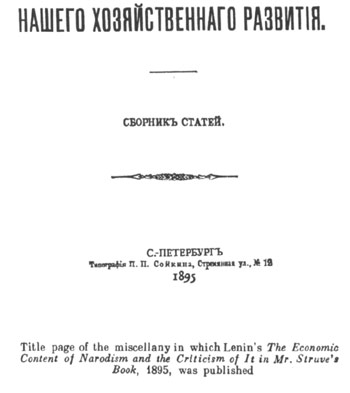
Mr. Struve’s book is a systematic criticism of Narodism—this word to be understood in its broad sense, as a theoretical doctrine that gives a particular solution to highly important sociological and economic problems, and as “a system of dogmas of economic policy” (p. VII). The very posing of such a problem would have made the book of outstanding interest, but of still greater importance is the standpoint from which the criticism is made. Of this the author in his Preface says the following:
“While adhering, on certain basic issues, to views that have been quite definitely established in literature, he (the author) does not consider himself bound in the least by the word and letter of any doctrine whatsoever. He is not infected with orthodoxy” (IX).
The contents of the book make it clear that these “views that have been quite definitely established in literature” are those of Marxism. The question arises: which, exactly, are the “certain basic” tenets of Marxism that the author accepts, and which are those he rejects? Why and to what extent? He gives no direct answers to these questions. That is why a detailed examination will be necessary in order to make clear exactly what there is in the book that may be classed as Marxist—which of the doctrine’s tenets the author accepts and how consistently he adheres to them—and which of them he rejects, and what are the results when he does so.
The contents are exceedingly varied: the author gives us, firstly, an exposition of “the subjective method in sociology” as accepted by our Narodniks, criticises it and sets against it the method “of historico-economic materialism.” Then he gives an economic criticism of Narodism, firstly on the strength of “human experience” (p. IX) and, secondly, on the basis of the facts of Russia’s economic history and present-day reality. A criticism of the dogmas of Narodnik economic policy is given in passing. The varied character of the contents (something quite inevitable when criticising a major trend in our public thought) determines the form in which the examination is made: we shall have to follow the author’s exposition step by step, dwelling on each series of arguments.
Before, however, proceeding to examine the book, I consider it necessary to give a preliminary explanation in somewhat greater detail. The task of the present article is to criticise Mr. Struve’s book from the viewpoint of one who “adheres to views that have been quite definitely established in literature” on all (and not merely on “certain”) “basic issues.”
These views have been expounded on more than one occasion for the purpose of criticism in the columns of the liberal and Narodnik press, and this exposition has abominably obscured them—has, indeed, distorted them by involving what has nothing whatever to do with them, namely, Hegelianism, “faith in the necessity of each country having to pass through the phase of capitalism” and much other purely Novoye Vremya nonsense.
It is above all the practical side of the doctrine, its application to Russian affairs, that has been badly distorted. Our liberals and Narodniks refused to understand that the starting-point of the Russian Marxist doctrine is a totally different concept of Russian reality, and by looking at that doctrine from the standpoint of their old views of this reality, reached conclusions that were not only absolutely absurd but that in addition levelled the most preposterous accusations at the Marxists.
It seems to me, therefore, that unless I define my attitude to Narodism exactly, it will be impossible to set about an examination of Mr. Struve’s book. Furthermore, a preliminary comparison of the Narodnik and Marxist viewpoints is necessary to explain many passages in the book under review, which confines itself to the objective side of the doctrine and leaves practical conclusions almost entirely untouched.
The comparison will show us what points of departure Narodism and Marxism have in common, and in what they differ fundamentally. It will be more convenient to take the old Russian Narodism, since, firstly, it is immeasurably superior to that of today (as represented by publications such as Russkoye Bogatstvo) in consistency and forthrightness, and, secondly, it gives a fuller picture of the best aspects of Narodism, aspects which in some respects Marxism also adheres to.
Let us take one of the professions de foi[1] of the old Russian Narodism and follow the author step by step.
Volume CCXLII of Otechestvenniye Zapiski[2] contains an unsigned article entitled “New Shoots in the People’s Fields,” which graphically sets forth the progressive aspects of Narodism as against Russian liberalism.
The author begins by saying that “now” it is considered “almost treachery” to protest against “those who emerge from the midst of the people and reach a higher level of society.”
“Not long ago a certain literary donkey kicked at Otechestvenniye Zapiski for displaying pessimism towards the people, as he expressed himself regarding a brief review of a book by Zlatovratsky which contained nothing pessimistic apart from pessimism towards usury and the corrupting influence of money in general; and when, later, Gleb Uspensky wrote a commentary to his latest articles (Otechestvenniye Zapiski, No. 11, 1878), the liberal bog heaved and surged, just as in the fairy-tale ... and all of a sudden, so many defenders of the people appeared that, verily, we were surprised to find that our people had so many friends.... I cannot but sympathise ... with the way of posing the problem of the beauteous countryside and of the attitude of the literary lads towards it, or, to put it better, not lads but old roués from among Messrs. the nobility and lackeys, and the young merchants.... To sing serenades to the countryside and “to make eyes at it” does not at all mean to love and respect it, just as pointing to its defects does not mean to be hostile towards it. Should you ask the very same Uspensky ... what is closest to his heart, where he sees the greatest guarantees for the future ... in the countryside or in the old-nobility and the new middle-class strata, can there be any doubt at all that he would say: ‘The countryside.’”
This is a very typical passage. Firstly, it shows clearly the essence of Narodism: it is protest against serfdom (the old-nobility stratum) and bourgeoisdom (the new middle-class stratum) in Russia from the peasant’s, the small producer’s, point of view. Secondly, it shows at the same time that this protest is based on fantasy, that it turns its back on the facts.
Does the “countryside” exist somewhere outside of the “old-nobility” or “new middle-class” regimes? Was it not the “countryside” that representatives of both the one and the other built and are still building each after their own fashion? The countryside is in fact a “stratum” that is partly “old-nobility,” and partly “new middle-class.” Whichever way you look at the countryside, if you confine yourself to stating the actual situation (that is all that is at issue) and not to possibilities, you will not be able to find anything else, any third “stratum,” in it. And if the Narodniks do, it is only because they cannot see the wood for the trees, the form of land tenure in the separate peasant communities prevents them from seeing the economic organisation of Russian social economy. This organisation turns the peasant into a commodity producer, transforms him into a petty bourgeois, a petty isolated farmer producing for the market. This organisation, therefore, makes it impossible to look backwards for “guarantees for the future” and makes it essential to look for them ahead. They should not be sought in the “countryside,” where the combination of the “old-nobility” and “new middle-class” strata terribly worsens the position of labour and deprives it of the opportunity of fighting against the masters of the “new middle-class” order, for here the antithesis between their interests and those of labour is insufficiently developed. But they should be sought in the fully-developed stratum which is completely “new middle-class” and has entirely disposed of the blessings of the “old-nobility,” has socialised labour, has brought to a head and clarified that social contradiction which, in the countryside, is still in an embryonic, suppressed condition.
Now we must indicate the theoretical differences existing between the doctrines that lead to Narodism and to Marxism, between the different conceptions of Russian reality and history.
Let us follow the author further.
He assures “spiritually indignant gentlemen” that Uspensky understands the relation between the poverty and the morality of the people
“better than many admirers of the countryside, for whom ... the countryside ... is something like the liberal passport which all intelligent and practical bourgeois usually provide themselves with in an epoch like the present.”
You, Mr. Narodnik, are wondering why something so lamentable and hurtful should take place—that a man who wants to represent the interests of labour should see that which he regards as “guarantees for the future” transformed into a “liberal passport.” That future has to rule out the bourgeoisie—but the way in which you wish to arrive at this future, far from being given a hostile reception by the “practical and intelligent bourgeois,” is accepted willingly, is accepted as a “passport.”
Do you think such a scandalous thing would be possible if you were to point to the “guarantees for the future,” not where the social contradictions inherent in the system dominated by the “practical and intelligent bourgeois” are still in an undeveloped, embryonic state, but where they are developed thoroughly, to nec plus ultra, where, consequently, one cannot confine oneself to palliatives or half-measures, where the desiderata of the working people cannot be utilised for one’s own benefit, and where the issue is squarely put?
Do you not yourself say further on:
The passive friends of the people refuse to understand the simple thing that in society all active forces usually add up to two equally operating, mutually opposite ones, and that the passive forces which apparently take no part in the struggle, merely serve the force preponderant at the given moment” (p. 132).
Does not this description apply to the countryside, or is the countryside some specific kind of world devoid of these “mutually opposite forces” and struggle, a countryside that can be spoken of indiscriminately, without fear of playing in to the hands of the “preponderant force”? Is it sound, since we are talking about struggle, to begin where the content of this struggle is cluttered up with a host of extraneous circumstances that prevent those mutually opposite forces from being definitely and finally separated from one another, that prevent the chief enemy from being clearly seen? Is it not obvious that the programme advanced by the author at the end of his article—education, expansion of peasant land tenure, reduction of taxes—can have no effect on the one who is preponderant, while the last point of the programme—“organisation of people’s industry”—presumes, does it not, that the struggle has not only taken place, but, furthermore, has already ended in victory? Your programme fights shy of the antagonism whose existence you yourself could not help admitting. That is why it holds no terrors for the masters of the “new middle-class stratum.” Your programme is a petty-bourgeois dream. That is why it is only good enough to be a “liberal passport.”
“People for whom the countryside is an abstract concept, and the muzhik an abstract Narcissus, even think badly when they say that the countryside should only be praised and be told that it is standing up splendidly to all influences destructive to it. If the countryside is placed in such a position that it must fight every day for a kopek, if it is skinned by the usurers, deceived by the kulaks, oppressed by the landlords, if it is sometimes flogged in the Volost offices, can this be without influence to its moral side?... If the ruble, that capitalist moon, sails to the forefront of the rural landscape, if all eyes, all thoughts and spiritual forces are focussed on it, if it becomes the aim of life and the yardstick of individual abilities, can the fact be hidden and can we say that the muzhik is such an altruist that he needs no money at all? If in the countryside there are visible tendencies towards conflict, if kulakdom is in full bloom and is striving to enslave the weakest peasants and turn them into labourers, to wreck the village community, etc., can we, I ask, conceal all these facts?! We may wish for a more detailed and comprehensive investigation of them, we may explain them to ourselves by the oppressive conditions of poverty (hunger drives people to theft, murder, and in extreme cases even to cannibalism), but we cannot conceal them at all. To conceal them means to defend the status quo, to defend the notorious laissez faire, laissez aller until the sad phenomena assume terrible proportions. To colour the truth is never worth while.”
Once again, how fine is this description of the countryside and how petty the conclusions drawn from it! How well are the facts observed and how paltry the explanation, the understanding of them! Here again we see the gigantic abyss between the desiderata of the defence of labour, and the means of fulfilling them. Capitalism in the countryside, so far as the author is concerned, is no more than a “sad phenomenon.” Despite the fact that he sees the same sort of capitalism in the towns on a big scale, that he sees how capitalism has subordinated to itself not only all spheres of the people’s labour but even “progressive” literature, which presents the measures of the bourgeoisie in the name and in behalf of the people, despite this, he refuses to admit that it is a matter of the specific organisation of our social economy, and consoles himself with dreams about its being merely a sad phenomenon called into existence by “oppressive conditions.” And if, says he, one does not cling to the theory of non-interference, then these conditions may be eliminated. Yes, if ifs and ans! But Russia has never yet witnessed a policy of non-interference; there always has been interference ... for the benefit of the bourgeoisie, and only sweet dreams of “after-dinner tranquillity” can give rise to hopes of changing this without a “redistribution of the social force between the classes,” as Mr. Struve puts it.
“We forget that our society needs ideals—political, civic and others—mainly so that, having acquired a stock of them, it may be able to think of nothing; that society seeks them not with youthful eagerness but with after-dinner tranquillity, that society is not disillusioned in them with torments of the soul but with the lightness of a prince of Arcady. Such, at least, is the overwhelming majority of our society. Actually it requires no ideals because it is sated and is fully satisfied by digestive processes.”
A superb description of our liberal-Narodnik society.
The question arises, who is more consistent now: the “Narodniks,” who continue to fuss and bother with this “society,” who regale it with a picture of the horrors of “on coming” capitalism, of the “threatening evil,”[3] as the author of the article expressed it, who call on its representatives to leave the wrong road on to which “we” have deviated, etc.—or the Marxists, who are so “narrow” that they sharply fence themselves off from society and consider it necessary to address themselves exclusively to those who are not “satisfied” and cannot be satisfied with “digestive processes,” for whom ideals are a necessity, for whom they are a matter of daily life.
That is the attitude of a ladies’ college damsel—continues the author. That
“testifies to profound corruption of thought and feelings ... never has there been such decent, polished, such innocent and at the same time profound corruption. This corruption is entirely the property of our recent history, the property of middle-class culture” [i.e., of the bourgeois, capitalist order, to be more exact. K. T.[4] ] “that has grown up on the soil of landlordism, the sentimentality, ignorance and indolence of the nobility. The middle class have introduced their own science, their own moral code and their own sophisms into life.”
One would have thought that the author had so well assessed the situation that he should have understood the only possible conclusion to be drawn. If it is all a matter of our bourgeois culture, there can be no other “guarantees for the future” except in the “antipode” of this bourgeoisie, because it alone has been totally “differentiated” from this “middle-class culture,” is finally and irrevocably hostile to it and is incapable of any of the compromises out of which it is so convenient to fashion “liberal passports.”
But no. One may still dream. “Culture” is certainly nothing but “middle-class,” nothing but corruption. But this is only because it comes from the old landlordism (he himself has just admitted that this culture is a product of contemporary history, of that history, in fact, that destroyed the old landlordism) and from indolence—something, therefore, that is fortuitous and has no firm roots, etc., etc. Then come phrases that have no meaning other than turning one’s back on the facts and sentimental dreaming that ignores the existence of “mutually opposite forces.” Listen:
“They (the middle class) have to instal them (science, the moral code) in the university chairs, in literature, in the courts and in other spheres of life.” [Above we have seen that they have already installed them in such a profound “sphere of life” as the countryside. K. T.] “First and foremost, they do not find a sufficient number of people suitable for this, and of necessity address themselves to people of other traditions.” [Is it the Russian bourgeoisie that “does not find people”?! This is not worth refuting, especially as the author refutes himself further on. K. T.] “These people have no knowledge of business” [the Russian capitalists?! K. T.], “their steps are uncertain, their movements clumsy” [their “knowledge of business” is sufficient for them to get tens and hundreds per cent profit; they are sufficiently “experienced” to practise the truck-system[38] everywhere, they are sufficiently astute to secure preferential tariffs. Only somebody who has no immediate and direct experience of oppression by these people, only a petty bourgeois could entertain such a fantasy. K. T.]; “they try to copy the West-European bourgeoisie, order books, study” [here the author has himself to admit the fantastic character of the dream he has now concocted about “middle-class culture” having grown up in Russia in the soil of ignorance. That is untrue. It is precisely the middle-class culture that brought culture and “education” to post-Reform Russia. “To colour the truth,” to picture the enemy as impotent and devoid of foundation is “never worth while.” K. T.]; “at times they become regretful about the past and at times uneasy about the future, because voices are heard from somewhere saying that the middle class are only the impertinent parvenus of the day, that their science will not bear criticism, while their moral code is no use at all.”
Is it the Russian bourgeoisie that commits the sin of being “regretful about the past” and “uneasy about the future”?! You don’t say! Don’t some people like pulling their own legs by spreading such wholesale slander about the poor Russian bourgeoisie being embarrassed by voices proclaiming the “uselessness of the middle class.” Is not the opposite the case: were not these “voices” “embarrassed” when they were given a good bawling out, is it not they who display “uneasiness about the future”?...
And gentlemen of this sort even express surprise and pretend they do not understand why they are called romantics!
“Yet we must save ourselves. The middle class do not ask, but order people, on pain of destruction, to go to work.[5] If you refuse, you will go without bread and will stand in the middle of the street, crying out, “Spare something for an ex-soldier!” or die of starvation altogether. And so work begins, you hear a squeaking, creaking, and clanking, there is a turmoil. The job is an urgent one that brooks no delay. Finally, the machine is set going. There seems to be less creaking and fewer strident sounds, the parts seem to work, all you hear is the din of something clumsy. But that makes it all the more fearsome because the planks bend more and more, screws get loose and, look!—before you know where you are the whole thing may fall to pieces.”
This passage is particularly typical in that it contains in graphic, laconic, and elegant form the line of argument which the Russian Narodniks like to clothe in scientific dress. Starting out from facts which are indisputable, which are beyond all doubt, and which prove the existence of contradictions under the capitalist system, the existence of oppression, starvation, unemployment, etc., they exert every effort to prove that capitalism is an exceedingly bad thing, is “clumsy” [cf. V. V., Kablukov (The Workers in Agriculture), and partly Mr. Nikolai—on], and “look, before you know where you are it may fall to pieces.”
We are looking, we have been looking for many, many years, and see that this force, which orders the Russian people to go to work, keeps growing stronger and bigger, boasts to the whole of Europe about the might of the Russia it is creating, and is glad, of course, that “voices are heard” only about the need to hope that “the screws will get loose.”
“Weak people are terror-stricken. ’All the better,’ say reckless people. ’All the better,’ say the bourgeoisie:—’the sooner we order new machinery from abroad, the sooner we prepare platforms, planks and other rough parts from our own material, the sooner we shall get skilled engineers.’ In the meantime, the moral aspect of society is in a very bad way. Some people acquire a taste for the new activity and make frantic efforts, some lag behind and become disillusioned with life.”
Poor Russian bourgeoisie! They make “frantic” efforts to appropriate surplus-value! and feel in a bad way in the moral sense! (Don’t forget that a page earlier all this morality amounted to digestive processes and corruption.) It is clear that here there is no need for a struggle—and for a class struggle at that—against them; all that is needed is to chide them properly, and they will stop overdoing it.
“In the meantime practically nobody thinks of the people; yet, according to the rules of the bourgeoisie, everything is done for the people, on their account; yet all prominent public and literary people consider it their duty to hold forth on the people’s welfare... This coquettish liberalism has crushed all other trends and become predominant. In our democratic age not only does Mr. Suvorin publicly ’confess his love for the people and say: I have always had but one love, and I shall have it till I die—that love is the people. I myself came from the people’ (which in itself does not prove anything at all); even Moskovskiye Vedomosti[39] seems to have quite a different attitude to them... and in its own way, of course, concerns itself with their well-being. At the present time there is not one single paper like the late Vest, i.e., openly unfriendly to the people. But the obviously unfriendly attitude was better because the enemy was then plainly visible, as on the palm of your hand: you could see in what way he was a fool, and in what way he was a knave. Now all are friends and at the same time enemies; everything is mixed up in a general chaos. The people, as Uspensky says, are, in fact, enveloped in a sort of fog in which the inexperienced person may go astray. Formerly they saw themselves faced With just outspoken lawlessness. Now they are told that they are as free as the landlord, they are told that they manage their own affairs, they are told that they are being raised from insignificance and being put on their feet, whereas running through all these manifestations of concern there is a thin but tenacious thread of endless deceit and hypocrisy.
There’s no gainsaying that!
“At that time far from everybody was engaged in organising loan-and-savings societies that encouraged the kulaks and left the genuinely poor without credits.”
At first one might have thought that the author understood the bourgeois character of credit and so was bound to give a wide berth to all such bourgeois measures. But the distinctive and basic feature of the petty bourgeois is to battle against bourgeoisdom with the instruments of bourgeois society itself. That is why the author, like the Narodniks in general, corrects bourgeois activity by demanding more extensive credits, credits for the genuinely poor!
“... they did not talk of the need for intensive farming, which is hindered by the redistribution of fields and by the village community (?); they did not dwell on the burden of the poll-tax and did not propose an income tax, keeping silent about indirect taxation and the fact that income tax is usually turned in practice into a tax on the very same poor people; they did not speak of the need for credits with which the peasants could purchase land from the landlords at abnormally high prices, etc.... The same is the case in society: there, too, the people have such a multitude of friends that you can only marvel.... Very likely the pawnbrokers and tapsters will soon start talking about love for the people....”
This protest against bourgeoisdom is superb; but the conclusions are paltry: the bourgeoisie reign supreme both in everyday life and in society. One would have thought that the thing to do is to turn away from society and go to the antipode of the bourgeoisie.
No, the thing to do is to propagate credits for the “genuinely poor”!
“It is difficult to decide who is more to blame for such a confused state of affairs—literature or society—and it is, moreover, quite useless. They say that a fish starts rotting at the head, but I attach no significance to this purely culinary observation.”
Bourgeois society is rotting—that, then, is the author’s idea. It is worth emphasising that this is the starting-point of the Marxists.
“Yet while we are flirting with the countryside and making eyes at it, the wheel of history is turning, spontaneous forces are at work, or to speak more clearly and simply, all sorts of tricksters are insinuating themselves into life and remaking it after their own fashion. While literature argues about the countryside, about the kind-heartedness of the muzhik and his lack of knowledge, while the publicists exhaust bucketfuls of ink on the village community and the forms of land tenure, while the tax commission continues its discussion on tax reform, the countryside will be utterly ruined.”
There you have it! “While we are talking, the wheel of history is turning, spontaneous forces are at work.”
What a howl, my friends, you would raise, were it I that spoke thus![40]
When Marxists speak of the “wheel of history and spontaneous forces,” and explain specifically that the “spontaneous forces” are the forces of the rising bourgeoisie, Messrs. the Narodniks prefer to say nothing about whether or not the growth of these “spontaneous forces” is true and whether this fact has been rightly estimated; and they blather in terminable asininities about those who dare to speak of “the wheel of history” and “spontaneous forces,” calling them “mystics and metaphysicians.”
The difference—and a very substantial one—between the above-cited admission of the Narodnik and the ordinary proposition of the Marxists is only this—for the Narodnik these “spontaneous forces” boil down to “tricksters” who “insinuate themselves into life,” whereas for the Marxist the spontaneous forces are embodied in the bourgeois class, which is a product and expression of social “life,” which in its turn constitutes the capitalist social formation, and do not “insinuate themselves into life” by accident or from somewhere outside. The Narodnik, who keeps to the surface of credits, taxes, forms of land tenure, redistribution, improvements, and so forth, cannot see that the bourgeoisie are deeply rooted in Russia’s production relations and for that reason soothes himself with childish illusions about their being no more than “tricksters.” And, naturally, from this point of view it really will be absolutely incomprehensible where the class struggle comes in, when it is all a matter of merely eliminating “tricksters.” Naturally, Messrs. the Narodniks answer the Marxists’ emphatic and repeated references to this struggle with the totally incomprehending silence of one who sees only the “trickster” and not the class.
A class can only be fought by another class, and only by one that is already totally “differentiated” from its enemy, totally opposite to it, whereas the police alone, and in an extreme case “society” and the “state,” are, of course, enough to fight the “tricksters.”
We shall soon see, however, what these “tricksters” are like from the description given by the Narodnik himself, how deeply rooted they are and how universal their social functions.
Then, immediately after the above-quoted words about “passive friends of the people,” the author continues:
“This is something worse than armed neutrality in politics, worse because in this case active aid is always rendered to the strongest. However sincere a passive friend may be in his sentiments, however modest and unobtrusive a position he may try to assume in everyday life, he will nevertheless injure his friends....
“For individuals of greater or lesser integrity and who sincerely love the people,[6] such a state of affairs finally becomes intolerably repugnant. They become ashamed and disgusted to hear this wholesale and sugary confession of love that is repeated from year to year, repeated daily in offices, fashionable salons, and in restaurants over bottles of Clicquot, and is never translated into action. That is why they finally come to the sweeping denial of all this hotchpotch.”
This description of the attitude of the former Russian Narodniks to the liberals would fit the attitude of the Marxists to the present-day Narodniks almost completely. The Marxists, too, now find it “intolerable” to listen to talk of aid for the “people” in the shape of credits, land purchases, technical improvements, artels, common tillage,[7] etc. They also demand a “sweeping denial” of all this liberal-Narodnik hotchpotch from individuals desirous of siding ... not with the “people,” no, but with him whom the bourgeoisie order to go to work. They find it “intolerable” hypocrisy to talk of choosing paths for Russia, of misfortunes from “threatening” capitalism, of the “needs of people’s industry,” when in all spheres of this people’s industry we see the reign of capital, a smouldering battle of interests, that one must not hide but expose—one must not dream that “it would be better without struggle,”[8] but must develop the stability, continuity, consistency, and, chiefly, ideological nature of that struggle.
“That is why certain civic canons finally appear, certain categorical demands for decency, demands that are strict and on occasion even narrow, and for this reason are particularly disliked by liberals in the grand style who love wide shady spaces and forget that the demands have a logical origin.”
Superb wish! There is an undoubted need for demands that are “strict” and “narrow.”
The trouble, however, is that all the superb intentions of the Narodniks have remained in the realm of “pious wishes.” Despite the fact that they have recognised the need for such demands, despite the fact that they have had quite enough time to give effect to them, they have not yet drawn them up, they have steadily merged with Russian liberal society by a whole series of gradual transitions, and continue to do so to this day.[9]
Therefore, they have only themselves to blame if the Marxists now put forward demands against them that are really very “strict” and “narrow,” demands for exclusive service to one class exclusively (the class that is “differentiated from life”), to its independent development and thinking, demands that they should make a complete break with the “civic decency” of the “decent” bourgeois of Russia.
“However narrow these canons may be on particular points, at any rate one cannot say anything against the following general demand: ’one of two things: either be real friends, or turn into open enemies!’
“We are now passing through an exceedingly important historical process, namely, that of the formation of a third estate. The selection of representatives is going on before our eyes, and the organisation of the new social force that is preparing to govern life is taking place.”
Only just “preparing”? But who does “govern”? What other “social force”?
Surely not the one that was expressed in newspapers of the Vest type? That is impossible. We are not in 1894, but in 1879, on the eve of “the dictatorship of the heart”;[41] the time when, to use the expression of the author of the article, “extreme conservatives have fingers pointed at them in the street,” and are “loudly laughed at.”
Surely not the “people,” not the working population? A negative reply is provided by the whole of the author’s article.
Can they still say after that: “preparing to govern”?! No, that force “finished preparing” ages ago and has been “governing” for ages; it is only the Narodniks who “are preparing” to select the best paths to be followed by Russia, and they will, presumably, spend their time getting ready until the consistent development of class contradictions sweeps aside, jettisons all those who fight shy of them.
“This process, which began in Europe much earlier than ours did, has come to an end[10] in many countries; in others it is still being held up by the debris of feudalism and by the resistance of the working classes, but the wheel of history is there, too, year by year breaking up these debris to an ever greater extent and paving the way for the new order.”
That is the extent to which our Narodniks misunderstand the West-European labour movement! It “holds up” capitalism, you see—and, as “debris,” it is placed on a par with feudalism!
This is clear proof that in respect of not only Russia, but also of the West, our Narodniks are incapable of understanding how one can fight capitalism by speeding up its development, and not by “holding it up,” not by pulling it back, but by pushing it forward, not in reactionary, but in progressive fashion.
“In its general features this process consists of the following: between the nobility and the people a new social stratum is being formed of elements that descend from above and of elements that rise from below, who, as it were, are of equal relative weight, if one may so express oneself; these elements are welding themselves closely together, are joining forces, undergoing a profound inner change and beginning to change both the upper and the lower strata, adapting them to their requirements. This process is extremely interesting in itself, but for us it is of particularly great significance. For us a whole series of questions arise: does the rule of the third estate constitute a fatal and inevitable stage in the civilisation of each people?...”
What sort of rubbish is this?! Where does “fatal inevitability” come from, and what has it to do with the matter? Did not the author himself describe, and will he not in still greater detail describe, the domination of the third estate in our country, in holy Russia, in the seventies?
The author apparently accepts the theoretical arguments behind which the representatives of our bourgeoisie have hidden themselves.
Now, what else is it but dreamy superficiality to accept such inventions at their face value? Not to understand that behind these “theoretical” arguments stand interests, the interests of the society that has now been so rightly assessed, the interests of the bourgeoisie?
Only a romantic can think that interests are to be combated by syllogisms.
“... cannot the state pass directly from one stage to another without any of the somersaults that our over-prudent philistines see at every step, and without paying heed to the fatalists who see in history just fatal order, a consequence of which is that the domination of the third estate is as inevitable to the state as old age or youth is to man?...”
That’s the kind of profound understanding the Narodniks have of our reality! If the state assists the development of capitalism it is not at all because the bourgeoisie possess material force enabling them to “send” the people “to work” and bend policy in their own will. Nothing of the sort! It is simply that the Vernadskys, the Chicherins, the Mendeleyevs and other professors hold wrong theories about a “fatal” order, and the state “takes heed” of them.
“... cannot, finally, the negative aspects of the advancing order be softened, somehow altered or the period of its domination shortened? Is the state really something so inert, involuntary and helpless that it cannot influence its own destiny and change it; is it really something like a spinning-top, released by providence, that moves only along a definite road, only for a certain time, and performs a certain number of revolutions, or like an organism of very limited will-power; is it really directed by something resembling a huge iron wheel which crushes every audacious person who dares to seek the nearest roads to human happiness?!”
This is a highly typical passage that shows with particular clarity the reactionary, petty-bourgeois character of the way in which the direct producers’ interests have been and are being represented by the Russian Narodniks. Being hostile to capitalism, the small producers constitute a transitory class that is closely connected with the bourgeoisie and for that reason is incapable of understanding that the large-scale capitalism it dislikes is not fortuitous, but is a direct product of the entire contemporary economic (and social, and political, and juridical) system arising out of the struggle of mutually opposite social forces. Only inability to understand this can lead to such absolute stupidity as that of appealing to the “state” as though the political system is not rooted in the economic, does not express it, does not serve it.
Is the state really something inert? the small producer asks in despair, when he sees that as regards his interests it really is remarkably inert.
No, we might answer him, the state can on no account be something inert, it always acts and acts very energetically, it is always active and never passive—and the author himself a page earlier described this vigorous activity, its bourgeois character, its natural fruits. The only bad thing is that he refuses to see the connection between the character it has and the capitalist organisation of the Russian social economy, and that he is, therefore, so superficial.
Is the state really a top, is it really an iron wheel? asks the Kleinburger, when he sees that the “wheel” turns in a direction quite different from what he would like.
Oh no, we might answer him—it is not a top, nor a wheel, nor the law of fate, nor the will of providence: it is moved by “living individuals,” “through a lane of obstacles”[11] (such, for example, as the resistance of the direct producers, or the representatives of the stratum of the old nobility), by precisely those “living individuals” who belong to the preponderant social force. And so, in order to compel the wheel of history to turn in the other direction, one must appeal to “living individuals” against “living individuals” (i.e., against social elements who do not belong to the liberal professions, but who directly reflect vital economic interests), appeal to a class against a class. For this, good and pious wishes about “nearest roads” are highly inadequate; this requires a “redistribution of the social force among the classes,” this requires that one becomes the ideologist not of the direct producer who stands apart from the struggle, but of the one who stands in the midst of heated struggle, who has already become totally “differentiated from life” of bourgeois society. This is the only and hence the nearest “road to human happiness,” a road along which one can not only soften the negative aspects of the existing state of things, not only cut its existence short by speeding up its development, but put an end to it altogether, by compelling the “wheel” (not of state, but of social forces) to turn in quite another direction.
“... We are interested only in the process of organising the third estate, in individuals, even, who emerge from the midst of the people and take their places in its ranks. These are very important individuals: they fulfil exceedingly important social functions, and the degree of the intensity of bourgeois order is directly dependent on them. No country where this order was installed could manage without them. If a country has none or insufficient of them, they have to be obtained from the ranks of the people, conditions have to be created in the life of the people to help them emerge and take shape, and then they have to be protected and assisted to grow until they get on their feet. Here we meet with direct interference in historical destiny by the most energetic individuals, who take advantage of circumstances and of the moment to serve their own interests. These circumstances consist mainly of the need for industrial progress (the replacement of handicraft production by manufacture and manufacture by factory production, the replacement of one system of farming by another, a more rational one), without which a country really cannot manage if it has a population of a certain density, if it maintains international relations and if there is political and moral dissension conditioned both by economic factors and the growth of ideas. It is these changes, urgent in political life, that shrewd people usually connect with themselves and with a certain order; this order could undoubtedly be replaced, and always can be replaced, by another, if other people are wiser and more energetic than they have been hitherto.”
So then, the author cannot but admit that the bourgeoisie perform “important social functions”—functions that can be generally expressed as: the subordination to themselves of the people’s labour, the direction of it and the raising of its productivity. The author cannot but see that economic “progress” is really “bound up” with these elements, i.e., that our bourgeoisie really are the vehicle of economic, or more exactly, technical progress.
Here, however, begins a radical distinction between the ideologist of the small producer and the Marxist. The Narodnik explains this fact (the connection between the bourgeoisie and progress) by asserting that “shrewd people” “take advantage of circumstances and of the moment to serve their own interests”—in other words, he considers this accidental and for that reason draws the following naïvely bold conclusion: “undoubtedly these people can always (!) be replaced by others” who will also provide progress, but not bourgeois progress.
The Marxist explains this fact by those social relations of people in the production of material values that take form in commodity economy, that convert labour into a commodity, subordinate it to capital and raise its productivity. He does not regard it as an accident, but a necessary product of the capitalist system of our social economy. He therefore sees a way out not in fairy-tales about what “undoubtedly can” be done by individuals who replace the bourgeois (the latter, bear in mind, have still to be “replaced”—and mere words or appeals to society and the state are not enough), but in the development of the class contradictions of the present economic order.
Everybody understands that these two explanations are diametrically opposed to each other, that from them follow two mutually exclusive systems of action. The Narodnik, who considers the bourgeoisie an accident, sees no connection between them and the state, and with the credulity of a “simple-minded muzhik” appeals for aid precisely to the one who guards bourgeois interests. His activity boils down to the modest and precise, official liberal activity that is on a par with philanthropy, for it does not seriously affect the “interests” and holds no terror for them at all. The Marxist turns his back on this hotchpotch, and says that there can be no other “guarantees for the future” than the “stern struggle of economic classes.”
It is also understandable that if these differences in systems of action follow directly and inevitably from differences in explaining the fact of the domination of our bourgeoisie, the Marxist, when conducting a theoretical dispute, confines himself to proving the necessity and inevitability (under the given organisation of social economy) of this bourgeoisie (that was the case with Mr. Struve’s book); and that if the Narodnik, avoiding the issue of these different methods of explanation, engages in talk about Hegelianism and about “cruelty towards the individual,”[12] this is merely a clear indication of his impotence.
“The history of the third estate in Western Europe is an exceedingly long one.... We, of course, shall not repeat all this history, despite the teaching of the fatalists; nor will the enlightened representatives of our third estate proceed, of course, to utilise the same means for achieving their aims as were resorted to previously, and will only take from them those that are most suitable and correspond to the conditions of place and time. To deprive the peasantry of the land and create a factory proletariat they will not, of course, resort to crude military force or the no less crude clearing of estates.”
“Will not resort”... ?!! Only among the theoreticians of sugary optimism can one meet such deliberate forgetfulness of past and present facts that have already said their “aye”–and rose-spectacled trustfulness that the future will, of course, yield “no.” Of course that is false.
“... but they will resort to the abolition of communal landownership, to the creation of capitalist farmers, a numerically small class of wealthy peasants,[13] and will, in general, resort to means that allow the economically weak to perish of himself. They will not now start setting up guilds but will organise credit, raw-material, consumers’ and producers’ associations which, with their promise of general happiness, will only help the strong to become still stronger, and the weak to become still weaker. They will not bother about the patrimonial court, but will bother about legislation to encourage assiduity, sobriety and education, which will be pursued only by the young bourgeoisie, since the masses will continue as hitherto to get drunk, will be ignorant and will work for others.”
How well described are all these credit, raw-material, and miscellaneous other associations, all these measures for encouraging assiduity, sobriety and education, towards which such a touching attitude is displayed by our contemporary liberal-Narodnik press, including the Russkoye Bogatstvo. All that remains for the Marxist is to emphasise what has been said, to agree fully that all this is mere representation of the third estate, and, consequently, those who show tender concern for it are nothing more than little bourgeois people.
This quotation is a sufficient answer to the present-day Narodniks, who draw the conclusion from the contemptuous attitude of the Marxists to such measures that they want to be mere “spectators” and do nothing. True enough, they will never set their hands to bourgeois activity; as far as that is concerned they will always be “spectators.”
“The role of this class (these offspring of the people—the petty bourgeoisie), which forms the outposts, the sharpshooters and vanguard of the bourgeois army, has been, unfortunately, of very little interest to historians and economists, whereas its role, we repeat, is an exceedingly important one. When the destruction of the village community and the alienation of the peasants’ land took place, it was not done by the lords and knights alone, but by their own folks, i.e., again by offspring of the people, offspring endowed with practical shrewdness and a flexible spine, who had been awarded by the lord’s grace, who had fished some capital out of troubled waters or had acquired it by plunder, individuals to whom the upper estates and the legislature stretched out their hands. They were called the most industrious, capable and sober elements of the people....”
This observation is a very true one as far as the facts go. Really, the alienation of the peasants’ land was done mainly by “their own folks,” by the petty bourgeois. But the Narodnik understands this fact unsatisfactorily. He does not distinguish two antagonistic classes, the feudal lords and the bourgeoisie, the representatives of the “old nobility” and of the “new middle-class” systems, does not distinguish between different systems of economic organisation, does not see the progressive significance of the second class as compared with the first. That is the first point. Secondly, he attributes the rise of the bourgeoisie to plunder, to shrewdness, servility, etc., whereas small-scale farming based on commodity production makes a petty bourgeois of the most sober, hard-working peasant: he accumulates “savings” and by virtue of environmental relations they turn into capital. Read about this in the descriptions of handicraft industries and peasant farming, in the works of our Narodnik men of letters.
They are not the sharpshooters and vanguard even, they are the main bourgeois army, the lower ranks, formed into units under the command of staff and senior officers, commanders of separate units and the General Staff, made up of publicists, speakers and scientists.[14] Without this army the bourgeoisie could have done nothing. Could the English landlords, who number less than 30,000, have been able to govern the hungry mass of tens of millions without the capitalist farmers?! The farmer is a real fighting man in the political sense and a little expropriating nucleus in the economic sense.... In the factories the role of the farmers is fulfilled by the foremen and assistant foremen, who get a very good wage not only for more skilled work, but for keeping a watch on the workers, for being the last to leave the bench, for preventing the workers from putting forward demands for wage increases or for reduction of working hours, and for enabling the employers to say as they point at them: ’See how much we pay those who work and are of benefit to us’; by the shopkeepers, who maintain the closest relations with the employers and factory managements; by the office staff, all sorts of supervisors and such like small-fry, in whose veins workers’ blood still flows, but over whose minds capital has already taken complete control.” [Quite true! K. T.] “Of course, the things we see in Britain are also to be seen in France, Germany and other countries.” [Quite true! And in Russia, too. K. T.] “The only difference in some cases is in details, and even those in greater part remain unchanged. The French bourgeoisie, who at the end of last century triumphed over the nobility, or to put it better, who took advantage of the people’s victory, produced from among the people a petty bourgeoisie that helped to fleece the people, and themselves fleeced the people and delivered them into the hands of adventurers.... At a time when in literature hymns were being sung to the French people, when their greatness, magnanimity and love of liberty were being lauded to the skies, when all this adulation was enveloping France in a cloud, the bourgeois cat was eating the chicken, disposing of it almost entirely and leaving only the bones for the people. The much vaunted people’s land tenure turned out to be microscopic, measured in metres and often incapable even of covering taxation expenditure
Let us pause here...
Firstly, we would like to ask the Narodnik: who in our country “took advantage of the victory over serfdom,” over the “old-nobility stratum”? Not the bourgeoisie, of course? What was going on in our country among the “people” when “hymns,” now quoted by the author, “were being sung in literature” about the people, love for the people, magnanimity, community peculiarities and qualities, the “social mutual adaptation and joint activity” within the village community, about Russia being a single artel, and the community being “all that is in the minds and actions of village folk,” etc., etc., etc., hymns that continue to be sung to this day (though in a minor key) in the columns of the liberal-Narodnik press? The land, of course, was not taken from the peasantry; the bourgeois cat, of course, did not make a hearty meal of the chicken, did not dispose of it almost entirely; “the much vaunted people’s land tenure” did not “turn out to be microscopic,” it contained no excess of expenditure over income?[15] No, only “mystics and metaphysicians” are capable of asserting that, of considering it to be a fact, of making that fact the starting-point of their opinions about our affairs, of their activity, which is aimed not at seeking for “different paths for the fatherland,” but at working along the present, now quite established, capitalist path.
Secondly. It is interesting to compare the author’s method and the method of the Marxists. One can far better understand wherein they differ on the basis of specific judgements than by way of abstract thinking. Why does the author say of the French “bourgeoisie” that it triumphed at the end of last century over the nobility? Why is activity that consisted chiefly and almost exclusively of the activity of the intelligentsia, called bourgeois? And then, was it not the government that acted, depriving the peasantry of the land, and imposing heavy payments, etc.? Finally, these personalities surely spoke of their love for the people, of equality and universal happiness, as the Russian liberals and Narodniks did and are doing now? Under these circumstances can one see just the “bourgeoisie” in all this? Is not this view a “narrow” one, reducing political and ideological movements to Plusmacherei?[16] Just note, these are the same questions as those with which the Russian Marxists are flooded when they say identical things about our peasant Reform (seeing it as differing merely in “details”), about post-Reform Russia in general. I speak here, I repeat, not of the factual correctness of our view, but of the method used in the given case by the Narodnik. He takes as his criterion the results (“it turned out” that the people’s land tenure was microscopic, the cat “was eating” and “ate up” the chicken), and what is more—exclusively economic results.
The question arises: why does he apply this method only to France, and refuse to employ it for Russia, too? Surely, the method should be universal. If in France you seek for interests behind the activity of the government and the intelligentsia, why do you not seek them in holy Russia? If there your criterion raises the question of what the character of people’s land tenure “turned out” to be, why is what it “may” turn out to be made the criterion here? If there, phrases about the people and its magnanimity, while the “chicken was being eaten,” fill you with legitimate disgust, why do you not here turn your backs, as you would on bourgeois philosophers, on those who, while the “eating” undoubtedly exists and is recognised by you, can talk of “social mutual adaptation,” the “community spirit of the people,” the “needs of people’s industry” and suchlike things?
There is only one answer. It is because you are an ideologist of the petty bourgeoisie, because your ideas, i.e., Narodnik ideas in general, and not the ideas of Tom, Dick, and Harry—are the result of their reflecting the interests and the viewpoint of the small producer, and not at all the result of “pure”[17] thought.
“But particularly instructive for us in this respect is Germany, which was late, as we were, with her bourgeois reform and for that reason made use of the experience of other nations, in the negative and not the positive sense, of course.” The composition of the peasantry in Germany—says the author, paraphrasing Vasilchikov—was heterogeneous: the peasants were divided up according to their rights and the land they held, i.e., the size of their allotments. The entire process led to the formation of a “peasant aristocracy,” an “estate of small landowners not of noble origin,” to the transformation of the mass from “householders to unskilled labourers.” “Finally the finishing touch was given, and all legal roads to an improvement of the workers conditions were cut off by the semi-aristocratic, semi-middle-class constitution of 1849, which gave the vote only to the nobility and the wealthy middle class.”
An original way of arguing. The constitution “cut off” legal roads?! This again is a reflection of the good old theory of the Russian Narodniks, according to which the “intelligentsia” were invited to sacrifice “freedom,” since, we are told, it would be of service to them alone, while the people would be surrendered to the “wealthy middle class.” We are not going to argue against this stupid and reactionary theory, because it has been rejected by the contemporary Narodniks in general and our immediate opponents, Messrs. the publicists of Russkoye Bogatstvo, in particular. We must, however, note that by rejecting this idea, by taking a step towards openly recognising Russia’s existing paths instead of palavering about the possibility of different paths, these Narodniks reveal their petty-bourgeois nature once and for all; their insistence on paltry, middle-class reforms, arising out of their absolute inability to understand the class struggle, places them on the side of the liberals against those who take the side of the “antipode,” seeing in it the only creator, so to speak, of the good things in question.
“In Germany, too, there were many people at that time who only waxed enthusiastic over the emancipation, and did so for ten, twenty, thirty years and more; people who considered all scepticism, all dissatisfaction with the Reform playing into the hands of reaction and cursed the sceptics and the grumblers. The simple-minded among them imagined the people as a horse that had been set at liberty and could be put back into the stable again and could go once more into the mail-coach (something by no means always possible). But there were also knaves who flattered the people and who, pursuing another line on the quiet, tacked themselves on to these simpletons who were full of sincere love of the people, and could be tricked and exploited. Oh, those sincere simpletons! When civic struggle begins, by no means everybody is ready for it and by no means everybody has an aptitude for it.”
Splendid words that give a good summary of the best traditions of the old Russian Narodism and that we can utilise to characterise the attitude of the Russian Marxists to contemporary Russian Narodism. To make such use of them not much has to be changed—so identical is the process of capitalist development in both countries; so identical are the social and political ideas reflecting this process.
In our country, too, “progressive” literature is governed and guided by individuals who talk of “fundamental differences between our peasant Reform and that of the West,” about the “sanction of people’s (sic!) production,” about the great “allotment of land” (land redemption is called that!!), etc., and who therefore await the dispensation by their superiors of a miracle called the “socialisation of labour,” wait for “ten, twenty, thirty years and more,” while the cat—of which we have spoken earlier—eats the chicken, looking with the tenderness of a sated and satisfied animal at the “sincere simpletons” who talk of the need to choose another path for the fatherland, of the harm of “threatening” capitalism, and of measures for assisting the people with credits, artels, common cultivation of the land and suchlike innocent patching. “Oh, those sincere simpletons!”
“And now we, too, and mainly our peasantry, are experiencing this process of the formation of a third estate. Russia is in this respect behind the whole of Europe, even behind its college companion, or to be more exact ’teacher-in-training,’ Germany. The towns were the main breeding ground and ferment of the third estate everywhere in Europe. In our country the opposite is the case”—we have far fewer urban inhabitants... “The chief cause of this difference is our people’s system of land tenure, which keeps the population in the countryside. The increase in the urban population in Europe is closely bound up with the separation of the people from the land and with factory industry which, under capitalist conditions of production, requires cheap labour and a surplus of it. The European peasantry, driven out of the villages, went to earn a living in the towns, whereas our peasantry keep to the land as long as they possibly can. Land tenure by the people is the principal strategic point, the principal key to the peasant position, a key whose significance is perfectly well understood by the leaders of the middle class, and that is why they direct all their art and all their energy against it. This is the origin of all these attacks on the village community, this is the source of the great number of projects of different kinds about the alienation of the peasants’ land, for the sake of rational farming, for the sake of industrial prosperity, for the sake of national progress and glory!”
This shows clearly the superficiality of the Narodnik theory which, as a result of dreams about “different paths,” quite wrongly assesses the real situation: it sees the “principal point” in such juridical institutions, which play no fundamental role, as the forms of peasant land tenure (community or household); it sees something peculiar in our small peasant economy, as though it is not the ordinary economy of small producers, of the same kind—as to the type of their political and economic organisation—as the economy of the West-European handicraftsmen and peasants, but some “people’s” (?!) system of land tenure. According to the terminology established in our liberal and Narodnik press, the meaning of the word “people’s” is one that rules out the exploitation of the one who works—so that by the definition he gives the author actually conceals the undoubted fact that in our peasant economy there is the very same appropriation of surplus-value, the very same work for others as prevail outside of the “community,” and so opens the doors wide to sentimental and unctuous Pharisaism.
“Our present village community, land-poor and weighed down by taxation, is not much of a guarantee. The peasant had little land as it was, but now, as a result of the growing population and declining fertility, has still less, and the burden of taxation is not lessening, but increasing; there are few industries; there are still fewer local employments; life in the countryside is becoming so difficult that the peasants of entire villages go far away in search of employment, leaving only their wives and children at home. In this way entire uyezds become deserted.... Influenced by these hard conditions of life, on the one hand, a special class of people emerges from among the peasantry—the young bourgeoisie, who try to buy land on the side, each on his own, try to engage in other occupations—trade, usury, the organisation of workers’ artels headed by themselves, to get all sorts of contracts and in similar petty business.”
It is worth dwelling in great detail on this passage.
We see here, firstly, the statement of certain facts that can be expressed in a couple of words: the peasants are fleeing; secondly, an assessment of the facts (a negative one), and thirdly, an explanation of them from which there directly follows an entire programme, here not expounded, but well enough known (add land, reduce taxes; “raise” and “develop” peasant industries).
It must be emphasised that from the viewpoint of the Marxist both the first and the second are wholly and undoubtedly correct (except, as we shall see, that they are expressed in an extremely unsatisfactory way). But the third[18] is absolutely useless.
Let me explain this. The first is correct. The fact is correct that our village community is no guarantee, that the peasantry are abandoning the village, leaving the land; he should have said: are being expropriated, because they possessed (on a private property basis) certain means of production and are losing them (among them land by special right, which, however, allowed land redeemed by the community to be also privately exploited). It is correct that handicraft industries “are declining”, i.e., the peasants here too are being expropriated, are losing their means and instruments of production, are giving up domestic weaving and are leaving to work on railway construction jobs or hiring themselves out as bricklayers, unskilled labourers, etc. The means of production from which the peasants are freed pass into the hands of an insignificant minority, and serve as a source of exploitation of labour-power—as capital. That is why the author is right when he says that the owners of these means of production become a “bourgeoisie,” i.e., a class which under the capitalist organisation of social economy holds in its hands the “people’s” labour. All these facts are correctly stated and truly assessed for their exploiting significance.
But from the description given the reader has, of course, seen that the Marxist explains these facts in a totally different way. The Narodnik sees the causes of these things in that “there is little land,” taxes are burdensome, and “earnings” are falling—i.e., in peculiarities of policy— land, taxation, industrial—and not in the peculiarities of the social organisation of production, an organisation from which the given policy inevitably follows.
There is little land—argues the Narodnik—and it is becoming less. (I do not even necessarily take the statement made by the author of the article, but the general proposition of the Narodnik doctrine.) Quite correct, but why do you merely say that there is little land, and not add that there is little on sale. Surely you are aware that our peasants are redeeming their allotments from the landlords. Why, then, do you concentrate your attention mainly on what there is little of, and not on what is on sale?
The very fact of sale, of redemption by purchase points to the domination of principles (the acquisition of the means of production for money) which, in any case, leave the peasants without the means of production whether few or many of them are sold. By ignoring this fact you ignore the capitalist mode of production on which basis alone the sale became possible. By ignoring this you take the side of that bourgeois society and turn into a plain political jobber who argues about whether much or little land should be on sale. You do not see that the very fact of the redemption by purchase proves that “capital has already taken complete control” over the “minds” of those in whose interests the “great” Reform was carried through, who themselves accomplished it; you do not see that it is the “capitalist moon” that casts the only light existing for all this liberal Narodnik “society” which bases itself on the system created by the Reform speechifying on how to make various improvements in that system. That is why the Narodnik so savagely attacks those who adhere consistently to a basis that is different in principle. He raises a cry about their not being concerned about the people, about their wanting to take the land away from the peasants!!
He, the Narodnik, is concerned about the people, he does not want the peasant to lose his land, he wants him to have more of it (sold to him). He is an honest shopkeeper. True, he keeps silent about the fact that land is sold and not supplied gratis, but then, does anybody in the corner shops say that goods have to be paid for? As it is, everybody knows it.
It is understandable that he hates the Marxists, who say that we must address ourselves exclusively to those who are already “differentiated” from this shopkeepers’ society, “excommunicated” from it, if one may use these highly characteristic petty-bourgeois expressions of the Messrs. Mikhailovskys and Yuzhakovs.[19]
Let us proceed. “There are few industries”—such is the Narodnik’s viewpoint on handicraft industries. And again he is silent on the way the industries are organised. He complacently shuts his eyes to the fact that both the industries that are “declining” and those that “are developing” are similarly organised on capitalist lines, labour being totally enslaved to the capital of buyers-up, merchants, etc., and confines himself to petty-bourgeois demands for progressive measures, improvements, artels, etc., as though such measures can in any way influence the fact of the domination of capital. In the sphere of both agriculture and of manufacturing industry he accepts their existing organisation, and does not fight against the organisation itself, but against its various imperfections. As to taxes, here the Narodnik has refuted himself by bringing into sharp relief the basic characteristic feature of Narodism— the capacity for compromise. Earlier on he himself asserted that every tax (even income tax) would hit at the workers where a system of appropriating surplus-value exists— nevertheless, he does not in the least object to discussing with the members of liberal society whether taxes are large or small and to offering, with “civic decency,” the appropriate advice to the Department of Taxes and Levies.
In short, the cause—in the Marxist’s view—lies neither in policy, nor in the state, nor in “society,” but in the present system of Russia’s economic organisation; the point is not that “shrewd people” or “tricksters” fish in troubled waters, but that the “people” constitute two opposite, mutually exclusive, classes: “in society all active forces add up to two equally operating, mutually opposite ones.”
“People who are interested in installing the bourgeois order, when they see the collapse of their projects,[20] do not stop at that: they hourly repeat to the peasantry that the blame for everything lies with the community, collective responsibility, the redistribution of the fields, the whole system of the village community, which favour idlers and drunkards; they organise loan-and-savings societies for the prosperous peasants and busy themselves about small land credits for plot holders; in the towns they arrange technical, handicraft and various other schools, entrance to which is again available only to the children of well-to-do folk, whereas the mass are without schools; they help the rich peasants to improve their cattle by means of exhibitions, prize awards, supplying pure-bred sires on hire from depots, etc. All these petty efforts go to make up a considerable force that has a degenerating effect on the countryside and increasingly splits the peasantry into two.”
The description of the “petty efforts” is a good one. The author’s idea that all these petty efforts (which Russkoye Bogatstvo and our entire liberal and Narodnik press now uphold so zealously) signify, express and further the “new middle-class” stratum, the capitalist system, is quite a correct one.
This is precisely the reason for the Marxists’ negative attitude to such efforts. And the fact that these “efforts” are undoubtedly the immediate desiderata of the small producers—proves, in their view, that their main thesis is correct that the representative of the idea of labour is not to be seen in the peasant, since he, being a petty bourgeois under the capitalist organisation of economy, takes, accordingly, the side of this system, adheres in certain aspects of his life (and of his ideas) to the bourgeoisie.
It will be worth while to utilise this passage to stress the following. The negative attitude of Marxists to “petty efforts” particularly evokes complaints from the Narodnik gentlemen. By reminding them of their forefathers we show that there was a time when the Narodniks took a different view of this, when they were not so eager and zealous in their compromises [although they did compromise even then, as the same article proves], when they—I will not say understood—but at least sensed the bourgeois character of all such efforts, and when the denial of them was condemned as “pessimism towards the people” by only the most naïve of liberals.
The pleasant intercourse of the Narodnik gentlemen with the latter, as representatives of “society,” apparently yielded good fruit.
The fact that one cannot content oneself with the “petty efforts” of bourgeois progress by no means signifies absolute rejection of partial reforms. Marxists by no means deny that these measures are of some (albeit miserable) benefit they can result in some (albeit miserable) improvement in the working people’s conditions; they speed up the process of extinction of particularly backward forms of capital, usury, bondage, etc., they speed up their transformation into the more modern and humane forms of European capitalism. That is why Marxists, if they were asked whether such measures should be adopted, would, of course, answer: they should—but would thereupon explain their attitude in general to the capitalist system that is improved by these measures, would motivate their agreement by their desire to speed up the development of this system, and, consequently its downfall.[21]
“If we bear in mind that in this country, as in Germany, the peasantry are divided up according to rights and tenure, into various categories (state, appanage and former landlords’ peasants, among them being those who received full allotments, medium and quarter lots, as well as manor serfs); that our community way of life is not the universal way of life; that in the south-west, among private landowners, we again meet with peasants owning draught animals, and footers,[22] market gardeners, farm labourers and chinsh peasants,[42] some of whom possess 100 dessiatines and more, while others have not an inch of soil; that in the Baltic gubernias the agrarian system is a perfect copy of the German agrarian system, etc., then we shall see that we too have a basis for a bourgeoisie.”
One cannot but note here that fanciful exaggeration of the significance of the community from which the Narodniks have always suffered. The author expresses himself as though “community life” ruled out a bourgeoisie, ruled out the splitting up of the peasants! Now that is totally untrue!
Everybody knows that the community peasants are also split up according to rights and allotments; that in every village where the community is strong the peasants are again split up both “according to rights” (landless, allotment-holding, ex-manor serfs, paid-up allotment holder, registered, etc., etc.) and “according to tenure”: peasants who have rented out their allotments, who have been deprived of them for arrears in taxes or for not cultivating and letting them fall into neglect or who lease the allotments of others; peasants who own land in “perpetuity” or who “purchase a few dessiatines for several years”; lastly, homeless peasants, peasants owning no cattle, peasants owning no horses and those owning many horses. Everybody knows that in every village where the community is strong this economic fragmentation and commodity economy provide a basis for the full blossoming of usury capital, for bondage in all its forms. And the Narodniks continue telling sugary tales about something they call “community life”!
“Our young bourgeoisie is indeed growing by leaps and bounds, and is growing not only in the Jewish border areas, but in the heart of Russia. As yet it is difficult to express their number in figures, but when we look at the growing number of landowners, at the increasing number of commercial certificates, at the increasing number of complaints from the villages about the kulaks and the blood-suckers and other evidence,[23] there are grounds for thinking that their number is already considerable.”
Quite true! It is this fact, that was true in 1879 and is still more true in 1895, that serves as one of the mainstays of the Marxist understanding of Russian reality.
Our attitude to this fact is equally negative; we are both agreed that it expresses phenomena opposed to the interests of the direct producers—but we understand these facts in quite different ways. I have already described the theoretical aspect of the difference above, and I shall now turn to the practical aspect.
The bourgeoisie, especially those of the countryside, are still weak in this country; they are only just coming into existence, says the Narodnik. Hence one can still wage a struggle against them. The bourgeois trend is still not very strong—therefore we can still turn back. It is not too late.
Only the metaphysical sociologist (who in practice becomes a cowardly reactionary romanticist) can argue that way. I shall not bother to say that the “weakness” of the bourgeoisie in the countryside is to be explained by the departure of their strong elements, their top-rankers, to the towns—that only the “rank and file” are in the villages, whereas in the towns we have the “general staff”—I shall not bother to speak of all these thoroughly obvious distortions of fact by the Narodniks. There is another mistake in this argument, one that makes it metaphysical.
We are faced with a certain social relation, a relation between the village petty bourgeois (the rich peasant, shopkeeper, kulak, blood-sucker, etc.), and the “labouring” peasant, labouring “for others,” of course.
This relation exists—the Narodnik will not be able to deny its generally widespread character. But it is weak, says he, and for that reason may still be corrected.
History is made by “living individuals,” we tell this Narodnik, offering him his own wares. It is, of course, possible to correct, to change social relations, but only when such action originates from the people themselves whose social relations are being corrected or changed. This is as clear as the clearest daylight. The question arises: can the “labouring” peasant change this relation? What does it consist of? Of the fact that two small producers operate under the system of commodity production, that this commodity economy splits them into “two,” to one it gives capital, and the other it compels to work “for others.”
How can our labouring peasant change this relation if he himself is half-rooted in what has to be changed? how can he understand that isolation and commodity economy are no good to him if he himself is isolated and works at his own risk and responsibility for the market? if these conditions of life evoke in him “thoughts and feelings” that are peculiar to one who works on his own for the market? if he is isolated by the very material conditions, by the size and character of his farm, and if by virtue of this his contradiction to capital is still so little developed that he cannot understand that he is faced by capital and not merely by “tricksters” and shrewd people?
Is it not obvious that one should turn to where this same (N. B.) social relation is fully developed, where those involved in this social relation, the immediate producers, are themselves fully “differentiated” and “excommunicated” from the bourgeois order, where the contradiction is already so far developed as to be self-evident, and where it is impossible to raise the problem like a dreamer, in half-hearted fashion? And when the immediate producers in these advanced conditions are “differentiated from life” of bourgeois society not only in fact but also in their minds—then the labouring peasantry, who are in backward and worse conditions, will see “how it is done,” and will join with their fellow workers “for others.”
“When people speak here of cases of peasants buying land, and explain that the peasantry buy land privately or as a whole community, they almost never add that purchases by the community are only rare and insignificant exceptions to the general rule of private purchases.”
The author further quoted figures to show that the number of private landowners was 103,158 in 1861 and reached a total of 313,529 according to data for the sixties; he said that the explanation of this is that small proprietors of peasant origin were not included under serfdom but were included on the second occasion and continued:
“These are our young rural bourgeoisie, who immediately border on and are linked up with the small landed nobility.”
True—is what we say to that—quite true, especially that about them “bordering on” and being “linked up”! And that is why we class as petty-bourgeois ideologists those who attach serious importance (in the sense of the interests of the immediate producers) to “the extension of peasant land tenure,” i.e., including the author, who on page 152 says just this.
That is why we consider as no more than political jobbers people who discuss the problem of purchases made privately and by the community as though “installing” the bourgeois order depended on it in the slightest degree. We place both the one and the other case in the bourgeois category, for purchase is purchase, money is money in both cases, i.e., the sort of commodity that only falls into the hands of the petty bourgeois,[24] irrespective of whether he is united with others by the community “for social mutual adaptation and joint activity” or is isolated by having a plot of land of his own.
“Incidentally, they (the young rural bourgeoisie) are not shown here to the full. The word ’blood-sucker’ (miroyed) is not new in Russia, but it has never had the meaning it now has, it has never exerted such pressure on fellow villagers as it does now. Compared with the blood-sucker of today, the old miroyed was a patriarchal sort of individual who was always subordinated to the community and was sometimes merely an idler who did not particularly hunt after profit. The word miroyed has now acquired a different meaning and, in the majority of gubernias, is merely a generic term that is relatively little used and has been replaced by such words as: kulak, welsher, merchant, publican, cat-skinner, contractor, pawnbroker, etc. This splitting up of one term into several, into words, some of which are not new either, and some quite new or have not hitherto been current among peasants, shows first and foremost that a division of labour has taken place in the exploitation of the people, and that there has been an extensive development of rapacity and that it has become specialised. In almost every village and every hamlet there are one or several such exploiters.”
Without a doubt the fact of the development of rapacity has been correctly noted. It is, however, to no purpose that the author, like all Narodniks, refuses despite all these facts to understand that this systematic, universal, regular (even with division of labour) kulak activity is a manifestation of capitalism in agriculture, is the domination of capital in its primary forms, capital which, on the one hand, engenders the urban, banking, and in general European, capitalism that the Narodniks consider to be something adventitious, and, on the other hand, is supported and fed by this capitalism —in a word that it is one of the aspects of the capitalist organisation of the Russian national economy.
In addition, the description of the “evolution” of the blood-sucker enables us to catch the Narodnik once again.
In the Reform of 1861 the Narodnik sees the sanction of people’s production, discerns in it features that are fundamentally different from those of Western reform.
The measures that he now thirsts for amount equally to similar “sanction”—of the community, etc., and to similar “provisions of allotments” and means of production in general.
Why, then, Mr. Narodnik, did the Reform, which “sanctioned people’s (and not capitalist) production,” merely result in the “patriarchal idler” turning into a relatively energetic, lively, civilisation-adorned vulture? merely result in a change in the form of rapacity, as did the corresponding great reforms in the West?
Why do you imagine that the next steps in “sanctioning” (which are quite possible in the shape of an extension of peasant land tenure, migration to other areas, regulation of land rentings and other undoubtedly progressive measures—although they are bourgeois progressive measures)—why do you imagine that they will lead to something other than a further change in the form, a further Europeanisation of capital, its transformation from merchant’s into productive, from medieval into modern?
It cannot be otherwise—for the simple reason that such measures do not in the least affect capital, i.e., that relation between people under which money, the product of social labour organised by commodity economy, is accumulated in the hands of some, while others have nothing but free “hands,”[25] free precisely of the product that is concentrated in the possession of the previous category.
...“Of them (of these kulaks, etc.) the smaller fry possessing no capital usually attach themselves to the big merchants, who supply them with credit or instruct them to make purchases on their account; the more prosperous ones carry on independently, are themselves in touch with big commercial cities and ports, send waggonloads there in their own name and go themselves for goods required locally. If you travel on any railway line you will invariably meet in the 3rd (rarely in the 2nd) class dozens of people of this type on their way somewhere on business. You will recognise them by the specific clothes they wear, by their extremely bad manners, and by their boisterous laughter at some lady who asks them not to smoke, or at a muzhichok”[26] [that’s what it says: muzhichok. K. T.], “who is on his way somewhere to get work and who is ’ignorant’ because he understands nothing of commerce, and wears bast shoes. You will also recognise these people by their conversation. They usually talk about calf-hides, vegetable oils, leather, smelt, millet, etc., and you will hear cynical stories about the swindling they do and the way they fake their goods, about how ’strong smelling’ salt beef was ’palmed off on a factory,’ about how ’anybody can give tea a colour if you show him once,’ about ’how you can add three pounds’ weight of water to a sugar loaf in such a way that the customer won’t notice anything,’ etc. All this is spoken of with such frankness and impudence that you can easily see that the only reason why these people do not steal spoons from public dining rooms and do not turn out station gas lamps is because they are afraid of landing in jail. Morally these people are below the most elementary standards; their morals are all based on the ruble and are limited to aphorisms, such as: trading means twisting; keep your eyes skinned; don’t miss your chance; look for what you can easily lay your hands on; use the moment when nobody’s looking; don’t pity the weak; bow and scrape when necessary.” An item is then quoted from a newspaper about how a publican and usurer named Volkov set fire to his house which he had insured for a big sum. This person “... is considered to be their most respected acquaintance by the local teacher and priest,” one “teacher, in return for wine, writes his legal letters for him.” “The Volost Clerk promises to bamboozle the Mordovians for him.” “A Zemstvo agent, at the same time a member of the Zemstvo Board, insures him his old house for 1,000 rubles,” and so on. “Volkov is no isolated example, but a type. There is no locality without its Volkovs, where they tell you not only about similar fleecing and enslaving of the peasants, but also of cases of the same sort of fires....”
“... But what is the attitude of the peasantry to such people? If they are stupid, grossly heartless and petty like Volkov, the peasantry have no love for them, and fear them, because those people can play all sorts of dirty tricks on them, while they can do nothing in return; the homes of those people are insured, they have fast horses, strong locks, fierce dogs and connections with the local authorities. But if those people are cleverer and more cunning than Volkov, if they give their fleecing and enslaving of the peasantry a decent form, if, while robbing them of a ruble, they make an ostensible reduction of a farthing, and if they do not begrudge an extra supply of vodka or a couple of buckets of millet for a burnt-out village, they are held in honour and respect and enjoy authority among the peasants as benefactors, as fathers of the peasant poor, who, no doubt, would be lost without them. The peasantry regard them as clever people, and even let their children be trained by them, considering it an honour for their boy to have a job in a shop, and fully confident that it will make a man of him.”
I deliberately copied out the author’s argument in great detail so as to cite a description of our young bourgeoisie made by an opponent of the proposition that the organisation of Russia’s social economy is bourgeois. An examination of this description can clear up many points in the theory of Russian Marxism, in the character of the current attacks made on it by contemporary Narodism.
It would seem from the beginning of this description that the author understands how deeply-rooted this bourgeoisie is, understands its connections with the big bourgeoisie, to which the petty bourgeoisie “attaches itself,” and its connections with the peasantry, who let their “children be trained” by them. The examples given by the author show, however, that he is far from adequately appraising the strength and stability of this phenomenon.
The examples he gives deal with crime, swindling, arson, etc. One gets the impression that the “fleecing and enslaving” of the peasantry is a matter of accident, the result (as the author expressed himself above) of severe conditions of living, of the “grossness of moral ideas,” of obstacles to “making literature accessible to the people” (p. 152), etc.— in a word, that all this does not inevitably result from the present-day organisation of our social economy.
The Marxist adheres to this latter view; he asserts that all this is no accident at all, but a necessity, a necessity conditioned by the capitalist mode of production prevailing in Russia. Once the peasant becomes a commodity producer (and all peasants have already become such), his “morality” will inevitably be “based on the ruble,” and we have no grounds for blaming him for this, as the very conditions of life compel him to catch this ruble by all sorts of trading devices.[27] Under these conditions, without resort to any crime, servility, or falsification, the “peasantry” split into rich and poor. The old equality cannot hold out against the fluctuations of the market. This is not mere talk—it is a fact. And it is a fact that under these conditions the “wealth” of the few becomes capital, while the “poverty” of the masses compels them to sell their hands, to work for other people. Thus, from the Marxist’s viewpoint capitalism has already taken firm root, taken definite shape not only in factory industry but also in the countryside and all over Russia in general.
You can imagine now how witty the Narodniks are when, in reply to the Marxist’s argument that the cause of all these “unfortunate things” in the villages is not politics, land poverty, payments, or bad “personalities,” but capitalism, that all this is necessary and inevitable where the capitalist mode of production exists, where the bourgeois class prevails—when in reply to this the Narodnik begins to howl that the Marxists want to deprive the peasantry of the land, that they “prefer” the proletarian to the “independent” peasant, that they display—as provincial ladies say and as Mr. Mikhailovsky does in reply to Mr. Struve—“contempt and cruelty” towards the “individual.”
In this picture of the countryside, which is interesting because it has been drawn by an opponent, we see clearly the absurdity of the current objections made against the Marxists, how artificial they are—they avoid the facts, and forget their earlier statements—all in order to save, coûte que coûte,[28] the theories made up of dreams and compromises which fortunately no power is now able to save.
When they talk of capitalism in Russia the Marxists borrow ready-made schemes, dogmatically repeat propositions that are copied from quite different conditions. They make capitalist production in Russia, which is infinitesimal in development and significance (all told, 1,400,000 people are employed in our factories and works), cover the mass of the peasantry, who still own land. Such is one of the favourite objections raised in the liberal and Narodnik camp.
Now from that same picture of the countryside we see that when the Narodnik describes the way of life of the “community” and “independent” peasants, he cannot man age without this very category of the bourgeoisie derived from abstract schemes and alien dogmas, he cannot avoid stating that it is a village type and not an isolated case, that it is bound by the strongest ties to the big urban bourgeoisie, that it is also bound to the peasantry, who “let their children be trained by them,” and from whom, in other words, this young bourgeoisie emerge. We see, consequently, that the young bourgeoisie grow within our “community,” and not outside of it, that they are brought into existence by the very social relations that exist among the now commodity-producing peasantry; we see that not only “1,400,000 people,” but the entire mass of Russian village folk work for capital, are “superintended” by it. Who is it that draws more correct conclusions from these facts, which are not stated by some “mystic and metaphysician,” not stated by a Marxist, who believes in “triads,” but by a Narodnik exceptionalist who is well able to appreciate the peculiarities of Russian life? Is it the Narodnik, when he talks of the choice of a better path, as though capital has not already made its choice—when he talks of the turn to another system expected from “society” and the “state,” i.e., from such elements as have arisen only on the basis of this choice and in support of it?—or the Marxist, who says that to dream of different paths means to be a naïve romanticist, since reality shows most obviously that the “path” has already been chosen, that the domination of capital is a fact not to be evaded by reproaches and censures, a fact that only direct producers can reckon with?
Another current reproach. The Marxists consider large-scale Russian capitalism to be progressive. They thus prefer the proletarian to the “independent” peasant, favour the alienation of the land from the people and, from the view point of a theory that makes its ideal the ownership of the means of production by the workers, favour the separation of the worker from the means of production, i.e., fall into an irreconcilable contradiction.
Yes, the Marxists do consider large-scale capitalism progressive—not, of course, because it replaces “independence” by dependence, but because it creates conditions for abolishing dependence. As to the “independence” of the Russian peasant, it is a sugary Narodnik fairy-tale, and nothing else; actually it is non-existent. And the picture that has been cited (as well as all works about and investigations of the economic condition of the peasantry) also contains an admission of this fact (that actually independence is non-existent): the peasantry, like the workers, work “for others.” This was admitted by the old Russian Narodniks. But they failed to understand the causes and character of this lack of independence, failed to understand that it is also capitalist lack of independence, differing from that of the towns in being less developed, and containing greater relics of medieval, semi-feudal forms of capital, and nothing more. Let us compare, say, the village depicted by the Narodnik with the factory. The only difference (as regards independence) is that in the former we see “small fry” and in the latter large, in the former exploitation singly, by semi-feudal methods—in the latter, exploitation of the masses, and what is more, purely capitalist exploitation. Of course, the latter is progressive: the very capitalism that is undeveloped in the village and, therefore, abounds in usury, etc., is developed in the factory; the very antagonism existing in the countryside is fully expressed in the factory; here the split is complete and the question cannot be posed in the half-hearted way that satisfies the small producer (and his ideologist), who is capable of upbraiding, reproaching and cursing capitalism, but not of abandoning the basis[29] of this capitalism, of abandoning his faith in its servants, of abandoning his roseate dreams about its being “better without struggle,” as the splendid Mr. Krivenko said. Here dreams are not possible—and that alone is a tremendous step forward; here it is clearly evident which side possesses the strength, and there can be no talk of choosing the path, for it is clear that at first this strength has to be “redistributed.”
“Sugary optimism”—is the way Mr. Struve described Narodism, and it is profoundly true. What else is it but optimism when the complete domination of capital in the countryside is ignored, passed over in silence, pictured as something accidental, when all sorts of credits, artels, and common land cultivation are proposed, just as if all these kulaks, vampires, merchants, publicans, contractors, pawnbrokers, etc., as though all this “young bourgeoisie” did not already hold “every village” “in their hands.” What else is it but sugary talk when people continue to talk of “ten, twenty, thirty years and more,” of “better without struggle,” at the very time when the struggle is already on, a smouldering struggle, it is true, unconscious, and not illumined by an idea.
“Cross over now to the towns, reader. There you will encounter the young bourgeoisie in still larger numbers and still greater variety. All who become literate and consider themselves suitable for more honourable activity, all who consider themselves worthy of a better fate than the miserable lot of the rank-and-file peasant, all, finally who under these conditions find no place in the countryside, now make their way to the towns....”
Nevertheless, the Narodnik gentlemen engage in sugary talk about the “artificial character” of urban capitalism, about its being a “hothouse plant,” that will die of itself if not looked after, etc. One has only to take a plainer view of the facts to see clearly that this “artificial” bourgeoisie is simply the village blood-suckers who have settled in the towns, and who are growing quite spontaneously on soil illumined by the “moon of capitalism” which compels every rank-and-file peasant to buy cheaper and sell dearer.
... “Here you meet salesmen, clerks, petty tradesmen, pedlars, all sorts of contractors (plasterers, carpenters, bricklayers, etc.), conductors, senior porters, policemen, artel captains, owners of ferry-boats, eating- and lodging-houses, proprietors of various workshops, factory foremen, etc., etc. All these are the real young bourgeoisie, with all their characteristic features. Their code of morals is not a very broad one, either: their entire activity is based on the exploitation of labour,[30] and their object in life is to acquire capital, big or small, with which stupidly to pass away their time...” “I know that many people rejoice when they look at them, see cleverness, energy and enterprise in them, consider them to be the most progressive elements among the people, see in them a straight and natural step forward in their country’s civilisation, the unevenness of which will be smoothed out by time. Oh, I have long known that a top-rank bourgeoisie has been formed in this country out of educated people, merchants and nobles who either failed to sustain the crisis of 1861 and went under, or were caught by the spirit of the period; that this bourgeoisie has already formed cadres of a third estate and that all it lacks is precisely those elements from the people which it likes because it can do nothing without them....”
A loophole has been left here, too, for “sugary optimism”: the big bourgeoisie “lacks only” bourgeois elements from the people!! But where did the big bourgeoisie come from, if not from the people? Surely the author will not deny the ties between our “merchants” and the peasantry!
We see here a tendency to depict this rise of a young bourgeoisie as a matter of chance, the result of policy, etc. This superficiality in understanding things, incapable of seeing the roots of the phenomenon in the very economic structure of society, capable of giving a most detailed enumeration of the different representatives of the petty bourgeoisie, but incapable of understanding that the peasant’s and the handicraftsman’s small independent undertaking itself is not, under the present economic order, a “people’s” undertaking at all, but a petty-bourgeois one—is highly typical of the Narodnik.
...“I know that many descendants of ancient families are now engaged in distilling and in running taverns, railway concessions, and in prospecting, have ensconced themselves on the boards of joint-stock banks, have even established themselves in the literary sphere and are now singing other songs. I know that many of the literary songs are extremely tender and sentimental, that they deal with the needs and desires of the people; but I also know that it is the duty of decent literature to lay bare the intention of offering the people a stone instead of bread.”
What an Arcadian idyll! Only the “intention” as yet of offering?!
And how it harmonises: he “knows” that a bourgeoisie has “long” been formed—and still thinks that his task is to “lay bare the intention” of establishing a bourgeoisie!
And this is what is called “serenity of the spirit” when in sight of the already mobilised army, in sight of the arrayed “rank and file” united by a “long” established “general staff,” people still talk of “laying bare intentions,” and not of an already fully disclosed battle of interests.
..“The French bourgeoisie also identified themselves with the people and always presented their demands in the name of the people, but always deceived them. We consider the bourgeois trend taken by our society in recent years to be harmful and dangerous to the people’s morals and well-being.”
The petty-bourgeois character of the author is, I imagine, most clearly expressed in these sentences. He declares the bourgeois trend to be “harmful and dangerous” to the morals and well-being of the people! Which “people,” respected Mr. Moralist? Those who worked for the landlords under the serfdom that fostered the “family hearth,” “settled living” and the “sacred duty of labour,”[31] or those who subsequently went away to earn money to pay off land redemption fees? You are well aware that the payment of this money was the main and chief condition of the “emancipation,” and that the peasant could only get this money from Mr. Coupon.[43] You yourself have described how this gentleman carried on his business, how “the middle class have introduced their own science, their own moral code and their own sophisms into life,” how a literature has already been formed praising the “cleverness, enterprise and energy” of the bourgeoisie. Clearly, it all boils down to one form of social organisation being succeeded by another: the system of appropriating the surplus labour of tied-to-the-land serf peasants created feudal morality; the system of “free labour for others,” for the owners of money, created bourgeois morality to replace it.
The petty bourgeois, however, is afraid to look things straight in the face, and to call a spade a spade. He turns his back on these undoubted facts, and begins to dream. He considers only small independent undertakings (for the market—he keeps a modest silence about that) to be “moral,” while wage-labour is “immoral.” He does not understand the tie—an indissoluble tie—between the one and the other, and considers bourgeois morality to be a chance disease, and not a direct product of the bourgeois order that grows out of commodity economy (which, in fact, he has nothing against).
So he begins his old-womanish sermon about its being “harmful and dangerous.”
He does not compare the modern form of exploitation with the previous one, that of serfdom; he does not look at the changes that it has introduced into the relations between the producer and the owner of the means of production—he compares it with a senseless, philistine utopia, with the sort of “small independent undertakings” that, while being commodity economy, should not lead to what it actually does lead to (see above: “kulakdom is in full bloom, is striving to enslave the weakest, and turn them into farm labourers,” etc.). That is why his protest against capitalism (as such, as a protest, it is quite legitimate and fair) becomes a reactionary lamentation.
He does not understand that, by replacing the form of exploitation which tied the working man to his locality with one that flings him from place to place all over the country, the “bourgeois trend” has done a good job; that, by replacing the form of exploitation under which the appropriation of the surplus product was tangled up in the personal relations between the exploiter and the producer, in mutual civic political obligations, in the “provision of an allotment,” etc.,—by replacing this with a form of exploitation that substitutes “callous cash payment” for all that and equates labour-power with any other commodity or thing, the “bourgeois trend” strips exploitation of all its obscurities and illusions, and that to do so is a great service.
Then; take note of the statement that the bourgeois trend has been taken by our society “in recent years.” Only “in recent years”? Was it not quite clearly expressed in the sixties, too? Was it not predominant throughout the seventies?
The petty bourgeois tries to smooth things out here as well, to present the bourgeois features that have characterised our “society” during the entire post-Reform period as some temporary infatuation, fashion. Not to see the wood for the trees is the main feature of the petty-bourgeois doctrine. Behind the protest against serfdom and bitter attacks on it, he (the ideologist of the petty bourgeoisie) does not see bourgeois reality, the reason being that he fears to look straight at the economic basis of the system that has been built up while he has been shouting vociferously. Behind the talk in all advanced (“liberal-coquettish,” p. 129) literature about credits, and loan-and-savings societies, about the burden of taxation, about the extension of landownership and other such measures of helping the “people” he only sees the bourgeois features of “recent years.” Finally, behind the complaints about “reaction,” behind the wailing about the “sixties” he totally fails to see the bourgeois features underlying all this, and that is why he merges increasingly with this “society.”
Actually, during all these three periods of post-Reform history our ideologist of the peasantry has always stood and marched alongside “society,” not understanding that the bourgeois features of this “society” rob his protest against them of all strength and inevitably doom him either to dream or indulge in miserable petty-bourgeois compromises.
Many people find this closeness of our Narodniks (who “in principle” are hostile to liberalism) to liberal society very touching, and Mr. V. V. (cf. his article in Nedelya, 1894, Nos. 47-49) continues to find it so even to this day. From this the conclusion is drawn that the bourgeois intelligentsia in this country are weak or maybe even non-existent, a point that these people connect with the absence of a basis for Russian capitalism. Actually, however, the very opposite is the case. This closeness is a powerful argument against Narodism, a direct confirmation of its petty-bourgeois character. Just as in everyday life the small producer merges with the bourgeoisie by the fact of his isolated production of commodities for the market, by his chances of getting on in the world, and of becoming a big proprietor, so the ideologist of the small producer becomes a liberal when discussing problems of credits, artels, etc.; just as the small producer is incapable of fighting the bourgeoisie and hopes for such measures of assistance as tax reduction, land extension, etc., so the Narodnik places his trust in liberal “society” and its chatter, clothed in “endless deceit and hypocrisy,” about the “people.” If he occasionally abuses “society,” he immediately adds that only “in recent years” has it become spoilt, but that generally speaking it is not bad in itself.
“Sovremenniye Izvestia [Contemporary News] recently made a study of the new economic class that has taken shape in this country since the Reform and gave the following good description of it: ’Modest and bearded, wearing well-greased top boots, the old-time millionaire, who humbled himself before a junior official, has rapidly turned into the European type of jaunty and even offhanded and haughty entrepreneur, occasionally wearing a very noticeable decoration and holding a high office. When you take a good look at these unexpectedly thriving people you notice with surprise that most of these luminaries are yesterday’s publicans, contractors, stewards, etc. The new arrivals have enlivened, but not improved, urban life. They have introduced bustle into it, and extreme confusion of concepts. Increased turnover and capital requirements have intensified the feverish activity of the enterprises, which has turned into the excitement of a gamble. The numerous fortunes have been made over night, have increased the appetite for profit beyond all hounds, etc....
“Undoubtedly, such people exert a most ruinous influence on public morals” [that’s the trouble—the spoiling of morals, and not capitalist production relations at all! K. T.] “and while we do not doubt the fact that town workers are more corrupted than village workers, there is still less doubt, of course, that this is due to their being much more surrounded by such people, breathing the same air, and living the life that they established.”
Clear confirmation of Mr. Struve’s opinion about the reactionary character of Narodism. The “corruption” of the town workers scares the petty bourgeois, who prefers the “family hearth” (with its immorality and club rule), “settled life” (accompanied by crushing oppression and savagery) and does not understand that the awakening of the man in “the beast of burden,”[44] an awakening of such enormous and epoch-making significance that all sacrifices made to achieve it are legitimate, cannot but assume tempestuous forms under capitalist conditions in general, and Russian in particular.
“The Russian landlord was distinguished for his barbarism, and required but a little scratching for the Tatar in him to be seen, whereas the Russian bourgeois does not even need to be scratched. The old Russian merchant class created a realm of darkness, whereas now, with the aid of the new bourgeoisie, it will create darkness in which all thought, all human feeling will perish.”
The author is sadly mistaken. The past tense should be used here, not the future, and should have been used when those words were written, in the seventies.
“The hordes of new conquerors disperse in all directions and meet with no opposition anywhere or from anybody. The landlords patronise them and give them a welcome reception; the Zemstvo people give them huge insurance bonuses; school-teachers write their legal papers, the priests visit them, while District Clerks help them to bamboozle the Mordovians.”
Quite a correct description! “far from meeting with opposition from anybody,” they meet with support from the
representatives of “society” and the “state,” of whom the author gives a rough list. Hence—exceptionalist logic!—in order to change matters, we should advise the choosing of another path, advise “society” and the “state” to do so.
“What, however, is to be done against such people?”
...“To await the mental development of the exploiters and an improvement in public opinion is impossible from the viewpoint either of justice, or of the morals and politics which the state must adopt.”
Please note: the state must adopt a “moral and political viewpoint”! This is nothing but phrase-mongering. Do not the representatives and agents of the “state” just described (from the District Clerks upwards) possess a “political” viewpoint [cf. above ... “many people rejoice ... consider them to be the most progressive elements among the people, see in them a straight and natural step forward in their country’s civilisation”] and a “moral” one [cf. ibid.: “cleverness, energy, enterprise”]? Why do you obscure the split in moral and political ideas which are just as hostile to those “whom the bourgeoisie order to go to work” as “new shoots” are undoubtedly hostile in life? Why do you cover up the battle of these ideas, which is only a superstructure to the battle of social classes?
All this is the natural and inevitable result of the petty-bourgeois viewpoint. The petty producer suffers severely from the present system, but he stands apart from the forthright, fully disclosed contradictions, fears them, and consoles himself with naïvely reactionary dreams that “the state must adopt a moral point of view,” namely, the viewpoint of the morality that is dear to the small producer.
No, you are not right. The state to which you address yourselves, the contemporary, the present state must adopt the viewpoint of the morality that is dear to the top bourgeoisie, must because such is the distribution of strength among the existing classes of society.
You are indignant. You start to howl about the Marxist defending the bourgeoisie, when he admits this “must,” this necessity.
You are wrong. You feel that the facts are against you, and so resort to trickery: to those who refute your petty-bourgeois dreams about choosing a path without the bourgeoisie by referring to the domination of the latter as a fact; to those who refute the suitability of your petty, paltry measures against the bourgeoisie by referring to their deep roots in the economic structure of society, to the economic struggle of classes that is the basis of “society” and the “state,” to those who demand of the ideologists of the toiling class that they make a complete break with these elements and exclusively serve those who are “differentiated from life” in bourgeois society—to all these you attribute a desire to defend the bourgeoisie.
“We do not, of course, consider the influence of literature to be quite powerless, but if it is not to be powerless it must, firstly, better understand its mission and not confine itself to merely (sic!!!) educating the kulaks, but must rouse public opinion.”
There you have the petit bourgeois in the pure form! If literature educates the kulaks, it is because it badly understands its mission!! And these gentlemen are surprised when they are called naïve, and when people say of them that they are romantics!
On the contrary, respected Mr. Narodnik: the “kulaks”[32] educate literature—they give it ideas (about cleverness, energy, enterprise, about the natural step forward in their country’s civilised development), they give it resources. Your reference to literature is just as ridiculous as if somebody, in full sight of two opposing armies, were to address to the enemy field marshal’s aide the humble request to “act in greater harmony.” That is just what it is like.
The same is true of the desire—“to rouse public opinion.” The opinion of the society that “seeks ideals with after-dinner tranquillity”? That is the customary occupation of Messrs. the Narodniks, one to which they have devoted themselves with such splendid success for “ten, twenty, thirty years and more.”
Try a little more, gentlemen! The society that delights in after-dinner slumber sometimes bellows—that very likely means that it is ready to act in harmony against the kulaks. Talk a little more with that society. Allez toujours.[33]
...“and secondly, it must enjoy greater freedom of speech and greater access to the people.”
A good wish. “Society” sympathises with this “ideal.” But since it “seeks” this ideal, too, with after-dinner tranquillity, and since it fears more than anything else to have this tranquillity disturbed ... it hastens very slowly, progresses so wisely that with every passing year it gets farther and farther behind. Messrs. the Narodniks imagine that this is an accident, and that their after-dinner slumber will soon end and real progress begin. So keep waiting!
“Nor do we consider the influence of education and training to be quite powerless, but we presume, first of all: 1) that education should be given to each and every person, and not merely to exceptional persons, taking them out of their environment and turning them into kulaks...”
“Each and every person” ... that is what the Marxists want. But they think this is unattainable under the present social and economic relations, because even if tuition is free and compulsory, money will be needed for “education,” and only the “offspring of the people” have that. They think that here, too, there is no way out except “the stern struggle of social classes.”
... “2) That public schools should be accessible not only to retired parsons, officials, and all sorts of good-for-nothings, but also to individuals who are really decent and sincerely love the people.”
Touching! But surely those who see “cleverness, enterprise and energy” in the “offspring of the people,” also assert (and not always insincerely) that they “love the people,” and many of them are undoubtedly “really decent” people. Who will be the judge? Critically thinking and morally developed personalities? But did not the author himself tell us that you cannot influence these offspring with scorn?[34]
We again, in conclusion, meet with the same basic feature of Narodism which we noted at the very outset, namely, that it turns its back on the facts.
When a Narodnik gives us a description of the facts, he is always compelled to admit that reality belongs to capital, that our actual evolution is capitalist, that strength is in the hands of the bourgeoisie. This has now been admitted, for example, by the author of the article under review, who established the point that “middle-class culture” has been set up in this country, that the people are ordered to go to work by the bourgeoisie, that bourgeois society is occupied only with digestive processes and after-dinner slumber, that the “middle class” have even created bourgeois science, bourgeois morals, bourgeois political sophisms, and bourgeois literature.
Nevertheless, all Narodnik arguments are always based on the opposite assumption, viz.: that strength is not on the side of the bourgeoisie, but on the side of the “people.” The Narodnik talks about the choice of the path (while at the same time admitting the capitalist character of the actual path), about the socialisation of labour (which is under the “management” of the bourgeoisie), about the state having to adopt a moral and political point of view, and about its being the Narodniks who have to teach the people, etc.—as though strength were already on the side of the working people and their ideologists, and all that remained was to indicate the “immediate,” “expedient,” etc., methods of using this strength.
This is a sickening lie from beginning to end. One can well imagine that such illusions had a raison d’ètre half a century ago, in the days when the Prussian Regierungsrat[45] was exploring the “village community” in Russia; but now, after a history of over thirty years of “free” labour, it is either a mockery, or Pharisaism and sugary hypocrisy.
It is the basic theoretical task of Marxism to destroy this lie, however good the intentions and however clear the conscience of its author. The prime task of those who wish to seek “roads to human happiness” is not to hoodwink themselves, but to have the courage openly to admit the existence of what exists.
And when the ideologists of the toiling class have understood and felt this, then they will admit that “ideals” do not mean constructing better and immediate paths, but the formulation of the aims and objects of the “stern struggle of social classes” that is going on before our eyes in our capitalist society; that the measure of the success of one’s aspirations is not the elaboration of advice to “society” and the “state,” but the degree to which these ideals are spread in a definite class of society; that the loftiest ideals are not worth a brass farthing so long as you fail to merge them indissolubly with the interests of those who participate in the economic struggle, to merge them with those “narrow” and petty everyday problems of the given class, like that of a “fair reward for labour,” which the grandiloquent Narodnik regards with such sublime disdain.
...“But that is not enough; intellectual development, as we unfortunately see at every step, does not guarantee man against rapacious proclivities and instincts. Hence, immediate measures must be taken to safeguard the countryside against rapacity; measures must be taken, above all, to safeguard our village community, as a form of public life that helps correct the moral imperfection of human nature. The village community must be safeguarded once and for all. But that, too, is not enough. The village community, under its present economic conditions and tax burdens, cannot exist, and so measures should be taken to extend peasant ownership of land, to reduce the taxes, and to organise people’s industry.
Such are the measures against the kulaks with which all decent literature must be at one about and stand for. These measures are, of course, not new; the point, however, is that they are the only ones of their kind, but far from everybody is as yet convinced of this.” (End.)
There you have the programme of the grandiloquent Narodnik! From the description of the facts we have seen that a complete contradiction of economic interests is everywhere revealed—“everywhere” meaning not only in both town and country, both within and without the village community, both in factory and in “people’s” industry, but also outside the bounds of economic phenomena—in both literature and “society,” in the sphere of moral, political, juridical and other ideas. Our petty-bourgeois knight, however, sheds bitter tears and appeals for “immediate measures to be taken to safeguard the countryside.” The petty-bourgeois superficiality of understanding, and the readiness to resort to compromise is perfectly evident. The countryside itself, as we have seen, constitutes a split and a struggle, constitutes a system of opposite interests—but the Narodnik does not see the root of the evil in the system itself, but in its particular shortcomings, and does not build up his programme to provide an ideological basis for the struggle that is now going on, but makes “safeguarding” the countryside against chance, illegitimate, extraneous “plunderers” his basis! And who, worthy Mr. Romantic, should take measures to safeguard? Should it be the “society” that is content with digestive processes at the expense of just those who should be safeguarded? Or the Zemstvo, Volost and all other sorts of agents who live off fractions of surplus-value and therefore, as we have just seen, offer assistance but not resistance?
The Narodnik finds that this is a lamentable accident, and nothing more—the result of a poor “understanding of the mission”; that it is sufficient to issue a call to “be at one and work as a team,” for all such elements to “leave the wrong path.” He refuses to see that in economic relations the Plusmacherei system has taken shape, a system under which only the “offspring of the people” can have the means and the leisure for education, while the “masses” have “to remain ignorant and work for others”; the direct and immediate consequence is that only members of the former make their way into “society,” and that it is only from this same “society” and from the “offspring” of the people that there can be recruited the District Clerks, Zemstvo agents and so on whom the Narodnik is naïve enough to consider as people standing above economic relations and classes, over them.
That is why his appeal to “safeguard” is directed to quite the wrong quarter.
He satisfies himself either with petty-bourgeois palliatives (struggle against the kulaks—see above about loan-and savings societies, credits, legislation to encourage temperance, industry and education; extension of peasant land ownership—see above about land credits and land purchase; tax reduction—see above about income tax), or with rosy, ladies’ college dreams of “organising people’s industry.”
But is it not already organised? Have not all the young bourgeoisie described above already organised this “people’s industry” after their own, bourgeois fashion? Otherwise how could they “hold every village in their hands”? How could they “order people to go to work” and appropriate surplus-value?
The Narodnik reaches the height of righteous indignation. It is immoral—he howls—to consider capitalism to be an “organisation” when it is based on the anarchy of production, on crises, on permanent, regular and ever-increasing mass unemployment, on the utmost deterioration of the conditions of the working people.
On the contrary. It is immoral to colour the truth, to picture the order that characterises the whole of post-Reform Russia as something accidental and incidental. That every capitalist nation is a vehicle of technical progress and of the socialisation of labour, but at the cost of crippling and mutilating the producer, is something that was established long ago. But to turn this fact into material for discussing morals with “society,” and, closing one’s eyes to the struggle going on, to murmur with after-dinner composure: “safeguard,” “ensure,” “organise”—means to be a romantic, and a naïve and reactionary romantic at that.
It will very likely seem to the reader that this commentary has no connection whatever with an analysis of Mr. Struve’s book. In my opinion, only an external connection is missing.
Mr. Struve’s book does not discover Russian Marxism at all. It merely introduces into our press for the first time theories that have taken shape and been stated previously.[35] This introduction was preceded, as has already been noted, by a furious criticism of Marxism in the liberal and Narodnik press, a criticism that confused and distorted matters.
Unless this criticism was answered, it was impossible, firstly, to approach the contemporary position of the problem; secondly, it was impossible to understand Mr. Struve’s book, its character and designation.
The old Narodnik article was taken as the subject for reply because a principled article was required, and, moreover, one retaining at least some of the old Russian Narodnik precepts that are valuable to Marxism.
By means of this commentary we have tried to show the artificiality and absurdity of the current methods of liberal and Narodnik polemics. Arguments about Marxism being connected with Hegelianism,[36] with belief in triads, in abstract dogmas and schemes that do not have to be proved by facts, in the inevitability of every country passing through the phase of capitalism, etc., turn out to be empty blather.
Marxism sees its criterion in the formulation and theoretical explanation of the struggle between social classes and economic interests that is going on before our eyes.
Marxism does not base itself on anything else than the facts of Russian history and reality; it is also the ideology of the labouring class, only it gives a totally different explanation of the generally known facts of the growth and achievements of Russian capitalism, has quite a different understanding of the tasks that reality in this country places before the ideologists of the direct producers. That is why, when the Marxist speaks of the necessity, inevitability, and progressiveness of Russian capitalism, he proceeds from generally established facts which are not always cited precisely because of their being generally established, because of their not being new; his explanation is different from the one that has been told and retold in Narodnik literature—and if the Narodnik replies by shouting that the Marxist refuses to face the facts, he can be exposed even by simply referring to any principled Narodnik article of the seventies.
Let us now pass to an examination of Mr. Struve’s book.
[2] 1879, No. 2, Contemporary Review, pp. 125-52. —Lenin
[3] Threatening what? The digestive processes? Capitalism not only does not “threaten” them, but, on the contrary, promises the most refined and dainty victuals. —Lenin
[4] K. T. (K. Tulin)—V. I. Lenin—Ed.
[5] Note that, reader. When a Narodnik says that here, inRussia, “themiddle class order people to go to work,” that is the truth. But should a Marxist say that the capitalist mode of production prevails in Russia—then Mr. V. V. will set up a howl about his trying to “replace the democratic (sic!!) system by the capitalist.” —Lenin
[6] How vague are the features which here distinguish the “passive friends”! Among them, to be sure, there are also people of. “integrity” who undoubtedly “love the, people sincerely.” From the previous comparison it obviously follows that we should contrast to the passive friend the one who participates in the struggle of “mutually opposite” social forces. Hier liegt der Hund begraben (That’s the skeleton in the cupboard.—Ed.). —Lenin
[7] G. Yuzhakov in Russkoye Bogatstvo, issue No. 7, 1894. —Lenin
[8] Mr. Krivenko’s expression (Russkoye Bogatstvo, 4894, No. 10) in reply to Mr. Struve’s phrase about “the stern struggle of social classes.” —Lenin
[9] Certain naive Narodniks, who in their simplicity do notunder stand that their wordsare directed against themselves, even boast of this:
“Our intelligentsia in general, and literature in particular,” writes Mr. V. V. against Mr. Struve, “even the representatives of the most bourgeois trends, bear, so to speak, a Narodnik character” (Nedelya, 1894, No. 47, p. 1506).
Just as in everyday life the small producer merges with the bourgeoisie by a series of imperceptible transitions, so in literature the pious wishes of the Narodniks become a “liberal passport” for the receptacles of digestive processes, skimmers,[46] etc. —Lenin
[10] What’s the meaning of “has come to an end”? Does it mean that its end is visible, that a “new force” is assembling already? In that case it is coming to an end in Russia, too. Or that there the third estate is no longer growing?—that is wrong, because there, too, small producers still exist from whom come handfuls of bourgeoisie and masses of proletarians. —Lenin
[11] Mr. N. Mikhailovsky, in Mr. Struve’s book, p. 8: “The living individual with all his thoughts and feelings becomes a history-maker at his own risk. He and not some mystic force, sets aims in history and pushes events towards them through a lane of obstacles placed before him by the spontaneous forces of nature and of historical conditions.” —Lenin
[12] Mr. Mikhailovsky in Russkoye Bogatstvo, No. 10, 1894. —Lenin
[13] That is being superbly put into effect even without the abolition of the village community which does not in the least eliminate the split among the peasantry—as has been established by Zemstvo statistics. —Lenin
[14] And administrators and the bureaucracy, it should be added. Otherwise the reference to the composition of the “General Staff” will suffer from an impossible incompleteness—impossible in the conditions peculiar to Russia. —Lenin
[15] And not only “often,” as in France, but as a general rule, the excess running not only into tens, but into hundreds per cent. —Lenin
[17] Mr. V. V. ’s expression. See Our Trends, and also Nedelya, Nos. 47-49, 1894. —Lenin
[18] That is why the theoreticians of Marxism, in combating Narodism, lay the stress on explanation and understanding, on the objective side. —Lenin
[19] Apart from ignoring and failing to understand the capitalist character of land redemption, Messrs. the Narodniks also modestly avoid the fact that side by side with the peasants’ “land poverty” there are some very nice pieces of land in the possession of the representatives of the “old-nobility” stratum. —Lenin
[20] So then, the collapse of the project to abolish the village community means victory over those who want to “install the bourgeois order”!!
Having concocted a petty-bourgeois utopia about the “community,” the Narodnik goes so far in his dreams as to ignore reality that he sees in the project against the community nothing less than the installing of the bourgeois order, whereas it is simply political jobbery based on the already fully “installed” bourgeois system.
To him the most forceful argument against the Marxist is the question that be asks with an air of final triumph: just tell me, now, do you want to destroy the community or not, yes or no? For him the whole question is that of “installation.” He absolutely refuses to understand that from the Marxist’s viewpoint the “installation” is a long-established and irrevocable fact that will not be affected either by the destruction or the consolidation of the community—just as the domination of capital is the same in the community village and in a village consisting of individual peasant households.
The Narodnik tries to advance a profounder protest against “installation” by an apology for the installation. A drowning man clutches at a straw. —Lenin
[21] See p. 45 of this volume.—Ed.
[22] This refers not only to “technical and other schools,” to technical improvements for peasants and handicraftsmen but also to “the extension of peasant land tenure” and to “credit,” etc. —Lenin
[23] To which should be added purchases with the aid of the Peasant Bank, “progressive trends in peasant farming” such as technical and agronomical improvements, introduction of improved implements, grass-growing, etc., the development of small-scale credits and organisation of a market for handicraftsmen, etc. —Lenin
[24] This does not refer, of course, to such money as merely serves for the acquisition of necessary articles of consumption, but to free money that can be saved for the purchase of means of production. —Lenin
[25] “The masses will, as hitherto ... work for others” (see article under discussion, p. 135): If they were not “free” (free de facto though de jure they may even be “provided with an allotment”), this, of course, could not take place. —Lenin
[26] Muzhichok—a diminutive of muzhik, a peasant.—Ed. Eng. ed.
[29] To avoid misunderstanding, let me explain that by “basis” of capitalism I infer the social relation that in various forms prevails in capitalist society and which Marx expressed in the formula: money—commodity—money with a surplus.
The measures proposed by the Narodniks do not touch on this relation, and do not affect either commodity production, which places money—the product of social labour—into the hands of private individuals, or the split of the people into paupers and owners of this money.
The Marxist turns to the most developed form of this relation, to the form that is the quintessence of all the other forms, and shows the producer that the aim and object to follow is the abolition of this relation and its replacement by another. —Lenin
[30] Not exact. What distinguishes the petty from the big bourgeois is that he works himself, as the categories enumerated by the author do. There is, of course, exploitation of labour, but more than mere exploitation.
One more remark. The object in life of those who are not satisfied with the peasant’s lot is to acquire capital. This is what the Narodnik says (in his sober moments). The tendency of the Russian peasantry is not towards the community, but towards the petty-bourgeois system. That is what the Marxist says.
What is the difference between these two propositions? Is it not merely that the former constitutes an empirical observation of life while the latter generalises the facts observed (which express the real “thoughts and feelings” of real “living individuals”) and makes of them a law of political economy? —Lenin
[31] Terms used by Mr. Yuzhakov. —Lenin
[32] This is too narrow a term. The more precise and definite term “bourgeoisie” should have been used. —Lenin
[34] P. 151: “... do they not scorn in advance (take good note of the “in advance”) those who might scorn them?” —Lenin
[35] Cf. V. V. Essays on Theoretical Economics. St. Petersburg, 1895, pp. 257-58.[48] —Lenin
[36] I am speaking, of course, not of the historical origin of Marxism, but of its content today. —Lenin
[37] The essay, The Economic Content of Narodism and the Criticism of It in Mr. Struve’s Book (The Reflection of Marxism in Bourgeois Literature). P. Struve: Critical Remarks on the Subject of Russia’s Economic Development, St. Petersburg, 1894, was written by V. I. Lenin in St. Petersburg at the end of 1894 and the beginning of 1895. It was the first of Lenin’s works to be printed legally. In this essay Lenin continued the criticism of Narodnik views that he had begun in his previous writings, and gave a comprehensive criticism of the mistaken views of the legal Marxists. Lenin was the first to recognise the liberal-bourgeois nature of legal Marxism. As early as 1893, in his work On the So-Called Market Question Lenin not only exposed the views of the liberal Narodniks, but also criticised the legal Marxist outlook that was then emerging.
In the autumn of 1894 Lenin read a paper in the St. Petersburg Marxists’ circle directed against Struve and other legal Marxists. This paper served as the basis for the essay The Economic Content of Narodism and the Criticism of It in Mr. Struve’s Book. Lenin wrote the following in 1907 about his reading of the paper in the St. Petersburg Marxists’ circle: “In this circle I read a paper entitled The Reflection of Marxism in Bourgeois Literature.” As the heading shows, the controversy with Struve was here far sharper and more definite (as to Social-Democratic conclusions) than in the article printed in the spring of 1895. It was toned down partly because of censorship considerations and partly due to the “alliance” with legal Marxism for joint struggle against Narodism. That the “push to the left” then given to Mr. Struve by the St. Petersburg Social-Democrats was not entirely without result is clearly shown by Mr. Struve’s article in the Miscellany which was burned (1895), and some of his articles in Novoye Slovo (New Word) (1897), Preface to the Miscellany “Twelve Years.” (See present edition, Vol. 13.)
The Economic Content of Narodism and the Criticism of It in Mr. Struve’s Book was printed (under the pen-name of K. Tulin) in the Miscellany entitled Material for a Characterisation of Our Economic Development. An edition of 2,000 copies of the Miscellany was printed in April 1895, but its circulation was banned by the tsarist government, which, after retaining the ban for a full year, confiscated the edition and had it burned. It only proved possible to save about 100 copies, which were secretly circulated among Social-Democrats in St. Petersburg and other cities.
Lenin’s article was the most militant and politically acute in the Miscellany. The censor, in his report on Material for a Characterisation of Our Economic Development, dwells in particular detail on Lenin’s work. Pointing out that the contributors to the Miscellany put forward Marx’s theory about the inexorable advance of the capitalist process, the censor stated that K. Tulin’s article contained the most outspoken and complete programme of the Marxists.
At the end of 1907, Lenin included The Economic Content of Narodism and the Criticism of It in Mr. Struve’s Book in Volume One of the Miscellany Twelve Years, and gave it the sub-heading “The Reflection of Marxism in Bourgeois Literature.” The first volume of this Miscellany was published by the Zerno Book Publishers in the middle of November 1907 (the title-page is dated 1908). Of the three volumes intended for publication, the publishers succeeded in issuing only Volume One, and part one of Volume Two. Apart from the paper mentioned, Volume One contained the following works by Lenin: The Tasks of the Russian Social-Democrats, The Persecutors of the Zemstvo and the Hannibals of Liberalism, What Is To Be Done?, One Step Forward, Two Steps Back, The Zemstvo Campaign and “Iskra’s” Plan, and Two Tactics of Social-Democracy in the Democratic Revolution. Volume One was confiscated soon after its appearance, but a considerable part of the edition was salvaged, and the book continued to circulate illegally. p. 333
[38] The truck-system—the system of paying the workers wages in the shape of goods and foodstuffs from the employer’s shop. This system was an additional means of exploiting the workers, and was particularly widespread in Russia, in the areas where there was handicraft industry. p. 346
[39] Moskovskiye Vedomosti (Moscow Recorder)—a Russian newspaper of long standing, first issued in 1756 as a small sheet by Moscow University. From the 1860s it pursued a monarchist-nationalist line, its views being those of the most reactionary landlords and clergy. From 1905 onwards it was one of the principal organs of the Black Hundreds. Continued publication until the October Revolution of 1917.
Vest (News)—a reactionary feudalist newspaper that appeared in Russia in the 1860s and 1870s. p. 348
[40] Lenin quotes from I. A. Krylov’s fable “The Wolf and the Shepherds.” p. 349
[46] Skimmers—ironical expression repeatedly used by. M. Y. Saltykov-Shchedrin in his works to describe the bourgeois liberal press and its representatives. In Chapter V of The Diary of a Provincial in St. Petersburg, Saltykov-Shchedrin bitterly derides the liberals, and writes: “For want of real work to do, and by way of an innocent pastime they have established a learned literary society, “The Free League of Skimmers.” Saltykov-Shchedrin describes the “duties” of this “League” as follows: “Not to miss a single contemporary problem, but to discuss everything in such a manner as to ensure that no result shall ever be achieved.” p. 352
[41] Dictatorship of the heart—ironical term used to indicate the short-lived policy of flirting with the liberals pursued by the tsarist official Loris-Melikov. In 1880 he was first appointed chief of the Supreme Control Commission for combating “sedition,” and then Minister of Home Affairs. Loris-Melikov tried to base his policy on promises of “concessions” to the liberals and on ruthless persecution of revolutionaries. The revolutionary situation of 1879-80 gave rise to this balancing policy, the purpose of which was to weaken the revolutionary movement and to win over to tsarism the oppositional liberal bourgeoisie. After suppressing the revolutionary wave of 1879-1880, the tsar’s government abandoned the policy of the “dictatorship of the heart” and hastened to issue a manifesto on the “inviolability” of the autocracy. In April 1881, Loris-Melikov had to resign. p. 352
[42] Chinsh peasants—those entitled to the hereditary possession of the land in perpetuity, and who had to pay a quitrent that rarely changed, known as chinsh. In tsarist Russia, the chinsh system operated mainly in Poland, Lithuania, Byelorussia, and the Black Sea littoral of the Ukraine. p. 370
[47] See, for example, Gleb Uspensky’s stories and essays “From a Village Diary,” “Cheque-Book,” “Mid-Journey Letters,” “Unbroken Ties,” “Living Figures.” p. 378
[43] Mr. Coupon—a term adopted in the literature of the 1880s and 1890s to indicate capital and capitalists. The expression “Mr. Coupon” was put in circulation by the writer Gleb Uspensky in his essays “Grave Sins.” p. 383
[44] “Beast of burden”—the downtrodden poor peasant, exhausted by excessive toil, typified by M. Y. Saltykov-Shchedrin in his satirical tale Konyaga (literally—overworked nag). In this tale the author speaks allegorically of the “unmoving enormity of the fields” which shall keep man in bondage until he releases the “magic force” from captivity. At the same time Saltykov-Shchedrin derides the Narodniks’ vulgar arguments that the “real labour” which the “konyaga” found for himself is the guarantee of the peasant’s invulnerability, spiritual equilibrium, clarity and integrity. p. 387
[45] The Prussian Regierungsrat (State Counsellor)—refers to the German economist, Baron A. Haxthausen, who visited Russia in the 1840s. In his book Studies of Internal Relations in Popular Life and Particularly of Rural Institutions of Russia, Haxthausen gave a detailed description of the Russian village community, in which he saw a means of consolidating feudalism. He sang the praises of Russia under Tsar Nicholas I, considering it to be superior to Western Europe in that it did not suffer from the “ulcer of proletarianism.” Marx and Engels showed the reactionary character of Haxthausen’s conclusions, and his views were also severely criticised by A. I. Herzen and N. G. Chernyshevsky. p. 391
[48] Owing to the censorship, Lenin could make no direct reference to the Marxist works published by the Emancipation of Labour group. He refers the reader to V.V.’s (Vorontsov’s) work Essays on Theoretical Economics (St. Petersburg, 1895), which, on pages 257-58, contains a lengthy extract from Plekhanov’s article “Domestic Review,” that appeared in the Sotsial-Demokrat (Social-Democrat), Book Two, August 1890. p. 394
| | |
|
||
| | | | | | |