Ba
Babbitt
Real estate salesman in the American Midwest, was the protagonist of a novel with the same name by Sinclair Lewis, 1922.
Babeuf, Francois Noel (1760-1797)
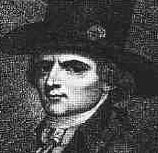 French political agitator; plotted unsuccessfully to destroy the Directory in revolutionary France and establish a communistic system.
See also: Babeuf Archive
Biography of Babeuf by E Belfort Bax.
Bablikov A. A. (1875- )
Engineer. Member 4th Duma. After February 1917 on Provisional Committee of State Duma. Member of Petrograd Soviet. Participated in State Conference at Moscow.
Bachmann, Otto (1887–) .
Building worker trade-union secretary in Breslau in 1908, chairman in Chemnitz during 1919–21, founding member of KPD (Kommunistischen Partei Deutschlands/German Communist Party) . Expelled from trade-union and became secretary of ‘red trade union’, put in charge of builders’ section of Zentrale’s trade-union department. Chairman of union of stonemasons expelled from ADGB from September 1923. After 1926, was a leader of red unions; in 1927, was first Communist mayor in Germany, at Ölsnitz. Expelled in 1929 as rightist. Continued to support Brandler, active in KPO. Emigrated in 1933, and probably died in exile.
Bacon, Francis (1561 - 1626)
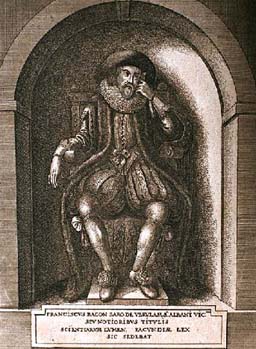 English philosopher, founder of materialism and experimental science in modern times; saw task of science as to increase the power of humanity over Nature, and that this could be achieved only by revealing the "true causes" of things; promoted scepticism in relation to all previous learning, cleansing the mind of all preconceptions and "Idols", to rationally re-interpret the facts of experience by methodical generalisation - "induction", particularly including the analysis of experimental activity, and attention to "negative instances".
Bacon wrote the Phenomena of the Universe Or Natural History for the Building Up of Philosophy when he was 48. For most of his life, Queen Elizabeth I was Queen of England, a period of expansion of British trade and influence. Sir Francis Drake circumnavigated the globe in 1580, when Bacon was 19. The Italian Giordano Bruno, had further developed the Copernican system of the heavens (which replaced the Earth as the centre of the Universe with a heliocontric system), proposing an infinity of worlds and removing the Sun from the centre of the Universe. In 1600, when Bacon was 39, Bruno was burnt at the stake by the Roman Inquisition for his heresy. Shortly before Bacon's death Charles I ascended the throne.
Bacon's New Atlantis, written in 1617, foresaw a utopia in which people flourished on the basis of rational learning and advanced technology. New Atlantis was no "classless society" but a bourgeois republic. In 1640, Oliver Cromwell lead the English Revolution, for the first time in history beheading the King and replacing the monarchy with a bourgeois republic.
Bacon was a contemporary of Galileo Galilei (1564 - 1642) though Galileo's principal work, Dialogo dei due sistemi dei mondo, was not completed until after Bacon's death. Galileo was forced to recant.
In Bacon's time, there could not be said to exist anything which could be called natural science. What we have today began with the work of Galileo and Bacon. In Bacon's time, it would have been impossible for someone with a scientific disposition to distinguish between fact and fiction - religious dogma, travellers' yarns, superstition, the untested and unsubstantiated wisdom of the ancients, the practice of farmers and artisans handed down from father to son and mother to daughter. Only mathematics and, thanks to Galileo, the infant science of mechanics, could lay any claim to demonstrable verity.
The advantage Bacon had over his fellow-philosophers on the Continent, was that while war and the inquisition ravaged Europe, England was relatively (relatively!) united, prosperous and liberal and it was possible for Bacon to write as he did without winding up on the rack or the stake. In fact, Bacon had at one time spent 4 days in the Tower of London, not for his radical views, but for accepting bribes in his job as Lord Chancellor!
Bachofen, Johann (1815-1887)
Swiss historian and attorney.
Bagchi, Amal
Joined Bolshevik Leninist Party of India in Bengal. Led several unions in late 1940s and 1950s: General Secretary, Bengal Paper Mill Mazdoor Union, 1940s-1950s, Raniganj. Working Secretary, Paper Mills Employees Union, Titagarh and Kankimara. Secretary, Titagarh Jute Workers Union.
Compiled by Charles Wesley Ervin
Bakayev, Ivan (1887-1936)
Bolshevik before the revolution, head of the GPU in Leningrad and a supporter of Zinoviev. Bakayev was expelled from the party in 1927 for his political views but renounced them and was allowed back into the party. He was accused of treason in the first Moscow trial (1936) and was executed.
Bakunin, Michael (1814-76)
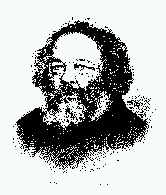 Russian revolutionary. One of the founders of anarchism. In the 1830s Bakunin was a Young Hegelian. In 1848 he took part in the German revolution (the rising in Dresden). He was arrested (1849), and eventually handed over to the Russian government and sentenced to life imprisonment. After the death of the Tsar Nicholas I, Bakunin was exiled to Siberia (1857). In 1861 he escaped exile and went to London.
Bakunin became a member of the League of Peace and Freedom. At the Berne Congress of this League (1868) he and his supporters (E. Reclus, Aristide Rey, Jaclard, Fanelli, N. Joukovsky, V. Mratchkovsky and others) were in a minority, and seceded from the League and established their own International Alliance of Socialist Democracy. In 1869 this Alliance became affiliated to the International. In the International Bakunin was an opponent of Marx. (Further Reading: the Marx/Engels conflict with Bakunin) In Ludwig Feuerbach and the End of Classical German Philosophy Engels wrote that Bakunin combined Stirner with Proudhon and christened this combination "anarchism."
Further Reading: Bakunin Reference Archive: Biography for more information.
Bakhnietiev, Boris Alexander (1880-1951)
Engineer, member War Industries Committee 1914-15. Deputy Minister Trade & Commerce under Lvov. Ambassador to Washington 1917. Lived after October in the USA.
Balabanoff, Angelica (1878-1965)
Born in the Ukraine, Balabanoff was exposed to radical ideas while a university student in Brussels. She settled in Rome and began organizing immigrant laborers in the textile industry. Later, she became a leader of the Italian Socialist Party and then the Italian Social Democrats.
Balabanoff continued to stay closely in touch with the Russian revolutionary movement and served on the executive committee of the Union of Women Socialists and worked with Clara Zetin on women's congresses. Soon after the Bolshevik triumph, Balabanoff returned to Russia where she served as secretary to the International in 1919. She later became a critic of Bolshevism and returned to Italy, but the rise of fascism led her to exile in Switzerland, where she edited the Paris Avanti! in 1928. She continued to be involved in socialist activities internationally until her health began to fail in 1964. None of her writings have yet been transcribed for MIA. For a review of her autobiography by Max Shachtman, see his article in the New International.
See Angelica Balabanoff Archive
Balaram, G.
Joined MLU as typist. Became strong follower of SCC Anthony Pillai. Member, MLU Strike Committee, 1947; arrested during the strike. Entered SP with the Bolshevik Leninist Party of India, 1948. When SP merged with KMPP, remained with SP (Loyalists). Joined SP (Lohia) with rest of S.C.C. Anthony Pillai’s group. General Secretary, Transport and Dock Workers Union, Madras. Contested Madhavaram Constituency, Madras Legislative Assembly, on Socialist Labour ticket, 1962 (unsuccessful).
Compiled by Charles Wesley Ervin
Balasingham, V. (ca. 1919– 1943)
Party pseudonym: Peter.
Nickname: “Bala”
Born Jaffna, Ceylon, son of a government civil servant, elder brother of V. Karalasingham (see Biographical Note). Educated St. Benedict’s College, Kotahena (Colombo) and Ceylon University College. Studied philosophy and Marxist economics. Employed as a lecturer. Joined Lanka Sama Samaja Party, 1935 or 1936. Sent to work with the All-Ceylon Estate Workers Union in Kandy, 1939. Led strikes on several plantations in the Central Province, late 1939, and played a role in the famous Mooloya Estate strike, January 1940. Organized a Trotskyist circle in Madurai, 1941-42. Developed important connections with radical Congressmen. Arrested, July 1941, and jailed for three months before being deported. Worked at the underground party headquarters in Colombo. Struck by a military lorry while walking on Turret Road (now Dharmapala Mawatha) in Colombo and killed, February 25, 1943.
Balasubramaniam, V. (ca. 1919– 1943)
Born Bodinayakkanur (Theni District, Tamil Nadu). Joined Students’ Congress during WWII and supported the Congress Socialist Party. Recruited to Trotskyism by B.M.K. Ramaswamy and his brother, K. Shanmuganathan, late 1945. Platform speaker in Tamil for Bolshevik Leninist Party of India in Bodinayakkanur area.. Joined Socialist Party with BLPI, 1948. Became a teacher, 1950. Remained life-long supporter of the Trotskyist movement. Author: October Puratzhi: Trotsky [October Revolution: Trotsky] (1991). Re-established contact with the Fourth International in 1991. Elected Secretary of the Tamil Nadu Organizing Committee for re-launching the BLPI. Editor, Tamil-language bulletin of the Organizing Committee. Resides in Sillaimanathupatti (Theni District), Tamil Nadu.
Compiled by Charles Wesley Ervin
Baldwin, Stanley (1867-1947)
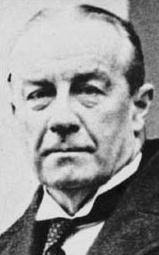 Tory Prime Minister at time of the General Strike. Educated at Harrow and Cambridge university; he became vice-chairman of his family iron and steel business and a Conservative MP in 1906. President of Board of Trade, 1921-22; Chancellor of the Exchequer, 1922-23. In 1923 unexpectedly succeeded Bonar Law as Prime Minister and Tory leader but soon called an election which he lost. Prime Minister again 1925-29 and as such formulated the Tory policy of preparing a decisive confrontation with the working class movement after a strategic retreat on 'Red Friday' in July 1925. In the 1926 General Strike Baldwin took the TUC leaders to the brink and then relied on their cowardice to sell out the miners, who were starved back to work. Later a member of the National Government' set up by the Tories and a rump of right-wing Labour leaders in 1931. Prime Minister once again 1935-37 in succession to MacDonald. His policy of intervention in Spain in this period was agreed with French Foreign Minister Laval and helped Franco to come to power.
Balfour, Arthur James (1848-1930)
Of Scottish aristocratic origin; educated at Eton and Cambridge, entering parliament as a Tory MP in 1874. Secretary to Lord Salisbury (his uncle) in 1878 and served in his government until becoming Prime Minister, 1902-06. Resigned the Tory leadership in 1911 but became Foreign Secretary in Lloyd George's War Cabinet, 1916-19. Made an earl in 1922; and was a member of Baldwin's 1925 cabinet.
Bamberger, Ludwig [Louis] (1823-1899)
German newspaper editor. Partcipant in the Baden-Palatinate uprising of 1849. Became a liberal.
Bamberger, Simon
Father of Louis Bamberger. English banker.
Banerjee, Bimalpratibha (Devi)
Born in Burnpur (Burdwan District). Joined the terrorist movement in Bengal as a youth. Associated with the Jugantar party. Organized a dacoity in 1931 in Maniktala (Calcutta) to raise funds for the imprisoned revolutionaries of the Chittagong Armoury Raid. She was arrested during the getaway, tried in Alipore Judges’ Court, acquitted, but immediately rearrested, imprisoned for six years, and put under house arrest until 1938. Elected President of the Bengal Congress. Later became a Trotskyist and joined the Bolshevik Leninist Party of India after the war. She mentored Robin Sen and other BLPI mass workers who built the BLPI trade union base in Raniganj, another important industrial town in Asansol subdivision, not far from her home in Burnpur. She died in penury.
Compiled by Charles Wesley Ervin
Banerjee, Dhiren (1925-97)
Joined RCPI in Calcutta; expelled for Trotskyism. Joined Bolshevik Leninist Party of India. Worked as a teacher. Active in All-Bengal Teachers Association after independence. Joined Socialist Party (Lohia) in the ‘fifties. Settled in Dalmianagar, Bihar. Associated with Bengali journal Utsa Manush [Humanity as the Source], established in 1980 to promote rational humanism. Joined Narmada Bachao Andolan, a movement launched in 1989 to stop the construction of the Sardar Sarovar Dam on the Narmada River. Joined the Pakistan-India Forum for Peace and Democracy, formed in 1994. Chairman, West Bengal Committee of the Pak-India Forum until his death in Deli.
Compiled by Charles Wesley Ervin
Banerjee, Kamalesh Chandra (1910– 1967)
Party pseudonyms: Chatterjee, Mahmoud, and Hakim Mirza. Pseudonyms in International Secretariat of Fourth International: Bernard, Mahmoud, and Ali.
Born in Bengal, son of a Bengali father and Irish mother. Schooled in Calcutta. Joined the Civil Disobedience campaign, 1930-32. Jailed for 6 months. Joined the Students’ Radical Party. Recruited to Trotskyism by Ajit Roy-Mukherjee, 1937-38. Founder, Revolutionary Socialist League of Bengal, 1940. Founding leader, Bolshevik Leninist Party of India. Jailed 1942-45. Sent to Paris, 1947, as BLPI representative to Fourth International. Worked in Paris as Foreign correspondent, Amrita Bazaar Patrika . Member, International Secretariat of Fourth International, 1947. Attended Second World Congress of the Fourth International, 1948. Visited Yugoslavia and interviewed Tito and other leaders of the Yugoslav CP, February, 1950. Sent back to India to help regroup the Trotskyists in the Socialist Party, 1950-51. Sided with Michel Pablo in split in IS, 1953. Became estranged from the Fourth International leadership. Companion to Margarete Buber-Neumann (1901-89). Returned to India, 1967.
Compiled by Charles Wesley Ervin
Baracchi, Guido (1887-1975)
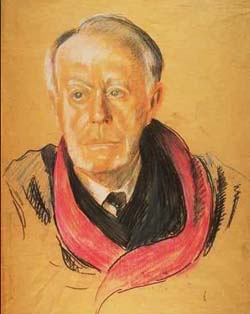 Born in 1887, the son of Italian nobleman who was the Victorian government astronomer, Guido Baracchi became a socialist while visiting Europe shortly before World War I, under the influence of guild socialists.
On returning to Melbourne he began working closely with Percy Laidler of the Victorian Socialist Party, and with Andrade's bookshop, the main distributor of Marxist literature in Melbourne, was a founder of the Victorian Labor College. He was jailed for opposition to conscription in 1918.
He joined the International Industrial Workers, the name of the IWW in Victoria at that time, and edited its paper, Industrial Solidarity, until 1920. Beginning in June 1920, with Laidler as publisher, he edited The Proletarian Review for a year until returning to Europe. The Proletarian was a magazine that was later to become the theoretical journal of the Communist Party. He was a founding member of the CPA and set up its Victorian branch in November 1920.
He visited Europe again in 1921, where he joined the German Communist Party and became editor of Inprecor, the English-language magazine of the Comintern. In 1924 he visited Britain and joined the British Communist Party.
On returning to Australia in 1925, he advocated with Bill Earsman, a propagandist perspective for the CPA which had become isolated from the working class; for this he was expelled. He left Australia again, and joined the German CP in 1935. In 1939, back in Australia, Baracchi spoke out against the Stalin-Hitler Pact. The young Eric Aarons, who was to lead the Party to its liquidation 50 years later, was secretary of the Sydney University Branch at the time and delivered him a letter saying the Branch had decided his services were no longer required as tutor of the Branch class. The last remaining founding member of the CPA, Baracchi was soon expelled and joined the Trotskyists later in 1939.
Guido Baracchi died on December 13, 1975, when he collapsed after working for the Labor Party on a polling booth on election day.
Barbès, Armand (1809-1870)
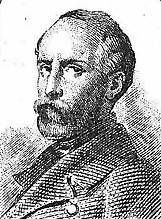
Born in Guadeloupe, Armand Barbès began his revolutionary activities as a young man, serving in a National Guard battalion during the revolution of 1830. As a member of the Société des Droits de l’Homme he was arrested in 1834 following demonstrations in support of a workers uprising in Lyon, and was freed a year later.
After the breaking up of the Société des Droits de l’Homme he, along with Louis-Auguste Blanqui formed the Société des Familles, and was arrested in 1836 when caught with ammunition in his apartment. Released after a year in prison, he and Blanqui formed the Société des Saisons, and in 1839 they led an armed insurrection that was briefly able to hold city hall and the Palais de Justice. Wounded in the attempt, Barbès was arrested and sentenced to death, but his sentence was commuted to life imprisonment.
The failure of the 1839 uprising led to a break between Blanqui and Barbès, and in 1848 – when Barbès was released from prison – the two men led rival groups during that revolution.
Barbès was elected to the Constituent Assembly, but was arrested again when he participated in the May 15 demonstration that called for a more revolutionary republic.
Released from prison in 1854, he lived his final years in self-imposed exile in Holland.
Barbusse, Henri (1873-1935)
Pacifist novelist who joined the French Communist Party, authored biographies of both Joesph Stalin and Jesus Christ. Sponsor of anti-war and anti-fascist congresses.
Barta (David Korner) (1914-1976)
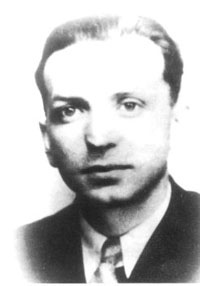 Trotskyist militant, born in Romania, he participated in the creation of one of the first Trotskyist groups in his country.
Living in France from 1936, he was active in the Parti Ouvrier Internationaliste (POI), the official section of the Fourth International in France, then until 1939 in the trotskyist group in the Parti Ouvrier Socialiste et Paysan (PSOP). The PSOP was created the year before by the “Gauche Révolutionnaire” (Revolutionary Left) tendency of Marceau Pivert, following its expulsion from the Socialist Party (SFIO).
After the collapse of PSOP at the beginning of the war, Barta founded on strictly internationalists positions the “Groupe Communiste (IVème Internationale), later renamed “Union Communiste (Trotskyste).”
By april 1947, this group led an important strike in Renault, which resulted in the expulsion of the Communist Party from the government, when it failed to control it.
The Communist Union disappeared at the end of 1949 after having suffered a split and Barta stops its political activities in 1951.
The “Voix Ouvrière” group, (renamed “Lutte Ouvrière” in 1968), claims since its creation (1956) to stand in the continuity of the UC(T), although, in spite of several attempts, no durable relationships with Barta were reestablished.
Barth, Emil (1879–1941) .
Metalworker and Social Democrat. Discharged from army in 1917. Member of USPD. Replaced Richard Müller at head of group of revolutionary delegates after strike in January 1918. Member of Executive of Councils, People’s Commissar in November–December 1918, disowned by his comrades. Chairman of Factory Councils in 1921. Remained in USPD in 1920, returned to SPD (Sozialistische Partei Deutschlands, Social-Democratic Party) in 1922. Then returned to anonymity.
Barthes, Roland (1915 - 1980)
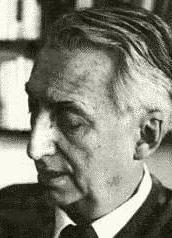 French academic and literary critic whose writings on semiotics, pioneered by Ferdinand de Saussure and Roman Jakobson, helped establish structuralism and was a central figure in the development of the leaders of recent French philosophy, such as Foucault and Derrida.
After graduating from the University of Paris in classics, grammar and philology in 1943, Barthes later worked at the Centre National de la Recherche Scientifique, and in 1976 became the first person to hold the chair of literary semiology at the Collège de France.
Further developing Saussure's conception of the arbitrariness of speech-sounds in relation to their meaning, Barthes examined the arbitrariness of the linguistic forms more generally and in his 1964 The Eiffel Tower and Other Mythologies he applied the same approach to the hidden assumptions behind popular culture.
In Elements of Semiology, Barthes proposed the inversion of Saussure's thesis that the study of language would be a part of a larger science of semiology, asserting instead that “it is semiology which is a part of linguistics”. At the same time he analysed literature as a sequence of signs, the meaning of which bears no relation to the intention of the author, but rather is a free construction of the reader.
By the 1970s, Barthes' theories had become extremely influential not only in France but throughout Europe and the U.S. Other leading French thinkers associated with Barthes include the psychoanalyst Jacques Lacan, social theorist Michel Foucault, and philosopher Jacques Derrida. Barthes' later works added to his fame as a literary critic, a reputation as a novelist with an "anti-autobiography," Roland Barthes by Roland Barthes (1975), and his 1977 A Lover's Discourse. Barthes died in a car accident in 1980. His posthumous writings include Susan Sontag's A Barthes Reader published in 1982.
Bartz, Wilhelm (1881–1929) .
Printer, joined union and SPD (Sozialistische Partei Deutschlands, Social-Democratic Party) in 1900; attended Party School in 1910–11; full-time Party worker and journalist. Joined USPD in 1919. Joined VKDP (Vereinigte Kommunistische Partei Deutschlands/United Communist Party of Germany) in 1920. Protested against March Action, but did not follow Levi or Friesland. Worked on Inprekorr in 1921, joint chairman of KPD (Kommunistischen Partei Deutschlands/German Communist Party) parliamentary fraction in Reichstag in 1922. Member of Left in 1923. Joined centre tendency in 1925.
Bastelica, Andre (1845-1884)
Followed Bakunin. French printer.
Bauer, Bruno (1809-1882)
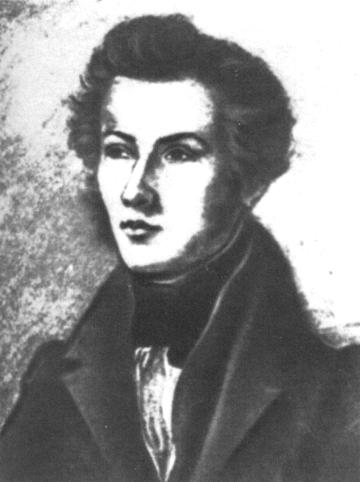 Prominent Young Hegelian philosopher, who was acquainted with the young Karl Marx in his student days in Berlin. Author of a number of books on the history of Christianity. The target of Marx's criticism in Chapter Two of the German Ideology.
Bauer, Edgar (1820-1886)
German journalist. Younger brother of Bruno Bauer.
Bauer, Otto (1881-1938)
 The most prominent leader of the Austrian Social-Democratic Party. Prior to the war of 1914-18 Bauer was the secretary of the parliamentary fraction of the Austrian party. Author of a number of books on the national and colonial questions. During the First World War Bauer held a centrist position. In 1919 he became Minister of Foreign Affairs in the coalition government set up after the overthrow of the Hapsburgs. Together with Friedrich Adler and others, Bauer participated both in creating the 2½ International and in fusing it with the Second International in 1923. Major theoretician of Austro-Marxism.
Bax, Ernest Belfort (23.7.1854-26.11.1925)
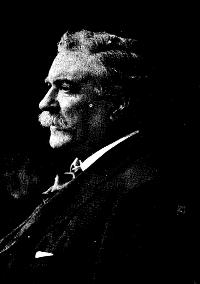 Bax was born at Leamington of wealthy non-Conformist parents, became a barrister and was an important propagandist and historian. He is important as the first source through which many of the Marxist and materialist ideas of history were disseminated through the English speaking world. Marx noted his efforts with approval in a letter to Sorge. He studied music at the Stuttgart Conservatoire (his nephew was Arnold Bax the composer) and he had been a music critic with Bernard Shaw, whom he knew well and is named as a philosopher by Shaw in the prologue to Major Barbara. He took part in the foundation of the Social Democratic Federation and collaborated in its organ, Justice, and in the monthly, To-Day, which he first tried to run independently but, owing to lack of funds, had to make over to Hyndman in 1884. He broke with Hyndman at the end of 1884 and together with Morris and Eleanor Marx-Aveling, etc, helped to form the Socialist League, which, however, later fell under anarchist influence. He went back to the SDF in 1889 and stayed with Hyndman thereafter. After the death of Morris his increasingly eccentric views about feminism came to the fore though he had a high opinion of “Fraulein Luxemburg” as appears in a polemic with Bernstein in Justice in 1896 on the Colonial question where he had an excellent position. Finally, during the First World War he went over to chauvinist positions seeing the main threat to his rather romanticised Republican France in the anti-democratic and aristocratic Junkers of Germany. He mourned Karl Liebknecht and denounced Noske and Scheidmann as reactionaries in his autobiography (1918) and his memorial biography was written by “Robert Arch” Archibald Harold Mann Robertson, a member of Hyndman’s surviving but tiny rump organisation.
He married twice and had seven children by his first wife, none by his second. There are today a number of his descendants.
Further reading on Bax
Reminiscences and Reflexions of a Mid and late Victorian, Belfort Bax, Allen and Unwin, 1918, reprinted by Kelley (New York 1967) autobiography
An obituary in the Times (21.11.1926)
Robert Arch, EB Bax, Thinker and Pioneer, (1927)) Hyndman Literary Committee, Hyndman Club and Institute, 54 Colebroke Row, N1, [24 p.]
The Victorian Encounter with Marx: a study of Ernest Belfort Bax, John Cowley London: British Academic Press, 1992, with a bibliography.
Marxism and Social Democracy, The Revisionist Debate, 1896-1898 Edited by Henry Tudor, J. M. Tudor, CUP, July 1988,400 pp. | ISBN: 0521340497
Entry by Phillip E. Koerper in Biographical Dictionary of Modern British Radicals, 1988, Harvester-Wheatsheaf.
A much more useful entry in The Dictionary of Labour Biography Vol X, 2000
See Ernest Belfort Bax Archive
Ted Crawford
Bazarov, Vladimir Aleksandrovich (1874-1939)
Born Vladimir Aleksandrovich Rudnev, Russian Marxist economist, philosopher, publicist and political activist. Son of zemstvo doctor, joined revolutionary movement as student in 1895, became Marxist in 1896. Closely associated with A A Bogdanov (Malinovsky, 1873-1928); Bazarov and Bogdnaov organised social-democratic workers’ circles in Tula and elsewhere from 1890s onwards. Joined the Bolsheviks with Bogdanov and A V Lunacharsky 1904, active in St Petersburg in 1905 revolution. Wrote in legal and clandestine social-democratic and Bolshevik press. From 1904 developed empiriocritical philosophy with Bogdanov, Lunacharsky, A M Gor'ky (Peshkov) and others. Criticism by V I Lenin in 1908 marked end of Bazarov’s connection with Lenin, but not with Bolshevik faction. Translated Marx’s Kapital with I I Skvortsov-Stepanov (3 volumes published 1907-1909, still regarded as standard Russian translation).
Internationalist during WW1, Bazarov contributed to Gor'ky’s journal Letopis’ 1915-1917. Involved with Petrograd Soviet and its paper Izvestiya from the outset, he attended first meetings of St Petersburg Bolshevik committee after February 1917, then finally broke with Bolshevism. Closely associated with Gor'ky, N N Sukhanov (Gimmer), B V Avilov (Tigrov) on social-democratic newspaper Novaya zhizn’ April 1917-July 1918. Its position was close to Yu O Martov and the Menshevik-Internationalists, and advocated overcoming divisions in Russian social-democracy on common internationalist platform. Bazarov was among founders of United S-D Internationalists (later RSDRP(i)) in summer 1917.
Opposed Bolshevik takeover in October 1917, advocated unified socialist government and convocation of Constituent Assembly. During civil war took position close to Martov but never joined Mensheviks. Recruited to work in Gosplan from 1921. Worked closely with V G Groman and S G Strumilin on devising methodology for creating a single economic plan.
Out of favour with the Stalin leadership after 1928, Bazarov was arrested in 1930 with Groman, Sukhanov and others in preparation for “Menshevik” show trial of 1931. He refused to admit guilt; did not appear in dock. Imprisoned for 18 months, then in internal exile, allowed back to Moscow 1935. Died at home, of natural causes, 1939.
Bazarov’s work from the 1920s on planning theory and methodology is probably his most original and significant contribution to Marxist thought. It deals both theoretically and practically with the most fundamental question of socialist political economy — how to ensure the economic victory of socialism over capitalism. The work was published as a series of articles in the journals Planovoe khozyaystvo and Ekonomicheskoe obozrenie, as well as a book from 1927 on Capitalist Cycles and the Economic Restoration Process in the USSR.
See What is Needed for Socialism, December 1917.