Cr
Crane Walter (1845-1915)
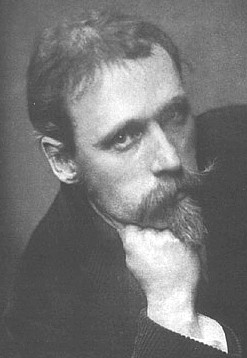 Walter Crane was born in Liverpool in 1845. Apprenticed as a youth to an engraver, he developed his artistic talents, especially strong in illustration and design. His employer was the former Chartist, William Linton, who introduced him to political ideas and also got him commissions with influential political figures. Crane became established as a ceramic designer, children's book illustrator and interior designer.
In the 1860s Crane became more politically active as a supporter of the radical wing of the Liberal Party and by the time of the Paris Commune in 1871, he was a socialist. He began long-time collaboration with William Morris in the 1880s, having common ground as designers and both appalled by industrial design over craftsmanship and artistry that was articulated in Morris's pamphlet Art and Socialism.
Crane and Morris joined the Social Democratic Federation in 1884 and he frequently contributed illustrations for the party journal Justice. After less than a year, disillusionment with the leadership of H. Hyndman left the SDF and joined the Socialist League formed by Eleanor Marx and Edward Aveling, Morris, Belford Bax, where he drew illustrations for party's journal, Commonweal. In 1888 Crane, Morris and others founded the Art and Crafts Exhibition Society, in order to promote contemporary arts and handicrafts.
Crane's belief that socialism could be achieved through reforms led him to also join the Fabians for a time, where he associated with George Bernard Shaw and the Webbs, but broke with them later their decision not to oppose the Boer War. He continued to collaborate with Morris and others to produce art for the movement including events like Bloody Sunday in 1887, and also a series of illustrations depicting heroic deeds done by working-class people. It was during this time that he published his widely-read book, The Claims of Decorative Art, where he claimed that an unjust labor system inhibited the function and beauty of art.
In the 1890s' Crane drew his now famous May Day illustrations published in the collection, Cartoons for the Cause, as well as banners, posters, and pamphlets that could be seen throughout Europe. He published two books of lectures from his teaching, The Bases of Design in 1898 and Line and Form two years later, as well as providing illustrations for many socialist journals. Crane died in 1915, shortly after the shocking accidental death of his wife.
Further Reading:
Visual Arts: Satire: Walter Crane
The Donkey and the Common: A Fable
William Morris Internet Archive
Crawfurd, Helen (1877-1954)
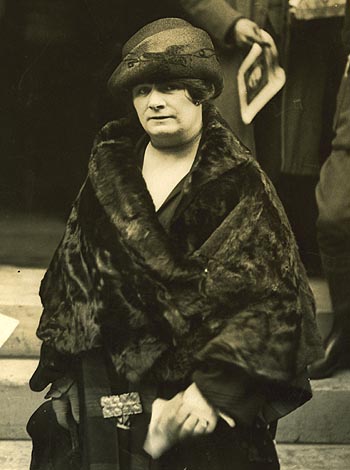 Helen Crawfurd was a prominent suffragette, originally a member of the Independent Labour Party, and was one of the leaders of the rent strikes of 1915. As leader of the Women’s Peace Crusade of 1916-17, Helen Crawfurd was also a vociferous anti-war and anti-conscription campaigner.
Helen Crawfurd-Anderson was born on November 9th 1877, in the Gorbals District of Glasgow, the daughter of a master baker. He was President of the Operative Bakers’ Association, a Conservative Party member and a Presbyterian. Helen had two sisters and three brothers. Her parents moved to Ipswich, in Suffolk, England during her childhood.
In the Docklands, she began to listen to the Socialist propagandists at open-air meetings, was impressed by their arguments, and soon entered the suffragette movement, feeling “that if the Mothers of the race had some say, then things would be changed.” Thus began a lifetime of devoted service to the working class movement. From around 1900, she joined the WSPU and became an outstanding fighter for the right of British women to vote. She was sent to prison three times for her activities in the suffragette movement, and spent a month in Holloway Prison in 1912 for breaking windows and was imprisoned for one month for making inflammatory comments in Perth but released after a five day hunger strike). She was also conditionally released from prison in Glasgow’s Duke Street Prison from a one month sentence for smashing windows of the army recruiting offices, only after an eight-day hunger strike. After her release a bomb exploded at Glasgow’s Botanic Gardens and Helen was implicated and was sent back to prison, only to be released after another hunger strike.
She took a fearless stand in opposition to the Imperialist War of 1914-18. In June 1916, she initiated, and became Secretary of the Women’s Peace Crusade. Also involved were her good friends Mary Barbour and Agnes Dollan. She was twice arrested for her anti-war work, appearing in the dock with William Gallacher and other Socialist leaders. Helen was also active with Mary Barbour, Agnes Dollan, Jessie Stephens and other women in the Glasgow rent strikes against profiteering Landlords that resulted in the ‘Rent Restriction Act’ of 1915.
She was a member of the British delegation to the Conference of the Women’s International League at Zurich in 1919. This delegation included all the foremost women representatives of the British working class movement of that time—Mrs. Snowden, Madame Despard, Ellen Wilkinson, Mrs. Pethick- Lawrence and others. This delegation chose Helen Crawfurd Anderson to make the report to the Conference on their behalf.
During the 1914-18 war she had joined the Independent Labour Party, and became Vice-President of that organisation in 1918, and one of its principal propagandists, travelling throughout Scotland and many other parts of Britain to address meetings. She became disillusioned with the ILP and in 1920 established an unofficial grouping within the ILP, known as ‘Left Wing Committee’, with a journal the International. This grouping, which included Emile Burns, R. Palme Dutt, E. H. Brown, Shapurji Saklatvala, J. R. Wilson and J. Walton Newbold, joined the Communist Party.
She had welcomed the victory of the Russian Revolution in 1917, and visited Russia in 1920, as an ILP delegate to the second congress of the Third International. There she had an interview with Lenin, which was to help chart the future course of her participation in the movement. To the end of her life she was filled with unbounded admiration for the Bolsheviks.
On her return from Russia in 1920 she became Secretary (in 1921) of the Workers International Relief Organisation (WIR). She raised money for the famine-stricken people of the Volga region and carried out relief work in Germany, addressing a meeting of 10,000 in Berlin in 1924 on behalf of the German Communist Party (KPD) and in all the mining districts of Britain during the lockout, which followed the General Strike of 1926. She succeeded in extending the relief work to the famine-stricken West of Ireland and to the Scottish Highlands during periods of depression.
In 1921 she joined the newly-formed Communist Party, becoming a central committee member, setting up the Women’s Department of the Communist Party in January 1922 and editing the women’s page of Communist, the Party’s journal. Helen Crawfurd, in her Communist Party election address for the Govan ward, Glasgow City Council in 1921, stressed her commitment to improving the political and economic status of women. This is one of the earliest examples of a political candidate in Britain making gender into a political issue.
On the eve of the Second World War in 1939, she organised a Peace Congress of representatives from countries with the British Empire.
She was to remain an illustrious member of the Communist Party right to the end of her life. Helen Crawfurd Anderson died on 18th April 1954, in her 77th year. Sadly, her autobiography remains unpublished.
by Graham Stevenson
Cremer, W. R. (1838-1908)
Joiner. First secretary of the General Council of the International. Cremer was an active member of the strike committee in the first great London building trades' strike, July 1859 to February 1860. (For Marx's reference to this strike see Capital, Vol. I, Chpt. 10: The Working Day, and for his reference to the London building industry, Vol. II, Chpt. 12 The Working Period.) Original member of first London Trades Council (1860) and a founder of the Amalgamated Society of Carpenters and Joiners (1860), the second great trade union founded on the "new model." At the first Congress of the International (Geneva, September 1866), which voted for the abolition of standing armies and the general arming of the people, he took a pacifist line. After the Congress he failed, to his great surprise and disgust, to secure re-election as secretary (See Marx to Engels, September 26, 1866); he resigned from the Council and was not re-elected at the 1867 Congress. Identified himself with various pacifist organisations (secretary of the "Workmen's Peace Association"). He was knighted – Sir Randall Cremer – and in 1903 received the Nobel Peace Prize.
Creutzburg, August (1892–1940?) .
Painter and lacquer worker, member of SPD (Sozialistische Partei Deutschlands, Social-Democratic Party) in 1908. In army during 1912–18. Joined USPD in 1917 and VKDP (Vereinigte Kommunistische Partei Deutschlands/United Communist Party of Germany) in 1920, secretary in Jena. KPD (Kommunistischen Partei Deutschlands/German Communist Party) leader in Magdeburg district in 1923. A real ‘commissar’ of the KPD leadership, played important role in expelling each successive opposition. Leading figure in apparatus from 1929. Emigrated in 1933 and reached USSR in 1935, arrested in 1937, and said to be one of the prisoners whom Stalin handed over to Hitler.
Crispien, Artur (1875–1946) .
Painter and decorator, Social Democrat, became journalist. Joined Die Internationale group on its foundation; arrested in 1915 and put in army. Joined centrist opposition during its formation and became USPD leader when it was founded. People’s Commissar in November– December 1918. Leader of USPD Right, stayed with it despite vote at Halle, returned to SPD (Sozialistische Partei Deutschlands, Social-Democratic Party) with it in 1922. Emigrated to Switzerland in 1933, died there without returning to Germany.
Croce, Benedetto (1866-1952)
 Italian critic, philosopher, politician, historian.
Croce was born in Pescasseroli, Abruzzi, into a moderately wealthy land-owning family and was educated at a Catholic boarding school. In 1883 Croce lost his family in an earthquake and he went to live with his uncle in Rome and studied law at the university, but left without taking a degree and returned to Naples.
He traveled through Spain, Germany, France, and England. In 1893, influenced by the ideas of Gianbattista Vico and Giovanni Gentile, he turned to philosophy. His famous commentary on Hegel, What is Living and What is Dead in the Philosophy of Hegel, appeared in 1907.
Together with Antonio Labriola (1843-1904) and Georges Sorel (1847-1922), Croce introduced the study of Marxism to Italy. Croce regarded Marxism as deterministic, and leaned towards art rather than science as the central focus for his understanding of history. In 1903 he founded the magazine La Critica with Gentile, but when Gentile signed the ‘Manifesto of Fascist Intellectuals,’ in the 1920s, Croce denounced the paper. In 1910 he was made senator for life and in 1920-21 he was Minister of Public Instruction and planned school reform. Under Mussolini, Croce supported democratic principles, living in isolation as one of the major anti-fascist thinkers in Italy. After the war he was made a Minister without Portofilio.
Cromer, Evelyn Baring (Lord Cromer) (1847-1917)
Colonial administrator from a banking family who had also served as an artillery officer. He was installed as the effective governor of Egypt (the British 'Agent') by British forces in 1883 and remaining until 1907. He consolidated British economic and political control of Egypt and developed it as a strategic military base for operations against Sudan and later Turkey.
Cromwell, Oliver (1599-1658)
 Puritan revolutionary of the English civil war of the 1640s. Defeated the Royalists of Charles I (and decapitating same) and established the English parliamentary system on stronger ground than any previous generation. While seeking to expand English trade and further develop English capitalism, under the guise of being opposed to the Roman Catholic Church he launched vicious wars of domination against mostly Roman Catholic Ireland, murdering thousands of Irish and establishing oppressive English colonial rule there.