The documentary record of the New Communist Movement in the 1970’s presents a rich tapestry of groups, collectives, organizations, “pre-party formations”, and even parties, struggling to master the Marxist-Leninist tradition as they interpreted it and apply it to the conditions of their work.
Many of these groups were local collectives which arose out of the mass struggles of the 1960’s and subsequently turned to Marxism-Leninism in the 1970’s as these mass movements began to ebb. Some of these groups managed to develop strong ties in the workplaces and communities in which they worked and had a significant public presence. Others operated in a semi-clandestine fashion, through union caucuses and/or as fractions in “mass organizations.”
Some of these New Communist Movement groups were overwhelmingly white; others, however, were composed predominantly of people of color, such as the Revolutionary Workers League, the August 29th Movement, Wei Min She, El Comité, the Japan Town Collective and I Wor Kuen.
While aware of the developing party-building projects of the Communist League, Revolutionary Union and October League (documented in subsequent sections of EROL), the vast majority of these smaller groups chose not to join in any of them. The larger organizations may have decried what they perceived as the “local-circle mentality” of these smaller groups, but they were unsuccessful in overcoming it.
Documenting the history of the smaller anti-revisionist groups in the New Communist Movement in this period is particularly challenging because many of them focused on local organizing and eschewed involvement in national debates about party-building, the national question, the united front, etc.; produced little printed material; or otherwise chose to keep a low public profile.
Family Tree Chart of U.S. Anti-Revisionism, 1956-1977 by the Communist Workers Group (Marxist-Leninist)
People’s Voice, Vol. 1, No. 5, November 1972
People’s Voice, Vol. 1, No. 8, October 1973
Workers With No Names. Illegal Aliens in the U.S.
Uncommon Sense Vol. 1, No. 2, February 1980
[Back to top]
History of the Amilcar Cabral/Paul Robeson Collective
Organizing for Afro-American Liberation and Socialism
The Greensboro Massacre: Critical Lessons for the 1980’s by the Amilcar Cabral/Paul Robeson Collective and the Greensboro Collective
In Defense of the Right of Political Succession for the Afro-American Nation. Papers and Resolutions from the School on the Afro-American National Question, September 1982 by the Revolutionary Political Organization (M-L), Amilcar Cabral/Paul Robeson Collective and with the participation of the Red Dawn Collective
Amilcar Cabral/Paul Robeson Collective Study Guide on the Afro-American National Question, 1982-1983
Workers’ Voice [May 1985]
[Back to top]
The Basic Program of the American Student Movement [from Ann Arbor Student, Vo. 2, No. 1, January 18, 1973]
Mass Meeting to Denounce Fascist Ford! [flyer]
The Palestinian Revolution Forges Ahead! [flyer]
Afro-Asian Latin American Peoples Solidarity Newsletter [Vol. 1, No. 1, August 1, 1973]
[Back to top]
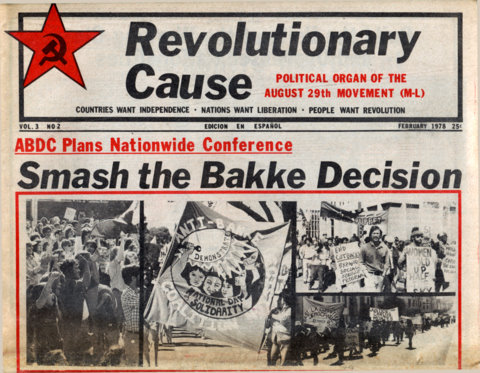
The August 29th Movement (ATM) was a Chicano New Communist Movement organization that took its name from the historic August 29, 1970 Chicano Moratorium against the Vietnam War in Los Angeles. It was formed at a Unity Conference in May 1974 from the merger of the August 29th Collective of Los Angeles, California; the East Bay Labor Collective of Oakland, California; La Raza Workers Collective of San Francisco; and a collective from Albuquerque, New Mexico.
The ATM published a pamphlet, “Fan The Flames: A Revolutionary Position on the Chicano National Question,” in 1975. The document argued that Chicanos living in the Southwestern United States were an oppressed nation, rather than an oppressed national minority, as was argued by most other New Communist Movement organizations.
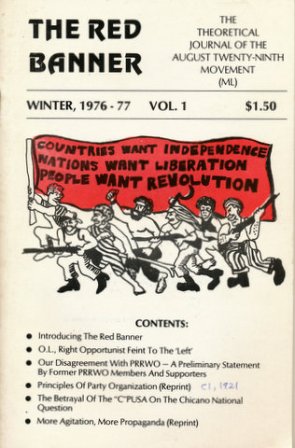
The August Twenty-Ninth Movement published a newspaper, Revolutionary Cause, and a theoretical journal, The Red Banner.
In 1978, ATM merged with I Wor Kuen to form the League of Revolutionary Struggle.
History of the August 29th Movement
ATM – Traitors to the Proletariat – Mensheviks to the Bone! by the Revolutionary Wing
ATM: Social Democrats from the National Movement. Competes with OL to be the Vanguard of the Petty Bourgeoisie by Workers Viewpoint Organization
Polemic with ATM: Factory Propaganda and Agitation by the Workers Congress (M-L)
Comradely Polemics with ATM-ML: The Present Situation & Our Tasks by the League for Proletarian Revolution (M-L)
Comradely Polemics with ATM-ML, Part II: In This Period, Place All Work in the Context of Party Building by the League for Proletarian Revolution (M-L)
Exchange with a Resistance reader on the LPR (M-L)’s ATM Polemics [Resistance, Vol. 8, Nos. 3-4, April 1977]
ATM Consolidates Right Line: Right Opportunism is the Main Danger! by the League for Proletarian Revolution (M-L)
ATM Peddles Reformism on Chicano Question by the October League (M-L)
Nationalist Reformism Disguised as Marxism. A polemic against the political line of the August 29th Movement by Barry Litt
A Party Building Retreat by the Workers Congress (M-L)
Look Who's Lecturing the “C”PUSA... by the League for Proletarian Revolution (M-L) [Resistance, Vol. 8, No. 7, August 1977]
Unity in Words – Sectarianism in Deeds: ATM/IWK and CP(ML) ’Unite’ to Exclude WC(ML) from ABDC by the Workers Congress (M-L)
The Wildcat at DASCO and its Lessons for the Communist Movement in the U.S.
Selected Speeches presented at forums by the August 29th Movement, 1974-1975
Our Central Task: Building the New Communist Party
Editorial: Marxist-Leninists Unite [Revolutionary Cause, Vol. 1, No. 1, November 1975]
Chicano Liberation and Proletarian Revolution
R.C.P. – Vanguard or Chauvinist Sect??
October League – Right Opportunism Is the Main Danger
Self-Determination for the Afro-American Nation [Revolutionary Cause, Vol. 1, No. 3, February 1976]
The Tasks of Communists in the Trade Unions
C.L.P. – Social Prop of the Bourgeoisie
October League – How Not to Build a Communist Party
Historic Alamosa Conference: Reformism or Revolution!
ATM Response to Questions from Resistencia Puertorriqueña Resistencia, Vol. 7, No. 4, n.d.
Equal Rights for Women – Fight for the E.R.A.! [Revolutionary Cause, Vol. 1, No. 6, May 1976]
Struggle for Party is Struggle for Revolution – Current state of our movement [part I]
A Tribute to Mao Tsetung. Our Comrade Has Fallen [Revolutionary Cause, Vol. 1, No. 8]
Letter from Farah Workers: Expose Chauvinism of Revolutionary Communist Party [Revolutionary Cause, Vol. 1, No. 8]
Historic Occasion: August 29th Movement (M-L) Holds 2nd Congress
A Letter to the O.L.: Opportunism on International Situation
Opening Statement to the Second Congress of the August 29th Movement (M-L)
Propaganda, Agitation, and Winning over the Vanguard: Response to the Workers Congress
Western Yarn Strike Ends, Class Struggle Continues
Fan the Flames. A Revolutionary Position on the Chicano National Question
PRRWO-RWL: ’Hurling Threats and Insults in Not Fighting’ [part II]
Communists in Court: The Role of the O.L. and R.C.P.
Editorial: The Revolutionary Cause and Our Tasks
Sadlowski, an Inside-Out Abel [Revolutionary Cause, Vol. 1, No. 10, November 1976]
Victory in China, victory for entire working class: Masses Rout ’Gang of 4’
October League, Right Opportunist Feint to the ’Left’
The Betrayal of the “Communist” Party U.S.A. on the Chicano National Question
WVO Proclaims Itself General Staff
Soviet Union Gears Up for World War
W.V.O. Kicked Out Of Chicago Forum: National Movements – Main Allies of the Working Class
Speech at Denver Party Building Forum, March 1977
Cuba’s Role in Africa [Revolutionary Cause, Vol. 2, No. 4, June 1977]
A Brief Review of Some Agitation and Propaganda
Work Summed Up: ATM and the UAW Convention
Editorial: Practice Marxism Not Revisionism. ATM Cadre Reject Splitters
Editorial: Continue the 2-Line Struggle
Kampuchea CP Visits China [Revolutionary Cause, Vol. 2, No. 8, November 1977]
Communist Analysis of Anti-Bakke Movement: All Out for Oct. 15!
Editorial: Build the Unity of the Working Class and Oppressed Nationalities
Joint Statement of ATM, CP (M-L) and IWK for Marxist-Leninist Unity
Editorial: Build the Committee to Unite Marxist-Leninists!
ATM-IWK newspapers to merge by The Call
[Back to top]
Marxist-Leninist Movement: ’Beginning Analysis’ by William Gurley [Guardian, April 28, 1976]
Proposed Position on Black Liberation Struggle
Position Paper of BACU on Bay Area Angola Coalition
History of the U.S. Left [Study Class/Study Guide]
Organizational Guidelines on Recruiting, Obligations of Members, Democratic Centralism and Security
Marxism-Leninism-Mao Tsetung Thought. Basis of our political line. Guide to our practical work Resolutions of our fourth general meeting (July 1977) as revised and approved by the membership
[Back to top]
The Fight for Freedom in South Africa and what it means for workers in the United States
[Back to top]
The Buffalo Student Movement (BSM) was a chapter of the American Student Movement, created by the American Communist Workers Movement (Marxist-Leninist).
American Working Class Has High Aspirations
Cultural Affairs Discussion Group Holds Meeting on: “Teaching and Learning in the University”
Hail the Victory of the Proletarian Revolutionary Line of the Buffalo Student Movement Conference!
Down With Bourgeois Hang-Ups Discussion Group Report [North America News, May 30, 1972]
Initial Report on Revolutionary Conference Held in Buffalo [North America News, October 17, 1972]
[Back to top]
The Buffalo Workers’ Movement (BWM) grew out of local opposition to the Vietnam War. The foundaing members came together to form the Veterans Club at the University of Buffalo. Later the group expanded to become a chapter of a national organization of anti¬war veterans named Vietnam Veterans Against the War/Winter Soldier Organization. Beginning in 1976, with the development of its positions set forth in the published Working Papers, the group consolidated its Marxist-Leninist line and began to involve itself more strategically in local working class and community struggles.
At the same time, the BWM became more active in the national anti-revisionist movement through its participation in the Organizing Committee for an Ideological Center (OC-IC).
Statement on the Split in the Buffalo Workers’ Movement
Visitors from Another Planet? Comic Relief Column
“Me Start a Vanguard Party to Lead the Working Class to Revolution? You Must Be Kidding!!”
The Formation of a Leading Ideological Center – comments by the Buffalo Workers’ Movement
Response by the Buffalo Workers’ Movement to the Recent [OCIC] Conference
Buffalo Workers’ Movement Newsletter
[Back to top]
The Colorado Organization for Revolutionary Struggle (Marxism-Leninism-Mao Tsetung Thought (COReS (M-L-M)) was a regional multi-national anti-revisionist group that was formed in 1974. It had its origins primarily in the Chicano national movement and its headquarters in Denver. COReS sponsored a number of forums in Denver with other party building organizations in the latter half of the 1970s.
In 1980, COReS merged with the League for Proletarian Revolution (M-L) to form the Marxist-Leninist League.
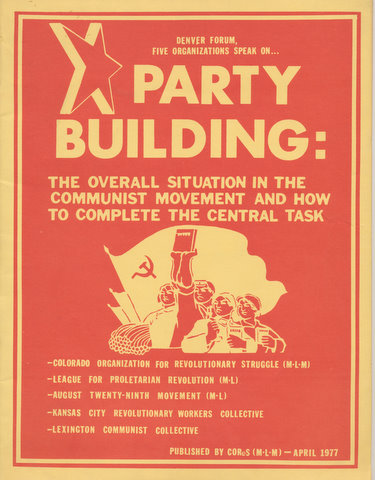
Colorado Organization for Revolutionary Struggle (M-L-M)
Speech at the Denver Party Building Forum, March 1977
The Right is Evermore Dangerous
On the Coors Strike [Resistance, Vol. 9, No. 1, n.d. [1977]
Commemorate the Chicano Moratorium. Continue to implement its lessons [Resistance, Vol. 9, No. 6, August 1978]
Social-Chauvinism Comes Out in Practice
COReS (mlm) and LPR (m-l) On Road to Higher Unity
Rectification Campaign – COReS (mlm)
IWD or IWWD? [the positions of COReS
Progress Report: Forward COReS-LPR merger!
Colorado-Teach In: Anti-draft, anti-war movement grows
COReS-LPR Joint Statement: Our work within the working class movement
LPR-ML and COReS-MLM Complete Meger – Marxist-Leninist League Founded
[Back to top]
The Commentator Collective was a small anti-revisionist group in New York City with Dave Davis, who may have formerly been with the Progressive Labor Party, at its center. The Collective began publishing a paper, The Anti-Fascist Commentator in 1973. The paper changed its name the following year to The Commentator and continued publishing irregularly thereafter until approximately 1978.
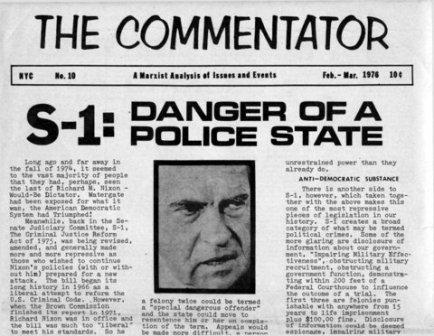
A Critique of the United Front against Imperialism as a Strategy for Revolution within the U.S.
Nixon and Watergate: Toughing It Out
The SLA or How Not to Make Revolution
Hundreds attend forum on Watergate
Publisher’s Preface to the reprint of Dimitrov’s “The United Front Against War and Fascism”
Bad Caricature [letter from Dave Davis to The Guardian]
Out of the Frying Pan, Into the Fire. A Political Analysis of George Wallace
Fascist Danger Increases World Wide
Who’s Next? [on the suppression of The Guardian by pro-China bookstores]
[Back to top]
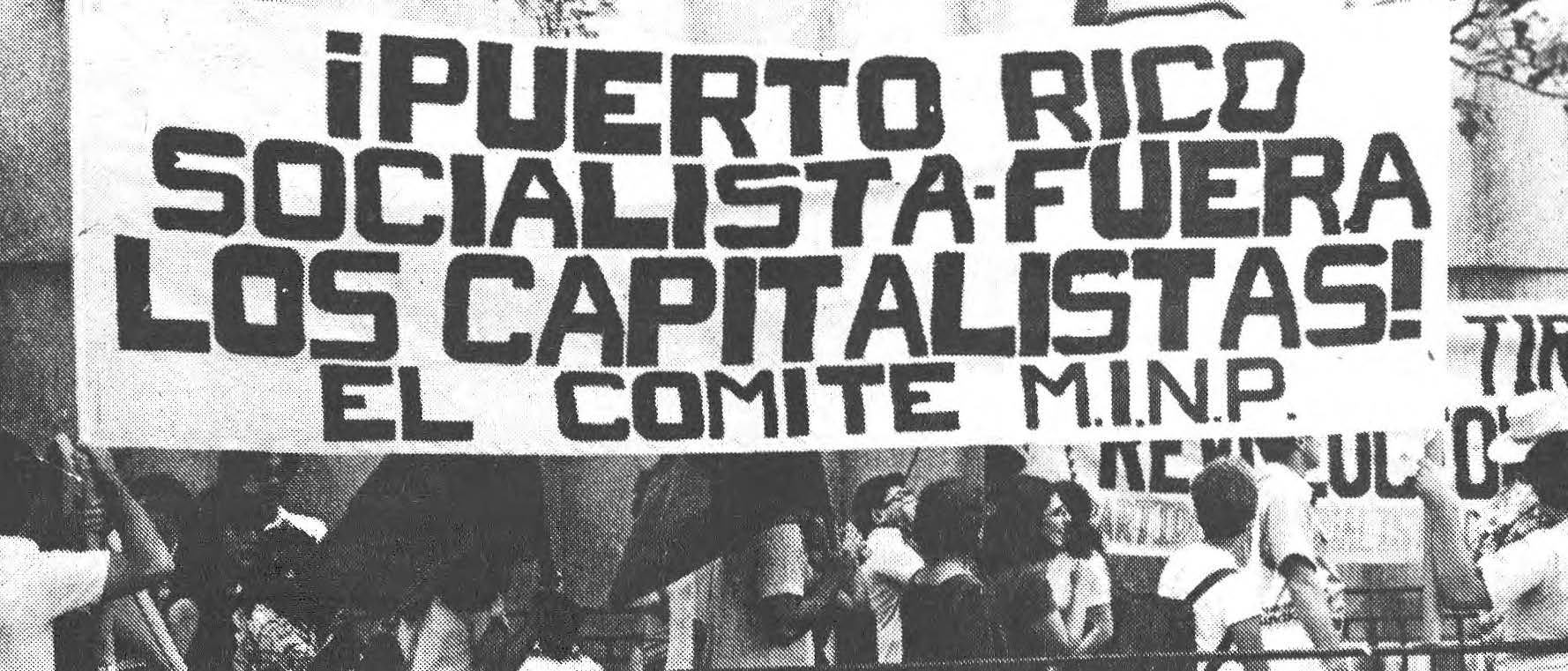
El Comité began in 1970 as a Puerto Rican community action group in Manhattan’s West Side. Over the course of the next several years, it transformed itself into an anti-revisionist Marxist-Leninist organization and in 1975 changed its name to El Comite-Movemiento de Izquierda Nacional Puertorriqueño (El Comité-MINP).
El Comité-NINP was active in the New Communist Movement, including party building activities, until it disintegrated in 1984.
The Struggle against “Urban Renewal“ in Manhattan's Upper West Side and the Emergence of El Comité by Rose Muzio
Celebrating 50 Years of El Comité-MINP
Radical Imagination, Radical Humanity. Puerto Rican Political Activism in New York by Rose Muzio
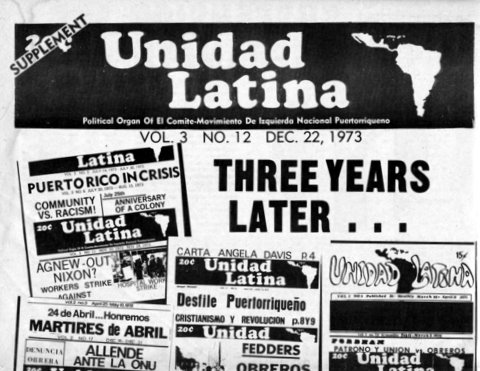
Three Years Later...[On the Suspension of UNIDAD LATINA]
El Comite/MINP: Its Formative Assembly
M.I.N.P.-El Comité Celebrates its Tenth Anniversary
Presentation of the First Secretary of MINP-El Comité [at the 10th Anniversary Celebration]
Resolution of the Conference of North American Marxist-Leninists on Creating a Continuations Committee [People’s Tribune, Vol. 5, No. 5, June 1973]
Editorial: PRRWO Responds to El Comité [Palante, March 15, 1973]
The Process of Puerto Rican Migration and the U.S. Working Class
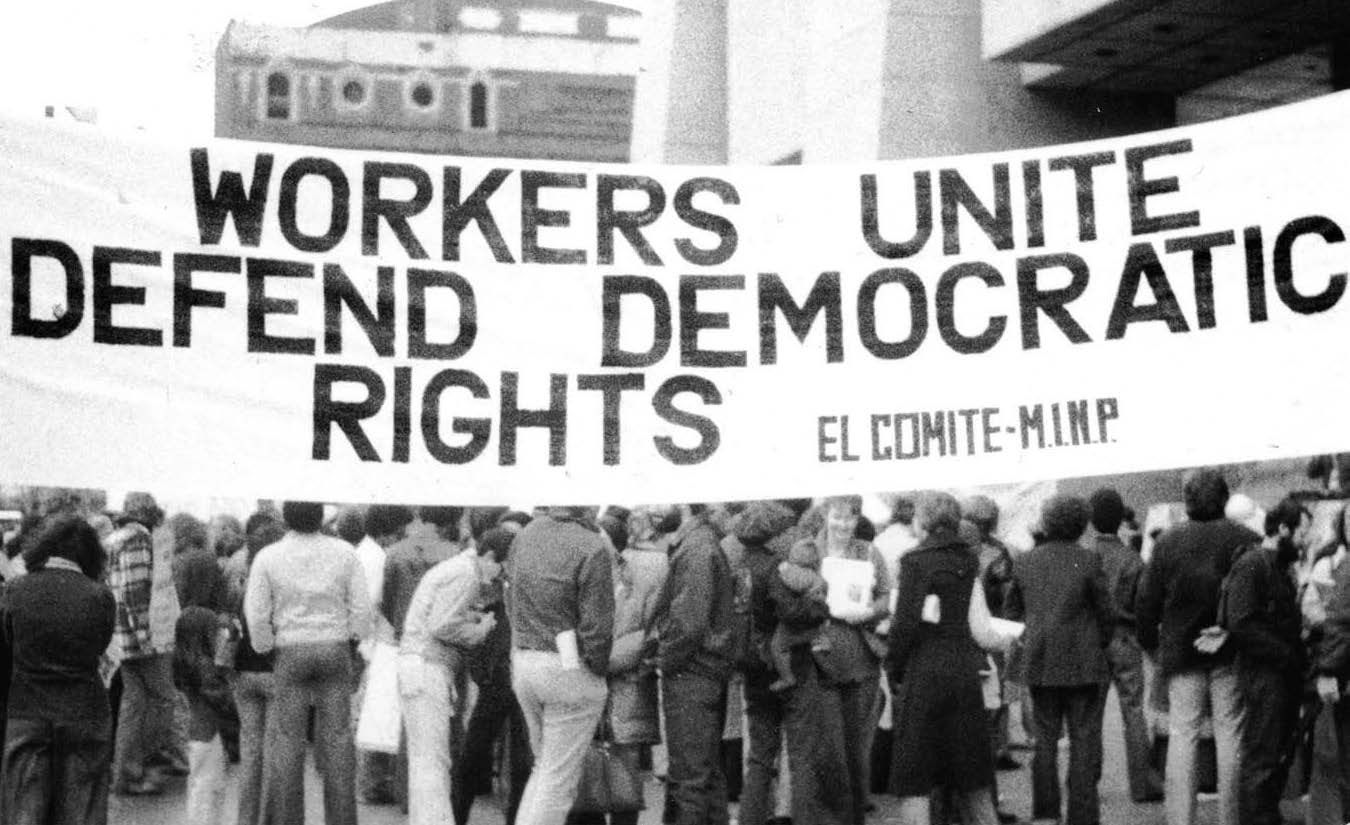
Salute to Revolutionary Cuba [from Obreros en Marcha, Vol. 1, No. 18, July 1976]
On Mao’s Death [from Obreros en Marcha, Vol. 1, No. 20, September 1976]
Cuba – A Response [from Obreros en Marcha, Vol. 1, No. 20, September 1976]
Editorial: O.E.M. – A Critical View
Steelworkers Elect Leadership [from Obreros en Marcha, Vol. 2, No. 1, January 1977]
Editorial: P.R.S.C. – Solidarity with Puerto Rico [from Obreros en Marcha, Vol. 2, No. 3, March 1977]
Women in the Revolutionary Movement/The Children, and Women as Cadre [from Obreros en Marcha, Vol. 2, Nos. 3 & 4, March, April 1976]
Editorial: On Revolutionary Morals [from Obreros en Marcha, Vol. 2, No. 4, April 1977]
Dialogue with M.S.P. Part I [from Obreros en Marcha, Vol. 2, No. 4, April 1977]
Dialogue with M.S.P. Part II [from Obreros en Marcha, Vol. 2, No. 5, May 1977]
Editorial: Another “Communist Party” Founded
U.S. Left: Solidarity with Cuba? [from Obreros en Marcha, Vol. 2, No. 7, July 1977]
Bakke Decision – Attacks Affirmative Action [from Obreros en Marcha, Vol. 2, No. 7, July 1977]
Editorial: OEM: A Year of Progress
Obreros En Marcha [from Obreros en Marcha, Vol. 3, No. 8, September 1978]
Puerto Rico: Revolutionary Unity and the Solidarity Movement [from Obreros en Marcha, Vol. 3, No. 8, September 1978]]
First Assembly: Program for the Coming Period
First Assembly Dedicated to Outgoing Leader
Outgoing First Secretary Leaves. Says Goodbye To Organization
Message from the Central Committee
El Comité-M.I.N.P. Completes its First Assembly
* * *
Editorial: On the Chinese Invasion of Vietnam
Puerto Rican Solidarity Committee Holds Third National Conference
On the Left and Unity in Puerto Rico
Editorial: On Our Tenth Anniversary
El Comité-MINP Celebrates Tenth Anniversary
Presentation of the First Secretary off MINP-El Comite
Messages to M.I.N.P. (El Comité) on its 10th Anniversary
* * *
Metropolitan Hospital: A Summary of Our Experiences
Puerto Rico and the Present State of the Revolutionary Movement
Letter on the suspension of publication of Obreros En Marcha
Letter on the Division in M.I.N.P.-El Comité
Statement on the Division in M.I.N.P.-El Comité
[Back to top]
The Committee for a Proletarian Party (CPP) was a local San Diego collective which formed in the Spring of 1977. It was active in a number of local struggles and participated in the New Communist Movement nationally by publishing a number of pamphlets on issues of strategy and party building.
In 1978 it drew close to the Marxist-Leninist Organizing Committee and joined with it to create the Communist Party U.S.A./(Marxist-Leninist) that same year. However, a number of members soon left the CPUSA (M-L) over its pro-Albania positions and rejection of Mao Zedong’s contribution to Marxism-Leninism and reformed the CPP. Post 1980 documents of CPP can be found here.
In 1983 CPP merged with the Communist Organization, Bay Area (COBA) to form the Organization of Revolutionary Unity (ORU).
Strategy and Tactics of the Proletariat in the Era of Imperialism
The Party of the Working Class and the Small Circles of the Petit-Bourgeoisie
Two Articles: “On the Historical Merit of Mao Tsetung and Socialism in China” and “The PLA’s Treacherous Reversal: An Analysis of the PLA Letter“ by the Chicago Committee for a Communist Party and former members of the Committee for a Proletarian Party
[Back to top]
The Committee for Scientific Socialism (M-L) was a small, secret anti-revisionist group in Washington, DC that had its origins in the white anti-war left in that city.
A Proposal Concerning the General Line on Party-Building for the Communist Movement in the U.S.
Two Lines on Revolutionary Practice: Science Versus Spontaneity
RWL and OL: Two Wings of Same Bird
History of Two-Line Struggle on Party-Building
Expose OL’s All-Unity, Bourgeois Stand; Build Proletarian Unity Through Intensified Struggle
Smash Scholasticism and Bolshevize Our Ranks! Expose the Petty-Bourgeois Careerism of MLOC!
[Back to top]
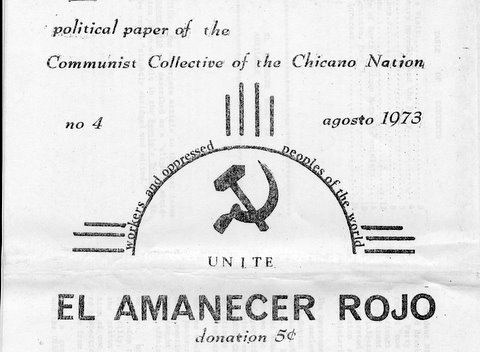
The Communist Collective of the Chicano Nation (CCCN) was a small group located in Albuquerque, New Mexico. It began publishing an irregular newsletter, El Amanecer rojo (Red Dawn) in April 1973.
The CCCN argued, following Stalin’s definition, that a Chicano nation existed in a part of the U.S. southwest, namely New Mexico, Southern Colorado, and Southwestern Texas.
The CCCN participated in the Conference of North American Marxist-Leninists held by the Communist League and others in May 1973 at which it presented a theoretical paper on the Chicano National Question.
Presentando “El Amanecer Rojo”
Resolution of the Conference of North American Marxist-Leninists on Creating a Continuations Committee [People’s Tribune, Vol. 5, No. 5, June 1973]
Conference of North American Marxist-Leninists
Fascist Attack on Spanish Speaking Peoples
Report to the Communist Collective of the Chicano Nation on the Chicano National-Colonial Question
El Amanecer Rojo, Vol. 1, No. 1. April 1973
El Amanecer Rojo, Vol. 1, No. 4. August 1973
[Back to top]
The Communist Committee was a small anti-revisionist communist group located in Chicago, Illinois.
The Soviet Union: Is it the Nazi Germany of Today?
Communist Committee Letter to the Guardian
“Three Worlds” Theory: Anti-Leninist Deception of the Masses
[Back to top]
A Brief History of the Political Line of the Communist Workers Group (Marxist-Leninist) by Rick Atkinson
Our Tasks on the National Question. Against Nationalist Deviations in Our Movement
Family Tree Chart of U.S. Anti-Revisionism, 1956-1977
The Workers’ Movement and the Movement for the Party by the CWG (M-L) and the Workers League of Struggle
Letter to the Lexington Communist Collective
The Situation in China and Social-Chauvinism in Our Movement by the Communist Workers Group (ML) and the Organization of Communist Workers (ML) Canada
A Tactical Dispute Among Social-Chauvinists – The PLA’s 7th Congress and the CPC
More “Great Disorder Under Heaven”
The State and Counter-Revolution. A Critical History of the Marxist Theory of the State by Tom Clark
[Back to top]
The Congress of Afrikan People (CAP) had its roots in the Black Arts movement in Newark, New Jersey in the mid-1960s, largely through the efforts of Amiri Baraka. By the late-1960s, under the influence of Malcolm X, Ron Karenga’s US organization and the example of the Black Panthers, the CAP became an explicitly political, Black nationalist organization, with a focus of community organizing and cultural politics. In 1970, at its Atlanta Convention, CAP became a national organization dedicated to building a Black Political Party, including involvement in electoral politics.
In the early 1970s, a growing struggle developed within the CAP between the Black nationalists and the emerging Marxist-Leninist forces, headed by Baraka. With the departure of Haki Madhubuti and Jitu Weusi, the Marxist-Leninist tendency in the organization was strengthened and in 1974-75, CAP took up the study of Marxism-Leninism-Mao Tse Tung Thought and, for a brief period, worked closely with the October League (Marxist-Leninist). Thereafter, it was briefly on the periphery of the Revolutionary wing.
In February, 1976 the organization changed its name to the Revolutionary Communist League (Marxist-Leninist-Mao Tse-tung Thought). Early in 1980 the Revolutionary Communist League (M-L-M) merged with the League of Revolutionary Struggle (M-L).
Baraka Abandons ’Racism’ as Ineffective And Shifts to ’Scientific Socialism’ of Marx
History of the Congress of Afrikan People
African American Intellectuals and Black Cultural Nationalism Between 1965 and 1975: The Case of Amiri Baraka by Toulgui Ladi
The Congress of African People. Baraka, Brother Mao, and the Year of ’74 by Robeson Taj P. Frazier
’Hard Facts’: Amiri Baraka and Marxism-Leninism in the 1970s by David Grundy
Imamu Baraka: From Mayor Gibson to Mao Thought Workers Vanguard, May 23, 1975
The “76 Strategy,” in Practice: CAP Unites with Urban League in Albany Workers Vanguard, October 10, 1975
Wreckers Cripple African Liberation Support Committee from The Call
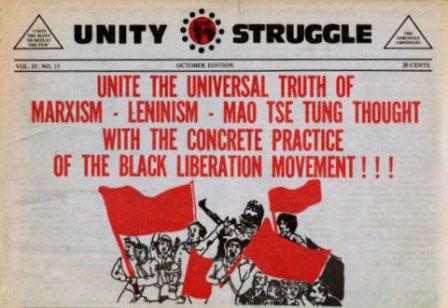
New Groups Join CAP by Cheo Hekima
Raise!!! by Imamu Amiri Baraka
Nationl Liberation and Politics by Imamu Amiri Baraka
Sectarianism, Undermining, Secret Agents & Struggle by Chairman Amiri Baraka
Boston... Fred Hampton Contingent Gives Critical Support for Boston March
Black Liberation is a Struggle for Socialism!!! by Amiri Baraka
Workers’ Solidarity Day [flyer]
Against Some Bogus Types Posing as Revolutionaries (Part I) by Amiri Baraka
Against Some Bogus Types Posing as Revolutionaries (Part II) by Amiri Baraka
Future Of Afrikan Liberation Support Committee Discussed In D.C. Meeting
Ford Comes to Newark – CAP Demonstrates!
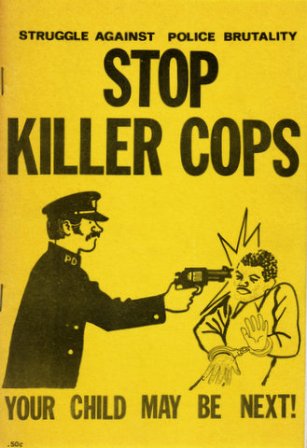
Stop Killer Cops. Struggle Against Police Brutality – Your Child May Be Next!
Hard Facts, 1973-1975 by Amiri Baraka [poems]
1st Draft of General CAP Summation: National African Liberation Support Committee – 1972-75, Part 1; Part 2; Part 3
Revolutionaries and the ’76 Elections by the October League (M-L)
CAP Supports Fightback Conference
CAP Summation of “Strategy ’76”
[Report on] National Fightback [Conference]
Angola: For True Independence Superpowers Must Be Thrown Out!!
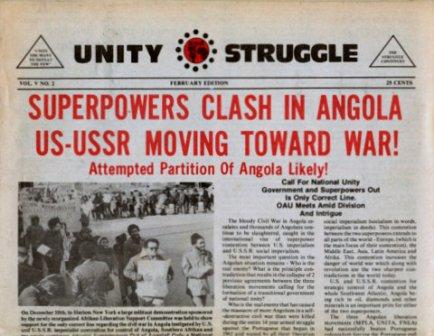
ALSC National Meeting Held in New York
Revolutionary Review: The Black Nation Thesis
Report From CAP’s Central Committee Meeting
Recommendation For Withdrawal From the Puerto Rican Solidarity Committee
Right Opportunism Main Danger! CAP Summation of International Women’s Day
Unity and Struggle [and Black NewArk]
[Back to top]
This was a small group formed in Denver, Colorado in January 1979, consisting of several members of the Central Organization of U.S. Marxist-Leninists (COUSML) and a number of individuals who wrote and issued the pamphlet, The U.S. Communist Movement and A Re-Assessment in Light of the Struggle Against the Revisionist “Three World Theory.”
The Denver Committee was active on the Denver left in propagating the positions of forces opposed to the theory of “three worlds” as well as in struggles in the community at large. It was also active in promoting COUSML’s work toward the formation of the Marxist-Leninist Party (MLP). Members of the Denver Committee joined or worked closely with the MLP from its founding to the dissolution of the Denver MLP branch in 1983. Thereafter, two members moved to Chicago, becoming part of the circle around the Chicago Workers’ Voice theoretical journal.
Down With Carter’s Aggressive Middle East “Peace” Fraud!
The Working Class is Opposed to the Nuclear Program of the Rich!
Resist Samsonite’s Productivity Drive!
Down with the U.S.-China Warmongering Alliance! [poster]
[Back to top]
Detroit Collective Statement: “Party Must Be Built Through Struggle”
Detroit Group Merges with October League: Detroit Collective Unity Statement
[Back to top]
The East Wind Collective (Marxist-Leninist) was formed in 1972 by leaders in radical Asian-American, primarily Japanese, community groups in Los Angeles. Its predecessor organization, the Community/Workers Collective, had brought together activists from the city’s campuses and community groups. At its height, the Collective had 25 to 30 members, with an activist core of 15. An interesting feature of the organization was that many of its members lived together collectively. East Wind was extremely active in a variety of projects, from helping publish the newspaper Gidra, to labor organizing, to opposition to gentrification in Little Tokyo.
Originally primarily nationalist in ideology, by 1975 East Wind adopted Marxism-Leninism and became involved in anti-revisionist party building. By the end of the 1970s it had drawn close to I Wor Kuen and in 1979, after IWK’s merger with the August 29th Movement in the League of Revolutionary Struggle (M-L) the previous year, East Wind dissolved itself and joined the League.
Race, Class and Political Activism: Black, Chicana/o and Japanese-American Leftists in Southern California, 1968-1978 by Laura Pulido
Unity in Words – Sectarianism in Deeds: ATM/IWK and CP(ML) ’Unite’ to Exclude WC(ML) from ABDC by the Workers Congress (M-L)
East Wind Collective Criticism
WC(M-L) Response to Criticism by East Wind Collective
May Day Speech [Seize The Time, Vol. 2, No. 5, November 1976]
Statement by the East Wind organization on its unity with the League
Editorial: Great advances in building Marxist-Leninist unity by the League of Revolutionary Struggle (M-L)
LA program celebrates merger of East Wind and the League of Revolutionary Struggle (M-L)
East Coast programs greet merger of East Wind and League
Building a unified Asian movement: SF program celebrates East Wind/League Merger
[Back to top]
The Birth of the Modern Hawaiian Movement: Kalama Valley, O’ahu by Haunani-Kay Trask
The Rise of Ethnic Studies at the University of Hawai’i: Anti-War, Student and Early Community Struggles by John Witeck
Angola and Zaire – Where the Vanguards Failed, Part I by John Witeck
Angola and Zaire – Where the Vanguards Failed, Part II by John Witeck
Zaire: Crucial Stakes Involved by John Witeck
A Proposal for an Open Socialist Organization in Hawaii
Hawaii Union of Socialists Calls Founding Meeting
Combat Sectarianism and Dogmatic Responses
Red Flag Bookstore Struggle [Article, Follow-up Letter, and Reply]
Hawaii Nation? Some Thoughts, Part I by S. Wallis
Positions on the Hawaii National Question, Part II by S. Wallis
Close Encounters With the Three Worlds
Critique of Albanian Position on the Three Worlds Theory
HUS, Con-Con Campaign Launched
Coalition Politics and Bakke Committee Work by Kyle Coffman
Speaking Out on Zaire: China’s Position – In Support of Reaction
HUS Picnic and Film Benefit Well-Attended
Mao Tsetung Memorial by J. W.
HUS and RCYB Form Alliance by A.F. Day [April Fool’s Day satire]
Comments on Article by B.D., S.P., HUS members
Tasks for Revolutionaries in Hawaii – A Contribution to the HUS Political Directions Discussion
Questions on the Revolutionary Communist Party by S. Wallis
“Three Worlds” Adherents in Bed with Reaction: Cuba Must be Supported by Walter Yonn, Honolulu
Anti-Draft Protests Sparked by B.D. and J.W.
Modern Times Editorial: Adventurism on the March? Reflections on the RCP’s May Day
Forum on Afghanistan Attacks U.S. Role, Reactionary Rebels: Soviet Intervention Deemed Necessary
Observing the RCP’s May Day by the Modern Times staff and editors
Thoughts on the Hawaii National Question by Ivan Hoe
Deepen the Critique of Stalinism by B.D.
Hawaiian Nationalism: A Non-Question by John Reinecke
Class and Ethnicity: Applying Wallerstein’s Core-Periphery Concept by Robert H. Stauffer
Response to John Reinecke: Hawaii As A Sovereign Nation by J.D.
Class And Ethnicity: A Response by Lilian Y. Yamasaki
The Chronology/Activities of H.U.S., 1978-1982: Looking Behind at Our 5-Year Plan by John Witeck
[Back to top]
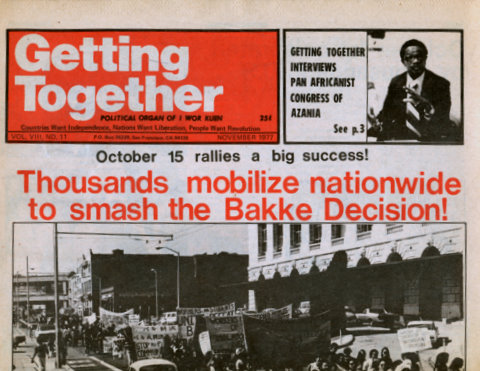
I Wor Kuen (Righteous and Harmonious Fists) took its name from a peasant organization that fought to expel foreigners from China during the so-called “Boxer Rebellion.” Founded in 1969 by second-generation Chinese Americans in New York’s Chinatown, it adopted a 12-point program Platform and Program, similar to those previously issued by the Black Panther Party and the Young Lords. It also advocated Mao Zedong thought and engaged in militant struggles in the community. It also started publication of a bi-lingual newspaper, Getting Together.
In 1971, I Wor Kuen became a national organization when it merged with former members of the San Francisco-based Red Guard Party, a group which was founded in February 1969 and disbanded in July 1971. Also influenced by the Chinese Cultural Revolution and the example of the Black Panther Party, the Red Guard Party had espoused Mao Zedong thought, advocated armed struggle and viewed itself primarily as a military rather than a political organization. By 1971, this focus on military rather than political organizing and other contradictions led to the Party’s break-up, but a group of former militants went on to join I Wor Kuen.
In 1972, to broaden its base and to reach out to community members unwilling to support an explicitly communist organization, I Wor Kuen created the Chinese Progressive Association which, after several years, had branches in New York, Boston and Los Angeles. 1972 also saw I Wor Kuen briefly participate in the National Liaison Committee, a joint party building effort of the Revolutionary Union, the Black Workers Congress, and the Puerto Rican Revolutionary Workers Organization [for more on the National Liaison Committee and IWK's relation to it see here].
Throughout the 1970s, I Wor Kuen frequently clashed with other Marxist-Leninist groups active in Chinese communities across the country, including Wei Min She and the Asian Study Group/Workers Viewpoint Organization.
In 1978, I Wor Kuen merged with the August 29th Movement to found the League for Revolutionary Struggle (Marxist-Leninist).
The Righteous Fists of Harmony: Asian American Revolutionaries in the Radical Minority and Third World Liberation Movements, 1968-1978 by Angela L. Zhao
History of the Red Guard Party
Black Panthers, Red Guards, and Chinamen: Constructing Asian American Identity through Performing Blackness, 1969-1972 by Daryl J. Maeda
Yellow Power: The Formation of Asian-American Nationalism in the Age of Black Power, 1966-1975 by Jeffrey O. G. Ogbar
The Interaction Between Service and Organizing: Two Housing Campaigns by the Chinese Progressive Association by Kaori Tsukada
“Learned from Black Friends”: The Asian-American Struggle for Housing and Equal Employment in New York City, 1969-1974 by Shouyue Zhang
A Letter to the I Wor Kuen by the Proletarian Unity League
Unity in Words – Sectarianism in Deeds: ATM/IWK and CP(ML) ’Unite’ to Exclude WC(ML) from ABDC by the Workers Congress (M-L)
Red Guard Program and Rules by the Red Guard Party
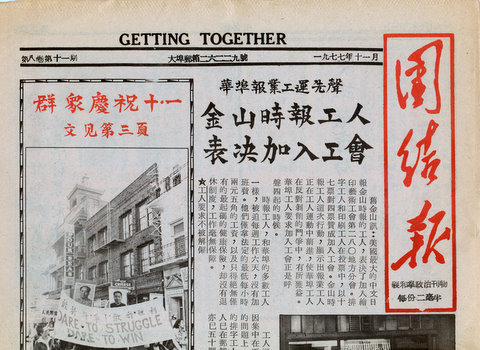
Wor Kuen Position Statement on the Gym
Chinese American Workers – Past and Present
I Wor Kuen Opens [Pamoja Venceremos, #10, September 1971]
Revolution, the National Question and Asian Americans
Reply to the “Asian Contingent Solidarity Statement”
Opportunism in the Asian Movement – Wei Min She/Revolutionary Union
On Wei Min She’s “Reactionary Line”
Fight for the day to day interests of the masses in a revolutionary way
Postal Service ’Reorganization’ Increases Exploitation
Overturn the Bakke Decision! End National Oppression!
Carter Immigration Plan Signals New Wave of Attacks
Communist Party of Kampuchea – 17 militant years
Countries Want Independence, Nations Want Liberation, People Want Revolution! Selected Articles on the International Situation From Getting Together
Theory of Three Worlds: A Major Contribution to Marxism-Leninism
Smash the Bakke Decision! Down With Imperialism! End National Oppression! Selected Articles From Getting Together
Commentary: Some perspectives on appeasement and the danger of world war
Striking changes in Democratic Kampuchea
Slanders Can’t Hide Kampuchea’s Achievements
Win Women’s Liberation Through Revolutionary Struggle! Selected Articles From Getting Together
The 109 Day United Mine Workers’ Strike Selected Articles From Getting Together
Postal Workers Get Ready for Contract Struggle
The World War II Imprisonment of Japanese in U.S. Concentration Camps
China sets high goals for science and technology
Joint Statement of ATM, CP (M-L) and IWK for Marxist-Leninist Unity
ATM-IWK newspapers to merge by The Call
[Back to top]
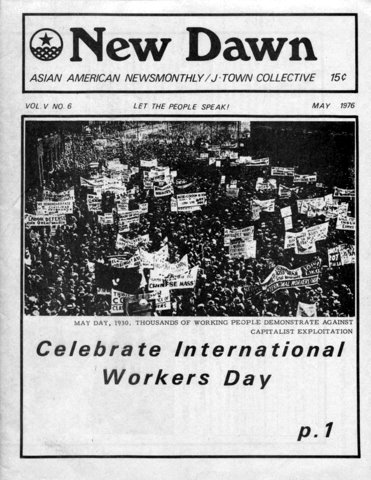
The Japan Town Collective (also known as the J-Town Collective) was a Marxist-Leninist organization in San Francisco’s Japan Town neighborhood (Nihonmachi). It was founded in 1971 by former members of the Red Guard Party. Initially the group was active in the anti-Vietnam War movement and solidarity campaigns on Japanese issues, particularly the anti-military base struggle in Okinawa. The organization was also very active in anti-gentrification struggles in the neighborhood through the Committee Against Nihonmachi Evictions (CANE).
The Japan Town Collective operated a community center in the neighborhood, involved itself in labor organizing, conducted study groups in Marxism-Leninism, and published a newspaper, New Dawn.
As differences developed in the New Communist Movement in 1975-6, particularly over Chinese foreign policy, the Japan Town Collective experienced sharp internal struggles with many cadre looking to I Wor Kuen for leadership. The resulting turmoil in the organization resulted in its disappearance by late 1975.
New Dawn Rising: History and Summation of the Japan Town Collective by Ray Tasaki
“J-Town Collective” [interview conducted by the the IWK paper Getting Together in 1972]
Rally Protests Japan-Town Evictions by the October League (M-L) [The Call, Vol. 2, No. 7, April 1974]
The History of the Committee Against Nihonmachi Evictions (CANE)
Left Meets Right [on a J Town Collective article on Angola] by Carl Bloice
Response to the Communist Party, USA: Defenders of Soviet Aggression have no just ground by the J-Town Collective
The Guardian’s “Russian Exceptionalism” and “socialism of a new type”
[Back to top]
The Kansas City Revolutionary Workers Collective (KCRWC) was formed in February 1975. It had its origins in the Black student movement, particularly the Youth Organization for Black Unity (YOBU).
After its formation, the KCRWC passed through a series of stages in which it grew close to different national Marxist-Leninist groups. First, it worked with the Revolutionary Union and participated in the process leading to the formation of the Revolutionary Communist Party. Then it aligned itself with the Workers Viewpoint Organization while the latter was a part of the Revolutionary Wing.
After breaking with the Wing, the KCRWC also began to reject the “theory of three worlds” and Mao Zedong Thought and thereafter actively involved itself with a number of small Marxist-Leninist groups around the country which had aligned themselves with the Party of Labor of Albania’s analysis of the crisis in the world communist movement. By 1980, the KCRWC decided that the Party of Labor of Albania was not taking a correct Marxist-Leninist line and broke with them, too, declaring that “part of the ’main blow’ must go against the revisionism-centrism of the PLA and their followers in every country.”
In August 1981 the Kansas City Marxist-Leninist Cell and the Kansas City Revolutionary Workers Collective merged to form the Organization for a Marxist-Leninist Workers’ Party U.S.A.
History of the Kansas City Revolutionary Workers Collective [from the pamphlet The Building of the Vanguard Party of the U.S. Proletariat]
The Building of Cores: Comments by LPR-ML on KCRWC’s Summation
Speech at the Denver Party Building Forum, March 1977
May Day – International worker’s Holiday
Class Struggle and the Teachers Strike
Summation of Teachers Strike (Excerpts)
The Building of the Vanguard Party of the U.S. Proletariat by the Kansas City Revolutionary Workers Collective and Witchita Communist Cell
Toward the Development of the International Marxist-Leninist Trend: A Contribution to the Criticism of the Revisionism-Centrism of Mao Zedong Thought and the Party of Labor of Albania by the Kansas City Marxist-Leninist Cell and the Kansas City Revolutionary Workers Collective
Letter to All Participants of the November 8, 1980 Forum in New York by the Kansas City Marxist-Leninist Cell and Kansas City Revolutionary Workers’ Collective
[Back to top]
Coming out of the “new left” movement, the League for Proletarian Revolution was formed in the summer of 1972 from the merger of two separate collectives: The Revolutionary Workers’ Caucus and the Red Detachment. The former was centered around trade union work, but was also involved in the study of Marxism-Leninism. The Red Detachment was a collective based in theoretical work which had developed in Berkeley’s student and intellectual circles. These two groups merged on the basis of building the Party as the central task of Marxist-Leninists, and began the work of studying and bringing Communist propaganda and agitation to the workers. In the early spring of 1974, a further merger took place between the League and the San Francisco Marxist-Leninist Organization which had been formed in the summer of 1973 by former members of the Venceremos Organization.
The League participated in the Communist League’s National Continuations Committee and joined the resultant Communist Labor Party, but many members soon left to form the Marxist-Leninist Collective.
This San Francisco Bay Area League for Proletarian Revolution should not be confused with another, New York-based League of Proletarian Revolution. That organization was the former Resistencia Puertorriqueña, which changed its name to the League for Proletarian Revolution in 1976.
Against Opportunism and Amateurishness: The Struggle to Build the Party by the San Francisco Marxist-Leninist Organization
From Trotskyism to Social-Imperialism by Michael A. Miller
Political Statement of the League for Proletarian Revolution
The Revolutionary Union’s “New Turn”
Against Revisionism by Michael A. Miller
The International Significance of the Restoration of Capitalism in the USSR
The International Significance of the Restoration of Capitalism in the USSR, Part II
Summary of the NCC Process, the Founding of the CLP, and the Role of the League for Proletarian Revolution by the Marxist-Leninist Collective
[Back to top]
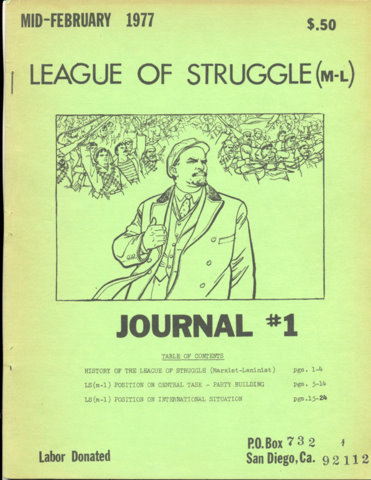
The League of Struggle (M-L) was formed in San Diego in 1974. For much of its history it functioned as a secret organization. In 1975, it decided that party-building was the central task of U.S. Marxist-Leninists. During this period it was close to the August 29th Movement, but in the following year it decided that its theoretical-political orientation was closer to the Workers Viewpoint organization.
The History of the League of Struggle
United and Exposed: League of Struggle’s Unprincipled Conciliation with Local Bureaucrats by the San Diego Organizing Committee (M-L)
Position on Central Task–Party Building
Position on the International Situation
Position on the Trade Union Question [from Journal #2, Mid-February 1977]
Position on Agitation and Propaganda [from Journal #2, Mid-February 1977]
* * *
Homosexuality: A Political and Historical Analysis by the San Diego Research Group
[Back to top]
The Lexington Communist Collective (LCC) began as a Marxist study group in the fall of 1972, which later reorganized itself as a communist organization. In 1973, the LCC joined the party building effort of the American Communist Workers Movement (M-L) and was one of the groups that formed the Central Organization of U.S. Marxist-Leninists (COUSML) later that year. In July 1974, some of the former members of the LCC broke with COUSML and refounded the LCC.
Lexington Collective Supports Call
Letter from the Communist Workers Group (M-L)
Statement Presented at the Denver Party Building Forum, March 1977
[Back to top]
Proposal for Building Our Embryonic Trend and Its Ideological Center
Introduction to the Packet from Los Angeles
Report on the Use of Propaganda at the Workplace
Annotated Bibliography on Propaganda and Agitation
Updated Outline of Study in the Worker’s Study Group [bibliography]
Sum-Up Study Outline – Worker’s Study Group [bibliography]
The Worker’s Study Group Outline of Study on the Woman Question
Study Guide for How to Learn Marxism-Leninism
Developing a Correct Attitude Towards Oneself [study guide]
Some Articles on Factory Nuclei [list]
[Back to top]
The Marxist-Leninist Collective, which had its origins in a Bay-area group called the League for Proletarian Revolution, was formed in 1975 as a split from the Communist Labor Party. It published a newsletter called the Workers’ Press and a pamphlet entitled Proletarian Revolution and the Split in the Working Class. When the China-Albania split developed in 1978-79, the Marxist-Leninist Collective took a pro-Albania position, which resulted in a split in the organization. The group continuing to call itself the Marxist-Leninist Collective subsequently involved itself in efforts to unify pro-Albania forces. The former members opposed to the pro-Albania position joined with others to form the Communist Organization, Bay Area, which later merged with other groups to form the Organization for Revolutionary Unity, which itself later merged into the Freedom Road Socialist Organization.
Independence for the Black Nation
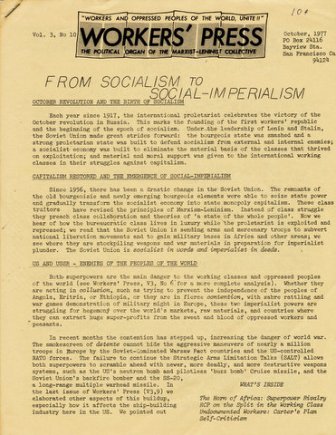
Proletarian Revolution and the Split in the Working Class
Party Building: Strategy and Tactics
Party Building: Unite Marxist-Leninists, Win the Advanced to Communism!
Exchange with the League for Proletarian Revolution (M-L) on Building Communist Cores [Resistance, Vol. 8, Nos. 3-4, April 1977]
Statement on the ’Third World’
Statement on the ’Third World’, Part 2
From Socialism to Social-Imperialism
RCP on the Split in the Working Class
RCP on the Split in the Working Class, Part 2
Lessons from the Moldmakers’ Strike
The Theory of Three Worlds and the Middle East Situation Today
[Back to top]
The Marxist-Leninist League was created in 1974 when approximately one-third of the members of the New Voice group left the organization over differences described in the pamphlet Pragmatism and the Split in the New Voice. In 1978, the Marxist-Leninist League started publishing a quarterly theoretical journal entitled Science, Class and Politics. The journal continued publication into the 1990s. The journal’s line reflected the group’s origins in the Progressive Labor Party and the New Voice.
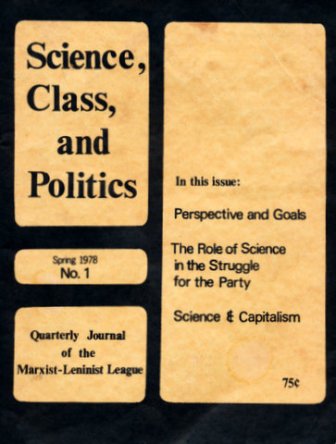
Pragmatism and the Split in the New Voice by the Marxist-Leninist League
Science, Class, & Politics: Perspective and Goals
The Role of Science in the Struggle for the Party
The Communist Movement in the United States
The Black National Question [Science, Class and Politics, #9, Spring 1980]
The Threat of Nuclear War and the Ruling Class Science, Class and Politics, #18, Summer 1982]
Lessons from the Revolution Science, Class and Politics, #24, Winter 1984]
Liberalism Science, Class and Politics, #24, Winter 1984]
National Liberation Movements and the Question of Socialism Science, Class and Politics, #28, Winter 1984]
On Stalin Science, Class and Politics, #29, Spring 1984]
On the Nature and Substance of Fascism Science, Class and Politics, #30, Summer 1985]
The Role of Law under Capitalism and Socialism Science, Class and Politics, #35, Fall 1986]
Bernstein and Modern Revisionism Science, Class and Politics, #36, Winter 1987]
To Our Readers: The Die is Cast Science, Class and Politics, #39, Fall 1987]
[Back to top]
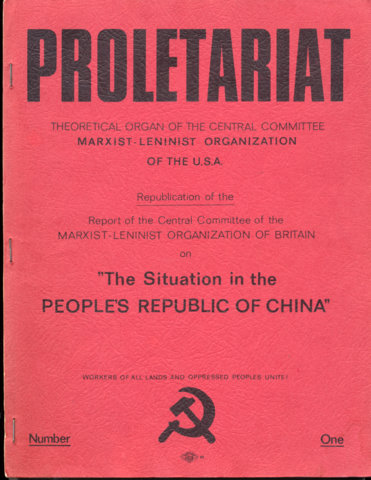
Few New Communist Movement organizations were affiliates of foreign anti-revisionist groups. The Marxist-Leninist Organization of the United States of America (MLOUSA) was an exception to this rule.
It was the U.S. sister organization of the Marxist-Leninist Organization of Britain (MLOB), a group that was created in the late 1960s out of elements from the first major UK anti-revisionist organization – the Committee to Defeat Revisionism for Communist Unity [for more on the MLOB see here].
While the MLOUSA had its own publications – a newspaper, the Workers’ Tribune and a theoretical journal, Proletariat – many of its major articles were reprints of its British sister organization. It also distributed MLOB publications such as Red Front, Red Vanguard and Class Against Class in the United States.
Like the MLOB, the MLOUSA sided with Liu Shao-Chi in the Chinese Cultural Revolution, which it viewed as a counter-revolutionary attempt to restore capitalism in China. To publicize its position, the MLOUSA reprinted the MLOB’s Report on the Situation in the People’s Republic of China in Proletariat.
The MLOUSA was ahead of its time. As early as 1972, it was predicting that China was moving toward an alliance with U.S. imperialism and that only Albania maintained a principled Marxist-Leninist position. These views would taken up by a variety of other anti-revisionist groups later in the 1970s.
Founded in the early 1970s and based in San Francisco, the MLOUSA seems to have disappeared a few years later.
Watergate: The Unmaking of the President by the Marxist-Leninist Organization of Britain
MLOUSA, SL Defend Against Philippine Nationalists by the Spartacist League
Draft Declaration of the Marxist-Leninist Organization of the U.S.A.
Workers!! Beware of Wolves in Sheep’s Clothing!
A New Comintern Marxist-Leninist Is Being Born! by the Marxist-Leninist Organisation of Britain, Marxist-Leninist Organization of Germany and Marxist-Leninist Organization of the U.S.A.
The Philosophical Foundations of the Marxist-Leninist World Outlook
Topics for Discussion: MLOB & MLOUSA
Workers’ Tribune, Vol. 1, No. 1, October-November 1972
[Back to top]
The Worker, Vol. 5, No. 13, August 5, 1991
[Back to top]
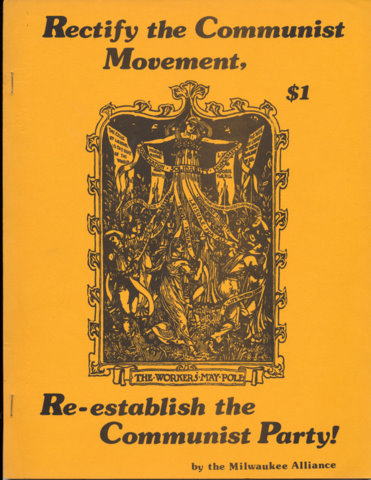
The Milwaukee Alliance (MA) grew out of the Wisconsin Alliance (WA), a group started in Madison in 1968 as an attempt to take the anti-war movement into Madison’s working class. The conception of the WA was to build a worker-farmer-student alliance around support for socialism.
The WA was started by Marxist-Leninists who had broken with the CPUSA and the Progressive Labor Party. They were reacting both against revisionism and ultra-leftism. The WA was conceived of as a classic popular front – an alliance of all classes opposed to capitalism. The organization was consolidated around a very low level of unity, which put forward socialism and communism in concept, but not in name.
The Milwaukee chapter of the WA was formed in 1973, after two previously unsuccessful attempts. After several years of struggle, the MA decided to leave the WA in 1976, arguing that class transformation was the primary task for the MA and that the MA could not concentrate on this task and be involved in a statewide organization at the same time.
At this point, the MA went to an intensive period of re-establishing mass work. In the spring of 1977 the MA embarked upon a study of party building to raise the ideological level and the political unity within the organization. The study resulted in the Milwaukee Alliance reaching unity on Marxism-Leninism, and the fact that party building was our central task.
In 1978, however, the MA underwent a split in which approximately 40% of the group left the organization to form the Milwaukee Socialist Union. By the end of the decade the MA had ceased to exist.
Rectify the Communist Movement, Re-establish the Communist Party!
Angola: National Liberation and the U.S. Left, 1974-76
Milwaukee Workers and Integration
Demonstrate Against the Nazis and Racism [flyer]
Stop the Nazis! Rally at Humbolt Park [flyer]
[Back to top]
The Milwaukee Socialist Union (MSU) was formed from a split in the Milwaukee Alliance in 1978. Approximately 40% of the organization left to form the MSU.
The split occurred over a number of issues, including party building and the basis of unity for party building, as well as the issue of defining the “main enemy” of the peoples of the world. The individuals who went on to form the MSU generally took a position on these issues closely aligned to those of the Philadelphia Workers Organizing Committee (PWOC).
The MSU actively participated in the work of the Organizing Committee for an Ideological Center (OC-IC) and in general faithfully followed the PWOC line, issuing criticisms of various forces which it deemed insufficiently loyal to the PWOC approach to building the OC-IC.
The Split in the Milwaukee Alliance: A Struggle Against Empiricism
Our Unions: Where we’re at, Where we’re going
[Back to top]
The Mother Jones Collective was a Marxist-Leninist formation in Baltimore, Maryland that grew out of the student movement. The organization existed circa 1970-72 after which many of its members joined the Revolutionary Union.
The Mother Jones Collective initially operated under a “serve the people” philosophy and ran a free lunch program for children in a working class community, a liberation school, a film program and a recreation program for children. The group owned an offset printing press on which the Black Panther Party printed their broadsides. Printing was done for other left-leaning groups in Baltimore as well.
On one occasion the Collective rallied community support to form a line of people outside the Black Panther Party headquarters in the city to protect that organization against an anticipated police raid. It was itself raided by Baltimore police who failed to show a warrant and evidently planted drugs in the headquarters building of the no-drug group. Five members of the Mother Jones Collective were arrested.
Later, the Collective organized Marxist-Leninist study sessions, and developed communist work at factories, shipyards other places of employment in Baltimore.
Flyer describing a suspected police agent named John Shaw [circa 1970]
Voice of Mother Jones, No. 3, [circa 1970]
[Back to top]
Additional Motor City Labor League documents can be found here.
History of the Motor City Labor League
A Nice Place to Visit – But You Wouldn’t Want to Live Here! Motor City Coalition [leaflet]
Motor City Labor League [leaflet]
MCLL: Origin, Purpose and Direction [Changeover, Vol. 1, No. 1, September 15, 1971]
Leninism and the Motor City Labor League [Spring 1972]
Some Suggestions for a Core Library for MCLL Cadre
Notes on Democratic Centralism (for internal use only)
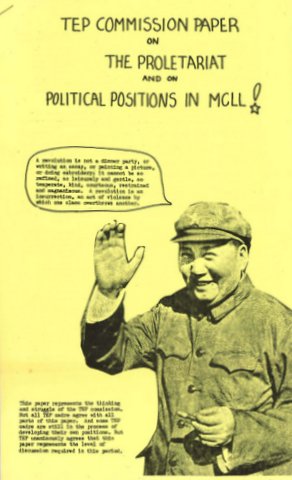
TEP Commission Paper on the Proletariat and on the Political Positions in MCLL!
A Working Paper Toward a Basic MCLL Public Statement
Can the Detroit News Defeat Crockett, Simpson, Razitz and Del Rio?
Ravitz Campaign Training Manual
Campaign Workers Training Notebook
Working Paper on Community Control of the Police
The Dialectics of the Ravitz Campaign
Report of the Central Committee, September 2, 1972
To the Members of the Motor City Labor League Regarding the September 1972 Split
[Untitled Reunification Document]
[Back to top]
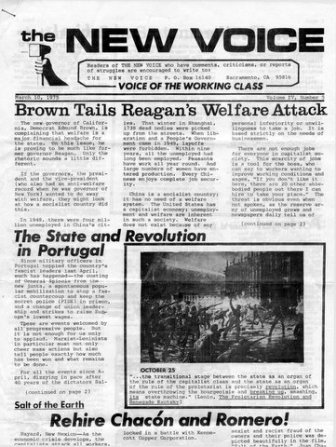
The New Voice (TNV) was started in the early 1970s by a group of former members of the Progressive Labor Party in Sacramento, California who left the Party for the reasons set out in The Anti-Marxist-Leninist Line of Progressive Labor by John Ericson and Charles Loren. Through most of its history the primary leader of TNV was Charles Loren.
TNV inherited from Progressive Labor a rejection of the “united front against imperialism” strategy in the U.S., calling instead for socialist revolution. Also like PL, it saw Black Americans as racially oppressed and rejected the “national oppression” theory associated with most U.S. anti-revisionists.
Over the course of its history, TNV consistently supported the international line of the Communist Party of China, including the “theory of three worlds” and the contention that the Soviet Union was the more dangerous of the two super-powers and the major source of war.
Perhaps TNV’s period of greatest influence was in 1973-74 when it was briefly associated with the Communist League and its National Continuations Committee. Charles Loren’s book, The Struggle for the Party, written during this period, was widely distributed and debated in the New Communist Movement.
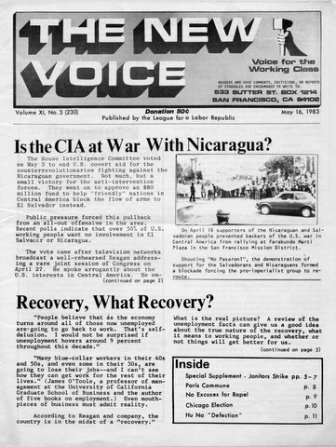
Throughout its history TNV issued a publication of the same name, first as a newssheet, later as a newspaper and finally as a pamphlet-sized journal.
In 1978, after years of criticizing other New Communist Movement groups for various deviations, TNV welcomed the announcement of the CP ML’s Marxist-Leninist Unity Committee and offered to participate, but was bitterly disappointed when the Committee declined to respond to its overtures. No doubt, TNV’s opposition to the Black Nation analysis of African-American oppression and its open sympathy for a US role in the world alliance against Soviet social-imperialism were the reasons for the CP (M-L)’s reluctance to engage with TNV.
In the early 1980s TNV changed its name to the League for a Labor Republic and abandoned most of the Marxist-Leninist language in its journal, which began to appear irregularly and finally ceased publication in the late 1980s.
Pragmatism and the Split in the New Voice by the Marxist-Leninist League
Resolution of the Conference of North American Marxist-Leninists on Creating a Continuations Committee [People’s Tribune, Vol. 5, No. 5, June 1973]
About The New Voice [1973]
Guardian Rewrites Reader’s Letter
Imperialism Today: An Economic Analysis
Guardian Continues to Apologise for Revisionism
Defeat the “National Question” Line in the U.S. and Unite to Fight Racism
A Brief History: The Issue of Racism and the Student Movement
Boston Busing: Phase Two Phases Out Education
New York Friends of the New Voice: A Step Towards the Party
Revolutionary Strategy in the U.S.
Three Key Points: A Powerful Tool for Party Building
OL’s View of Crisis Is Reformist
OL’s Line on Racism Distorts Reality
What Do “Left” and Right Mean?
Learning from the I-Hotel Struggle
Welcome Proposal for Unity Committee
CP M-L, RCP, Guardian All Have... Opportunist Strategy for the U.S.
Aggression, Social-Imperialism, Appeasement: Three Enemies of Democratic Kampuchea
On Our Work: Using the Second Key Point
New Possibilities for Unity Among Marxist-Leninists: Make the Proletarian Line Central
Guidelines for Caucus-building
Struggle Is At a High Level, Defines the Tasks of Revolutionaries
RCP Makes Anti-China Stand Public
Leading “Anti-Dogmatists” Debate
Soviet Union is No Longer Socialist
Behind the People’s Temple Sensation
Guardian Meddles in Eritrean Movement
Breaking the Chains: The Struggle Against Racism and National Minority Oppression
Countering Vietnam Aggression China Strikes Back
About The New Voice [1979]
The Cuban Army: Mercenaries for social imperialism
Debate: What Road for Communists in the ’80s? by Charles Loren
Debate: What Road for Communists in the ’80s? by Daniel Burstein
Two Letters on Burstein-Loren Debate
* * *
Afghanistan Signals World: Moscow Says, “We Want It All”
Soviet Union – Central Problem of World Politics. Affects Struggle for Socialism in U.S.
TNV’s 200th Issue: The 1970’s: A Decade Reviewed
Two “Communist Countries”? Why China is a Friend, Soviet Union is Not
Debate Held: Has Capitalism Been Restored in the Soviet Union?
Resist Separation Trend from the Masses
Views Changing: Does Busing Fight Racism?
Marxist-Leninists exchange views on racism
Poland and the Politics of the Two Superpowers
About the League for a Labor Republic
Book Review: Then and Now–Searching for the Path to Revolution
Lessons from the “Labor Notes” Conference by Richard Simpson
Labor Party: A Wolf in Sheep’s Clothing by Richard Simpson
Unite the Working Class to Fight the Crisis!
Continue the Struggle Against the Bakke Decision
[Back to top]
The New York Communist Workers’ Organization (NYCWO) was a small group that began in the early 1970s. It issued two papers. The first, entitled The Opportunism of The Revolutionary Union and The Black Workers Congress in Relation To The Trade Unions, appeared in 1972. The second paper, called A Party Or A Sect?, criticized what it saw as the ultra-left conception of party building being put forward by the Revolutionary Union in 1974.
Some of the members of the NYCWO later went on to form a group called the Trade Union Educational Alliance. This group attempted in a Guardian radical forum article to show the errors of the ultra-left conceptions of theory held by many in the movement.
Criticism of ultra-’leftism’ by the Trade Union Educational Alliance
[Back to top]
Open Letter to U.S. Communists Who Support the Struggle in China Against Wang, Chang, Chiang and Yao
Party-Formation and the Circle Spirit: A Reply to the MLOC
From Circles to the Party: The Tasks of Communists Outside the Existing Parties
Characteristic Features of “Left” and Right Opportunism by the Pacific Collective (Marxist-Leninist)
[Back to top]
The Organization for a Marxist-Leninist Workers’ Party U.S.A. was formed in August 1981 from the merger of the Kansas City Marxist-Leninist Cell and the Kansas City Revolutionary Workers Collective.
The Disarmament and Peace Demands and Pending Imperialist World War III
Amid the Imperialist Lies – Which Way for a Lasting Peace?
[Back to top]
The Party for Workers Power arose from a split in the Progressive Labor Party in January 1974. It consisted of most of the Boston PL leadership and membership, approximately 25% of the PL membership as a whole. Led by Jared Israel, the PWP published a newspaper, Spark.
“Chicken Little in Boston” [On the Boston PL split leading to the formation of the Party for Workers Power]
We Knew We Were Right by Jared Israel
[Back to top]
PWOC was formed in 1971 by a group of activists who had been deeply involved in the struggles of the 1960’s, particularly the anti-war and civil rights movements. In January 1975 it began publishing a newspaper, The Organizer, which soon gained a national circulation. The following year, PWOC began to publish a series of articles critical of Chinese Foreign policy, what it saw as the dogmatism and sectarianism of the major new communist movement groups. It also published a pamphlet rejecting the “Black nation” approach to analyzing African American oppression. These positions gained PWOC a national following among independent Marxist-Leninists and collectives across the country. PWOC also put forth a party building line, called “fusion” which prioritized fusing Marxism-Leninism with the working class movement.
Building on this support, PWOC took the lead in bringing together a loose network of groups which came to be known as the Committee of Five, consisting of PWOC, the Detroit Marxist-Leninist Organization (DMLO), El Comité, the Socialist Union of Baltimore (SUB), and the Potomac Socialist Organization (PSO). In June 1976 a public call was issued for a conference of Marxist-Leninists who associated themselves with an emerging “trend” in the New Communist Movement against “dogmatism”. The Committee also issued and distributed an 18-point draft of Principles of Unity for a Marxist-Leninist Conference, which was circulated in the first weeks of 1977. The two most critical of the 18 points were numbers 15 and 18. The former point identified “modern dogmatism” as “the main opportunist danger” within the party-building movement in the present period. The latter point identified U.S. imperialism as “the main enemy of the world's people”. Groups around the country which identified with this perspective became known as “the Trend.”
In February 1978, a conference of the Committee and other Trend groups formalized the creation of the Organizing Committee for an Ideological Center (OCIC) and adopted the 18 Points of Unity as amended in August. The OCIC’s aim was to lay the basis for building a new Communist Party.
PWOC and its leader, Clay Newlin, played a leading role in the OCIC. However, the pressures of trying to run a local M-L organization and a national party-building process took its toll on PWOC. In 1979 a bitter struggle broke out in PWOC over charges of racism against various members and leaders. The resulting campaign against white-chauvinism decimated the organization and had the same devastating impact when it was subsequently carried over into the OCIC. By 1982, PWOC ceased to exist.
Additional PWOC articles can be found here, here, and here.
Who's Being Dogmatic? a response to the Philadelphia Workers Organizing Committee on the national question by the Sojourner Truth Organization
How the Philadelphia Workers’ Organizing Committee Renders the CPUSA More Profound by the Marxist-Leninist Organizing Committee
Critique of PWOC’s Fusion and Labor Strategies by a Philadelphia Study Group
On the So-called Bankruptcy of Contract Unionism [Reply to Hammerquist and Ignatin]
Inspired Prophets and Ignorant Asses
The Trade Union Question: A Position Paper
The Workers’ Party and Modern Revisionism
Modern Revisionism: You Can Fool Some of the People Some of the Time... The Anti-Monopoly Coalition
Modern Revisionism: U.S.-Soviet Detente....
Black Liberation Today. Against Dogmatism on the National Question
Trade Union Question. A Communist Approach to Strategy, Tactics, and Program
Racism and the Workers’ Movement
PWOC Plenary Charts Future [The Organizer, Vol. 2, No. 1, January-March 1976]
Marxism vs. Terrorism in the US: Are Patty Hearst and the SLA Really Revolutionaries? [The Organizer, Vol. 2, No. 1, January-March 1976]
Angola: Neo-Colonialism vs. National Liberation: Anti-Imperialists Must Take A Stand!
OL Brings Party Building Bandwagon to Town. One Stomp on the Road to the Swamp [The Organizer, Vol 2, No. 1, January-March 1976]
French C.P. Holds Congress... Revisionism Lays Its Cards on the Table [The Organizer, Vol. 2, No. 2, April-May 1976]
Why Wc Need The Equal Rights Amendment [The Organizer, Vol. 2, No. 2, April-May 1976]
The Working Class and the Revolution [of 1776] [The Organizer, Vol. 2, No. 3, June-July 1976]
China’ s Foreign Policy: A Critical Analysis
PWOC Resolution on the Formation of a Women’s Liberation Commission [The Organizer, Vol. 2, No. 3, June-July 1976]
MCHR Holds Convention; Ultra Left Set Back [The Organizer, Vol. 2, No. 3, June-July 1976]
United Front Tactics in the Trade Unions [The Organizer, Vol. 2, No. 3, June-July 1976]
Pornography: Who Benefits from the So Called Sexual Revolution? by Jim Griffin [The Organizer, Vol. 3, No. 1, January 1977]
Rank & File Unionism Threatens Steel Bureaucracy by Anna Gold [The Organizer, Vol. 3, No. 1, January 1977]
Using The Organizer [PWOC internal document]
Sadlowski Loses USW Election by Ben Fletcher [The Organizer, Vol. 3, No. 2, February-March 1977]
Why Women Need a Vanguard Party by Sara Murphy [The Organizer, Vol. 3, No. 2, February-March 1977]
A Program to Guide Us: The Struggle Against Sexism [The Organizer, Vol. 3, No. 2, February-March 1977]
IWD Celebration a Success! [The Organizer, Vol. 3, No. 3, April-May 1977]
The U.S. and Southern Africa a special Organizer supplement in honor of African Liberation Day
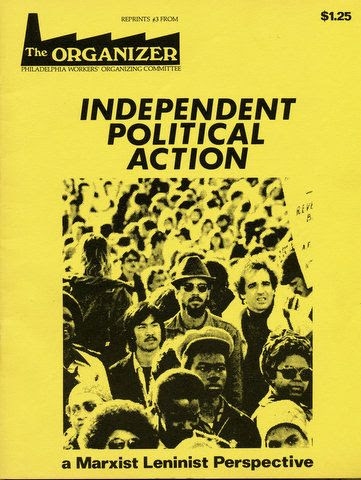
PWOC Commissions Review “The Organizer” [The Organizer, Vol. 3, No. 4, June 1977]
PWOC Convention Charts Future Course
The Soviet Union and southern Africa: Friend of the Liberation Forces? by Jenny Quinn
Overturn the Bakke Decision by Anna Gold
Our response to the Women’s Health Collective – The working class must lead women’s movement by Sara Murphy
An open letter to the Women’s Health Collective by the Organizer Staff [The Organizer, Vol. 3, No. 9, November 1977]
Do communists want your color tv? by Jim Griffin
Women’s Health Collective Responds to PWOC
Karl Marx: Tyrant? Hippie Bum? by Jim Griffin
Women’s Liberation – A Revolutionary Struggle Against Capital
U.S. Rulers Divided: The Salt II Debate by Jenny Quinn and Jim Griffin
Letter to The Organizer: More on the SALT II Debate [and Organizer response]
On Party-Building, Against Revisionism and Dogmatism [Reprints from The Organizer #1]
On Trade Unions and the Rank and File Movement [Reprints from The Organizer #2]
Independent Political Action. A Marxist-Leninist Perspective [Reprints from The Organizer #3]
[Back to top]
The Proletarian Unity League: Where We Came From, What We Look Like, What We Do by the PUL Unity Work Team
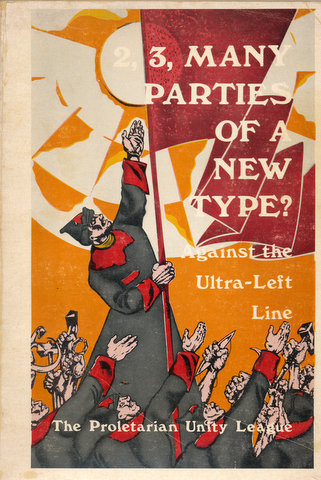
Exposing ultra-’left’ illusions/PUL downplays international line by Irwin Silber
Party-Building Line and the Fight against “Left” Opportunism [PUL reply to Irwin Silber]
Party-building: PWOC view of the Proletarian Unity League. On theory, unity and fusion (first in a series) by Clay Newlin
Party-building: PWOC view of the Proletarian Unity League. Political line and party-building (third in a series) by Clay Newlin
Party-building: PWOC view of the Proletarian Unity League. PUL’s Distortion of the ’left’ Line (fourth in a series) by Clay Newlin
Proletarian Unity League Responds: Fusion and the “Anti-Dogmatist” Phrase
A Response to PUL: Clearing Away the Fog by Clay Newlin
“It’s Not the Bus”: Busing and the Democratic Struggle in Boston, 1974-1975
On the October League’s Call for a New Communist Party – A Response by the Proletarian Unity League
2, 3, Many Parties of a New Type? Against the Ultra-Left Line
The Ultra-Left Danger and How to Fight It. Three Articles on “Anti-Dogmatism”
[Back to top]
Why the Red Dawn? [Red Dawn, No. 1, April 1978]
The Split in the Workers’ Congress (M-L): Statement of the Former Members of the New York District, Part 1: The Abandonment of the ISKRA Plan [Red Dawn, No. 1, April 1978]
The Split in the Workers’ Congress (M-L): Statement of the Former Members of the New York District, Part 2: In Defense of Democratic Centralism [Red Dawn, No. 1, April 1978]
Never Forget Class Struggle! [Red Dawn, No. 1, April 1978]
Letter of Resignation from the W.C. by former members of the political standing committee [Red Dawn, No. 1, April 1978]
* * *
The International Situation: Concerning our Views
[Back to top]
The San Francisco-based Red Guard Party was founded in February 1969 and disbanded in July 1971. Influenced by the Chinese Cultural Revolution and the example of the Black Panther Party, the Red Guard Party espoused Mao Zedong thought, advocated armed struggle and viewed itself primarily as a military rather than a political organization. By 1971, this focus on military rather than political organizing and other contradictions led to the Party’s break-up, but a group of former militants went on to join I Wor Kuen.
History of the Red Guard Party
Red Guard on Grant Avenue by Stanford M. Lyman
Black Panthers, Red Guards, and Chinamen: Constructing Asian American Identity through Performing Blackness, 1969-1972 by Daryl J. Maeda
Yellow Power: The Formation of Asian-American Nationalism in the Age of Black Power, 1966-1975 by Jeffrey O. G. Ogbar
Red Guard Program and Rules by the Red Guard Party
[Back to top]
Resistencia Puertorriqueña began as a small group of radical Puerto Ricans in New York city who started publishing a small mimeographed newsletter, RESISTENCIA on July 25, 1970. Written exclusively in Spanish, it bore the inscription “In exile”, indicting that Puerto Ricans in the U.S. were part of the Puerto Rican nation, and as such were living “in exile”.
In July 1971, RESISTENCIA became bilingual publication and the group began to involve itself in the party building efforts of the New Communist Movement, participating in the Communist League’s National Continuations Committee. Breaking with the CL, Resistencia then gravitated toward the Revolutionary Wing of PRRWO-RWL, but soon broke with them as well. In August 1976, it renamed itself the League for Proletarian Revolution (M-L)(LPR) and began to expand its work, creating a mass organization called the National Liberation Struggles Support Committee.
In 1978 LPR drew close to another group, the Colorado Organization of Revolutionary Struggle (COReS). In 1980 the two groups merged to form the Marxist-Leninist League.
The Struggle Against Left Opportunism – League for Proletarian Revolution by the August 29th Movement [The Red Banner, #2, Summer 1977]
In Struggle Against Left Sectarianism: Some Experiences with L.P.R.-M.L. by the Marxist-Leninist Collective
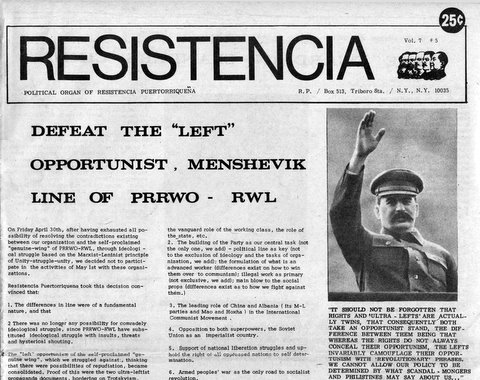
Resolution of the Conference of North American Marxist-Leninists on Creating a Continuations Committee [People’s Tribune, Vol. 5, No. 5, June 1973]
Puerto Rico: Superports, Symbol of Imperialism [published in People’s Tribune, Vol. 5, No. 7, August 1973]
Voice of the Puerto Rican National Minority?
Our Views on the Communist Movement in the United States
Sum-up of the Coalition for International Working Women’ Day
OL’s Sham Attempt at Party Building
Defeat the “Left” Opportunist, Menshevik Line of PRRWO-RWL
Using Hinton as straw man: The Guardian Slanders China
League for Proletarian Revolution
Who’s Engaging in Line Struggle?
Actively Take Part in the Struggle for Party Building
Self-Determination for the Puerto Rican Nation! (Part II)
WVO’s “Unite to Expose”: A policy of class collaboration
Dialectics of the development of the “C”LP: From “left” wing Trotskyism to right wing Trotskyism [Resistance. Vol. 7, No. 9, October 26, 1976]
International Communist Movement Hails Victories of China and Albania!
Independence for Puerto Rico! [Resistance. Vol. 8, No. 1, January 1977]
On the Question of Organization: The Building of Cores [Resistance. Vol. 8, No. 1, January 1977]
Comradely Polemics with ATM-ML: The Present Situation & Our Tasks
Exchange with the Marxist-Leninist Collective on Building Communist Cores [Resistance, Vol. 8, Nos. 3-4, April 1977]
Speech at Denver Party Building Forum, March 1977
WVO: from “Unite to Expose” to “Hide to Expose”
Daily World Traitors Picketed [Resistance, Vol. 8, No. 6, July 1977]
Look Who's Lecturing the “C”PUSA... [Resistance, Vol. 8, No. 7, August 1977]
N.L.S.S.C. Defeats Liquidators
Panama: Against a Social Chauvinist Trend
Cheap Shots are not Ideological Struggle
LPR’s Views on the International Situation
On Party Building: Right Opportunism is the Main Danger
OL-CP’s “Marxist-Leninist Unity Committee” is Not the Road to Communist Unity
Reply to R.C.L.(M.L.M.): Distorting an Opposing Line is not Marxism-Leninism
On Party Building and the RCP Split. Line Struggle, or Squabble between Opportunists?
LPR(M-L) Launches Rectification Campaign
Rectify Our Style of Work! Combat Spontaneity
The Struggle to Rectify Continues
The Struggle in Kampuchea. Articles from the pages of Resistance!
A Repulsive Editorial: Albania Praises Vietnamese Invasion of Kampuchea and Attacks China
COReS (mlm) and LPR (m-l) On Road to Higher Unity
Danger of War & Party Building
Social Chauvinism in U.S. & Nicaraguan Revolution
Progress Report: Forward COReS-LPR merger!
COReS-LPR Joint Statement: Our work within the working class movement
LPR-ML and COReS-MLM Complete Meger – Marxist-Leninist League Founded
[Back to top]
A Beginning Analysis of the Woman Question
Revolutionary Workers Collective Position on the International Situation
RWC Strike Sum-Up: Party Building Tasks
RWC Strike Sum-Up: Trade Union Tasks
[Back to top]
The Revolutionary Workers League (RWL) was formed in January 1974 from Marxist-Leninist elements active in the Youth Organization for Black Unity a nationwide student/youth organization, the Malcolm X Liberation University in Durham, North Carolina, Abdul Alkalimat’s People’s College, and the African Liberation Support Committee. At its birth, it was the largest black Marxist organization in the New Communist Movement.
While continuing to organize around support for African liberation movements and struggles in Black communities, in the period 1975-6, the RWL went through a series of internal struggles over its relationship to other new communist movement groups. Some leaders wanted the RWL to orient toward the October League and its party building process. Others favored collaboration with the Revolutionary Union as it moved toward the formation of the Revolutionary Communist Party. But the line that ultimately won out oriented the RWL toward the Puerto Rican Revolutionary Workers Organization (PRRWO), the Workers Viewpoint Organization (WVO) and the August 29th Movement, who were loosely grouped together as the Revolutionary Wing. However, sharp differences developed within the Wing itself [for more on this see here] and ultimately, while some cadre left the RWL to join WVO, in 1977, the RWL consolidated organizationally with PRRWO to create the U.S. Leninist Core.
Malcolm X Liberation University: An Experiment in Independent Black Education by Brent H. Belvin
Education for Liberation: Malcolm X Liberation University By Rebecca Wilson
The Rise and Fall of the Revolutionary Workers League by Ron “Slim” Washington
Steeled in Struggle – History of the Two Line Struggle in the RWL
Philistinism of the PRRWO & RWL Exposed! by the Workers Viewpoint Organization
Two Roads to Party Building by the Bolshevik Organizing Collective/Communist Workers Committee (M-L)
Presentation on Party Building: Expose the Anarcho-Socialism of PRRWO/RWL! by the Union for Working Class Emancipation
RWL and OL: Two Wings of Same Bird by the Committee for Scientific Socialism (M-L)
RWL/ALSC Appendix by the Committee for Scientific Socialism (M-L)
Wreckers Cripple African Liberation Support Committee from The Call
Expose RWL’s ’Left’ Opportunism on the International Situation by Workers Viewpoint Organization [Workers Viewpoint, Vol. 1, No. 3, Special Supplement, June 1976]
RWL: Building the Party on Bourgeois Ideology. A call to struggle against ’left’ opportunism by the Communist Workers Committee (M-L)
Dying Screams of the PRRWO/RWL Clique and Responding Echoes from Assorted Opportunists by the Workers Viewpoint Organization
An Open Letter to a District and all Revolutionary Workers League Comrades by the Bolshevik Organizing Collective
Party Spirit or Circle Spirit? Expose RWL/PRRWO’s Menshevism on the Organizational Question by the Workers Viewpoint Organization
PRRWO & RWL: Not a “Revolutionary Wing”, But a Dangerous Duo! by the Revolutionary Communist League (M-L-M)
Bolshevik, No. 1 [May 1976]
Superpowers Out of Angola. Self-Determination for the Angolan Masses!!
[Back to top]
The Revolutionary Workers Press was a one or two person anti-revisionist effort located in Denver, Colorado.
Down with the Shah! Down with U.S. Imperialism! Down with the “Theory of Three Worlds”
Eritrea: At War with Revisionism and Soviet Social-Imperialism
[Back to top]
The Rhode Island Student Movement was a unit of the American Student Movement, associated with the American Communist Workers Movement (Marxist-Leninist).
Meeting Announcing the Formation of Rhode Island Student Movement, Anti-Imperialist [flyer]
Jargon and the College Student
Black “Leadership” In Service to U.S. Imperialism
Progress of the Rhode Island Student Movement
Class Struggle Within the Movement is Just Fine!
The Ideological Preparation for the Acceptance of Fascism is the Everyday Activity of the U.S. Imperialists [North America News, April 23, 1972
Let Us Take Up the Aspirations of the American Working Class as Our Own! Build the American Communist Workers Movement (Marxist-Leninist)! [North America News, May 30, 1972
Revolutionary Students and Intellectuals Have a Great Role to Play in the American People's Struggle Against Fascism [North America News, August 20, 1972
Address by Representative of American Communist Workers Movement (M-L) at R.I. Student Movement Forum to Combat Cultural Fascism [North America News, August 20, 1972
Political Deception and Betrayal Can't Keep Students from Joining the Workingclass – R.I. Student [North America News, October 10, 1972
[Back to top]
The San Diego Organizing Committee (Marxist-Leninist) was a small Marxist-Leninist group formed in the summer of 1975. In late 1977 it dissolved with its members joining the Workers Congress (Marxist-Leninist).
S.D.O.C. Introductory Statement
Summing Up Calif. Proposition 14: Defend the Right to Unionize
A Communist View: Contradictions in the Family
Prop. 14 and the Struggle vs. Opportunism
SDOC (M-L) Comments: Uphold Our International Leadership!
United and Exposed: League of Struggle’s Unprincipled Conciliation with Local Bureaucrats
Winning the Vanguard to Communism
[Back to top]
The San Diego Revolutionary Anti-Imperialist Collective was a small group which began life as the Ocean Beach Revolutionary Anti-Imperialist Collective. Its members, who came out out the struggles against the Vietnam War, later became involved in community organizing in the Ocean Beach neighborhood of San Diego. The group was heavily influenced by the Praire Fire Organizing Committee.
[Back to top]
Statement on the Symbionese Liberation Army by ex-Venceremos of San Mateo Country and the San Francisco Marxist-Leninist Organization
Against Opportunism and Amateurishness: The Struggle to Build the Party
Reply to Carl Davidson [On Loren’s The Struggle for the Party]
[Back to top]
The Seattle Communist Workers Group was a small Marxist-Leninist collective close to the Workers Congress (M-L).
[Back to top]
The Seattle Workers Movement was a small group under the leadership of the Seattle Branch of the Central Organization of U.S. Marxist-Leninists. It published the Seattle Worker. Also under its leadership was the Afro-Asian Latin American Solidarity Forum (Seattle) which issued a newsletter called The Patriot.
[Back to top]
Seize The Time was a small Marxist-Leninist collective in Moutain View, California active from 1973 until 1979 when it merged with the League of Revolutionary Struggle.
Seize The Time newspaper, 1974-1976
Editorial: Purpose of the Paper [Seize The Time, Vol. 1, No. 1]
On Organization in the Revolutionary Movement [Seize The Time, Vol. 1, No. 2]
Mobilization, Counter-Mobilizing and the Revolutionary Movement [Seize The Time, Vol. 1, No. 4]
Against White Chauvinism: Toward Proletarian Internationalism [Seize The Time, Vol. 1, No. 4]
Struggle in VVAW/WSO [Seize The Time, Vol. 1, No. 5]
A Year of Practice [Seize The Time, Vol. 2, No. 1]
National Liberation and Propaganda [Seize The Time, Vol. 2, No. 1]
Mass Line and Scientific Socialism [Seize The Time, Vol. 2, No. 2]
The Political Line of Seize The Time [Seize The Time, Vol. 2, No. 5]
Seize the Time on the Principal Contradiction
Seize the Time Collective Greets the Founding of the League of Revolutionary Struggle (M-L)
Statement by Seize the Time on Uniting with the League of Revolutionary Struggle (M-L)
[Back to top]
The Socialist Organizing Committee was formed in 1975 in Orange County, California out of a variety of groups and individuals who came out of the white new left. These included independent Marxist-Leninists, members of a Left History study group, students and teaching assistants from the University of California-Irvine, petty bourgeois intellectuals off campus, county workers, and workers in factories and the skilled building trades.
Later that year, SOC joined the New America Movement (NAM), where it struggled to promote a Marxist-Leninist line. A year later, SOC left NAM and became an independent Marxist-Leninist collective.
The History of the Socialist Organizing Committee
NAM and Electoral Politics: The Tom Hayden Campaign [from Notes from Orange, #1 (Fall 1977)]
The Socialist Organizing Committee, Orange County: Why We Are Leaving NAM [from Notes from Orange, #1 (Fall 1977)]
What We Mean by Marxism-Leninism [from Notes from Orange, #1 (Fall 1977)]
What We Mean by the Mass Line [from Notes from Orange, #1 (Fall 1977)]
What We Mean by Revisionism [from Notes from Orange, #1 (Fall 1977)]
What We Mean by Opportunism [from Notes from Orange, #1 (Fall 1977)]
What We Mean by Pragmatism [from Notes from Orange, #1 (Fall 1977)]
What We Mean by Revisionism [from Notes from Orange, #1 (Fall 1977)]
Community Work [from Notes from Orange, #1 (Fall 1977)]
Campus Work [from Notes from Orange, #1 (Fall 1977)]
Women’s Issues [from Notes from Orange, #1 (Fall 1977)]
The Oppression of Homosexuals [from Notes from Orange, #1 (Fall 1977)]
SOC Study [from Notes from Orange, #1 (Fall 1977)]
[Back to top]
Venceremos began as a Chicano political organization in Redwood City, California in early 1969. In 1971, a split developed in the Revolutionary Union [documented in Red Papers 4]. As a result of the split, over half of the Bay Area Revolutionary Union, led by H. Bruce Franklin, one of the RU’s founders and including all the collectives from South San Francisco through Sunnyvale and some in San Jose, merged into Venceremos. The expanded organization was active in youth organizing, factory organizing and anti-imperialist struggles on Bay Area campuses.
Venceremos advocated armed self-defense, community control of the police, and reform of the prison system. To these ends, the group’s members engaged in a variety of activities, including working in prison education programs and running candidates for the Palo Alto City Council.
Venceremos broke up in 1972. Some of its former members went on to found the San Francisco Marxist-Leninist Organization in 1973, which the following year merged with the San Francisco-based League for Proletarian Revolution.
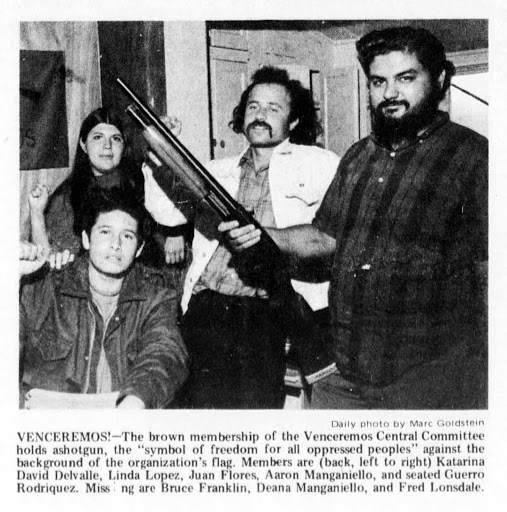
It is Right to Rebel. Local Cadre Leave the Revolutionary Union
It Is Right to Rebel, Self-Criticism
Revolutionary Union Splits Over Differences In Ideology, Tactics by Bill Evers
Venceremos Stresses Action, Not Theory by Ed Kohn
Venceremos: Action, Not Theory. University Complicity Attacked by Ed Kohn
Panther Split Precipitates Division In Venceremos by Bill Evers and Ed Kohn
Venceremos Leadership Denounces ’Racist Sissies’ by Bill Evers and Ed Kohn
Campus Venceremos Splits by Bill Evers
Venceremos Stresses ’Centralism’ by Kevin Smith
Letter: Venceremos Democracy by Peter Ober
Local Panther Group Runs ’Survival Programs’ by Gary Atkins
Reply to ’Daily’ article: Clarify Venceremos’ Position by Rick Cumings
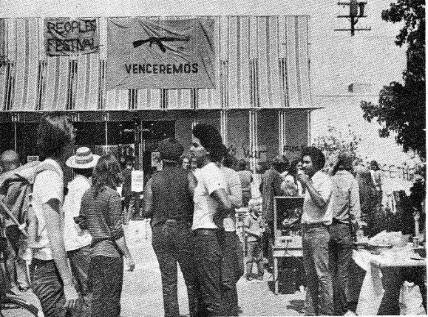
Blood On Agnew’s Hands by Rick Cumings
The Bruce Franklin Affair by Rachelle Marshall
Internal Security Investigation: Venceremos Cited In House Report by Glenn Garvin
America’s Maoists: The RU And Venceremos by Bill Evers
Venceremos Top Committee Ousts Manganiello As Head
Venceremos Disbands; Group Localism Blamed by Bill Evers
Editorial: Venceremos In Retrospect by The Stanford Daily
Former Venceremos Leaders Deny Charges Of SLA Ties by Jim Wascher
Academic Freedom and the Campus Revolution: The Dismissal of H. Bruce Franklin by James D. Wascher
Against Opportunism and Amateurishness: The Struggle to Build the Party by the San Francisco Marxist-Leninist Organization
Venceremos Principles of Unity
Franklin’s Statement To Trustees
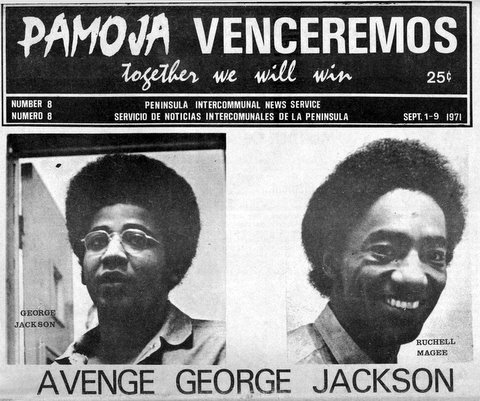
“Chairman Mao Sez” cartoons by Leif Erickson [from 100 Flowers, No. 1, Spring 1971]
Against Revisionism: In Defense of the Black Panther Party, 1966-1970
Avenge George Jackson [Pamoja Venceremos, No.8, September 1-9, 1971]
The Economics of Fascism [Pamoja Venceremos, No.8, September 1-9, 1971]
Venceremos Central Committee, circa December 1971 [photo]
Why Stanford is Trying to Fire Bruce Franklin
Bruce Franklin Talks on Revolution
On the Freeing of Angela by the Central Committee of Venceremos
Industrial Warfare [Pamoja Venceremos, Vol. 2, No.12, June 10-24, 1972]
Bay Area Organizations’ Letter to the Communist League [People’s Tribune, Vol. 4, No. 8, September 1972]
National Elections and the Revolutionary Movement: George McGovern – Friend or Foe?
SF Newsreel Expels Racist Leadership [Venceremos, Vol. III, No.6, May 25-June 7, 1973]
The Meaning of Watergate [Venceremos, Vol. III, No.6, May 25-June 7, 1973]
1 Out of 16 Vote for Armed Communist Revolution [Venceremos, Vol. III, No.6, May 25-June 7, 1973]
[Back to top]
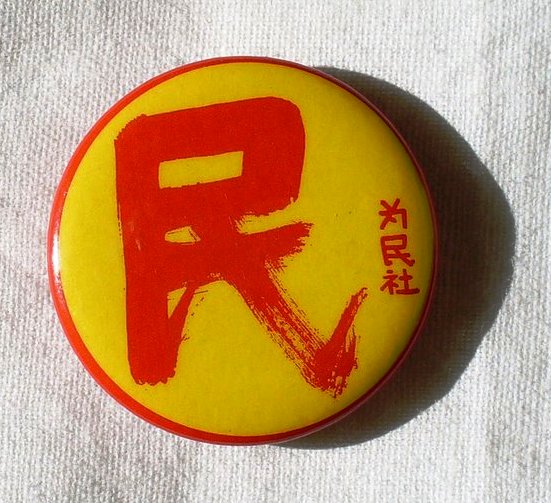
Wei Min She was a Marxist-Leninist Organization based in the San Francisco Bay Area. It had it origins in the Asian Community Center (ACC), which had been created by the Berkeley Asian American Political Alliance in March 1970. In 1972, the ACC decided to become an explicitly revolutionary, anti-imperialist organization and renamed itself Wei Min She (Organization of the People).
Initially primarily a community-focused group, active in labor and neighborhood struggles in San Francisco’s Chinatown, Wei Min She gradually developed into a Marxist-Leninist cadre organization.
In 1973-74, Wei Min She had sharp differences with I Wor Kuen, the other Marxist-Leninist group active in San Francisco’s Chinatown. In this same period it drew close to the Revolutionary Union, ultimately merging with it when the RU became the Revolutionary Communist Party in 1975.
History of Wei Min She by I Wor Kuen
Opportunism in the Asian Movement – Wei Min She/Revolutionary Union by I Wor Kuen
On Wei Min She’s “Reactionary Line” by I Wor Kuen
Asian Contingent Solidarity Statement by Wei Min She and others
[Back to top]
The Witchita Communist Cell (WCC) was a small Marxist-Leninist group which developed in Witchita, Kansas out of the mass anti-war and anti-imperialist movements of the 60’s and 70’s. Beginning with a series of M-L study circles, it was formally established in the Fall of 1976.
In 1977, the WCC rejected the “theory of three worlds” and accepted the Party of Labor of Albania as the leading center in the international communist movement. The following year, working with two other Kansas M-L groups – the Kansas City Revolutionary Workers Collective and the Kansas Collective for Proletarian Revolution – the WCC attempted to unite various other pro-Albania groups in party building. In particular, in early 1979, the WCC issued a call for a multilateral conference on party building. It seems that this effort was unsuccessful and the conference does not appear to have been held.
In 1980 the Witchita Communist Cell changed its name to the Kansas City Marxist-Leninist Cell. The following year, in August, it merged with the Kansas City Revolutionary Workers Collective to form the Organization for a Marxist-Leninist Workers’ Party U.S.A.
History of the Witchita Communist Cell [from the pamphlet The Building of the Vanguard Party of the U.S. Proletariat]
Announcement of a Multilateral Conference (MULC) on Party Building
The Building of the Vanguard Party of the U.S. Proletariat by the Kansas City Revolutionary Workers Collective and Witchita Communist Cell
Toward the Development of the International Marxist-Leninist Trend: A Contribution to the Criticism of the Revisionism-Centrism of Mao Zedong Thought and the Party of Labor of Albania by the Kansas City Marxist-Leninist Cell and the Kansas City Revolutionary Workers Collective
Letter to All Participants of the November 8, 1980 Forum in New York by the Kansas City Marxist-Leninist Cell and Kansas City Revolutionary Workers’ Collective
[Back to top]
The Worker-Student Organizing Committee was a small Marxist-Leninist group active in New York City in the 1970s.
The Worker-Student Organizing Collective (WSOC): A Brief History, by John Ziv
Principles of Unity – Worker-Student Organizing Collective (WSOC)
The Trade Union Movement: A Marxist Analysis
Women: the struggle for liberation
[Back to top]
The Worker Unity Organization was a small collective in St. Louis, Missouri. In the mid-1970s it was briefly a part of the Sojouner Truth Organization’s Federation of Marxist-Leninist Organizations. After leaving the Federation it oriented itself to the Organizing Committee for an Ideological Center.
Breaking with ’Local-Circle Mentality’ in the Fight against Revisionism by Clay Claiborne
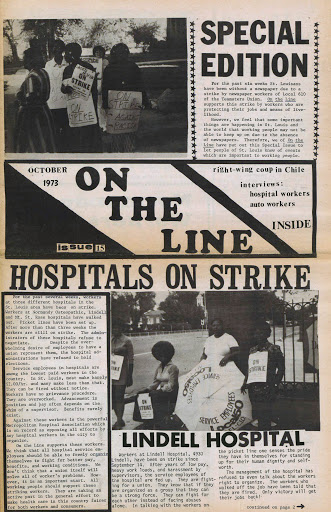
What We Believe [On The Line, #1, n.d.]
Life in China. A St. Louisan’s impressions [On The Line, #9, n.d.]
China: Health Care Serves the People [On The Line, #15, October 1973]
Racism: Still a Problem? [On The Line, #18, May 1974]
Worker Unity Viewpoint: Socialism: Working People’s Economy [On The Line, #19, July 1974]
Worker Unity Viewpoint: Socialism and Freedom [On The Line, #20, October 1974]
Worker Unity Viewpoint: Socialism in Russia [On The Line, #21, December 1974]
Workers’ Solidarity Day flyer [February 1975]
American Describes Chinese Factory Life [On The Line, #23, April 1975]
Who We Are [On The Line, #25, August 1975]
Sharing Under Socialism: Rationing [On The Line, #25, August 1975]
Angola: Fight For Freedom [On The Line, #27, December 1975]
Who We Are [On The Line, #28, March 1976]
National Black Assembly Meets: Which Way in ’76 [On The Line, #28, March 1976]
Hard Times in Chicago: National Conference on Economic Crisis [On The Line, #28, March 1976]
Notes for the February 1978 [OCIC] Conference
[Back to top]
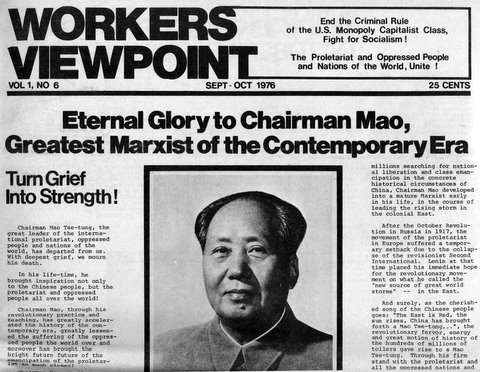
The Asian Study Group (ASG) was formed in the early 1970s by Jerry Tung, who had formerly been a member of the Progressive Labor Party. Initially, ASG consisted primarily of Asian-Americans in New York's Chinatown. In 1976, the group changed its name to the Workers Viewpoint Organization (WVO) when it merged with a group in Philadelphia called Yellow Seeds. WVO launched Asian-Americans for Equal Employment and actively competed with other Chinese Marxist-Leninist groups in the community.
Through its participation in national party building activities including, for a brief time, the “Revolutionary Wing”, WVO was able to attract members from other groups, including some active former members of the Revolutionary Workers League.
In October 1979, with several hundred members, WVO would change its name to the Communist Workers Party.
Short History of Yellow Seeds in Philadelphia, 1972-1977
Closed to Protest Police Brutality. Mobilizing Early Asian America by Ryan Lee Wong
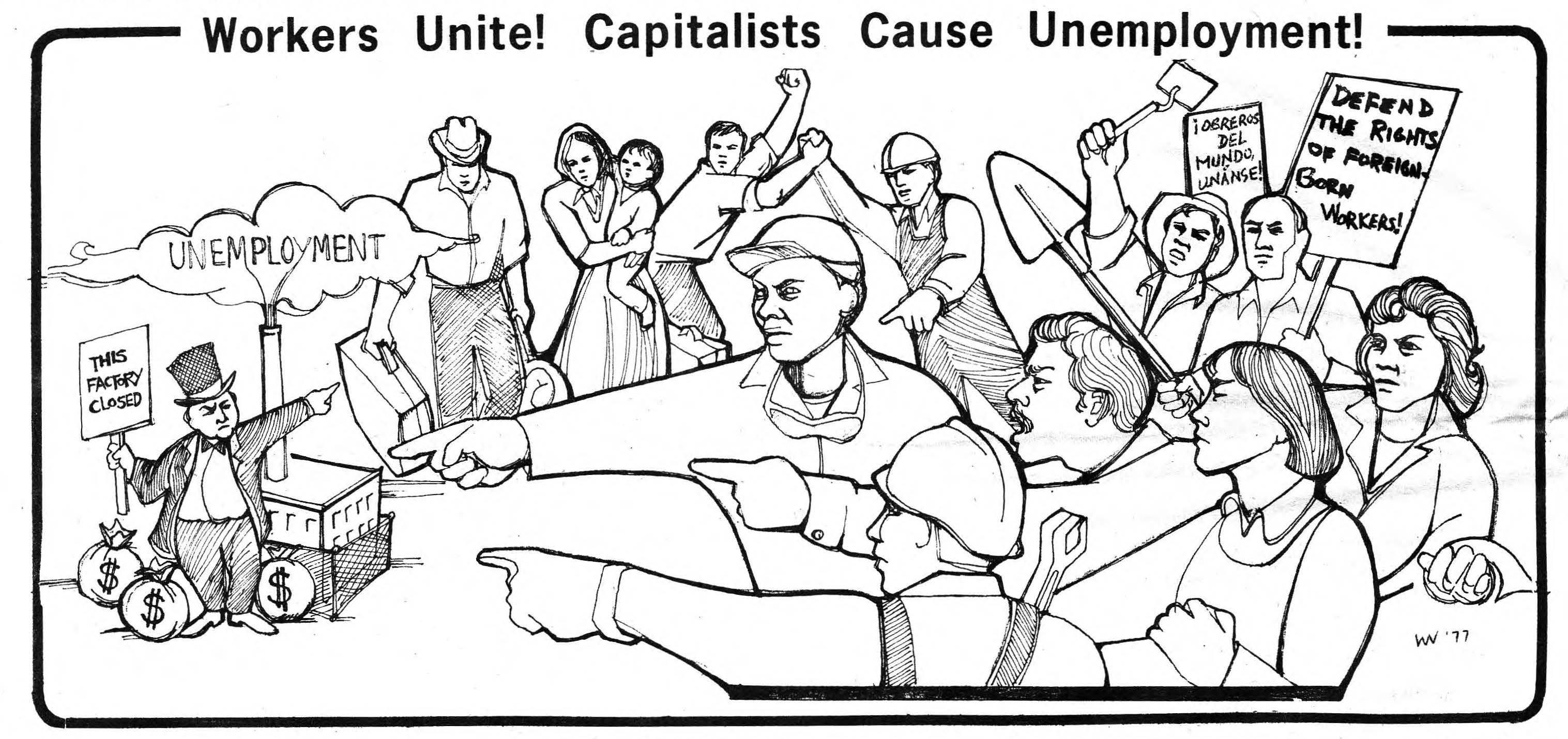
“Workers Viewpoint”: Spreading the Viewpoint of the Bourgeoisie by the October League (Marxist-Leninist)
W.V.O.’s Forum Backfires by Resistencia Puertorriqueña
Workers Viewpoint Organization Undermining Arab Unity from The Call
WVO’s “Unite to Expose”: A poiicy of class collaboration by the League for Proletarian Revolution (M-L)
WVO Proclaims Itself General Staff by the August 29th Movement
W.V.O. Kicked Out Of Chicago Forum: National Movements – Main Allies of the Working Class by the August 29th Movement
WVO: from “Unite to Expose” to “Hide to Expose” by the League for Proletarian Revolution (M-L)
WVO Esposes Itself – Again – at Women’s Conference [Resistance, Vol. 9, No. 6, August 1978]
AAFE can’t hide its anti-China role
Attack by WVO thugs in New York
WVO continues gangster tactics
The Chinese National Question by the Asian Study Group
Better Defender of the Bourgeoisie than the Bourgeoisie Itself – On the ’Communist’ League
Marxism or American Pragmatism? The Right Opportunist Line of the R.U.
Party Building and Anti-revisionist Premises
The October League: A Most Dangerous Revisionist Trend in U.S. Communist Movement
The Boston Forced Busing Plan: The Dialectics of Bourgeois Formal Democracy and Fascism
Periods and Types of National Questions
Racism, Nationalism and Race Theory: Relations Between Material Base and Ideology
Liquidationism on the Afro-American Nation: CPUSA, 1919-1940
To the Forefront of Struggle: Crucial Tasks of Communists in the Economic Crisis
Workers Viewpoint Supplement: Which Way Out of the Crisis?
April 26: “C”PUSA and All Reactionaries Say “It’s Terrible,” & We Say “It’s Fine”
Degenerate Culture and the Women’s Question
Philistinism of the PRRWO & RWL Exposed!
PRRWO: Anarcho-Socialism U.S.A. Expose PRRWO’s Hustlerism!
Slipping and Sliding: October League, the Most Dangerous Revisionist Trend in the Communist Movement and Their Call for the Party[Workers Viewpoint Journal #4, n.d.]
Angola Will Win! [Workers Viewpoint, Vol. 1, No. 1, March 1976]
Gun Control – A Step Toward Fascism [Workers Viewpoint, Vol. 1, No. 1, March 1976]
Expose the E.R.A. [Workers Viewpoint, Vol. 1, No. 1, March 1976]
Celebrate Int’l Working Women’s Day by the Chinatown Coalition for International Working Women’s Day
On Angola: Guardian Fully Degenerated, No Longer in the Communist Movement
Expose RWL’s ’Left’ Opportunism on the International Situation [Workers Viewpoint, Vol. 1, No. 3, Special Supplement, June 1976]
Bicentennial: Fight Imperialism & Opportunism
Capitalist Roaders Still on the Capitalist Road: Once Again on the October League
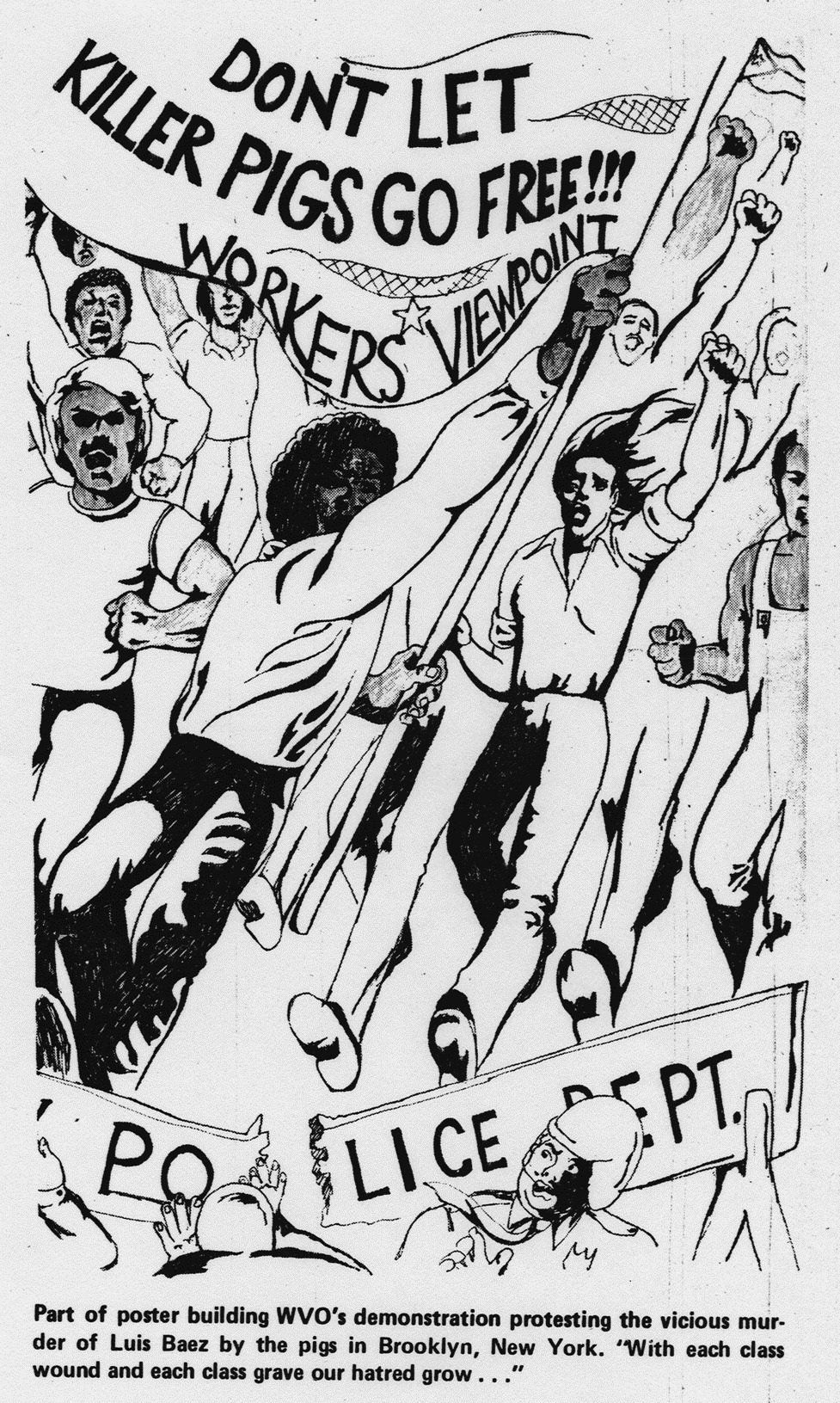
RCP Helps Ruling Class “Celebrate” Bicentennial
Dying Screams of the PRRWO/RWL Clique and Responding Echoes from Assorted Opportunists
Miners’ Struggle Surges Forward. October League Wags Tail for New Misleaders
October League’s Organizing Committee Forums: ’Unity Trend’ Hangs Itself!
Reprint of WVO Leaflet for OLOC Forum
Bourgeoisie Attacks WVO in Frenzy! Advance Our Work Forward!
Strategy and Tactics: OL & RCP Revise Marxism on the International Situation
RCP Discovers ’Theory in its Own Right’
Nicholaus vs OL: A Menshevik’s Criticism of Menshevism
October League’s Organizing Committee Doomed from the Start
Formation of the Genuine Communist Party is Single Greatest Step Towards Fusion!
ALSC: RWC Paves Way for RCP Takeover
RCP: Reversing Verdict on Soviet Social Imperialism is Total Treachery
The October League – Revisionist to the Bone. Touched to Their Soul by the Bourgeoisie
Auto workers on the move against capitalism! [WVO’s Auto Bulletin #5]
Rebuild ALSC by Correcting Methods of Leadership
Defend Zaire’s Sovereignty! Soviet Social Imperialists Back Invasion
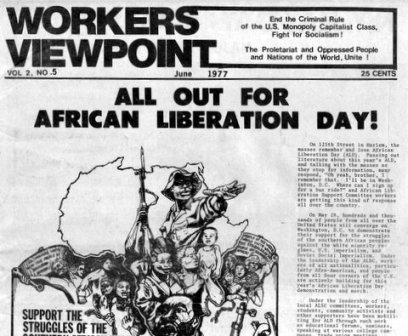
N.Y. May Day: 1000 Strong, Workers March Led by WVO: Major Speech from Central Committee of WVO
Grasp Lessons of Historic May Day 1977
Broad Horizons–Blitz Campaigns: The Trade Union Education League
Blackout Sheds Light on RCP’s Chauvinism
WVO Holds Nationwide Commemoration For Chairman Mao
Chairman Mao, Live Like Him, Dare to Struggle, Dare to Win! [WVO speech at Mao Commemoration, September 10, 1977]
Excerpts from WVO Speech at TUEL Founding Convention
Sum-Up, Study and Self-Criticism on the Mass Line Question
Yellow Seeds newspaper, 1972-1975 [thanks to Tamara K. Nopper]
Workers Viewpoint [newspaper]
[Back to top]