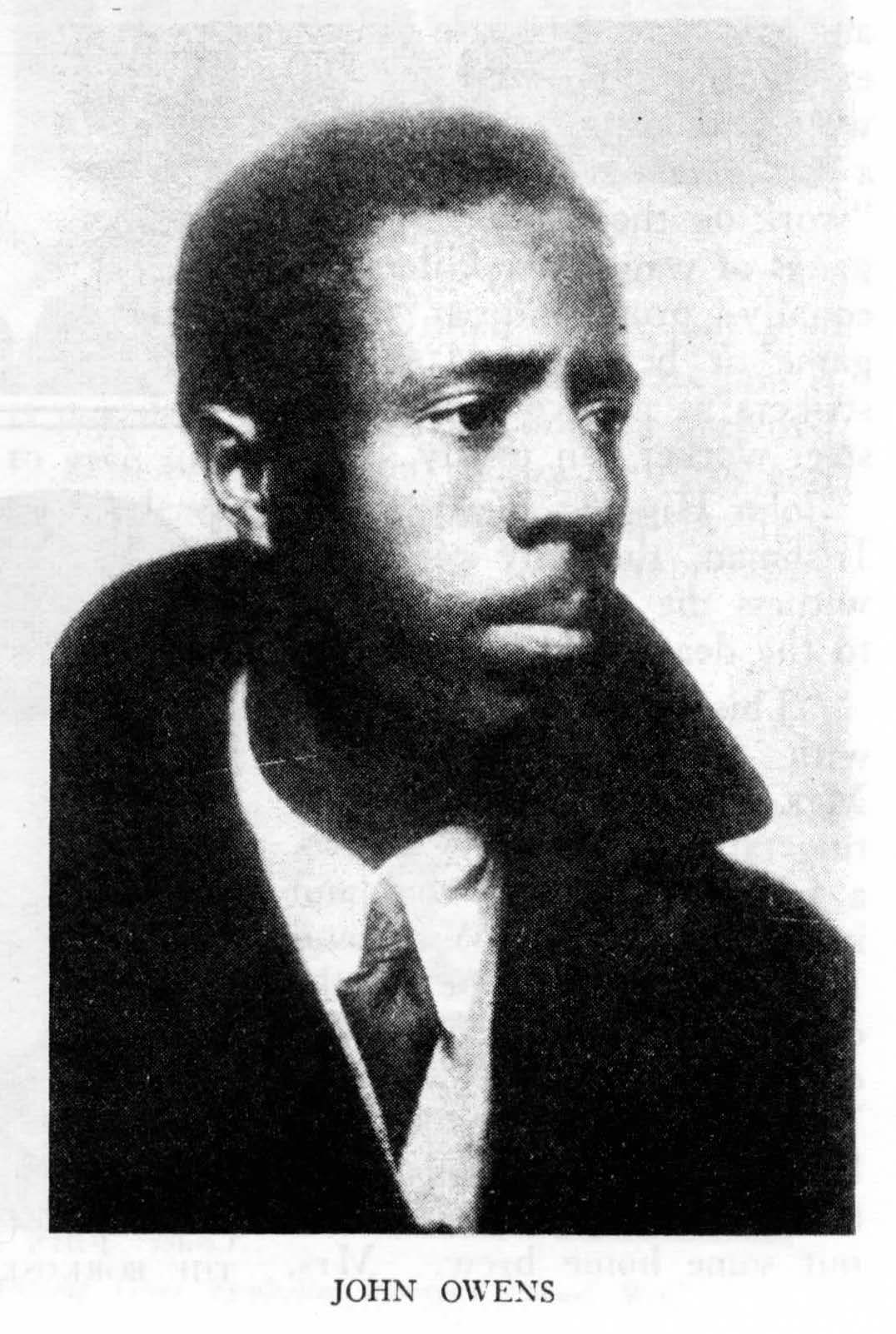
John H. Owens
* * *
Comparatively little is known about the life of John H. Owens, a 1920s Black activist and Communist organizer. His name first begins appearing in articles in the Communist Party USA’s newspaper, the Daily Worker, in 1925. Reporting from Ripley, California, they discuss the problems of tenant farmers and Black farm laborers in the state. Owens himself is variously described as a tenant farmer, an organizer of Negro agricultural workers, a leading Negro Communist among the poor farmers of California, and, more colorfully, as a “farm worker of California, who, gun in hand, had defended himself from the attacks of the “segregationists” in the San Pedro Valley in California.”
We can’t be sure that this is the same John H. Owens, but W.E.B. DuBois has an interesting editorial in the October 1921 issue of his magazine, The Crisis. In it, he references a letter he received from a “John H. Owens of Washington” discussing why Black Americans should look with favor on the “proletarian movement.” Such views would certainly be consistent with the John H. Owens who would begin writing for the Communist press four years later.
In addition to his organizing efforts in California, Owens participated in national Communist activities. He was, for example, one of the signers on the call for the founding of the American Negro Labor Congress (ANLC), for which he became an organizer.
A curious notice in A. Philip Randolph’s The Messenger for January 1928 reads: “J. B. Keim, one of the largest plantation owners and cotton farmers in the Palo Verde Valley of California, recently appointed John H. Owens, a Negro, supervisor of all his field hands, Mexicans, Indians, Negroes and Caucasians. Owens is highly respected by all.” We know this is the Communist John H. Owens because in an April 1929 article in the Labor Defender, he specifically states that his landlord was J.B. Keim. What the CPUSA made of this appointment, if anything, is not known.
Early in 1929, Owens appears to have been transferred to the East Coast where he was drawn into the work of the Party’s National Negro Department and its increasing focus on building a Party presence in the south. His transfer may have been in part a result of a dispute in the California CP over white chauvinism. A two-part series of articles in the Daily Worker in February 1929 accused the leadership of the state CP of white chauvinism and cited as proof their failure to utilize Owens’ talents in organizing and agitation.
In his book Hammer and Hoe, Robin D.G. Kelley asserts that Owens “opposed bringing Southern Blacks into the Party” citing a Daily Worker article from 1929 where he states that “the vast majority of southern Negroes are not revolutionary, not even radical.” A careful reading of the article itself, however, shows that Kelley is mistaken. Owens’ assessment of a lack of radicalism in the southern Black population is not offered as a reason to exclude them from the Party, but as a demonstration of the challenges facing Communists in recruiting them.
One of the CP’s 1929 campaigns of particular interest to the National Negro Department was the celebrated strike of Black and white textile workers in the Loray Mill in Gastonia, North Carolina, led by Party cadre Fred Beal, Albert Weisbord and his wife Vera Buch. Owens was sent by the Department to aid the strike effort, but recognizing the danger he was in, it also asked the Party’s Political Commission to send him his fare in case he had to leave in a hurry. Owens in fact remained in Gastonia only a short time before quickly returning to New York, where he filed a report on his trip. At a special meeting of the National Negro Department on April 15, 1929 Owens was severely criticized by Cyril Briggs and Otto Hall for his behavior in Gastonia and his decision to return to New York without consulting the other Party members there. The following resolution was unanimously adopted: “Motion that Comrade Owens be sharply censured by leaving his post of duty without instructions from the Party.”
There is some controversy surrounding Owens’ time in Gastonia. In his report to the Negro Department and in an article in the International Labor Defense magazine Labor Defender he states that he delivered a speech to a meeting of white strikers which drew an ethusiastic response. Glenda Elizabeth Gilmore in her book Defying Dixie: The Radical Roots of Civil Rights repeats this story about Owen’s positive reception by white strikers. Vera Buch recalls events differently. “Owens “made one brief scared appearance at Loray.” “I recall him standing by the car looking apprehensively at all those white people surrounding him.” He then, she states, quickly retreated to Charlotte before returning to New York.
Between these two conflicting reports it seems the latter is more probable. Black Communist Otto Hall, who followed Owens to Gastonia, in a letter to Cyril Briggs, complained: “As for that bunk Weisbord has been shouting about the strike down here doing away with race prejudice, that is a lot of bunk. The attitude of these cracker strikers toward the Negro has not been changed a bit.”
Owens’ relationship with the Party sharply deteriorated after he return from Gastonia. He complained that he was not being paid for his time spent there and his association with a certain “Jackson,” who already had been expelled from the Party, also stoked his dissatisfaction. Other Black cadre were aware of the problem. In a letter to Liston Oak Otto Hall writes: “tell Owens to be careful not to talk too much around him [Jackson] because he means harm to the Party.” Owens chose not to listen to this advice and in February 1930 he was expelled from the CPUSA.
I have not been able to discover what became of him after this.
* * *
Works:
1921: Socialism and the Negro, W.E.B. DuBois, The Crisis, October 1921
1925: Social Equality for the Negro, Daily Worker, January 22, 1925
1925: Negro Congress of Workers in Chicago Soon, Daily Worker, April 14, 1925
1925: Writer Calls for New Type of Leadership for Negro Workers, Young Worker, July 25, 1925
1925: Cotton Workers Force Bosses to Increase Wages After Strike, Daily Worker, November 17, 1925
1926: Negro Labor Congress Adds Many Branches, Esther Lowell, Daily Worker, March 5, 1926
1926: Poor Farmers and Agricultural Workers of Blythe Hear Owens, Daily Worker, March 27, 1926
1926: Workers Suffer in California Cotton Fields, Daily Worker, October 12, 1926
1927: Poor of All Colors United in a Common Misery in California, Daily Worker, March 16, 1927
1927: Peonage in the Golden State, Daily Worker, April 5, 1927
1928: Cotton Growers Enslave Workers in California, Daily Worker, March 27, 1928
1928: Negro Workers Find New Slave Driving State, Daily Worker, April 17, 1928
1928: Negro Leader Greets Meet, Daily Worker, May 18, 1928
1928: Poor Farmers Barely Exist in California, Daily Worker, July 18, 1928
1929: Problems of Communists in the South, Daily Worker, February 25, 1929
1929: Factionalism and Chauvinism in California, A. Busch, Daily Worker, February 25, 1929
1929: White Chauvinism in California, A. Busch, Daily Worker, February 27, 1929
1929: Race Discrimination in California, Labor Defender, April 1929
1929: Report of Trip to Strike Area, Gastonia, North Carolina, April 13, 1929
1929: Minutes, Special Meeting, National Negro Department, April 15, 1929
1929: May 1 Meetings Aid Communist Party Builders, Daily Worker, May 4, 1929
1929: [Gastonia] Strike Vignettes, Labor Defender, May 1929
1929: Plight of Negro Farmer, Agricultural Worker, in the South, Daily Worker, May 14, 1929
1929: Come Forth, Black Bard, [poem] Daily Worker, May 16, 1929
1930: Notice of Central Control Commission Decision on the Expulsion of John Owens, Daily Worker, February 6, 1930