Ru
Rubel, Maximilien (1905-1996)
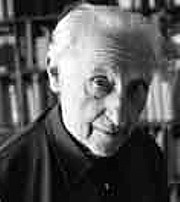 French sociologist, Marxist humanist and with T.B. Bottomore, a prolific publisher and translator.
Rubel began the study of the works of Marx during the German occupation of France. In 1948, Rubel enunciated his ethical interpretation of Marx: “the value of Marx at the present time is not so much as a scientific, therefore relative and debateable, economic theory, but more in the validity of his ethics and his radical critique of social institutions that prevent the full and free development of every individual, and consequently, of humanity.” According to Rubel, Marx had not become a revolutionary and a socialist by discovering the laws of the capitalist development, but was successful in identifying the essentially revolutionary dynamics of capitalism — capitalism is forced to bring to light a vision of a social organization that it must nevertheless suppress. In Marx, he wrote, two elements must be distinguished: the scientific analysis of the social relations of production within social economic formations, and the conception of Man, the agent of the history which refuses to be dominated. He dedicated himself to his role as a student of Marxism, which he understood as a return to an authentic Marx freed from the interpretation of Marxists. Rubel was a critic of “really existing Socialism,” judging their ideological superstructure to represent the false consciousness of the bureaucratic caste that had approriated from the proletariat the role of its representative.
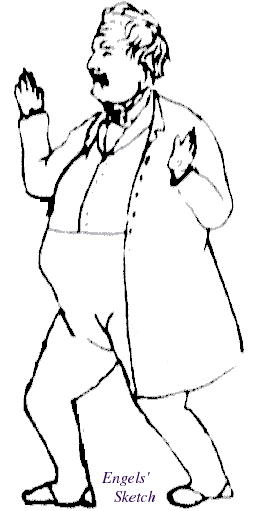
Ruge, Arnold (1802 - 1880)
Young Hegelian. Editor of Hallische Jahrbücher, then published Marx’s first really comprehensive political treatise. With Marx, Feuerbach, and Bakunin, founded the newspaper Deutsch-Französische Jahrbücher. Broke with Marx in quarrel over Herwegh.
Rühle, Otto (1874-1943)
German Left Communist. Joined German Social Democratic Party in 1900 and voted with Karl Liebknecht against the war credits in the Reichstag in 1915 and was a member of the Spartakus Group until 1917.
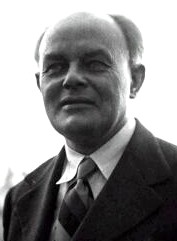 He did not join the USPD. He was a leader of the IKD (International Communists of Germany) in Dresden and the founding Chairman of the Dresden Workers and Soldiers Council and a delegate to the founding congress of the German Communist Party (KPD). He was among those who split to the left in 1919.
In 1937, Rühle served on the Dewey Commission to investigate the charges made against Trotsky in the Moscow Trials.
See Otto Rühle Archive.
Russell, Bertrand (1872-1970)
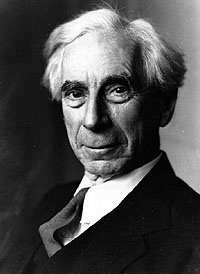 British philosopher and populariser and historian of philosophy, mathematician (leading exponent of Logicism), pacifist (jailed for 6 months in 1918 anticonscription campaign) and Fabian socialist; leader of Campaign for Nuclear Disarmament, co-organiser of International War Crimes Tribunal convened in 1966 to focus opposition to US war in Vietnam.
Russell is easily the most famous and widely read British philosopher of this century, a member of the British Peerage, he was a consistent fabian/pacifist critic who was a frequent figurehead for broad left campaigns, and an exceptionally prolific writer and pamphleteer.
His first major work was the 1903 Principia Mathematica, later expanded in a 3-volume work written jointly with Alan Whitehead, which endeavoured to prove that the whole of mathematics could be derived from a set of axioms drawing exclusively on the principles of logic. This conception gave to mathematics a kind of Platonic status. Russell was the only figure to recognise the value of Gottlob Frege’s system of Logic which was developed with the same objective. However, later developments proved that the Logicist thesis was untenable.
In his 1912 Problems of Philosophy Russell argued for a position which he called Realism, by which he meant that not only objects, but Universals, are “real”, that is exist like matter independently of consciousness. For Russell, this thesis was the only explanation for a priori knowledge: these universals exist, and the mind is capable of perceiving them through reason. However, in his later Philosophy of Logical Atomism, Russell modified his position, holding that what existed objectively were only “logical atoms” – relations, properties, etc.
In Problems of Philosophy Russell presents a systematic account of almost all of the main problems of epistemology, one of very many popular and comprehensive works that he produced over a lifetime of prolific writing. Russell was not always completely honest and objective in his writing though, and his great authority and wide readership meant that where there were inaccuracies in his work, these had a profound impact; one of these worthy of mention is his malicious misinterpretation of Hegel, which helped marginalise Hegel among English-speaking readers for a long time.
See his 1911 Philosophical Importance of Mathematical Logic and his contribution for the 1926 edition of the Encyclopedia Britannica on the Theory of Knowledge.
Rust, William (1903-1949)
Joined the CPGB in 1920, and became a leader of its youth section. He joined the party’s Executive Committee in 1929, and was editor of the Daily Worker during 1930-32 and from 1939 until suffering a fatal heart attack in 1949.
Ruthenberg, Charles (1882-1927)
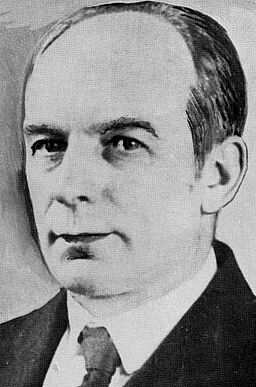 Charles Emil Ruthenberg was born July 9, 1882 in Cleveland, Ohio.[Oakley C. Johnson, The Day is Coming: Life and Work of Charles E. Ruthenberg, 1882-1927. New York: International Publishers, 1957. p 7.] The son of a German immigrant who worked in America as a longshoreman, Ruthenberg graduated school in June 1896, and went to work in a bookstore, attending Berkey and Dyke’s Business College in the evenings for a ten-month course in bookkeeping, accounting, and typing.[Johnson, The Day is Coming, pg. 14] Ruthenberg married Rosaline “Rose” Nickel, also of German descent, in June of 1904.[Johnson, The Day is Coming, pg. 16-7] The pair had a son named Daniel. In 1909, he received his law degree from Columbia Law School.
The socialist years (1908-1918)
Ruthenberg’s first political attraction was to the Single Taxer Tom Johnson, a “reform” Mayor of Cleveland from 1901 to 1909.[Johnson, The Day is Coming, pg. 18] Ruthenberg was soon drawn to more radical politics, however, and in the middle months of 1908 he began calling himself a socialist.[Johnson, The Day is Coming, pg. 21] Ruthenberg joined the Socialist Party of America (SPA) in January of 1909,[Johnson, The Day is Coming, pg. 25] and attended an English language branch of Local Cuyahoga County.
Ruthenberg was an Organizer for and later Secretary of Local Cuyahoga County continuously from 1909 to 1919. In addition he was on the Ohio State Executive Committee of the SPA from 1911 to 1916, during which time he edited the newspapers of local party, The Cleveland Socialist (1911-1913) and Socialist News (1914-1919). Ruthenberg also periodically contributed material to the official organ of the Socialist Party of Ohio, The Ohio Socialist. He was elected to the National Committee of the Socialist Party in 1915 but was defeated by Arthur LeSueur in the vote at the annual meeting of that body for election to the governing National Executive Committee of the party.[The Socialist Party published a monthly membership bulletin for its members from 1905 through 1914, available on microfilm. From July 1914 it published party news in a series of official newspapers, called variously The American Socialist (1914-1918), The Eye-Opener (1918-1919), The Socialist World (1920-1925), and The American Appeal (1926-1927).]
During this time Ruthenberg traveled to to many cities throughout the American Northeast and Midwest, speaking to labor groups, trade union organizations, and anti-war groups, building a network of contacts. Ruthenberg was associated with the far left so-called “Impossibilist” wing of the SPA, which had little hope for the efficacy of ameliorative reform, seeking instead revolutionary socialist transformation.
Despite his personal disdain for political half-measures, Ruthenberg was a frequent electoral candidate of the Socialist Party. He first ran for Ohio State Treasurer in 1910, and was later the party’s nominee for Senate in 1916, for Mayor of Cleveland in 1917 (receiving 27,000 votes of 100,000 cast), and for the United States Congress in 1918.
Ruthenberg was a delegate to the seminal 1917 Emergency National Convention of the SPA. There he was elected to the Committee on War and Militarism and was one of three primary authors of the aggressively antimilitarist St. Louis program, along with Morris Hillquit and Algernon Lee.
After American entry into World War I, Ruthenberg continued to publicly attack the "Imperialist" conflict and American participation therein. He was arrested for allegedly violating the Espionage Act by obstructing the draft in connection with a speech given at a rally on May 17, 1917. Also charged at the same time were Ohio State Secretary Alfred Wagenknecht and State Organizer Charles Baker. The trio were tried together in July of 1917 and sentenced to 1 year in the Ohio State Penitentiary, a decision upheld by the US Supreme Court on January 15, 1918. Informed of this decision, issued a statement declaring:
The Supreme Court has decided we must spend a year in jail. The crime for which we are convicted is truth telling. We believe in certain principles; we fought for those principles, and we go to jail ostensibly for inducing a certain Alphones Schue not to register. The charge is merely and excuse.... The important fact is that the ruling class feared our message to the workers and tried to silence that message. That fact should make a hundred willing workers take up the work we lay down...
Ruthenberg, Wagenknecht, and Baker served almost 11 months of their sentence, finally being released on December 8, 1918.
The communist years (1919-1927)
The 1919 Cleveland May Day Riot
Freed from prison in December of 1918, Ruthenberg dove in with both feet to the burgeoning left wing movement rocking the Socialist Party. May Day of 1919 was an event of enormous enthusiasm and great fear. A gigantic assembly was planned in Cleveland, in which four parades of marchers, many waving red flags, would come together in the public square to hear speeches and rally for freedom for Eugene V. Debs and Tom Mooney and the adoption of the 6 hour day and the $1 minimum wage. As many as 20,000 people are said to have participated in the march, with 20 to 30,000 more people lining the streets to watch. Ruthenberg later described the events that followed:
When the head of the line was within a block of the Public Square the first trouble occurred. An officer in the uniform of the Red Cross jumped from a “Victory” Loan truck and endeavored to take a red flag which a soldier in uniform was carrying at the head of the procession. A scuffle followed in which other soldiers from the truck and some businessmen joined. During the scuffle one of these businessmen ddrew a revolver and wildly threatened the workers in the procession. In fiveminutes, however, the struggle was over. The lieutenant and his supporters were driven back to the sidewalk, the head of the line reformed, and with the red flag still flying, marched on to the Public Square.
Suddenly, the police made their appearance:
They came down Superior Ave., which divides the “Square” into norther and southern sections, headed by the mounted squad, followed by auto load after load. The newspapers later reported that 700 men had been concentrated at the Central Statiion, who now descended upon the marchers.... The first thousand or so of workers marched onto the square and took possession of the “Victory” Loan speakers’ stand, which had been built over the stone blocks placed on the Public Square for the use of speakers at public meetings... The chairman was about to introduce [me] as the first speaker when an officer and a few soldiers tried to climb to the platform, demanding that the soldier that held the red flag give it up... [Then], without warning, a squad of mounted police dashed into the audience, driving their horses over the assembled workers and clubbing them as they went.”
A riot ensued, pitting the police and their supporters (backed by tanks) against the marchers. Two marchers were killed in the fighting, hundreds injured, and about 150 arrested in this Cleveland May Day Riot.[10] Ruthenberg was charged for incitement to murder in connection with this event but no conviction was obtained.
Formation of the CPA
Ruthenberg was an early endorser of the Left Wing Manifesto written by Louis C. Fraina and around which the formal Left Wing Section of the Socialist Party congealed. He was a Left Wing-supported candidate for the Socialist Party’s governing National Executive Committee in the party election of 1919, the result of which was overturned by the outgoing NEC ostensibly on the grounds of election fraud carried out by some of the branches associated with the party’s language federations. Ruthenberg was a delegate to the June 1919 Convention of the Left Wing Section and was elected there as a member of the faction’s governing National Council. Ruthenberg was initially supportive of the tactic of continuing to fight “to win the Socialist Party for the Left Wing” at its forthcoming 1919 Emergency National Convention in Chicago, but in the face of federation pressure for immediate formation of a Communist Party of America and the apparently hopeless task faced by Wagenknecht & Co., Ruthenberg shifted his support to the Federations and their call for an immediate Communist Party.
Dominated as it was sure to be by the Russian, Lithuanian, Polish, and Latvian language federations, the anglophonic Ruthenberg was a valuable commodity to federation leaders like Alexander Stoklitsky, Nicholas Hourwich, and Joseph Stilson. Nor did Ruthenberg owe any allegiance to the idiosyncratic Socialist Party of Michigan, led by John Keracher and Dennis Batt. Therefore, the ambitious Ruthenberg made an ideal candidate to head the new organization, which was established in Chicago on September 1, 1919, as the Communist Party of America (CPA). While decisive authority on the floor of the convention and on the Central Executive Committee which it elected remained in the hands of the so-called “Russian Federations,” Ruthenberg was elected by the Chicago conclave as the first Executive Secretary of the new organization. Ironically, it was his old Ohio party comrade and prison mate, Alfred Wagenknecht who was elected to head the rival Communist Labor Party of America (CLA) in the aftermath of the failed effort to win control of the Socialist Party at its August 1919 Convention. A period of bitter and acrimonious rivalry followed, in which both of the competing American communist organizations sought to win the favor (and financial support) of the Communist International (Comintern). Adding to the complexity of the situation, the Socialist Labor Party of America and the Socialist Party of America sought affiliation with the Comintern as well. The Comintern was adamant about its structure, however, and it sought one and only one centralized organization in each country. Merger between the CPA and CLP was demanded.
The fulfillment of the Comintern’s demand for unity proved to be no simple task, however, and the history of the next three years are a complex tale of splits, mergers, secret conventions, organized caucuses, and parallel organizations that lies outside of the scope of this presentation. In outline terms, a fight erupted among the leadership of the CPA in 1920 and Ruthenberg, together with an group of his English-speaking adherents such as Isaac Ferguson and Jay Lovestone as well as the Chicago-based section of the Russian federation, exited the organization (along with a major part of the group’s funds) in April 1920 and joined with the Communist Labor Party to form the United Communist Party (UCP) in May. Wagenknecht headed this new joint organization with Ruthenberg placed in charge of the party press. This still left a divided Communist movement, however, with the major part of the old CPA, now headed by Charles Dirba still remaining in increasingly bitter opposition. It was not until the end of 1922 — after another merger, split, and merger — that this rift was finally resolved, with the establishment with a new unified Communist Party of America and its parallel “Legal Political Party,” the Workers Party of America (WPA).
During much of this complicated dance, C.E. Ruthenberg was in jail. In October of 1920, Ruthenberg was tried together with his associate Isaac Ferguson in New York for alleged violation of the state’s Criminal Anarchism law, said to have been breached by the Left Wing Section when it published Fraina’s Left Wing Manifesto the previous year. The pair were tried and sentenced to 5 years’ confinement in the State Penitentiary on October 29, 1920. The pair sat in Dannemora Prison until finally released on a $5,000 bond on April 24, 1922. Ruthenberg was immediately made Executive Secretary of the WPA upon his release on bail, with Abram Jakira in charge of daily operations of the parallel and underground CPA. The above ground WPA headed by Ruthenberg grew rapidly, boosted by the addition of the massive Finnish Federation to its ranks, while the underground party withered and died, put to bed for good in 1923. Thereafter Ruthenberg was the sole Executive Secretary of the American Communist Party (still calling itself the Workers Party of America) — a position which he retained for the rest of his life, despite spending much of the 1920s as a leader of a minority faction within the party.
The Criminal Anarchism convictions of Ruthenberg and Ferguson were ultimately overturned by the New York Supreme Court In July of 1922, just in time for another round of prosecutions, this time related to ill-fate August 1922 Unity Convention of the CPA held at Bridgman, Michigan.
The 1922 Bridgman Convention
A secret conclave had been arranged at the Wolfskeel Resort on the wooded shore of Lake Michigan to finally unite the CPA with a parallel organization maintained by its dissident Central Caucus faction. The site was regarded as relatively safe, having previously been used for a secret convention of the United Communist Party in the spring of 1920. This time, however, an informant of the US Department of Justice had managed to win election to the gathering as a delegate and the authorities had been notified.
The forced merger did not, however, end the rivalries between the two groups. Ruthenberg and his supporter Jay Lovestone were at odds with a rival faction led by William Z. Foster, who had strong ties to organized labor and who wanted to direct the party’s work toward organizing within the American-born working class, and James P. Cannon, who led the International Labor Defense organization. C.E. Ruthenberg, 1924
He ran unsuccessfully for a seat in the House of Representatives from Ohio’s 20th Congressional District (now abolished) as the candidate of the Workers Party of America, as the CPUSA was then known, on his return to the United States.
In 1925, Comintern representative Sergei Gusev ordered the majority Foster faction to surrender control to Ruthenberg’s faction; Foster complied. The factional infighting within the CPUSA did not end, however; the communist leadership of the New York locals of the International Ladies’ Garment Workers’ Union lost the 1926 strike of cloakmakers in New York City in large part because of intra-party factional rivalries, as neither group wanted to take the responsibility for accepting a strike settlement that appeared insufficiently revolutionary.
In 1926–27 his First Amendment case, Ruthenberg v. Michigan, was pending in the U.S. Supreme Court. The Court had voted 7–2 (with Brandeis joined by Holmes dissenting) against Ruthenberg. But Ruthenberg died shortly before the Court rendered its ruling, thus the opinions in the case were never published.
Ruthenberg died in 1927 in Chicago from a ruptured appendix. He was cremated and an urn containing his ashes was placed in the Kremlin wall, not far from the burial place of his former factional rival John Reed.
Writings
As the head of the American Communist Party, C.E. Ruthenberg was essentially an administrator rather than a theoretician. His early journalism is scattered, he wrote relatively few pamphlets, and he published no books in his lifetime, save for a slim volume gathering his 1920 New York trial testimony with that of Isaac Ferguson, who also served as attorney in his case. A small volume of excerpts of speeches was also published by the Communist Party in 1928, shortly after his death. Nor has the CPUSA, despite Ruthenberg’s iconic status in party history, published any significant portion of his work in subsequent years. This paucity of available material has been mitigated to some extent in the internet age, with an appreciable slice of his journalism gradually becoming available online.
[http://en.wikipedia.org/wiki/Charles_Ruthenberg]
[Submitted by Tim Davenport]