The second wave of Canadian anti-revisionism was larger than the first and originated in Quebec where it spread to the rest of Canada. Like the first wave, it was rooted in support for Communist Party of China and its struggle against modern revisionism.
Two events determined the development of the Quebec left in the early 1970s. The first was the October Crisis of 1970. The repression by the Canadian state and the defeat of the Front de Libération du Québec (FLQ) forced the left to re-evaluate its strategy. Many followed the lead of FLQ spokesperson, Pierre Vallières, who argued that activists should abandon the immediate struggle for socialism and instead work for independence from within the mainstream Parti Québécois (PQ). The struggle for socialism could begin after independence was achieved. This dispute split the progressive movement into those who supported the Vallières’ position and those who focused more on changing the basic economic structures of society.
The second was the Common Front strike of 1972 that saw 250,000 workers walk off their jobs to support the jailed leaders of the three main union federations. This was the largest mass labour action in Canada since the Winnipeg General Strike in 1919. The strike saw workers take over radio stations and at least two towns before it was over. This development created a “workerist” trend in the Quebec left exemplified by the formation of the comites d’action politique (CAPs) in Montreal. Other supporters of this trend included the Agence de presse libre du Quebec, Librairie progressiste, and the magazine Mobilisation. They supported the policy of entering factories and other workplaces to build a militant union movement. Another group that emerged during this period was the Mouvement révolutionnaire des étudiants du Québec (MREQ), which was active in Quebec universities and CEGEPS (community colleges) including the English language universities in Montreal. It published the bilingual newspaper The Partisan and operated a bookstore (Librairie Ho Chi Minh). It was the first group to put forward the necessity of rebuilding a communist party in Canada. Although more to the left than the workerists, it also supported the trend of sending activists into the workplace
In 1972, a former FLQ member, Charles Gagnon, along with other a few other activists, released the document Pour la partie prolétairian. This polemic attacked both the “independence first” strategy promoted by Pierre Vallières and the workerist strategy promoted by the CAPS. It argued that the immediate task of activists was to build an ideological and political alternative to capitalism in the form of a revolutionary party that would win the workers to socialism. This document would form the basis of the group, In Struggle!, one of the leading second wave anti-revisionist organizations.
Soon after the publication of Pour la partie prolétairian, members of the CAPS and allied organizations began to develop more openly Marxist-Leninist political positions and a number of small groups spun out of the disintegrating CAPS, such as the Cercle Communiste marxiste-leniniste, Groupe d’action socialiste, and Mobilisation (groupe communiste marxiste-léniniste).
In the autumn of 1975, two of these groups – the Cellue militante ouvriere and the Cellule ouvriere revolutionnaire – joined with the MREQ to form the Canadian Communist League (Marxist-Leninist) (CCL (M-L) (known hereafter as the League), the other leading group in the second wave of Canadian anti-revisionism.
In English Canada, those Marxist-Leninists who were not attracted to any of the pre-existing organizations such as CPC (M-L), CPL, or CLM worked in broad-based left groups and newspapers such as the East Coast Socialist Movement in Nova Scotia or the Western Voice newspaper in Vancouver. Others worked in workers support networks such as the Right to Strike Committee in Toronto. Still others were in isolated study groups. This changed with the launching of the publication Canadian Revolution in 1975. This magazine was published by members of the Toronto Communist Group, Workers Unity, and future members of the Bolshevik Union as an open form for Marxists-Leninists. It not only translated and published documents from the Quebec organizations but also provided a means for isolated groups in a geographically huge country such as Canada to make contact with one another.
However, it was In Struggle! and the League that were the most developed groups with organizational structures, a regular press and developed positions that would define the second wave of Canadian anti-revisionists.
The second wave differed from their first wave predecessors in that the majority saw Canada as a developed capitalist country that had reached the stage of imperialism. Although U.S. imperialism did play an important part in the Canadian economy, these anti-revisionists argued that the Canadian capitalist class acted in its own interests and was not a puppet of the U.S. Further, this capitalist class was active in the exploitation of the Third World. For these groups and individuals, the struggle in Canada was a struggle for socialism – not for national independence.
The second issue that also separated this wave of anti-revisionists from the first was the issue of Quebec. Although the initiative for the second wave came from Quebec and they viewed Quebec as an oppressed nation, these anti-revisionists rejected the view that it was in a colonial relationship with Canada. Flowing from this, they also rejected the concept of separate organizations for Canada and Quebec and instead argued for building a single organization or party within the Canadian state. This was reflected in both In Struggle! and The Forge (newspaper of the CCL (M-L)) which carried identical articles in both their French and English editions.
At first, both In Struggle! and the League had a fairly harmonious relationship and even worked together on a number of campaigns, but relations deteriorated over a number of issues.
The first was how to unite the still dispersed Marxist-Leninist forces across Canada. In Struggle! argued that because the movement was still young and underdeveloped, it should be broadly defined so as to allow for debate and the delineation of political positions. In Struggle! proposed that four conferences be held to foster that debate. The first would be about Marxist-Leninist unity, the second on the nature of the Canadian state, the third on the international situation, and the fourth on the revolutionary program. It also offered to open the pages of its theoretical journal, Proletarian Unity, to smaller groups to publish their material.
The League on the other hand defined the movement much more narrowly and held that since In Struggle! and itself were the largest organizations, debate should be between these two organizations with smaller groups participating from floor. So, while In Struggle! was willing to allow the Red Star Collective – which held the Canada as neo-colony position – to participate in the conference process as a Marxist-Leninist group, the League did not consider it part of the movement. Although the League participated in the first conference, it announced that it was boycotting the subsequent ones.
The League’s position would prove more realistic as smaller groups began to dissolve into either of the two organizations. By the end of 1977, 90% of the small groups had ceased to exist. There were hold-outs such as Red Star Collective, and the Bolshevik Union (among others). The Bolshevik Union held that the process of small groups merging into the two larger groups (which it dubbed the “two superpowers”) was premature. Instead, they argued, these groups should remain independent and develop their political positions more. They also questioned the “pre-party organization,” a concept they said was imported from the U.S. On the other hand, the Red Star Collective (along with the Halifax Study Group) believed that objective conditions did not yet require the formation of a vanguard party. The League declared itself the Workers’ Communist Party (WCP) in 1979.
Both In Struggle! and the League were real forces on the Quebec left. In Montreal, meetings organized by In Struggle! usually had an attendance of 1,500 or more, while the League/WCP could top 2,000 and at one point even reached 3,000 people. Both had 16-page weekly newspapers that were published in two languages and both also had bilingual theoretical journals. However, these groups, although they had branches in most major Canadian cities, never really grew in English Canada – although the League had a base in Toronto and In Struggle! in Vancouver.
The differences between the two organizations continued to deepen to the point in late 1977 that the League declared that In Struggle! had degenerated into revisionism. In Struggle!, for its part, said that the League had a sectarian attitude toward the Marxist-Leninist movement and was never really interested in struggling for unity.
The final dividing line between the two organizations would be the Chinese policies following Mao’s death; and the “Theory of Three Worlds.” In Struggle! always had a “left” interpretation of the Three Worlds Theory that separated the foreign policy of China from support for revolutionary movements around the world. The League maintained a more rigid interpretation, going so far as to call for greater Canadian participation in NATO to counter the threat of Soviet imperialism and the influence of US imperialism. After the death of Mao and the arrest of the “Gang of Four”, the League enthusiastically supported the new regime in Peking. In Struggle! was however more guarded about events in China until late 1978 when they denounced the Chinese Communist Party.
By the 1980s, both In Struggle! and the League began to enter a period of crisis. Documents relating to that crisis and the collapse of these two organizations can be found here. The crisis in the worldwide Marxist-Leninist movement also claimed the life of smaller groups. By the mid-1980s, these groups, such as the Red Star Collective and Bolshevik Union had also disappeared. In this way, the anti-revisionist trend in Canadian communism came to an end.
Canadian Maoists, Stalinists VS. The Anti-War Movement by Carl Fleming
Beginnings of a Socialist Movement in Montreal (Translation and adaptation of “Quelques aspects du Debut d’un Mouvement Socialiste a Montreal”)
Shifting lines in the Maoist camp. China: Twice-purged Teng returns by Spartacist Canada
“The Extra-Parliamentary Left,” Chapter IX of Henry Milner’s Politics in New Quebec (1978)
BU, CPC(M-L), CPL, IS!: Albania: Last hope for Stalinists without a country by Spartacist Canada
L’extrême gauche au Québec A February 1979 Radio-Canada half-hour video featuring In Struggle! and the Canadian Communist League (as well as a Trotskyist group) (French only).
Balance Sheet of the Quebec Far Left by François Moreau
Red Power and Socialist Study: 1967–1975 by Ray Bobb
The Rise and Fall of Quebec Maoism: 1970-1982 by Spartacist Canada
Le maoïsme québécois: héritier d’une sinophilie qui s’ignore by Serge Granger
Le virage vers la classe ouvrière: L’implantation et l’engagement des marxistes-léninistes québécois·es en milieu de travail by Guillaume Tremblay-Boily
The origin of In Struggle! can be traced to the polemic For the Proletarian Party written in 1972 by ex-Front de Libération du Québec (FLQ) activist Charles Gagnon. This document attacked two popular positions within the Quebec left at that time. The first was put forward by his former FLQ comrade, Pierre Vallières, that activists should join the Parti Québécois to win independence first and then struggle for socialism later. The second was the strategy of activists entering the workplace and promoting militant trade-unionism. This tendency was represented by the Comités d’action politique active in Montreal. For the Proletarian Party argued that the main task was to build a revolutionary party and win the working class to socialism.
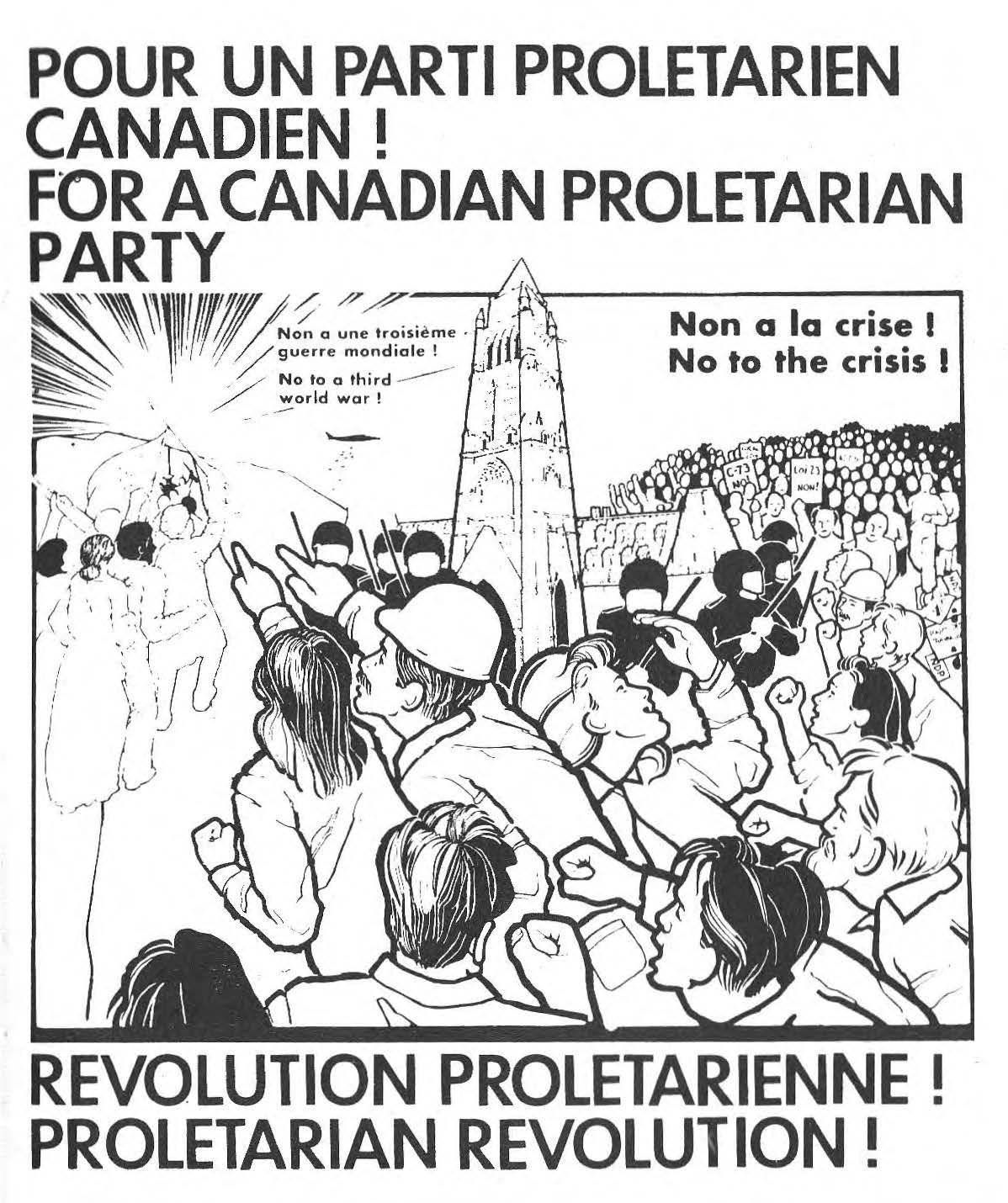
In 1972, the newspaper, En Lutte! began publishing to advance the concepts laid out in For the Proletarian Party. The Équipe de journal (newspaper team) that published the newspaper maintained it as an independent journal until 1974 when its supporters consolidated into a Marxist-Leninist group with the publication of Create the Marxist-Leninist Organization of Struggle for the Party at its first congress. In response to its publication, five groups in Quebec dissolved to join In Struggle!
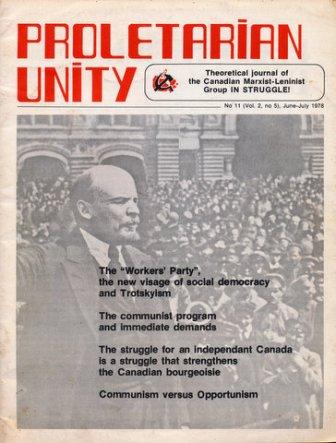
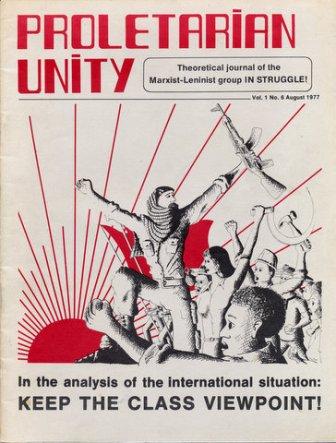
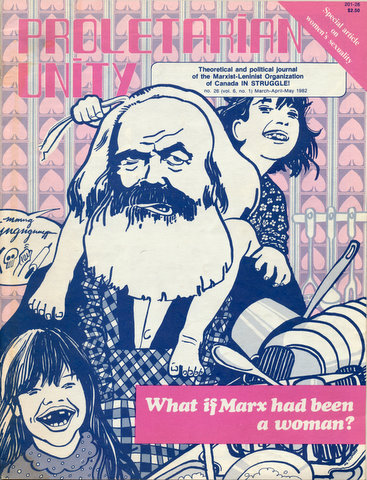
Create the Marxist-Leninist Organization of Struggle for the Party stated the necessity of forming a Canada-wide communist party. Accordingly, In Struggle! began publishing an English-language digest of its newspaper and in 1976 began to publish the newspaper in both French and English on a bi-weekly basis. Later in the year, it launched a bilingual theoretical journal, Proletarian Unity.
By autumn of 1976, the Toronto Communist Group merged with In Struggle! And in early 1977, groups in Halifax, Regina, and Vancouver would also join. It would also expand to other cities.
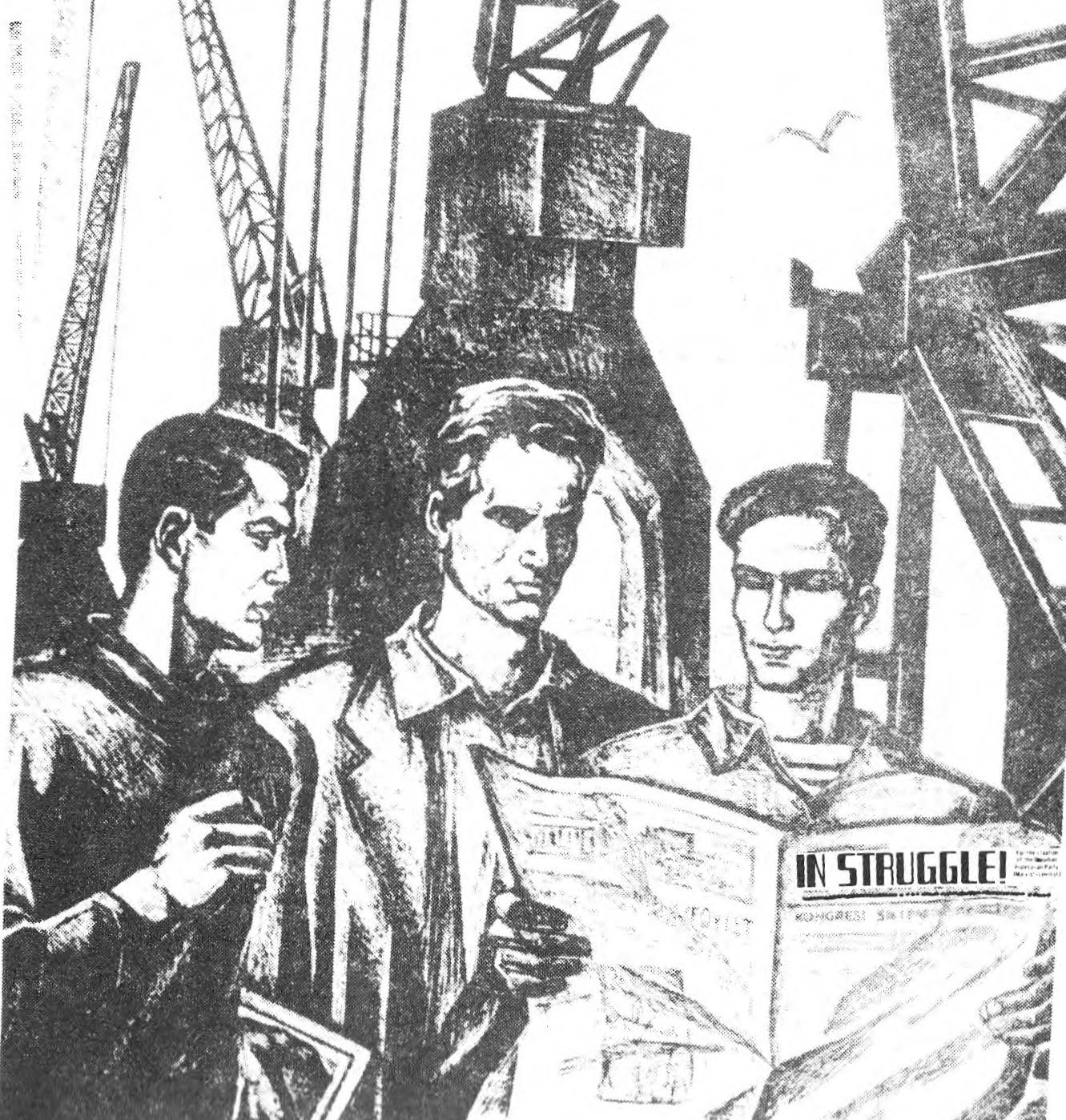
In Struggle! developed campaigns against the wage control act in the late 1970s and the struggle for democratic rights. However, it did not have a policy toward union work (although members were active in a number of unions). Most activity was geared to recruiting contacts into its readers’ circles to study the newspaper.
After the death of Mao and the arrest of the Gang of Four, In Struggle! maintained silence on the changes in China until 1977 when it came out against the Three-Worlds theory and generally supported the criticisms of it by the Party of Labour of Albania (PLA). In Struggle! would also denounce the Chinese leadership –however, it never supported the PLA’s attacks against Mao himself.
After the adoption of a programme at its third congress in 1978, In Struggle! renamed itself the Marxist-Leninist Organization of Canada, In Struggle! It also called for unification of the Marxist Leninist movement around a new communist international that would be based on a communist programme rather than the practice of following the line of “father parties” such as the Communist Party of China and the Party of Labor of Albania.
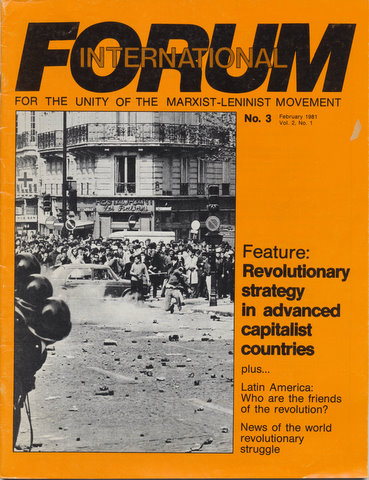
Toward this end, In Struggle! launched the magazine International Forum in 1980 as an open forum for debate between anti-revisionist groups that were opposed to the developments in China. However, it had little success as political positions were rapidly hardening between those organizations that supported the PLA and those that still supported Mao. During this time In Struggle! became critical of nationalism which in its opinion, had infected the Marxist Leninist movement for too long.
During this time, the organization began to adopt a more open attitude toward working with movements and groups that they had previously dismissed as reformist and vowed to be less sectarian than in the past. It also decided to embark on a study of socialism.
However, by 1981, the organization began to fracture with some members questioning the validity of Marxism-Leninism. Others in the organization – such as women, gays and lesbians, and workers – began to criticize a structure dominated by male intellectuals and professionals. Soon the paper became a free for all with different factions debating back and forth. This continued until In Struggle!’s fourth congress in May, 1982 when it voted to dissolve itself. Some factions tried to continue afterwards, but they disappeared soon after. Documents relating to the final crisis and collapse of In Struggle! can be found here.
FLQ’s final phase (part 1) by the Canadian Party of Labour
FLQ’s final phase (part 2) by the Canadian Party of Labour
The Political Journey of Charles Gagnon
«LE MONDE VA CHANGER DE BASE»: L'HORIZON INTERNATIONAL DU GROUPE MARXISTE-LÉNINISTE EN LUTTE! (1972-1982) by David St-Denis Lisee
NO to in Struggle’s Compromising with Revisionism by the Canadian Communist League (Marxist-Leninist)
In Struggle changes its line on the principal contradiction by the Bolshevik Union
Critique of In Struggle!’s “The Path of the Canadian Revolution” by the Red Star Collective
Unmask In Struggle! Denounce Gagnonism! by the Bolshevik Union
Critique Of In Struggle’s Declaration Of September 6, 1977 “Against Right Opportunism In International Questions” by the Red Star Collective
How Not to Defend Quebec: The Example of ’In Struggle’ by the Revolutionary Workers League
’In Struggle’ – latest addition to the revisionist family in Canada by the Canadian Communist League (Marxist-Leninist)
Down with the non-aligned “Marxist-Leninist” movement by the Communist Party of Canada (Marxist-Leninist)
The “MLOC” In Struggle!: Reformist to the core by Spartacist Canada
Cops are tops with In Struggle by the Canadian Party of Labour
On the necessity for criticism and self-criticism
Create the Marxist-Leninist Organization of Struggle for the Party
The Tasks of Canadian Marxist-Leninists Today
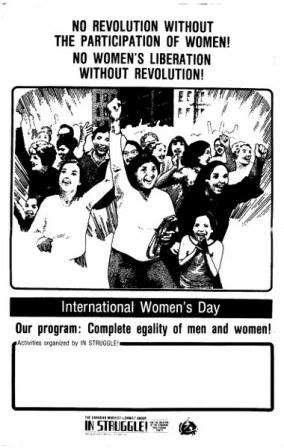
Learn from International Women’s Day
Fight the Sectarianism of the CCL (ML)
The Rallying of Mobilisation to the CCL(ML) Brings Out a Basic Question
Available soon: PROLETARIAN UNITY, a theoretical journal from IN STRUGGLE!
Towards the Unification of the Canadian Marxist-Leninist Movement
A Rectification in Our Reply to The Forge
A Step Forward in the Struggle for the Unity of Canadian Marxist-Leninists
What Happened in Regards to the Common Declaration on Oct 14th?
The Revolutionary Line of the Canadian Proletariat Triumphed
Four groups rally to In Struggle!
For the Unity of the Canadian Proletariat. Brief notes on the present conjuncture, April 1977
When the struggle against opportunism serves to justify opportunism
100% opportunism, an argument to justify opportunism
The struggle for a revolutionary program!
Three Marxist-Leninist groups rally to IN STRUGGLE!
No to the Bolshevik Union’s splitting and wrecking practices!
Unmask the imposters! Denounce the Bolshevik Union!
Build the weekly communist newspaper of the Canadian proletariat
IN STRUGGLE’s fourth anniversary, a celebration across Canada
DRAFT PROGRAM for the Canadian Proletarian Party
What kind of program does the Canadian proletariat need?
No Revolutionary Party Without a Revolutionary Program
IN STRUGGLE’s Communist Education Circles: Taking up party-building in a conscious way
The Vancouver Red Collective rallies to IN STRUGGLE!
What immediate demands should the program of the proletariat contain?
The League’s second congress: A leap into the arms of the bourgeoisie
Oppose sabotage against progressive groups and IN STRUGGLE!
National Conference on the Draft Program
The CPC(ML): A Revisionist Organization of Agent-Provocateurs
In Montreal, 1,900 people sing “One weapon that we need is the workers’ unity”
Bolshevik Union and the opportunist Hardial Bains have a lot in common by the Regroupement des ex-militants du PCC(m-l)
The CCL(M-L), The Voice of Social-Chauvinism in Canada
Long Live the Marxist-Leninist Organization of Canada IN STRUGGLE!
Our immediate goal: the creation of the party of the proletariat of Canada
Basis for a new party...with nothing new about it
Group of ex-CPC(M-L) members rallies to IN STRUGGLE!
The Third Congress of the Marxist-Leninist Organization of Canada IN STRUGGLE!
When unmasked, the League has no choice but to turn to police methods
A fourth counterfeit communist party [on the WCP]
The CPL accuses IN STRUGGLE! of chauvinism
IN STRUGGLE! organizes cadre conference
Conference of IN STRUGGLE!’s leading cadre
The Workers Communist Party unveils its constitution
A turning point on the development of the revolutionary struggle
IN STRUGGLE! Central Committee decisions: A critical issue: winning over workers
IN STRUGGLE! Central Committee decisions: Our work in unions
IN STRUGGLE! Central Committee decisions: The women’s movement
Inside IN STRUGGLE!: what political life is like
Come celebrate seven years of struggle
The Canadian left: It’s time for a real debate
IN STRUGGLE!’s work on the question of women
A research collective on women
The newspaper IN STRUGGLE!: important steps forward but...
The Leninist Proletarian Party
Marxism-Leninism, the Revolutionary Science of the Proletariat
The International Proletarian Associations
Subordinate the Struggle for National Independence to the Struggle for Socialist Revolution
Editorial: October 14th in the Context of the Current Political Crisis
What’s the path of revolution in our country?
On the evaluation of the Alcan strike in Kitimat (BC): Work for the Unity of the Proletariat!
The CCL(M-L)’s intervention in mass organizations swings from left opportunism to right opportunism
Determining the path of the revolution is not a question of a formula!
The national question in Canada can only be solved through the proletarian revolution
The role of communists in the struggle against Bill C-73
An old debate in the Canadian communist movement: The imperialist character of our country
In Struggle’s article on “The path of the Canadian revolution”: A ’change in formulation’ which is nothing but an opportunist manoeuver by the Canadian Communist League (Marxist-Leninist)
The goals and work of Canadian Communists in trade unions today
The Native peoples and the right to self-determination
Who is manipulating the unions?
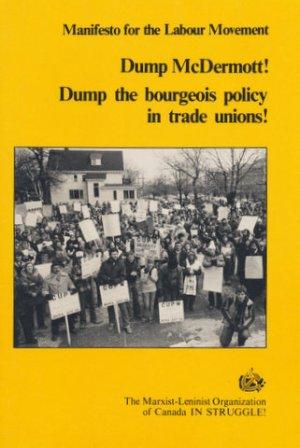
The work of communist fractions in unions by Charles Gagnon
Revisionism, another form of anti-communism
IN STRUGGLE!’s New Brunswick tour on the national question
IN STRUGGLE! counter attacks vigorously in Cape Breton
Dump McDurmott! Dump the bourgeois policy in trade unions!
McDermott declares war on unions’ ultra left by Wilfred List
IN STRUGGLE! replies to McDermott’s attacks
How far is McDermott ready to go?
Our plan of action on the constitution
Assessment of the Waffle (1): The NDP can’t be changed
Assessment of the Waffle (2): Failure of the marriage: independence and socialism
WCP work in unions: How NOT to fight class collaboration
Editorial: An Open Letter To Canadian Workers Of Both Nations
The Question of Quebec – Our Position
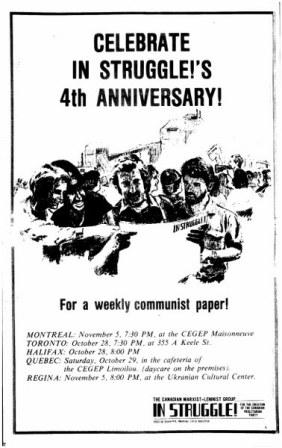
Support the Absolute Equality of Languages and Nations!
IN STRUGGLE’s Canadian tour on Quebec national question
Unreserved nationalism – The League’s “reserve nation”
Collect signatures for the Declaration [for the absolute equality of languages and nations in Canada]
The CPL has never broken with revisionism
The referendum in Quebec (2): The chauvinism of the self-styled “left”
The referendum in Quebec (3): Sovereignty-association: Just another song of “unrequited love”
The referendum in Quebec (4): “Independence and socialism”: nationalists favorite bait for workers
Equality of Languages and Nations – WCP style
The Quebec National Movement in the 1960s
Quebec referendum and the Native peoples’ right to self-determination debated
Fighting national oppression: The ball is in the workers’ court
The declaration campaign is over
The ’spoil-your-ballot’ call widely heard
Unity of action: how to build it and how not to
Support for Quebec’s right to self-determination is very much alive in English Canada
Socialisme et indépendance: a contribution to the debate on history of fight for socialism
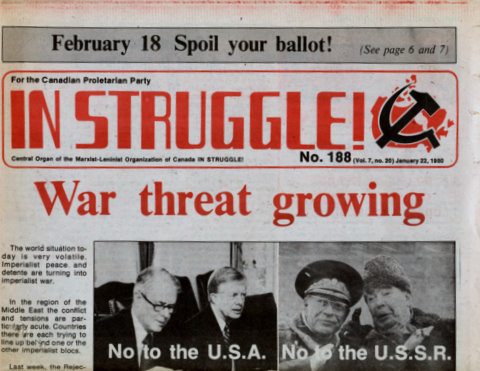
Message From Canadian Marxist-Leninist Group “In Struggle” [on the death of Mao] [Peking Review, #45, 1976]
China’s foreign policy: A policy that supports the revolutionary struggles of the peoples!
The CAPT conference on the Third World: To maintain a class viewpoint on all questions
On the theory of three worlds: Differences to solve on the basis of Marxism-Leninism
Against Right Opportunism on International Questions [On the “Three Worlds” Theory]
The “Three Worlds Theory” must be opposed: No compromises with imperialism
China on Mobutu: a revolutionary position?
The Chinese leaders descend onto the path blazed by Tito and Khrushchev
Second anniversary of Mao’s death: Step up the fight against the new revisionist impostors!
IPANA takes path of opportunism
The CCL(ML) accuses Albanian leaders
For a principled struggle against modern revisionism
It is up to the people of Kampuchea alone to choose that country’s political regime
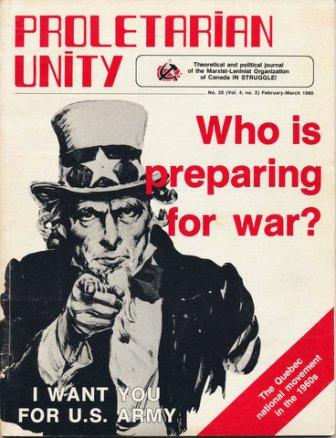
Who’s attacking the Iranian people?
The leaders of the Communist Party of China are taking China down the capitalist road
China in Vietnam – An act of aggression to match its return to capitalism
Who are the true friends of the Palestinian revolution?
IN STRUGGLE! wholeheartedly supports the Palestinian revolution
Nicaragua: a revolution to be continued
Behind the “Islamic revolution” lies the counter revolution
The Forge ponders its China puzzle
Why are Chinese leaders downgrading Mao?
El Salvador tour: Excellent Response: many give concrete support
The Communist Party of Cuba’s 2nd congress: Is Cuba still revolutionary?
Breathing new life into the struggle for socialism
CPC(M-L)’s International Conference: Doing everything to be recognized by other parties
The CPC(M-L)’s Revolutionary Rally: Confusion can never lead to unity
An important contribution in the struggle against revisionism
The need for an international communist organization
Communist Party of China slowly strangled by factionalism
Communist parties of Austria and Turkey: Questioning the notion of “superpowers”
For the political and organizational unity of the international communist movement
Our newspaper and the unity of communists
To unite the international communist movement
Chilean RCP publishes Appeal in Spanish for International Communist Movement
The unity of the international Marxist-Leninist movement: A political question for today
The stakes in the Mao – Stalin debate
A new publication International Forum
What road leads to unity in the world communist movement?
An openness to debate and polemics in the international communist movement
The international unity of the proletariat: What it is and how to fight for it by the Revolutionary Communist Party [USA]
How to unite communists: The RCP-USA sidesteps the key issue
An international conference: A way of broadening the criticism of revisionism
Four organizations call for international conference of Marxist-Leninists
On Enver Hoxha’s book, Eurocommunism is anti-communism. There are questions that still need to be answered by Charles Gagnon
International Forum: true forum for international debate
In Struggle!’s activities on the international scene [three-part series]
The unity of the international communist movement also involves many forces that we had overlooked
Responses to the conference proposal
To deepen our understanding of the struggle for socialism
Introduction to the “Documents for the criticism of revisionism” articles
For a materialist understanding of history by Charles Gagnon
Letter: A one-sided method in the study of revisionism
The working class seeks to win its political independence
The working class storms the bourgeois parliament
The working class seizes State power
What had become of the socialist camp by 1960? by Charles Gagnon
Analysis of the period 1800-1921
Analysis of the period 1800-1921 (part 2)
Criticism of In Struggle’s documents on revisionism: Socialism is a real alternative by Roger Rashi
Feedback and participation prove importance of revisionism debate by Charles Gagnon
Anti-imperialist struggles up to the Second World War
Rashi’s two “principles” (part 1) by Charles Gagnon
Rashi’s two “principles” (part 2) by Charles Gagnon
The imperialist countries between the world wars and the fight against fascism
The peasantry and the Soviet State (1917-1932): From class alliance to split
The Soviet Union between the world wars
Towards a scientific analysis of the evolution of the class struggle of the proletariat by Charles Gagnon
Our goal remains the same by Charles Gagnon
To achieve this goal, what methods do we need? by Charles Gagnon
Documents for Kautskyite Revisionism by Spartacist Canada
Between two world wars: No revolution in the imperialist countries – some reasons why
The Second World War: 1939-1945
Readers ask: was the U.S.S.R. ever really socialist?
The Chinese revolution: Part one: 1949 to the Cultural Revolution
For a scientific vision of the world: Determinism or free will? by Charles Gagnon
The People’s Democracies in Eastern Europe (some countries efforts to build socialism)
Despite its Marxist appearance: There is nothing revolutionary about radical feminism!
Police mount vast campaign of intimidation and provocation: What are the facts?
Necessity wins out over illegality
More than 30 organizations in Quebec denounce the Katevale police operation
Does IN STRUGGLE! support the rights of gay people?
Communists and the family: End the yoke of private ownership
How can the socialist movement and the gay movement work together? by Tim McCaskell
IN STRUGGLE! and homosexuality
Francois Seguin is a police informer
Francois Seguin, or the tactics of an informer
What happened in 1975-76: why progressive cultural groups joined IN STRUGGLE!
Chants Revolutionnaires du Canada et du Monde [first In Struggle! album]
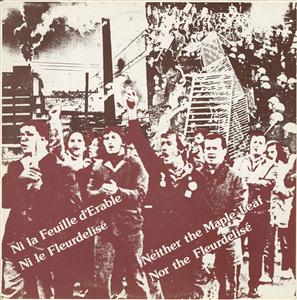
Ni la Feuille d’Érable ni le Fleurdelisé – Neither the Maple Leaf nor the Fleurdelisé [second In Struggle! album]
En Lutte! English Digest, Vol. 1, No. 3, March 1976
[Back to top]
The Conferences of Canadian Marxist-Leninists were four national meetings organized by In Struggle!. These conferences developed out of In Struggle!’s position that because the Canadian ML movement was underdeveloped; it was necessary to give the widest expression to all viewpoints on critical issues. IS! planned four national conferences that would also be supplemented with regional conferences.
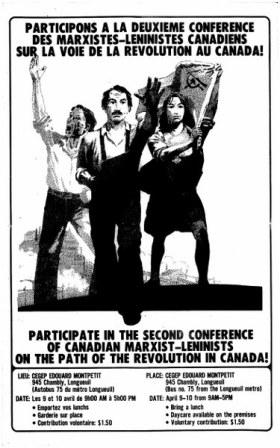
The first national conference was held on September, 1976, on the “unity of communists”. Over 1200 people participated with 14 groups giving presentations. The Canadian Communist League (M-L) participated in the conference but denounced it as an opportunist exercise that dodged issues of political line. The CCL (ML) also held that some other participating groups – such as the Bolshevik Union – were counter revolutionary and did not belong at the conference. The CCL (ML) subsequently announced that it would be boycotting future IS! national conferences. A regional conference on the issue of communist unity was also held in Toronto, Ontario.
Despite the League’s boycott, IS! organized a second conference in April, 1977 on the “path of the Canadian Revolution”. The conference included eight groups with over 1500 people attending. The reduced number of participating organizations was due to the fact that a number of the groups that had attended the first conference subsequently joined either IS! or the CCL(ML).
The third conference on the “international situation” was held in September, 1977. Debate at this conference centred on the “Theory of Three Worlds” that had been recently criticized by the Party of Labour of Albania. This time, over 1,000 people attended with five groups giving presentations (along with anti-imperialist groups from Africa, Haiti, Iran, Philippines as well as the Third World Peoples Anti-Imperialist Committee). A regional conference on the international situation was also held in Vancouver, British Columbia.
The fourth conference on the “tasks of communists” was held in February, 1978. While 1200 people attended, it was a much diminished event inasmuch as the majority of smaller ML groups had already joined either the CCL (ML) or IS!, At the conference itself, only IS! made a presentation. The prior debates between IS! and the Red Star Collective had become antagonistic to the point that the RSC had announced that it was boycotting the fourth conference. The Bolshevik Union, on the other hand, was no longer considered by IS! to be part of the movement – and BU members were ejected from the conference by mid-morning.
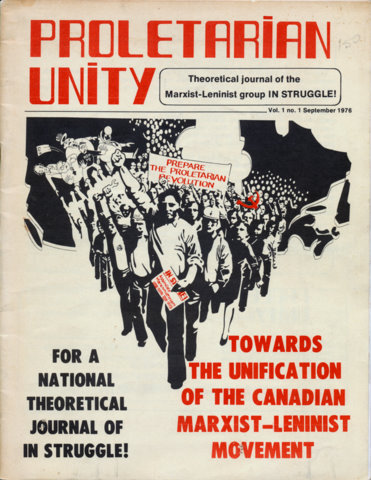
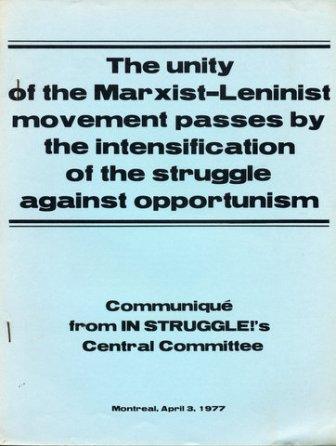
Towards the Unification of the Canadian Marxist-Leninist Movement by In Struggle!
Boycott In Struggle’s ’unity’ conference by the Canadian Communist League (Marxist-Leninist)
Prepare for the Second Marxist-Leninist Conference on the Path of the Revolution by In Struggle!
Why we won’t participate in In Struggle’s unity conference by the Vancouver Socialist Group
A Polemic Based on the Distortion of Our Line! by In Struggle!
Who Will Attend In Struggle’s Unity Conference by the Canadian Communist League (Marxist-Leninist)
Why we support the boycott of In Struggle’s unity conference by the Regina Marxist-Leninist Collective
An Odd Last Minute Invitation From the CCL (M-L) by In Struggle!
Some Questions to Ask the League by the October Study Group
The O.C.W.(M-L) will not participate at the Second Conference of Canadian Marxist-Leninists by In Struggle!
Matchmakers of Opportunism: Against En Lutte’s Unity Plan by the Organization of Communist Workers (Marxist-Leninist)
In Struggle’s 3rd conference clear evidence of opportunist betrayal by the Canadian Communist League (Marxist-Leninist)
Red Star Collective replies by In Struggle!
In Struggle confronted by Trotskyism by Spartacist Canada
In Struggle on the road to nowhere by Spartacist Canada
Regional Conference on the Unity of Canadian Marxist-Leninists in Quebec City
A Step Forward: The Vancouver Regional Conference on the Path of the Revolution
A Second Error Doesn’t Correct the First One
The Conference of Canadian Marxist-Leninists on October 9
Prepare for the Second Marxist-Leninist Conference on the Path of the Revolution
Discussion Guide for the Second Conference of Marxist-Leninists
How is the 2nd National Conference of Canadian Marxist-Leninists Going to Proceed?
Learn From the Second Conference of Canadian Marxist-Leninists!
Participate In The Third Conference Of Canadian Marxist-Leninists On The International Situation!
Attention! The Third Conference of Marxist-Leninists postponed
Who will attend the Fourth Conference?
Fourth Conference Discussion Guide
Documents of the National Conference on the Unity of Canadian Marxist-Leninists
Documents of the 2nd Conference of Canadian Marxist-Leninists on the Path of Revolution in Canada
Documents of the 3rd Conference of Canadian Marxist-Leninists on the International Situation
[Back to top]
The Canadian Communist League (Marxist-Leninist) – and later the Workers’ Communist Party (Marxist-Leninist) – was the largest of all the anti-revisionist organizations with a membership of over 1,000 at its height. The League was formed through the merger of three Montreal-area groups in the autumn of 1975. The largest group was the Mouvement révolutionnaire des étudiants du Québec which had been active at university campuses and CEGEPS (community colleges) after its split from the Parti communiste du Québec (marxiste léniniste) in 1971. The two other groups were the Cellue militante ouvriere and the Cellule ouvriere revolutionnaire. These groups came out of the comites d’action politique (CAPs) that were active in the working class neighbourhoods and workplaces in the Montreal area.
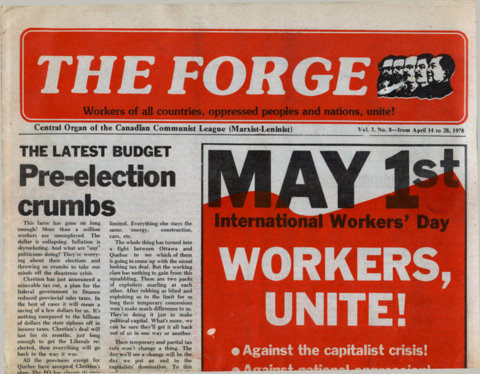
The League also held that Canada was part of the imperialist camp. It also supported the position that while Quebec was an oppressed nation, the goal should be to build a Canada-wide party. It published a bi-weekly paper in both French and English named The Forge which later became weekly. It also published a theoretical journal named October.
The League held that the groups that came out of the CAPS such as Cercle Communiste marxiste-leniniste, Groupe d’action socialiste, and Mobilisation (groupe communiste marxiste-léniniste) were right-opportunist and the members could only develop as communists under the leadership of the League. This strategy proved to be remarkably successful as these groups agreed and dissolved themselves into the League. The recruitment of most of the groups from the early-1970s workerist trend made the League the largest group in Quebec. When Workers Unity, a Marxist-Leninist collective in Toronto, joined the League and it started expanding across Canada – although the majority of its membership would remain based in Quebec.
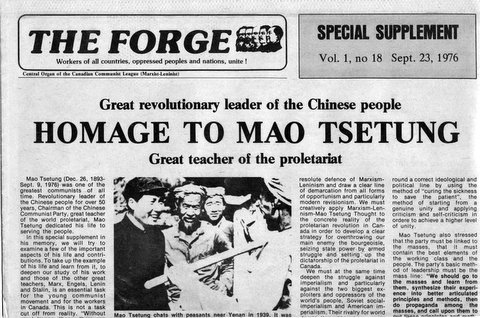
The League was very active in union movement – especially the Confederation of National Trade Unions in Quebec where it could mobilize up to 300 delegates (out of over 1,000) at CNTU conventions. In other parts of Canada, the League was active in the Canadian Auto Workers and the Canadian Union of Public Employees. During this period, the League was its largest with public meetings in Montreal with over 3,000 people attending. Their contingents in demonstrations in that city could number over 2,000 people.
In the spring of 1979, the Canadian Communist League renamed itself the Workers’ Communist Party (WCP). The WCP, like its predecessor, supported the new regime in China after Mao’s death and was a strident supporter of the Three-Worlds Theory. China reciprocated by officially recognizing the WCP and the leadership of the party met with Hua Guofeng and toured Pol Pot’s Democratic Kampuchea just prior to the Vietnamese invasion. During this period, the WCP also developed close ties with like-minded parties such as the Communist Party (Marxist-Leninist) in the U.S. and the Workers’ Communist Party of Norway.
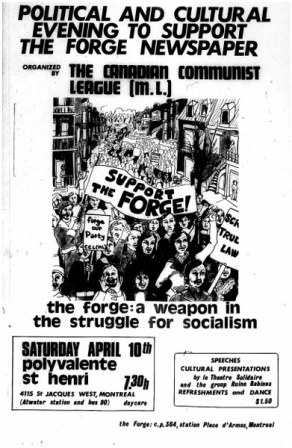
By late 1982, the WCP entered a period of crisis. Many began to question the direction that China was taking. Members also discovered that the majority composition of the Political Bureau was English speaking while the vast majority of the membership was French speaking. More controversy came to the fore as members complained about the rigid internal structure that was overseen by a security group that acted as an internal police. In the last issue of The Forge, the disintegrating WCP officially apologized to a couple who had been held prisoner by this group in their apartment for 14 hours while it searched for internal documents. Although some members wanted to form a broader based organization, the majority voted to dissolve the party. Documents relating to the crisis and collapse of the WCP can be found here.
The most prominent former member of the WCP is Gilles Duceppe who was the leader of the pro-independence Bloc Québécois which holds a number of seats in the Canadian Parliament. He resigned the position after the 2011 election.
Le discours de la Ligue communiste (marxiste-léniniste) du Canada (1975-1983) by Charles-Antoine Bachand
L’histoire du PCO & de la Ligue Marxiste-Léniniste by Roger Rashi
Feminisme et marxisme : un dilemme pour la Ligue communiste canadienne by Pierrette Bouchard
Fight the Sectarianism of the CCL (ML) by In Struggle!
Does Canadian Communist League (Marxist-Leninist) want the unity of (Marxist-Leninist) communists, or their division? by In Struggle!
The Rallying of Mobilisation to the CCL(ML) Brings Out a Basic Question by In Struggle!
A Rectification in Our Reply to The Forge by In Struggle!
When the struggle against opportunism serves to justify opportunism In Struggle!
100% opportunism, an argument to justify opportunism In Struggle!
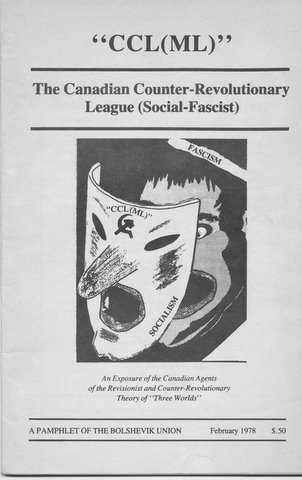
“CCL(ML)” The Canadian Counter-Revolutionary League (Social-Fascist) by the Bolshevik Union
The CCL(M-L), The Voice of Social-Chuavinism in Canada by In Struggle!
Announcing the Creation of the Canadian Communist League (Marxist-Leninist)
Organize March 8 on a revolutionary basis
International Women’s Day and the unity of Marxist-Leninists
Mobilisation must choose: Climb out of the opportunist swamp or drown
The League in the Regroupment for March 22
The struggle against right-opportunism is essential for building the party
Self criticism of the group Mobilisation: A profound criticism of right-opportunism and economism
Workers’ Unity (Toronto) rallies to the Canadian Communist League (ML)
When the struggle against opportunism serves to justify opportunism by two former members of Cercle Communiste (M-L)
The CCL (ML) Response to the Political Documents of Western Voice
100% opportunism, an argument to justify opportunism by two former members of Cercle Communiste (M-L)
Fight the Sectarianism of the CCL (ML) by In Struggle!
No compromise with opportunism
On the question of Canadian Revolution
For the unity of Marxist-Leninists
Mobilisation is not a Marxist-Leninist group
Combat right opportunism masked by intellectualism
New Victories in the Battle against Opportunism
NO to in Struggle’s Compromising with Revisionism
Boycott In Struggle’s ’unity’ conference
Editorial: In Struggle Completely Liquidates Self-Criticism on Political Line!
The Groupe Abitibi-Temiscamingue (ML) Rallies to the League
More than ever, we must demarcate in order to unite
The End of the “Family of Five” in Quebec
Opportunism Around Unity Again
League Holds Unity Conference in Vancouver
In Struggle Embarks on Another Dead-End Path
Bolshevik Union: A Counter-Revolutionary Sect
A Great Ally of Reformists and the Best Defender of Economism
May First Collective, An Opportunist Group
In Struggle slipping ever faster into right opportunism
Communist Work Developing in Acadia
Self-criticism of Regina Marxist-Leninist Collective on its participation in Saskatchewan Waffle
Regina Marxist-Leninist Collective rallies to the League
In Struggle now turns to direct attacks on socialist China
In Struggle has sunk completely into revisionism!
League publishes study handbook of Marxism-Leninism-Mao Tsetung Thought
Black Study Group rallies to the League
October 14 League meeting in Toronto a success!
In Struggle panics and puts on a new mask
Letter from former IS sympathizers: To the honest militants of IS
In Struggle’s draft program: A program to create a revisionist party
Communique of the Central Committee on the second congress of the CCL(ML)
’In Struggle’ – latest addition to the revisionist family in Canada
League Central Committee Delegation Returns from China and Kampuchea
Halifax Study Group’s brochure: an apology for right opportunism
League publishes draft program for the new communist party
Draft Program for a New Communist Party
Basis for a new party...with nothing new about it by In Struggle!
Founding Congress of the Workers Communist Party
Political Report Adopted at the Founding Congress of the Workers Communist Party (Marxist-Leninist)
Four years of communist work laid basis for party
Resolution on the unity of the international Marxist-Leninist movement
A fourth counterfeit communist party by In Struggle!
Alive magazine editorials on the formation of the Workers Communist Party (Marxist-Leninist)
“Our party is growing in the hearts of the workers’ struggles”
The Workers Communist Party unveils its constitution by In Struggle!
Report on the Party’s Work in a Big Plant
Criticism of In Struggle’s documents on revisionism: Socialism is a real alternative by Roger Rashi
The industrial proletariat: A decisive force in the revolutionary struggle
CPC ’opens doors’ for the ruling class
The relationship between the party and the unions: The communist viewpoint
Which way forward for Canadian socialists
WCP holds conference on woman question
Making a workers’ paper better
Discussion on the family within the WCP
WCP sets out to improve propaganda work
The CPC’s chauvinist view of the women’s movement
Debates underway as WCP prepares Second Congress
Does In Struggle’s demise reflect on the validity of Marxism
Sexist language in The Forge: You’re right!
Recognizing the WCP’s errors with intellectuals
Repression of the masses, capitulation on defence
Defence of sea rights: We can’t depend on the bourgeoisie
The League’s work among students
CCL(M-L): Running dogs of the bourgeois army by Spartacist Canada
Editorial: 1,200,000 Workers Out Against Wage Controls
“C”PC’s parliamentary illusions will never defeat capitalism
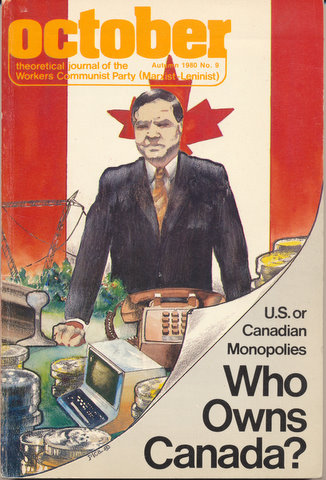
Who Owns Canada? by Richard Desrosiers and Julian Sher (October, Autumn 1980)
SOS Daycare Congress Adopts CCL(ML)’s Program
In Struggle on Unions: Opportunist Through and Through
Revisionist chiefs leading fishermen’s struggle to a dead end
Build a United Fightback of the Working Class
Newfoundland seal hunters get enthusiastic send-off in St John’s
The fight against superpower war preparations, part of the struggle for socialism in Canada
League May Day rallies stress fightback and unity
Workers celebrate May Day in 17 cities with the League
Why a communist candidate in the by-elections?
Which road in fight for Acadian rights?
WCP militants active in key labour struggle
The national question in Canada: Over eight million Canadians resist national oppression
Book Review: Life and Death of the Canadian Seamen’s Union
5,300 votes across the country: First WCP federal election campaign a success
’Multiculturalism’ pits immigrants against nationalities
NO to the Trudeau Constitution! YES to democratic and national rights!
What’s behind the CPC’s ’militant’ front?
Regional autonomy: Step towards equality of nationalities
Building the anti-racism movement in BC
Regional autonomy key to Native equality
Progressives from four Atlantic provinces hold socialist conference
For the unity of the proletariat of the two nations
No to separation, yes to self-determination and socialism
The significance of the Parti Quebecois election
In Struggle’s tour: building itself up as a bourgeois party
Independence and socialism: “left” cover for narrow nationalism in Quebec
Document from CCL(ML)’s second congress: Resolution on the Quebec national question
Unreserved nationalism – The League’s “reserve nation” by In Struggle!
Return of FLQ terrorists rekindles many old questions
In Struggle petition on the national question: Empty phrases to mask their chauvinism
Book Review: Le Quebec, La question nationale
Roland Lepage’s La complainte des hivers rouges: A play that distorts the Patriote’s history
Equality of Languages and Nations – WCP style by In Struggle!
CP tosses aside Quebec’s rights
What was behind the ’NO’ victory
Symposium on “The left after the referendum” urges return to spontaneous struggle
WCP campaign off to a good start across the province
WCP candidates get 5,000 votes
Editorial: Safeguard the independence of Canada
En Lutte and the International Situation
Joint Communique Issued by the October League and the Canadian Communist League
Joint Communique of the CCL (ML) and the AKP (ML) of Norway
CCL (ML) receives message from Communist Party of Kampuchea
CCL (M-L): Out of step with China over Near East by Spartacist Canada
Throwing off their masks: ’CPCML’ and In Struggle attack Mao Tsetung
Concerning the differences between Albania and China
The Soviet bear sets its claws on Africa and on Asia with ambitions of dominating the world
What Trotskyists did yesterday, In Struggle is doing today
In Struggle attacks Marxism-Leninism
Kampuchean People Resist Vietnamese Invasion
Editorial: it is our duty to support the Kampuchean people by Roger Rashi
Kampuchea Wages people’s War. League Delegation meets Fighters of Revolutionary Army
Invasion of Kampuchea part of Soviet drive for world domination
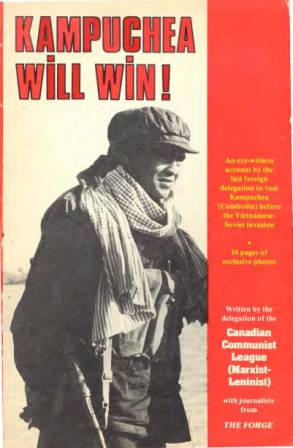
First Canadian visitors back with true picture of Kampuchea
Canadian M-L delegation visits Kampuchea
On the question of Coke in China
Enver Hoxha sinks to new depths in attack on Mao Zedong Thought
One-month campaign reached 16 cities: Continue education and support for Kampuchean resistance
A blow against Moscow-Hanoi aggressive aims
Why Vietnam and the USSR invaded Democratic Kampuchea
Canadian Arab Friendship Association denounces In Struggle
Why we support the struggles of the third world
What is the new democratic revolution?
CPC pretends Poland is ’democratic’
China today: The Forge answers readers’ questions
Capitalism encourages it, socialism fights it!
Against Feminism. Link the struggle for our rights to the struggle for socialism!
Fascist Bains gang tries to buy off worker
In Struggle Comes to the Rescue of Trotskyists
Who is really “conciliating the bourgeoisie”? CCL(M-L) in anti-Trotskyist frenzy by Spartacist Canada
Forgeons Notre Parti! – Forge Our Party!
[Back to top]
The Mouvement Revolutionnaire des Etudiants du Quebec (MREQ) was created from a split with the Parti Communiste du Quebec (Marxiste-Leniniste) in early 1972. The split saw a substantial loss of members and PCQ (M-L)’s flagship bookstore on Rue Amhearst (which later became Librarie Progressiste) with the formation of three organizations: the short-lived Mouvement Revolutionnaire Ouvriere, which published the newspaper Quebec Rouge until it dissolved into CAPs (Political Action Committees); the Afro-Asian Latin American Solidarity Committee, which was mostly active in Montreal’s English-language universities; and the MREQ.
The MREQ was active in the French-language universities and published the newspaper Le Partisan. Later, a group of students at McGill University joined and its paper was published in both French and English eight times during the school year. The MREQ set three tasks in its founding document, Contre L’ecole Capitalist: the struggle against the capitalist school, support for workers’ struggles, and support for anti-imperialist struggles. It also ran Libraire Ho Chi Minh. While its activities were centred in the student milieu, it also supported the concept of “implantation” (sending students into factories) as a means to proletarianize young middle-class revolutionaries. The MREQ was also active in the broad-based Comite de Solidarite avec les Luttes Ouvrieres. The MREQ held that the principal contradiction in Canada was between the proletariat and the Canadian bourgeoisie, in opposition to many groups in Quebec during this period that saw US imperialism as the main enemy. Although it always held to building a new Marxist-Leninist party, this position wasn’t explicitly stated until the publication of Towards the Marxist-Leninist Organization in 1974. In late 1975, the MREQ united with the Cellule Militante Ouvriere and the Cellule Ouvriere Revolutionnaire to form the Canadian Communist League (M-L).
Against Splits and Liquidation by the Communist Party of Canada (Marxist-Leninist)
A Call For Unity and Struggle – Against Disunity and Liquidation by the Communist Party of Canada (Marxist-Leninist)
Some Problems Facing the Student Movement by the Communist Party of Canada (Marxist-Leninist)
For the Unity of All Marxist-Leninists Against Splits and Liquidation by the Communist Party of Canada (Marxist-Leninist)
The Mouvement Revolutionnaire des Etudiants du Quebec by the Organization of Communist Workers (Marxist-Leninist)
Students and the Revolutionary Movement
Towards the Marxist-Leninist Organization
[Back to top]
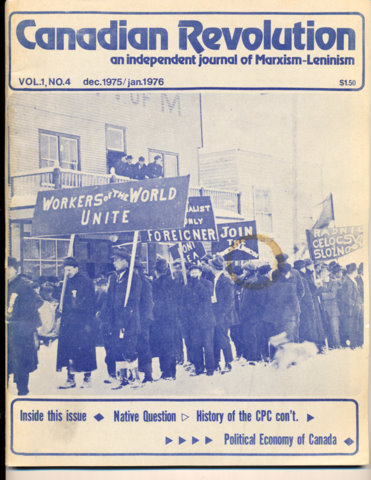
Canadian Revolution was a magazine founded by members of the Toronto Communist Group, Workers Unity, and individuals who would later go on to form the Bolshevik Union. The magazine was intended as an open forum for Marxist-Leninists to debate issues related to communist theory and practice. Although only six issues were published (from spring 1975 into early 1976) Canadian Revolution managed to connect often isolated groups across Canada with one other. However, disputes between the Bolshevik Tendency (the initial name of the Bolshevik Union) and the other groups on the magazine over its direction soon disrupted further publishing. Moreover, both the Toronto Communist Group and Workers Unity were soon to merge with the expanding Quebec groups – In Struggle! and the Canadian Communist League.
The Degeneration of Canadian Revolution by the Bolshevik Union
[Back to top]
The Bolshevik Union was originally formed as the Bolshevik Tendency by a group working with the magazine Canadian Revolution. The group held the position that the Canada’s native peoples were an oppressed nation and that Canada’s north is an internal colony. After the group split from Canadian Revolution, it started publishing its own magazine named Lines of Demarcation.
Although the Bolshevik Union initially supported In Struggle!, it soon denounced both In Struggle! and the Canadian Communist League (M-L) for being right-opportunist and economist. Instead, the Bolshevik Union argued that the smaller anti-revisionist groups and collectives across the country should maintain their independence in order to sharpen the ideological struggle and not merge with the larger groups. It also questioned the concept of a “pre-party organization” which was felt to be a concept imported from the United States. The Bolshevik Union managed to recruit a group of In Struggle! members and sympathizers in Montreal and began publishing the monthly bilingual magazine, Proletarian Revolution.
The BU supported the Party of Labour’s criticism of the Three-Worlds Theory and socialist Albania until the PLA recognized the CPC (M-L) as the vanguard party in Canada. After that, it claimed that there had been no socialist camp since the death of Stalin. Thereafter, the BU started working closely with the Bolshevik League in the United States and a journal, Correspondances Internationales, that was published by African Marxist-Leninists in Paris. It disbanded sometime in the mid-1980s.
When bourgeois nationalism replaces a class viewpoint. Bolshevik Union and the question of the native people by In Struggle!
Bolshevik Union: A Counter-Revolutionary Sect by the Canadian Communist League (Marxist-Leninist)
Deepening the criticism of the Bolshevik Union in the masses is to arm the workers to combat opportunism by In Struggle!
No to the Bolshevik Union’s splitting and wrecking practices! by In Struggle!
Unmask the imposters! Denounce the Bolshevik Union! by In Struggle!
Bolshevik Union and the opportunist Hardial Bains have a lot in common by the Regroupement des ex-militants du PCC(m-l)
A Strange Letter from the Bolshevik Union by In Struggle!
BU “Alone at last!” by In Struggle!
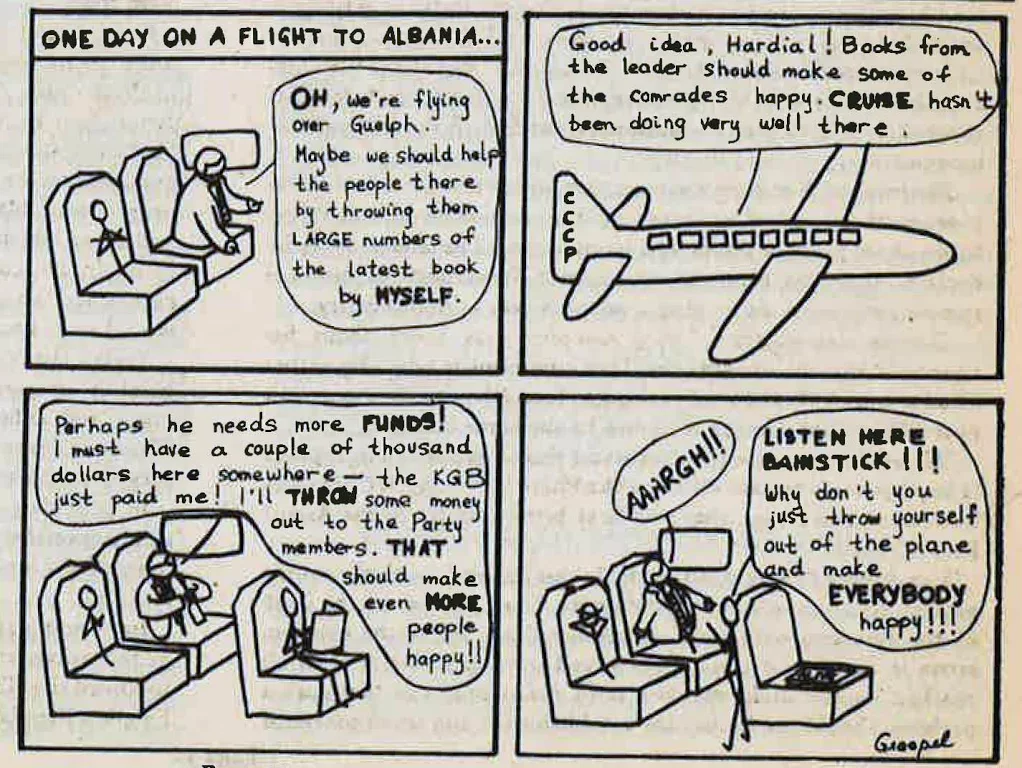
As Usual Alive Responds to Attacks!
Try, Fail, Try Again, Fail Again, Attacks on Alive Continue Alive #159, November 17, 1979
Regarding the Question of the Party of Labor of Albania by the Bolshevik League of the United States
Nationhood or Genocide: The Struggle of the Native People Against Canadian and American Imperialism
LINES OF DEMARCATION, the Marxist-Leninist Movement and the Bolshevik Union
The Degeneration of Canadian Revolution
Defeat economism! A reply to Workers’ Unity (Toronto)
’Marxism and Leninism’: The Trade Union Work of Workers’ Unity (Toronto)
CCL(ML) criticizes the Bolshevik Union: A reply
“Not with Whom to Go, But Where to Go”
Editorial: Going against the tide
The Native National Question and the Marxist-Leninist Movement
Combat cynicism about recent events in China
The League “rallies” to the Bolshevik Union’s “obstructionist” line on Canadian Revolution
Right opportunism is dead! Long live right opportunism!
One Country, Many Marxism-Leninisms by the Mass Line Study Group
The “theory of cadres” and the first stage of party building
In Struggle changes its line on the principal contradiction
Unmask In Struggle! Denounce Gagnonism!
Hardial Bains and his so-called “Communist Party of Canada (Marxist-Leninist)”
The Expulsion of the League from ADDS: A Great Victory for Welfare Recipients
“CCL(ML)” The Canadian Counter-Revolutionary League (Social-Fascist)
The Party of Labor of Albania Came to Canada Under a Stolen Flag
Alive Magazine on the “Unsheltered Class” and its Dirty Language
The Great Conspiracy Against Stalin
War and Proletarian Revolution
On the “Third International Youth Camp” in Spain: Provocation Under Cover of Cries Against Provocation [International Correspondence, #1, Spring-Summer 1980]
To: L’Union de Lutte Communiste (Upper Volta) Linea Bolchevique (Puerto Rico) La Voie Ouvriere (Ivory Coast) Bolshevik Union (Canada) En Avant! (Togo) Bolshevik League (United States) [critique of the BU] by MPLO Marxist-Leninist Party of Austria Gegen die Stromung, Westberliner Kommunist
Cuba: The Bitter Taste of a Sweet Revolution
International Correspondence, # 1, Spring-Summer 1980
International Correspondence, # 3, Spring 1981
[Back to top]
The Red Star Collective (RSC), a Vancouver area Marxist-Leninist group in the 1970’s, developed out of the Vancouver Study Group (VSG) which was active from 1972 to 1976. For much of this period the VSG was the only group in Vancouver which sought to base its analyses in Marxism-Leninism. Founders and leading members of the VSC included former members of the Progressive Workers Movement.
The RSC, like its predecessors, believed that Canada was not an imperialist country but rather an economic colony of the United States. However, it did not support the two-stage theory of an anti-imperialist revolution followed by socialism that the Progressive Workers Movement had put forward in the 1960’s. The RSC position was a minority one within the Marxist-Leninist movement during the 1970’s. However, some smaller groups such as the Halifax Study Group had similar positions. The RSC considered the Three Worlds Theory, developed by Mao, to be the correct approach to analyzing the international situation.
The RSC disagreed with the larger anti-revisionist groups like In Struggle! and the CCL (ML) on the priority of party building. While these two organizations saw the building of a vanguard party as the primary task of Canadian communists, the RSC held that the objective conditions did not yet exist for the creation of a vanguard party. The RSC saw the primary task as being to create these objective conditions (by strengthening the class consciousness, knowledge and organization of the working class and its allies). To this end, the RSC was active in labour, anti-imperialist and anti-racist movements as well as in conducting study groups and publishing various pamphlets.
The RSC willingly debated with other second wave anti-revisionist groups and worked in common campaigns with them and with other progressive organizations. The RSC participated in various conferences including some of those organized by In Struggle! Jack Scott – an RSC member and long-time activist – personally addressed the first IS! conference.
Like other second wave anti-revisionist groups, the RSC dissolved during the 1980s.
Two Roads: the Origins of the Sino-Soviet Dispute by Jack Scott
The Real Aim of the Pamphlet Two Roads – The Origins of the Sino-Soviet Dispute Written by Jack Scott: Phoney Defense of China and Real Slander of Leninist and the October Revolution by the Communist Party of Canada (Marxist-Leninist)
Summary of the Strike Against Alcan in Kitimat B.C. by the May First Collective and October Study Group
Reply to the Evaluation of the Alcan Strike in Kitimat B.C. by the Red Star Collective
The Progressive Workers’ Movement and the Red Star Collective: A Legacy Of Economism And Bourgeois Nationalism In The Marxist-Leninist Movement by the Long March Collective
Canada: Imperialist Power or Economic Colony?
Critique of In Struggle!’s “The Path of the Canadian Revolution”
The International Situation: World United Front & Proletarian Revolution
Discussion with Chinese Comrades (Notes on Chinese Foreign Policy) by Jack Scott
Basis of Unity of the Red Star Collective
[Back to top]
The Halifax Study Group had its origins in the East Coast Socialist Movement – a left group that supported workers’ struggles (such as the Nova Scotia fisherman’s strike in the early 1970’s) and published the newspaper, East Coast Worker. Two groups that identified with Marxism-Leninism emerged from the East Coast Socialist Movement (ECSM) when it dissolved in 1972. One group eventually became the Halifax Communist Group (which later joined In Struggle!). The other group became the Halifax Study Group (HSG).
The HSG was initially formed to work with the journal, Canadian Revolution, but as the Toronto groups joined the larger Marxist-Leninist formations and the Canadian Revolution project was abandoned, the HSG turned its attention to the analysis and critique of the new left in general, the major Canadian M-L groups in particular, and the connections it made between the two. The HSG’s New Infantilism pamphlet – which had begun as an analysis of the politics of the ECSM – was revised to take aim at what it saw as the ultra-leftism and “phoney Marxism” of In Struggle! and the Canadian Communist League (Marxist-Leninist). The HSG continued as a study group but dissolved in the early 1980s. The New Infantilism was its only publication.
A Wind Blows from the East (Coast) [Halifax Platypus Society audio]
Halifax Study Group’s brochure: an apology for right opportunism by the Canadian Communist League (Marxist-Leninist)
New Infantilism. The “New Communist Movement” in Canada
[Back to top]
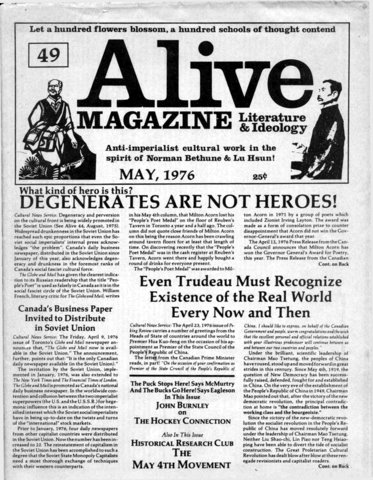
Alive began in as a generally left-wing Guelph, Ontario high school literary magazine in Nov.-Dec. 1969, inspired by a teacher, Edward Pickersgill, who continued to play a leading role in the magazine until 1978. For a number of years, it continued in this pre-anti-revisionist mode. By the early-1970s, however, Alive was clearly aligned with the anti-revisionist movement, publishing a variety of revolutionary poems, short stories, literary criticism and cultural news, “in the tradition of Norman Bethune and Lu Xun.” For a brief period in the mid-1970s, Alive merged with the Communist Party of Canada (M-L)’s cultural journal Literature & Ideology, only to break with it shortly thereafter. Peak circulation of Alive in the mid-1970s was approximately 6,000 – with 5,000 copies per issue being sold on the streets and campuses in southern Ontario and another 1,000 by mail to paid subscribers. Alive closely followed the political-cultural line of the Communist Party of China in its poetry, short stories, and editorials – during the late 1970s, for example, it had a regular news column entitled: “Soviet Union: Greatest Threat for World War”. Alive ceased publication in 1980.
Alive Magazine on the “Unsheltered Class” and its Dirty Language by the Bolshevik Union
Revolutionary Culture is a Practical Struggle
Writers and Artists Have Duty to Serve in the Worldwide Struggle Against Imperialism
Oppose Monopoly Capitalist Terrorism Against Individuals and Whole Segments of Society
Letter: Nothing Like Alive in England by T. Graham
The Progressive Cultural Club of the University of Guelph Sets a Good Example for Cultural Workers
Notes on the relations of Alive magazine and Literature and Ideology
CLM’s National Chauvinist Body Dead. Let’s Bury the Opportunist Spirit!
Dealing with the question: Should We Retract Our Characterization of Milton Acorn
The One That Got Away by John Burnley
Six of One, Half a Dozen of Some Other by John Burnley
Introduction to the Updated “Alive View”
The Destruction of On the line by Cathie Lauzon
Alive Will Move Forward! [special Edward Pickersgill issue]
Developing Unity [on the founding of the U.S. League of Revolutionary Struggle (M-L)]
Sea of People's War Drowns Vietnamese Aggressors Alive #127, March 17, 1979
Book Review: The Challenge of the Kampuchean Revolution by E. San Juan Jr.
An Historical Overview of the China-Viet Nam Conflict Alive #128, March 24, 1979
Albania’s Incorrect Line Exposed Alive #128, March 24, 1979
Struggle in New Zealand Develops
Native Struggles in Canada Alive #129, March 31, 1979
Socialist China Repulses Soviet-Instigated Attack Alive #129, March 31, 1979
Excerpts from a letter to Alive from an ex-member of the CLM, Toronto
Excerpts from a letter to Alive from Milton Acorn
Tian An Men Incident: A Completely Revolutionary Action Alive #130, April 7, 1979
On Anti-Imperialism and Unity [a speech delivered on July 2, 1979 by a member of the Alive Production Collective]
Excerpts from the Question and Answer Period
Response to Section 4, Alive 125: “Edward Pickersgill Had No Grasp Of Revolutionary Ideology” Cathy Lauzon
Letter to Alive from Cathy Lauzon
Answering Cathy Lauzon Alive #143, July 14, 1979
Unity for Revolution Alive #148, August 18, 1979
Editorials on the formation of the Workers Communist Party (Marxist-Leninist)
As Usual Alive Responds to Attacks!
Mao Zedong Thought and Our Revolutionary Work Alive #153, September 22, 1979
Try, Fail, Try Again, Fail Again, Attacks on Alive Continue Alive #159, November 17, 1979
Always Emulate Norman Bethune Alive #160, November 24, 1979
A Brief History of The Great Polemic Between the Communist Parties of China & Soviet Union
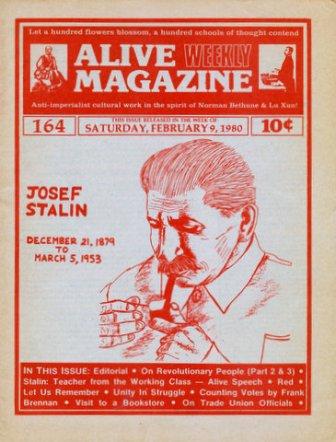
Joseph Stalin: A Teacher from the Working Class Alive #164, February 8, 1980
Summing Up Our Revolutionary Development and Looking Towards 1980 Alive #165, February 16, 1980
Past Lessons, Future Directions Alive #165, February 16, 1980
An Excerpt from the Question and Answer Period, January 1, 1980 Alive #165, February 16, 1980
An Excerpt from the Question and Answer Period, February 8, 1980 Alive #165, February 16, 1980
Guelph Maoists – A Critical Examination
An Interview with a Distinguished Counter-revolutionary
The Shoe by John Burnley
The Execution of the Infant Mary
Let Us Remember by Pat McLellan
The Taste of Oppression by Rita Bedard
Waitress, My Hot Pecan Pie Is Cold by George Steffler
[Back to top]
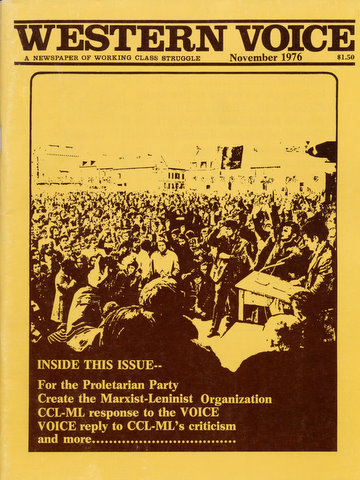
Western Voice was founded in 1973 by staff members of the Vancouver “alternative” newspaper, Grape. The newspaper’s masthead described Western Voice as a “Newspaper of Working Class Struggle” and it covered labour and social struggles across Canada with an emphasis on British Columbia. While many in the Western Voice Collective (WVC) were sympathetic to Marxism-Leninism, this was not reflected in the paper which focused more on broad-based labour support and solidarity rather than putting forward a revolutionary political line. The trend of publishing progressive papers with no discernable revolutionary line by activists who identified with Marxism-Leninism was repeated across Canada during the early 1970s. Other examples include Mobilisation, published by Libraire Progressiste in Montreal, and Ottawa Worker and New Foundations in Ontario. These activists were either not attracted to the existing M-L organizations, such as the CPC (ML) or the CPL, or else believed that conditions were not yet right for the creation of a Marxist-Leninist party. However, with the publication of Canadian Revolution and the expansion of the Quebec M-L groups, many began to re-evaluate these positions. The Western Voice Collective, in the last two issues of the publication, began a process of self-criticisms and a public orientation to Marxism-Leninism. Not only did it publish its own material but also included translated material from the M-L groups in Quebec. The WVC eventually dissolved Western Voice and most of its members went on to join In Struggle! Others similar publications, such as Mobilisation, became affiliated with the CCL, while others simply ceased publishing.
The CCL (ML) Response to the Political Documents of Western Voice
Against the Economist Line on the Western Voice
Liquidate Economism – Not the Struggle Against It
[Back to top]
The OCW (ML) began in Guelph, Ontario as the Guelph Worker’s Committee. The latter described itself in a letter to Canadian Revolution as a ‥small group of workers studying Marxism-Leninism”. The GWC later renamed itself as the Organization of Communist Workers (Marxist-Leninist).
For a brief period of time, the OCW (ML) was allied with a U.S.-based collective, the Communist Workers Group (Marxist-Leninist), based in Kasas City, Missouri. The two groups issued a joint statement on the situation in China after the defeat of the “Gang of Four.”
The OCW (ML) seems to have disbanded not long after the publication the “Movement for the Party.”
Three Letters to Canadian Revolution in response to the letter of the Guelph Workers Committee
The O.C.W.(M-L) will not participate at the Second Conference of Canadian Marxist-Leninists by In Struggle!
Letter to Canadian Revolution from the Guelph Workers Committee
The Situation in China and Social-Chauvinism in Our Movement by the Organization of Communist Workers (ML) Canada and Communist Workers Group (ML) U.S.A.
Matchmakers of Opportunism: Against En Lutte’s Unity Plan
[Back to top]