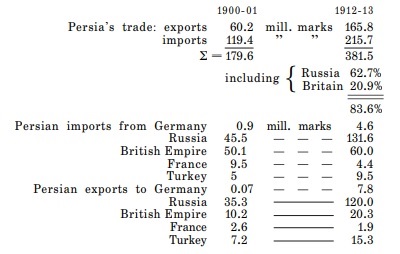
Professor Dr. Th. Jaeger (Hamburg), Persia and the Persian Question, Weimar, 1916 (Deutsche Orientbücherei. Published by Ernst Jäckh, XIV) (179 pp.).
| N.B.: Better than the preceding book. | ||||
|
A very good, comprehensive, clear account, with precise information and frequent citation of documents. An excellent map of Persia, showing Russian and British zones of influence. The author, of course, is an imperialist scoundrel. |
||||
| N.B. |
Reference is made to Persia and the European War. by a “Persian patriot” (price ? Place of publication?), which appeared while Jaeger’s book was being printed. |
Various quotations from Curzon’s book Persia, London, 1892. Two vols.
Jaeger’s book begins with a quotation from the “Testament of Peter the Great”, which Napoleon I “dictated in the form of theses when in 1812 he had to condition public opinion to accept his campaign against Russia” (p. 9).
1722-23: Peter the Great conquers Derbent, Baku, Resht and the greater part of Gilan (North-Western province of Persia, bordering on the Caspian Sea).
1735—Gilan, Derbent, Baku are returned to Persia.
1802—Georgia becomes a Russian province.
1800—Napoleon I and Paul I plan to attack India.
1807—Napoleon I’s military mission to Persia (70 officers, etc., led by General Gardanne).
1808—Britain sends a special envoy to Persia, and helps Persia in her war against Russia.
1813—Persia defeated in the war against Russia. Gulistan Peace. Persia surrenders Derbent, Baku, etc., etc. Undertakes not to keep naval vessels in the Caspian Sea.
1814—Anglo-Persian treaty; a “defensive and offensive. alliance” (13)....
1825—War between Persia and Russia (which, he says, drew Persia into a war just as Britain did the Boers in 1899). Britain tricked Persia: this development does not come under our treaty!!
1828—Persia defeated in the war against Russia Turkmanchai Peace (Persia surrenders Nakhichevan, Yerevan, etc.); £3,500,000 war indemnity.
1890—Britain (a British company) obtains a 50-year tobacco monopoly concession for 300,000 marks + one-quarter of net profit.
|
With a capital of 13,000,000 marks, the company obtained a net profit, after all deductions, of 7,500,000, i.e., > 50 per cent (p. 17). |
good example!! |
|
Popular disturbances as a result of this, etc. (“several hundred killed”!! p. 17)—the concession was bought by the Persian Government in 1892 for 10,000,000 marks (!!). The ten million marks were borrowed from Britain at 6 per cent!!! |
August 5, 1906. The Persian Shah promised the people a constitution and a parliament.
1909. British insistence compels the recall from Persia of Russia’s representative, von Hartwig, who had been most unscrupulously fomenting intrigues, etc. (He was transferred to Belgrade, where he was “one of the chief instigators of the assassination of the Archduke, the heir to the throne, and his wife”, p. 21)
June 23, 1908. Coup d’état in Persia. Mejlis dissolved, with the help of Lyakhov.
|
May 31-June 13, 1908—Lyakhov’s letter to the general headquarters of the Caucasian military area (full text)—from Browne: The Persian Revolution, 1905 -09, Cambridge, 1910, p. 222. A most brazen plan for counter- revolution in Persia, bribery, pogroms, etc. ((pp. 26-28 in Jaeger)). |
|||
| N.B. | |||
November 29, 1911—Russia’s ultimatum (the second) (to Persia): expulsion of Morgan Shuster, etc.
Russia steadily advances in Azerbaijan. (Railway from Dzhulfa to Tabriz begun.)
A series of quotations from Browne about the shameless robbery and violence committed by the Cossacks (38 et seq.).... The Cossacks hanged Moslem priests (41), etc.!!
Letter of a Frenchman on the same subject (Siècle, January 11, 1910)—p. 39.
Swedish gendarmerie called in to preserve order... (42).
1914—The Russians settle Russian peasants in Azerbaijan....
|
Persia has neither a “modern civil service” nor “money” (49). The collection of taxes is put up for purchase. Quotes Morgan Shuster: The Stran- gling of Persia, 1912. ((At a Cabinet meeting Morgan exposed one of the ministers of having accepted a bribe of 83,000 tomans = 332,000 marks. The reply: I did not know about it, it was done by my private secretary!)). |
||||
| N.B. | ||||
The Belgian customs officials act in the same way (de Naus bought himself a castle with money “earned” in Persia (53)).
Persia = 1,645,000 sq. km.
Population—four million (“probably”) (ten million is an exaggeration, p. 60).
Russia treats Persia as her “own” land, and does not allow free transit to Persia (67)....
The way round this is to send goods by parcel post:
| total | including Germany | ||||||
| (pp. 68-69) | 1904 — | 10 | 1 | !! | |||
| 1913 — | 384,318 | 193,816 | |||||
|
Russia tried to prohibit parcel post transit from February 1, 1914, but met with opposition from all the powers (including Britain and France), and had to give way (pp. 70-71) |
N.B.!! |
In 1902 Russia concluded a trade treaty with Persia by which she ensured a market for “her” sugar, oil, etc. (71)....
Morgan Shuster says this tariff is extremely harmful for Persia and profitable for Russia (73)—(p. 270 of Shuster’s book)....
|
Russia thus ensures herself a monopoly (74) in North Persia, compelling the Persians to pay high prices for trashy goods!! |
!! |
The struggle for influence in Persia: (Russian, French, German) schools, (Russian, British, German) hospitals, etc. German chemists’ shops (88), rug marketing company (89)
Russian annexations in Central Asia from 1861 to 1891 (1911 estimates)
| Sq. km. | Population | |||||
| (1869-73) | Transcaspian region | 598,090 | 451,000 | |||
| Bukhara | 203,430 | 1,500,000 | ||||
| (1873) | Khiva | 67,430 | 800,000 | |||
| Syr-Darya | 489,240 | 1,874,000 | ||||
| { | 1884 | } | (1875-76) | Ferghana | 142,790 | 2,069,000 |
| Merv | Samarkand | 87,560 | 1,184,000 | |||
| 1,588,540 | 7,878,000 | |||||
May 5, 1903. Lord Lamington’s speech in the House of Lords (p. 100 et seq.) (against Russia: we need the Persian Gulf—it is the defence of the Indian frontier...)
Also speech of Lord Ellenborough:
|
...“I should prefer to see Russia in Constantinople than a European arsenal on the shores of the Persian Gulf” (111) |
N.B. |
Anglo-Russian treaty of August 31, 1907 (text: p. 114 et seq.) (“Anglo-Russian treaty on partition”)....
Russian zone—790,000 sq. km.
British zone—355,000 ” ” (p. 119)....
|
Note of the British and Russian ambassadors to Persia (of February 18, 1912)—p. 124 et seq.— loans of £100,000 are granted by each at seven per cent!!!, etc. ... Of course, the ministers, Russian placemen, agree!! |
7% |
The Potsdam treaty of August 19, 1911—(text: 130 et seq.). Germany recognises Russia’s zone in Persia, Russia agrees not to oppose the Baghdad railway.
Reichs Chancellor’s speech in the Reichstag (December 10, 1910) on the same subject....
| ( |
Russia shares with Britain, but afterwards re-insures with Germany!! |
) | ) | double insurance!! |
|
Germany needs a road to Persia and India—only for trade, of course, only!!—The Baghdad railway ends in the Gulf, that will not do, the Gulf can be closed by Britain. The railway must end in Bandar Abbas (!!). |
Oman is, in fact, in British hands (p. 144).
Tabriz (population 220,000). Trade (1906-07):
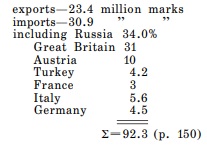
(This, author says, is below Germany’s trading capacity.) 1914 summer: treaty on the division of railways in Asia Minor.
| (p. 151)!! |
France gets 4,522 km. of railways in Turkey. Germany—4,909 km. |
Afghanistan—a mountainous region.
624,000 sq. km. 4,450,000 inhabitants. Nominally she is completely independent. In reality all foreign policy is in the hands of Great Britain; the Emir is on Britain’s pay-roll. Under the Anglo-Russian treaty (August 31, 1907), Britain recognised freedom of trade in Afghanistan, and Russia recognised Afghanistan as being “outside her sphere of influence”.
The British do not even allow foreigners to enter! Afghanistan (!! p. 154).
Militarily, the Afghans “should by no means be underestimated as adversaries” (157).
Britain treats them with the greatest caution:
|
“In this one sees the wisdom of Britain’s ‘velvet glove’ policy, for the British could not behave to anyone more tolerantly and cautiously than they have to him” (the Emir of Afghanistan) (158). |
N.B. |
Turkestan (= Central Asia). The Urals, Turgai, Akmolinsk, Semipalatinsk, Ferghana, Samarkand, Semirechye, Syr-Darya, and Transcaspian regions (p. 161).
—3,488,530 sq. km. and 10,957,400
+ Khiva and Bukhara
ΣΣ= 3,760,000 sq. km., 134 million inhabitants.
The population is almost exclusively Moslem.
|
“A special diplomatic mission from these coun- tries, notably from the Kirghiz region, is now touring the Courts of the Quadruple Alliance powers, and of the neutral states, to put their complaints against Russian oppression and to demand liberation from the Russian yoke and the restoration of their old states” (162). |
N.B. |
|
On Turkestan, author refers to the German transla- tion of the “memorandum” (Krivoshein’s?), and “Russian Turkestan”, the report of the Belgian consul, (Recueil Consulaire de Belgique, Brussels, Vol. 160, 1912). |
||
| N.B. |
The Anglo-Russian agreement on Tibet (same year, 1907).—Both sides recognise the sovereign rights of China (text, p. 169), the territorial integrity of Tibet, etc., etc. (this shifts the struggle for Tibet to the “Court” in Peking)....
“The Baghdad railway issue ... becomes a Persian issue” (173)....
|
Baluchistan is nominally independent. Great Britain owns the railway and 200 yards of “British territory” (“leased”!!) on each side. The country maintains “the closest relations of friendship and alliance with Bri- tain”, (the country) “has, of course, put its whole foreign policy entirely in her (Britain’s) hands, but for the rest is as much an independent native state as, say, Afghanistan or Nepal” (174-75). |
||
| !! | ||
The author’s conclusion:
|
“As against that” (in contrast to wicked Brit- ain and Russia) “Germany’s desire can only be not to insert herself as a third force between the two brothers—Russia and Britain—so that under certain circumstances, she shall not be attacked there by both of them; on the contrary, Germany’s aim, as in all similar cases (Turkey, Morocco), can only be a strong, independent Persia with equal rights for all, at most with some special privileges for Germany” (176).... |
||||
| ha-ha!!! | ||||
| “only” | ||||
| !!! | ||||
| German exports to Turkey |
Turkish exports to Germany |
|||||
| !! |
⌇⌇ ⌇⌇ ⌇⌇ ⌇⌇ ⌇⌇ ⌇⌇ |
1882 | — — — | 5.9 | 1.2 | million marks |
| 1887 | — — — | 12 | 3.2 | |||
| 1891 | — — — | 37 | 13.5 | |||
| 1900 | — — — | 34.4 | 30.5 | |||
| 1912 | — — — | 98.4 | 74.0 | (p. 179). | ||
July 17, 1914: The British House of Commons adopts (by 254 votes to 18) a government proposal to buy shares of the Anglo-Persian Oil Company (rich oil deposits along the River Karun). The author compares this to the purchase of Suez Canal shares.
|
p. 158-59: The testament of the old Afghan Emir (Abd-ur-Rahman)—must strive for an alliance of Persia, Turkey and Afghanistan to safeguard the whole Moslem world against Russia.... |
|||
| N.B. | |||
| | |
| | | | | | | ||||||