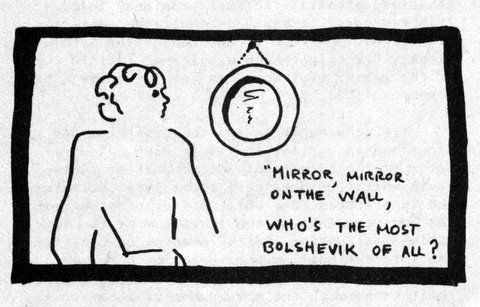
The struggle to build a new, anti-revisionist communist party continued to guide the efforts of many groups in the New Communist Movement in the years 1975-1977. In 1975, two years after the National Liaison Committee (NLC) which it had initiated collapsed amid mutual recriminations, the Revolutionary Union, together with a few allied organizations, formed the Revolutionary Communist Party.
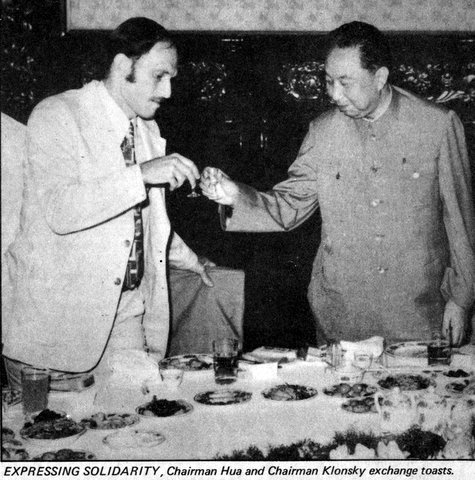
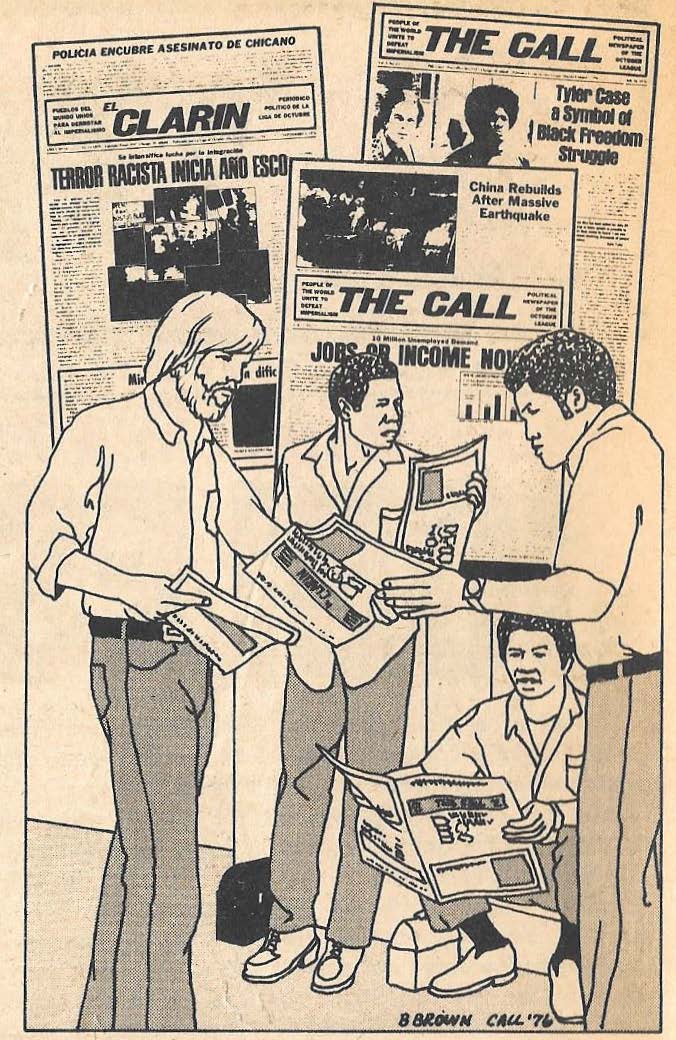
In November of the same year, the October League (OL) launched its own party building initiative with the goal of holding a founding convention within the year (in fact, the Communist Party (Marxist-Leninist) would not become a reality until 1977). As part of this effort, the OL creates a youth group, the Communist Youth Organization, and a mass organization, the National Fight Back Organization, to further broaden its base. Later, in 1976, OL converts is monthly newspaper, The Call, into a weekly.
The fall of 1975 also saw the birth of a short-lived party building initiative which called itself the “Revolutionary Wing,” or the “wing,” for short. The “wing” consisted of four groups: the Puerto Rican Revolutionary Workers Organization; the Revolutionary Workers League (RWL), a predominantly Black communist group that arose from the Youth Organization for Black Unity and the African Liberation Support Committee; the Workers Viewpoint Organization (WVO), a predominantly East Coast Asian organization; and the August 29th Movement (ATM), a predominantly Chicano organization based in California, New Mexico and Colorado. The “wing” did not hold together long – by March 1976 it had split apart, with WVO and ATM departing and PRRWO and the RWL undergoing a number of splits and purges, before announcing their intention to form a “U.S. Bolshevik Party.”
This inability to unite plagued other elements of the new communist movement in these years. Earlier in 1975, the Black Workers Congress split into four groups: the Revolutionary Workers Congress, the Revolutionary Bloc, the Workers Congress, and the Marxist-Leninist Organizing Committee (MLOC).
More significant for the future of the New Communist Movement, however, was the breach within its ranks opened up by changes in Chinese foreign policy. The practical consequences of China’s “theory of three worlds” became apparent in 1975 as China openly backs the FNLA and UNITA against the MPLA in the Angolan civil war. China’s stand dismayed many on the left who saw the MPLA as the legitimate leader of the Angolan liberation struggle rather than the South African and CIA-backed groups of UNITA and the FNLA. In 1976, sparked by the Angola controversy, the Guardian inaugurated a debate on China’s foreign policy and its line that the “Soviet Union was the more dangerous of the two superpowers” which opened a space within the New Communist Movement for voices openly critical of China’s line to be heard.
The death of Mao Zedong in September 1976 and the subsequent defeat of the “Gang of Four” marked the end of an era in China and raised new questions about the meaning of “Mao Zedong thought” and its relevance to the U.S. left. Increasingly, the resulting debates and polemics began to speak to a wider set of questions and problems which would call into question many of the assumptions upon which the New Communist Movement had been built.
Family Tree Chart of U.S. Anti-Revisionism, 1956-1977 by the Communist Workers Group (Marxist-Leninist)
Tirana Builds an Internationale Part One: The Struggle Against Modern Revisionism; Part Two: The Albanian Intervention; Part Three: Rally for Enver; Part Four: After Enver by woodsmokeblog
Mao in the Mines: An Anti-Systemic View of New Communist Movement Activity in the Appalachian Coalfields, 1962-1978 by Judson Abraham
The Joint Committee for Events on the Occasion of the 25th Anniversary of the Founding of the People's Republic of China: 1974 Sum-Up [includes criticisms of the Revolutionary Union, Wei Min She, Bay Area Worker, Wei Min Bao]
The Guardian: Rushing Headlong into the Swamp by the Revolutionary Union
Carl Davidson: Creature from the “White Skin Privilege” Lagoon by the Revolutionary Union
Phony Internationalism is Real Class Collaboration by the Revolutionary Union
’Revolution’ Polemic Deceives No One by Irwin Silber
Guardian Viewpoint: Sectarianism
On Party Building by the Philadelphia Workers Organizing Committee
Pragmatism and the Split in the New Voice by the Marxist-Leninist League
Toward A Scientific Analysis of the Gay Question [A response to the RU] by the Los Angeles Research Group
Party Building and Anti-revisionist Premises by Workers Viewpoint
The Trade Union Movement – A Marxist Analysis by the Worker-Student Organzing Committee
Criticism of ultra-’leftism’ by the Trade Union Educational Alliance
IWK Position on Party Building
2, 3, Many Parties of a New Type? Against the Ultra-Left Line by the Proletarian Unity League
What Are “Left” and Right Errors?
Constructive Criticism: A Handbook by Gracie Lyons
On Building the Party among the Masses by the League for Marxist-Leninist Unity
Win The Vanguard!! by the Workers Congress (M-L)
Gaining Clarity on our Communist Tasks. A self-criticism by the League for Marxist-Leninist Unity
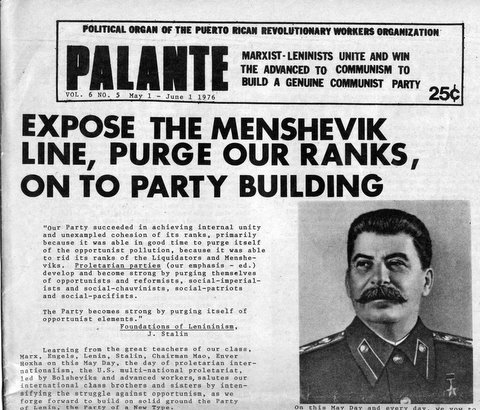
’Revolutionary Wing’ or Anti-Party Bloc? by Sherman Miller
RWL and OL: Two Wings of Same Bird by the Committee for Scientific Socialism (Marxist-Leninist)
Communists in Court: The Role of the O.L. and R.C.P by the August 29th Movement
October League, Right Opportunist Feint to the ’Left’ by the August 29th Movement
Nationalist Reformism Disguised as Marxism. A polemic against the political line of the August 29th Movement by Barry Litt
Strategy and Tactics: OL & RCP Revise Marxism on the International Situation by the Workers Viewpoint Organization
Struggle For The Right To National Development As A Component Part off Making Proletarian Socialist Revolution In the U.S. by the East Wind Organization
What Do “Left” and Right Mean? by The New Voice
On the National Question by Irwin Silber
In Defense of the Right to Self-Determination by Carl Davidson
’...fan the flames’ [reply to Carl Davidson] by Irwin Silber
International Women’s Day Sparks Two Line Struggle by the Revolutionary Union
Chicago Women Answer RU’s Slanders
Which Side Are You On? [on RU and women’s emancipation] by Carl Davidson
Women and Party Building by the October League (M-L)
All Out for March 8! by the October League (M-L) [The Call, Vol. 3, No. 6, March 1975]
’...fan the flames’ by Irwin Silber
October League replies to Women’s Day criticisms
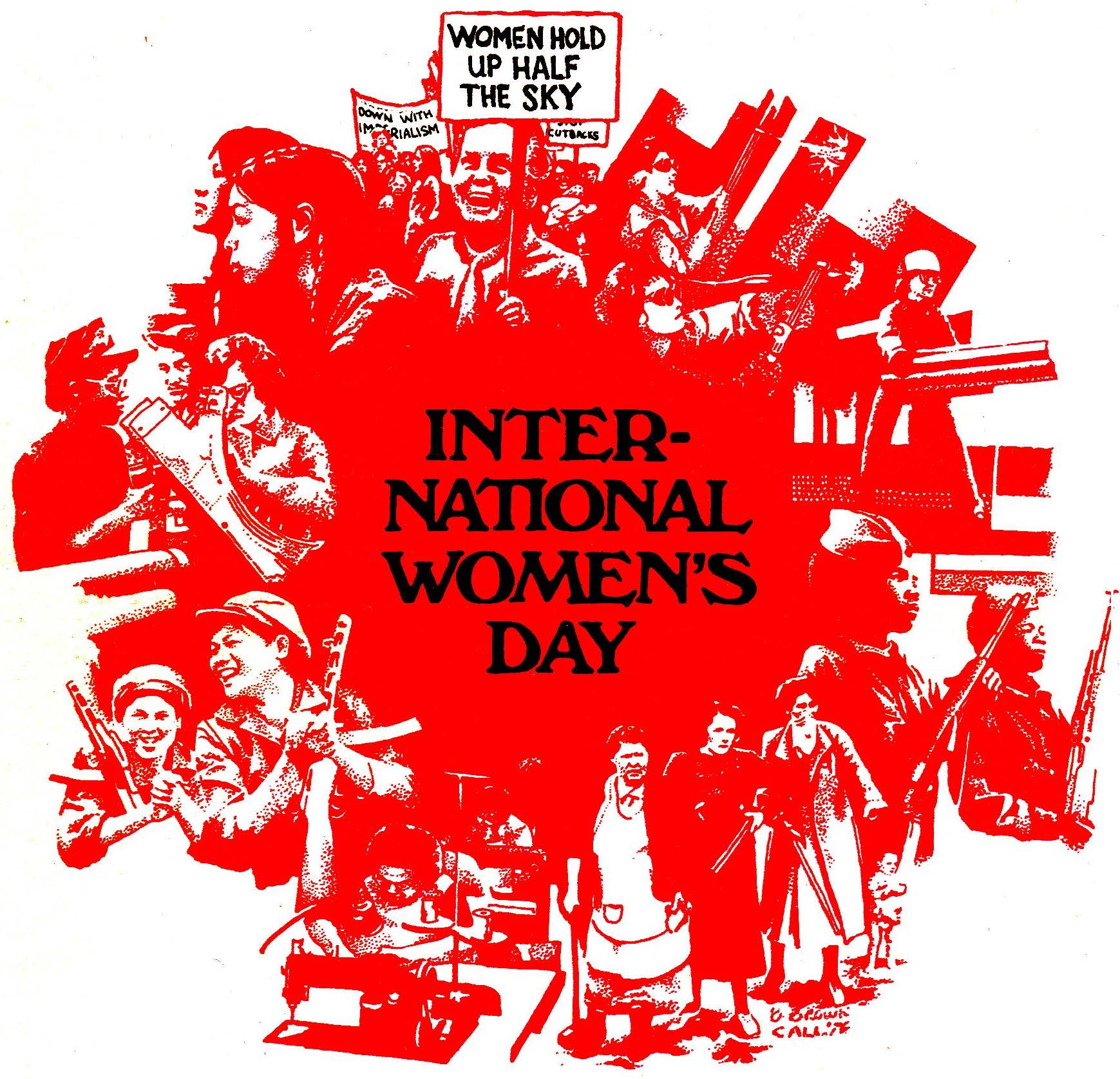
Imperialism to be Target of Women’s Day Events by the October League (M-L)
International Women’s Day by the Congress of Afrikan People [Unity and Struggle, Vol. 5, No. 2, February 1976]
March at the U.N. on Women’s Day by the October League (M-L)
Celebrate Int’l Working Women’s Day! by the Workers Viewpoint Organization
The Woman Question is a Class Question by the Puerto Rican Revolutionary Workers Organization [Palante, Vol. 6, No. 2, Feb.9-March 9, 1976]
International Women’s Day Takes Aim at Imperialism, Revisionism by the October League (Marxist-Leninist)
Right Opportunism Main Danger! CAP Summation of International Women’s Day by the Congress of Afrikan People
Sum-up of the Coalition for International Working Women’ Day by Resistencia Puertorriqueña
The Line of the Revolutionary Wing on I.W.W.D. by the Puerto Rican Revolutionary Workers Organization
P.R.S.U.-F.F.M. Statement on I.W.W.D. [Palante, Vol. 6, No. 4, April 1976]
Party Building and the Woman Question by the Revolutionary Workers League
A Critique of the Workers Viewpoint Organization’s Role in International Women’s Day Activities, 1975 and 1976 by Resistencia Puertorriqueña
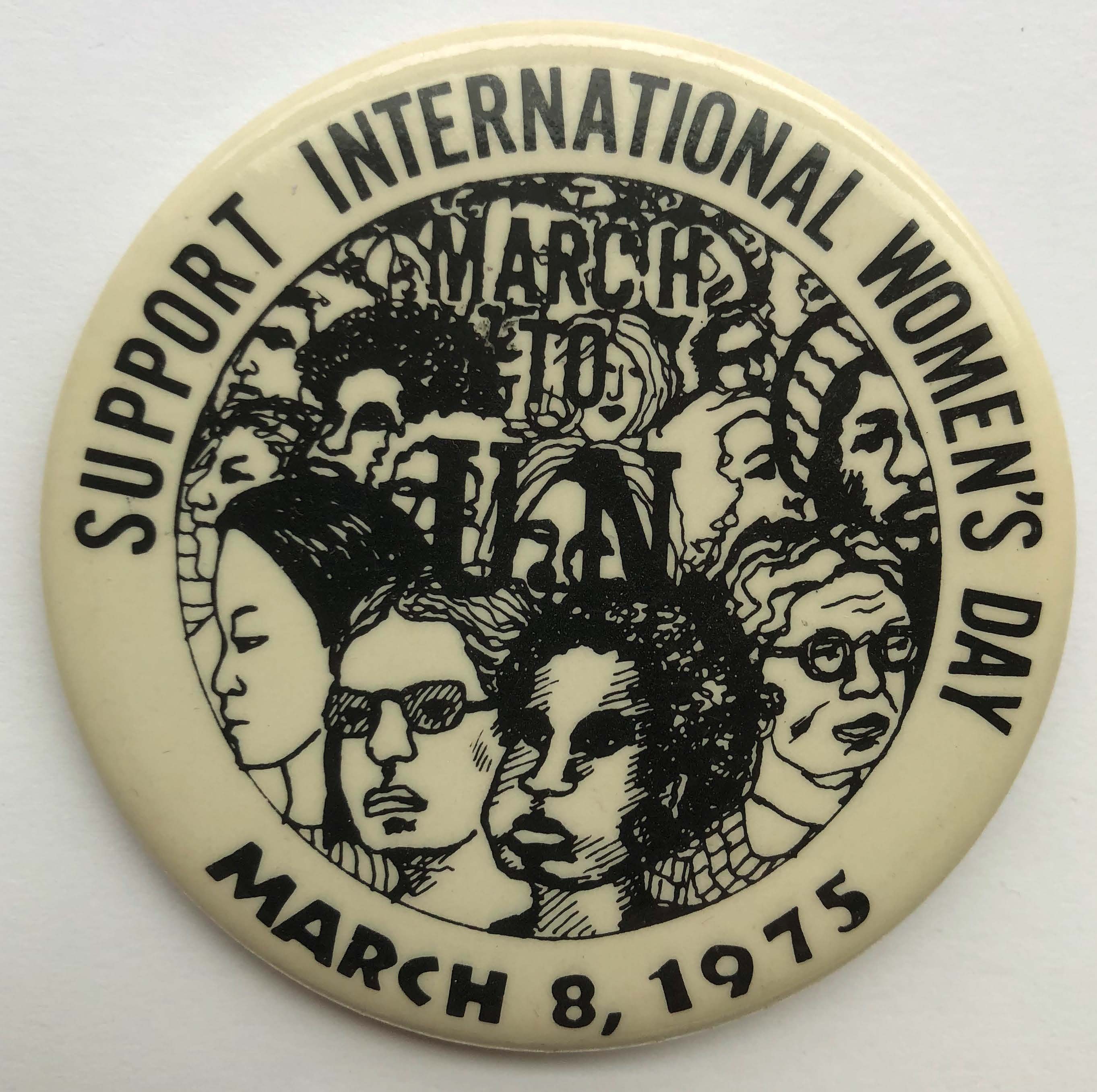
IWD Actions to Demand Women’s Equality by the October League (M-L)
Great Advance for Women’s Struggle: Thousands Rally to Celebrate Women’s Dayby the October League (M-L)
IWD: A History of Struggle Against Imperialism and Revisionism by the October League (M-L)
Organizers Report on IWD Work by the October League (M-L)
Lessons in Revolutionary Leadership from IWWD by the Workers Viewpoint Organization
[Back to top]
Free Puerto Rico! Day of Solidarity Oct. 27th by the October League (M-L)
Liberate Puerto Rico: October 27th!! by the Congress of Afrikan People [Unity and Struggle, Vol. III. no. 11, October 1974]
Fan the Flames... by Irwin Silber
Puerto Rico Solidarity Day Packs Garden by the October League (M-L) [The Call, Vol. 3. no. 2, November 1974]
Puerto Rico Solidarity Day... Puerto Rico Libre!! by the Congress of Afrikan People [Unity and Struggle, Vol. III. no. 12, November 1974]
Fan the Flames... by Irwin Silber
On the October 27 Day of Solidarity at the Madison Square Garden by Resistencia Puertorriqueña
Palante Editorial: On the October 27 Rally [Palante, Vol. 1, No. 2, January 1975]
Proletarian Internationalism or Revisionism: Analysis of October 27 Rally in Support of Puerto Rican Liberation Struggle by the Puerto Rican Revolutionary Workers Organization
Independence for Puerto Rico! Political Statement of the Puerto Rican Solidarity Committee
Joint Response by El Comité/MINP and the October League to Statements of P.S.P. [Obreros en Marcha, Vol. 1, No. 5, April 15, 1975]
El Comité/MINP Editorial on the Havana Conference [Obreros en Marcha, Vol. 1, No. 8, July 24, 1975]
Expose Havana Conference: Social-Imperialist Scheme to Leech Off Puerto Rico’s Struggle by the Puerto Rican Revolutionary Workers Organization [Palante, Vol. 1, No. 9, September-October 1975]
Conference Pushes Soviet Aims in Puerto Rico by the October League (M-L)
For Denouncing Soviet Danger: Anti-imperialists Expelled from PRSC by the October League (M-L)
Recommendation for Withdrawal from the Puerto Rican Solidarity Committee by the Congress of Afrikan People [Unity and Struggle, Vol. V. no. 4, April 1976]
The Guardian’s Man in Havana: An Exposure of ’Centrism’ by Martin Nicolaus
WVO’s “Unite to Expose”: A policy of class collaboration by Resistencia Puertorriqueña
P.R.S.C. – Second National Conference by El Comité/MINP
For Denouncing Soviet Danger: Anti-imperialists Expelled from PRSC by the October League (M-L)
PRSC Holds Convention by J. Reed (Philadelphia Workers Organizing Committee)
PRSC – From Conciliation to Outright Surrender by Marxist-Leninists for an Independent Puerto Rico [Unite!, Vol. 2, No. 3, June-July 1976]
Arguments and Proposals for the PRSC Conference by the March 1st Bloc [Urgent Tasks, #1, May 1977]
Repression Spurs Debate in PRSC by Jim Griffin (Philadelphia Workers Organizing Committee) [The Organizer, Vol. 3, No. 6, August 1977]
The PRSC Holds National Convention by Clay Newlin (Philadelphia Workers Organizing Committee) [The Organizer, Vol. 5, No. 9, September 1979]
[Back to top]
“Radicals” Arrested in China from Challenge
The Situation in China and Social-Chauvinism in Our Movement by the Communist Workers Group (ML) and the Organization of Communist Workers (ML) [Canada]
Whither China? from Challenge
China Struggle Intensifies by the Communist Labor Party
A Week of Struggle from Challenge
China Crushes ’Gang of Four’ from The Call
Progressive Labor Party Editorial: China: Factional Struggle Without Principle from Challenge
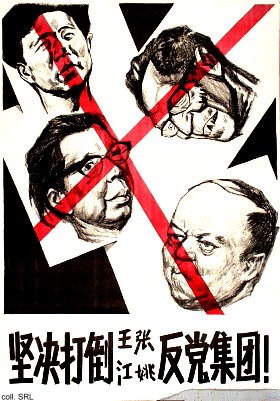
China: The Reversal of Socialism. How the “Gang of Four” Betrayed the Left in the Cultural Revolution by the Progressive labor Party
Class Struggle Sharpens in China by the Marxist-Leninist Organizing Committee
Revolution and Production in China from The Call
Hua Kuo-feng Is Successor To Chairman Mao’s Great Cause from The Call
China: The Return of Teng Hsiao-ping from Challenge
’Situation is Excellent’: China’s People’s Congress denounces ’gang of four’ from The Call
Revisionism Is the Main Danger by the Workers Congress (Marxist-Leninist)
Long Live the Great, Glorious and Correct Communist Party of China! by the League for Proletarian Revolution (Marxist-Leninist)
Support for Chairman Hua Kuo-Feng Affirmed: World communists denounce ’gang of four’ from The Call
Victory in China, victory for entire working class: Masses Rout ’Gang of 4’ by the August 29th Movement
Hua Kuo-feng sums up China’s struggle against ’gang of four’ from The Call
Supporting Revisionism: RCP Takes Stand with ’Gang’ by the October League (Marxist-Leninist)
The Struggle in China: The East Stays Red by Martin Nicolaus
Armed Struggle in China from Challenge
Seattle Communist Workers Group on the “Gang of Four”
World communists support Chairman Hua Kuo-feng from The Call
Chiang Ching’s Reactionary Line on the Woman Question from The Call
Revisionists are Revisionists and Must Not Be Supported; Revolutionaries are Revolutionaries and Must Be Supported by Bob Avakian
The Central Committee Report on China is a Counter-Revolutionary Document and Must be Criticized by the Revolutionary Workers Headquarters
China Advances Along the Socialist Road: The Gang of Four Were Counter-Revolutionaries and Revolutionaries Cannot Support Them by the Revolutionary Workers Headquarters
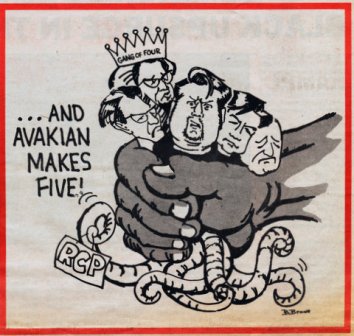
Militant, Guardian, William Hinton: ’Gang of Four Purge’ Debated in Chicago by Mike Taber
What is Happening in China? A Debate Between Jack Smith, Les Evans and William Hinton from International Socialist Review, June 1977
SDOC (M-L) Comments: Uphold Our International Leadership! by the San Diego Organizing Committee (Marxist-Leninist)
Behind WVO’s ’Silence’ on China and the ’Gang of Four’ from The Call
The Capitalist Roaders Are Still on the Capitalist Road. The Two-Line Struggle and the Revisionist Seizure of Power in China by the China Study Group
Analyzing China Since Mao’s Death (Part 1), (Part 2) and (Part 3) by Harry Eastmarsh, [Theoretical Review]
RCL’s Position on the Gang of Four (Part 1) by the Revolutionary Communist League (M-L-M)
Long Live the People’s Republic! Long Live Working Class Rule! by the National Office of the Revolutionary Student Brigade [Young Communist, Vol. 5, No. 3, March 1978]
China and the Gang of Four by Bill Ricard and Jim Griffin [Philadelphia Workers Organizing Committee]
Open Letter to U.S. Communists Who Support the Struggle in China Against Wang, Chang, Chiang and Yao by the Pacific Collective (M-L)
Against the Revisionist Take-Over in China: In Defense of Marxism-Leninism-Mao Tse-Tung Thought and Proletarian Revolution by the Witchita Communist Cell
China’s Great Leap Backward – A Review; and “A Short Note on Deng Xiaoping and the Present Line of the CCP” by Harry Eastmarsh
Analyzing China Since Mao’s Death (Part 4) by Harry Eastmarsh
[Back to top]
The October League (OL) took its party-building efforts into high gear in November 1975, after the formation of the Revolutionary Communist Party (RCP), led by its political rival, the Revolutionary Union. The polemical battle between RU and OL played a big role in setting the terms for the New Communist Movement’s understanding of party building. Both groups used the arguments of Lenin’s “What Is To Be Done?” on the need to draw “lines of demarcation” among communists to shape the future party’s political line and orientation – each side presented itself as the latter-day Bolsheviks.
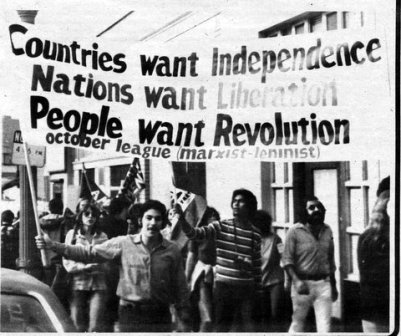
In the period preceding the formation of the RCP, the OL initially had set its stance toward party building as one such demarcation. OL was the first to declare party building as the “central task,” while RU argued that such a position was premature until a revolutionary workers movement could be developed. Both RU and OL grew rapidly in the early 1970s, and in 1974 the RU concluded that the time to form a party had finally come. This led to sharper polemics against the OL, which now sought to distinguish itself from RU as both less sectarian and more consistently in line with China and anti-revisionist orthodoxy.
As many independent activists with an anti-revisionist orientation, including both individuals and multi-city and local groups, had become estranged from the RCP, the OL focused on bringing them into its party-formation campaign. To a certain extent, OL won adherents because of the manner in which it differed ideologically with the RCP: its more open stance toward reform movements, its support for the Boston school integration struggle, etc.
However, OL made a sharp turn in late 1975, its contention with RU having moved to the background with the formation of the RCP. Political differences with one of the OL’s leaders, the noted theoretician Martin Nicolaus, led to a full-fledged “anti-rightist” ideological campaign aimed at the members. Internal discussion was reined in.
Meanwhile, in the field, the OL became hostile to campaigns and coalitions that included the CPUSA, targeted liberals and reformists as the “main danger” in mass movements, and began to shift its international line to opposing the USSR over the US. This came as the US-China anti-Soviet alliance became a major factor in world affairs.
In July 1976, the OL announced the formation of an Organizing Committee for a Marxist-Leninist Party to further its party-building campaign, but this only further estranged other groups. After a fierce effort to build the Committee’s membership and promote discussion with some independent groups, the Communist Party (Marxist-Leninist) (CPML) was formed in 1977, but no other national formations in the New Communist Movement chose to join. The following year, I Wor Kuen and the August 29th Movement, formerly of the “Revolutionary Wing,” merged to form the League of Revolutionary Struggle, essentially in opposition to the CPML’s claim to vanguard status.
Lessons from the Collapse of the Communist Party (Marxist-Leninist) by Carl Davidson
Summing Up the CPML’s Experiences in Trade Union Work by Charles Costigan
The October League: A Most Dangerous Revisionist Trend in U.S. Communist Movement by the Workers Viewpoint Organization
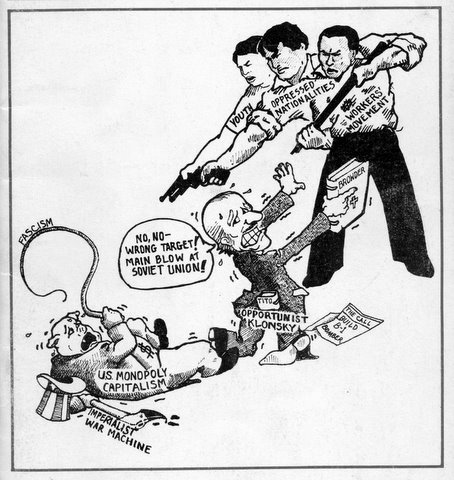
OL Supports Meany's Grain Boycott: Maoism and Anti-Communist Protectionism Workers Vanguard, September 26, 1975
’...fan the flames’ [On the OL’s attack on the Puerto Rican Solidarity Committee] by Irwin Silber
OL’s Call for the Party: Our Response by the Workers Congress (M-L)
On the Alliance of the October League (M-L) with the Shah of Iran by the Iran Report
On the Declaration by OL on Party Building by I Wor Kuen
Slipping and Sliding: October League, the Most Dangerous Revisionist Trend in the Communist Movement and Their Call for the Party by the Workers Viewpoint Organization [Workers Viewpoint Journal #4, n.d.]
Comment on OL’s Call for a Party by the Bay Area Communist Union
On the October League’s Call for a New Communist Party – A Response by the Proletarian Unity League
Imperialism: Also A Policy of the Soviet Union by A. Snyder [on a speech by Martin Nicolaus] [The Rag, February 23, 1976]
October League – Right Opportunism Is the Main Danger by the August 29th Movement
Angola – Another View by Phil Prim [on a speech by Martin Nicolaus] [The Rag, March 8, 1976]
OL Brings Party Building Bandwagon to Town. One Stomp on the Road to the Swamp by the Philadelphia Workers Organizing Committee [The Organizer, Vol 2, No. 1, January-March 1976]
’...fan the flames’ [On the OL’s “No united action with revisionists,”] by Irwin Silber
OL’s Sham Attempt at Party Building by Resistencia Puertorriqueña
Party Building: OL proposal criticized by William Gurley [The Guardian]
October League – How Not to Build a Communist Party by the August 29th Movement
Guardian: White Chauvinist? by William Gurley [The Guardian]
Sectarianism: OL’s July 4 coverup by William Gurley [The Guardian]
Expose OL’s All-Unity, Bourgeois Stand; Build Proletarian Unity Through Intensified Struggle by the Committee for Scientific Socialism (M-L)
OL’s “New” Proposal by the League for Proletarian Revolution (M-L) formerly Resistencia Puertorriqueña [Resistance, Vol. 7, No. 7, n.d.]
Polemics: RCP flails OL by William Gurley [The Guardian]
Capitalist Roaders Still on the Capitalist Road: Once Again on the October League by the Workers Viewpoint Organization
The O.L. on Party Building: A “Partial Modification” of Unprincipled Unity by the Marxist-Leninist Organizing Committee [from Communist Line, No. 9, August 1976]
A Letter to the O.L.: Opportunism on International Situation by Changing Times Bookstore
October League’s Organizing Committee Forums: ’Unity Trend’ Hangs Itself! by the Workers Viewpoint Organization
Reprint of WVO Leaflet for OLOC Forum
Mao Tsetung Thought or Social-Chauvinism. A Comment on the October League’s Call for “Unity of Marxist-Leninists” by the Central Organization of U.S. Marxist-Leninists
Response to OL’s Call for the Immediate Formation of the Anti-Revisionist Communist Party by the Detroit Marxist-Leninist Organization
Social Imperialism and Social Democracy, Cover-Up of Captialism in the USSR The Communist, Vol. 1, No. 1, October 1976
Against OL’s Party Congress: Prepare the Conditions by the Workers Congress (Marxist-Leninist)
Int’l Conf. Provokes OL, Guardian by the RCP
Maoist OL Somersaults Over Sadlowski by Workers Vanguard
OL Bloodies Own Nose With Its “Main Blow” by the Revolutionary Communist Party
Open Letter to the October League by the Marxist-Leninist Organizing Committee
OL’s Theory of “Three Worlds” Denies Revolution and Apologizes for U.S. Neo-Colonialism by the Central Organization of U.S. Marxist-Leninists
The October League – Revisionist to the Bone. Touched to Their Soul by the Bourgeoisie by Workers Viewpoint Organization
OC Draft Program: Proletarian Internationalism Or Social-Chauvinism by the Workers Congress (Marxist-Leninist)
Once Again on the OL’s Social-Chauvinist Theory of “Directing the Main Blow at Soviet Social-Imperialism” by the Central Organization of U.S. Marxist-Leninists
A Big U.S. League Error by Alive Magazine
Editorial: Communist Party (ML)... A Social Prop of the Bourgeoisie by the Marxist-Leninist Organizing Committee
U.S. Maoism: Peking Picks Its Flunkey by Young Spartacus
CP(ML) Cries Appeasement by the Marxist-Leninist Organizing Committee
OL’s View of Crisis Is Reformist by The New Voice
Editorial: Repudiate the Call For Menshevik Unity! by the Revolutionary Communist Party
A Communist Election Campaign? No Revolutionary Talk Allowed
CP – A Roadblock to Women’s Rights [The Call, Vol. 5, No. 7, June 14, 1976]
CP Election Campaign Promotes Détente
Call Editorial: Revisionists Ignore Tyler Struggle
Revisionist Campaign Flops [The Call, Vol. 5, No. 29, November 22, 1976]
The Enemy Within: Revisionism Helps Capitalists Attack the People
Ronnie Long Case Exposes CPUSA and National Alliance [The Call, Vol. 6, No. 15, April 18, 1977]
Revisionists Do Bosses Dirty Work in UMW [The Call, Vol. 6, No. 16, April 25, 1977]
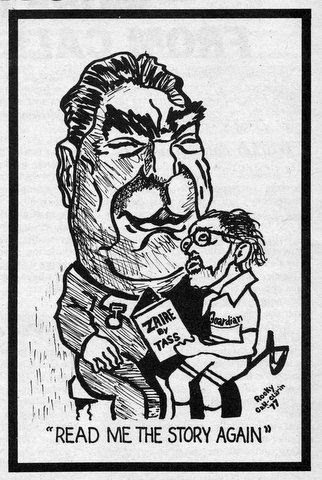
Daily World Repeats Kremlin Lies on Zaire
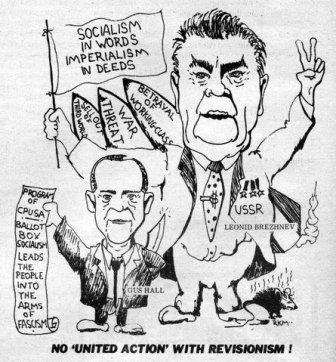
Gus Hall ’Rediscovers’ Dictatorship of the Proletariat
Gus Hall Twists Marxism. Peaceful Revolution? – Impossible!
Behind CP’s Attack on Nationalism
Revisionist CPUSA Slips and Slides on Equal Rights Amendment
CPUSA Cries Blues Over Lawyers Guild [The Call, Vol. 6, No. 36, September 19, 1977]
Revisionist Press Flounders: Daily World Readership Down 25% [The Call, Vol. 6, No. 44, November 14, 1977]
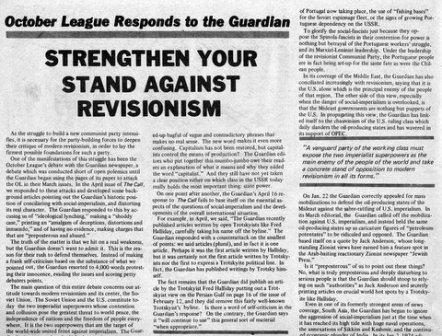
October League replies to Women’s Day criticisms
Guardian Covers Up Real Character of Social-Imperialism
October League Responds to the Guardian: Strengthen Your Stand Against Revisionism
The Guardian’s Man in Havana: An Exposure of ’Centrism’ by Martin Nicolaus
Call Editorial: Guardian Supports Revisionists in Portugal
Angola: The Guardian’s Treachery by Carl Davidson
With Friends Like the Guardian China Needs No Enemies
Struggle Inside Guardian Bureau [The Call, Vol. 5, No. 16, August 16, 1976]
Lenin’s Criticism of Kautsky Applies to Centrists Today
Guardian’s Revisionism on China
Guardian promotes reactionary view of Philippines Struggle [The Call, Vol. 5, No. 31, December 6, 1976]
Centrists Jump on Sadlowski Bandwagon: Guardian Tails Liberal Trade Unionists
Guardian Backs Soviet Aggression in Zaire
Feeble Polemics by Guardian, RCP
Guardian 10 Points: Revisionism’s Bare Bones
Critique of Red Papers 7: Metaphysics Cannot Defeat Revisionism by Martin Nicolaus
On the Intrigues of Joseph Waller & the R.U.
Self Criticism re: ’On the Intrigues of Joseph Waller & the R.U.’ [The Call, Vol. 3, No. 11, August 1975]
’Revolution’ Article: An Unsolicited Confession by RCP
July Fourth Demonstrations Trying to Save Capitalism
July 4 Protests Safe and Harmless
RCP Drifts Rightward, Covers Up for Revisionists
RCP Thugs Assault Call Sellers
Former member speaks: ’RCP formed around bankrupt line’
Supporting Revisionism: RCP Takes Stand with the ’Gang’
Editorial: Response to RCP’s Accusations
RCP’s Paper Reveals Rapid Rightward Drift
Readers Expose RCP in Farmer John Struggle [The Call, Vol. 6, No. 17, May 2, 1977]
Feeble Polemics by Guardian, RCP
RCP Tells People of Zaire ’Don’t Fight’
Whitewashing enemies and slandering friends. An exposure of the RCP’s revisionist line on the international situation by Eileen Klehr
RCP’s New Attack on Three Worlds
How RCP’s ’Theory of Equality’ Serves Soviet Social-Imperialism. A reply to ’Revolution’ on the international situation by Eileen Klehr
Look Who’s Marching Against Busing!
RCP’s “New” Stand on Busing: A Shameless Attack on Minority People
Despite RCP’s wishes situation in China remains excellent
“Workers Viewpoint”: Spreading the Viewpoint of the Bourgeoisie
Look Who’s Backing Soviet ’Peace’ Proposal!
’Hard Times’ Meet – Road to Defeat
For Denouncing Soviet Danger: Anti-imperialists Expelled from PRSC
Wreckers Cripple African Liberation Support Committee
’Revolutionary Wing’ in Shambles
Splits and Purges as ’Wing’ Grows More Isolated
Workers Viewpoint Organization Undermining Arab Unity
PSP’s ’Unity’ With Soviet Meeting [The Call, Vol. 5, No. 14, August 2, 1976]
MLOC’s Tactics of Splittism: ’Plan For a Joint Program’
Uniting a Bankrupt Trend: The Anti-Party Opposition Bloc
ATM Peddles Reformism on Chicano Question
Behind WVO’s ’Silence’ on China and the ’Gang of Four’
New Year Editorial: A New Communist Party is Needed to Lead the Peoples Struggle
The Right to Self-determination is Our Revolutionary Policy
Build Real Unity/Oppose Revisionist ’United Action’
The Alleged ’October League Manual on Open and Secret Work’
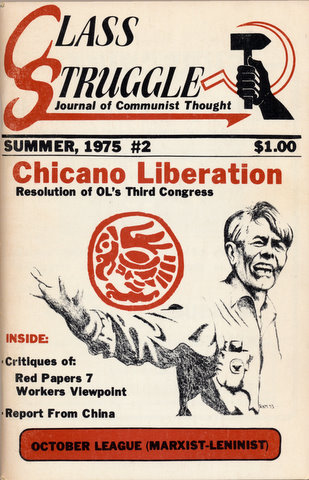
October League Holds Third National Congress
The Call Interviews Congress Delegate
Constitution of the October League (Marxist-Leninist)
Report from Third Congress: O.L. Demands Women’s Equality
O.L. Congress Deepens Stand on Afro-American Question
The Struggle for Black Liberation and Socialist Revolution
* * *
Tour Exposes Soviet Capitalism [The Call, Vol. 3, No. 11, August 1975]
Wash., D.C. Group Merges with O.L. [The Call, Vol. 4, No. 1, October 1975]
Marxist-Leninists Unite to Build the New Party
Call Committees Building for Weekly Newspaper
Building The Call in the Factories [The Call, Vol. 4, No. 4, January 1976]
The Tasks of Communists: How Can Unity be Built?
Cadre School Studies Marxist-Leninist Theory of State [The Call, Vol. 4, No. 3, December 1975]
The Politics of War: A Communist View [The Call, Vol. 4, No. 4, January 1976]
“On to the Party, Build the Weekly Call” by Mike Klonsky
Sharp Struggle Ahead, but Communist Unity is Growing
Central Committee Report: O.L. Calls for Party Congress, Warns of Growing War Danger
May Unity Meeting Will Lay Groundwork for Party Congress
Weekly Call to Hit Streets May First
Welcome the Marxist-Leninist Weekly [The Call, Vol. 5, No. 1, May 1, 1976]
Harry Haywood Honored. 78 Years of Struggle Hailed [The Call, Vol. 4, No. 7, April 1976]
Statement of Former BWC/RWC Leader Calls for Marxist-Leninist Unity by W. Jean Pierre
O.L. Chairman Speaks on May Day: ’The Basis for a New Communist Party Now Exists...’
Statement by Harry Haywood: ’Unite to Build the New Party’
Editorial: Looking Back on Mayday – Strengths and Weaknesses Summed Up –
’Forge Unity Around a Program.’ Statement of League for Marxist-Leninist Unity
’Unity is the Main Trend’ by the Bridgeport Workers Organization (M-L)
August 29 Forum Calls for Regional Autonomy [The Call, Vol. 5, No. 18, September 6, 1976]
Unity Statement of the Philadelphia Party-Building Collective
Unity Statement of Marxist-Leninist Student Collective
OL Women’s Commission Intensifies Ideological Struggle [The Call, Vol. 5, No. 9, June 28, 1976]
Breaking with ’Local-Circle Mentality’ in the Fight against Revisionism by Clay Claiborne
Building The Call: Workers Study Agit-Prop [The Call, Vol. 5, No. 23, October 11, 1976]
Build Newspaper as Party Scaffolding
The Call Builds Marxist-Leninist unity
Cadre School Analyzes Communist Tasks
Martin Nicolaus Expelled from OL
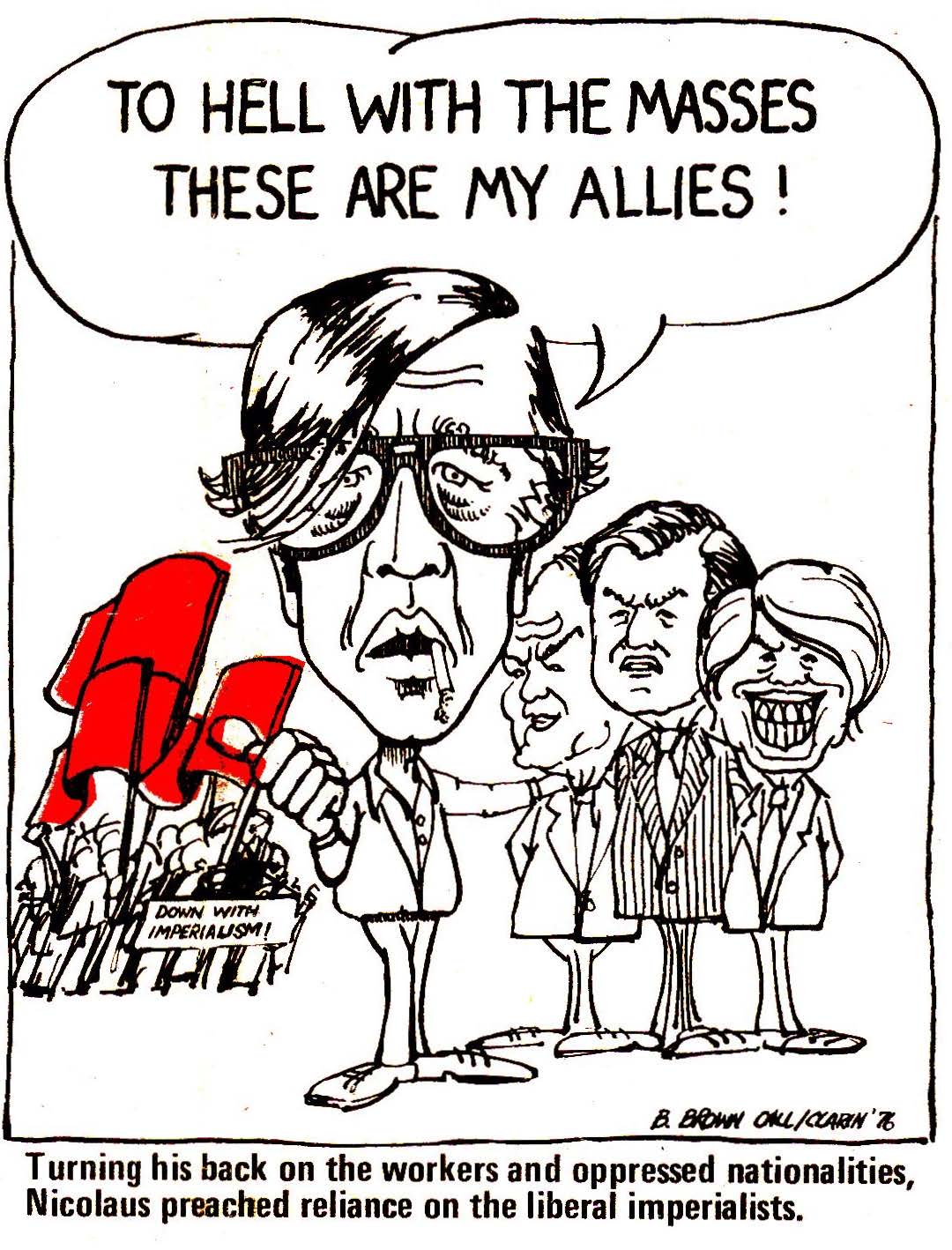
Criticizing Nicolaus’ line of alliance with imperialism: Friends and Enemies of Revolution
Marxism or Klonskyism? by Martin Nicolaus
Nicholaus vs OL: A Menshevik’s Criticism of Menshevism by the Workers Viewpoint Organization
Mass Criticism of Nicolaus’ Revisionist Line: ’We must root out this evil’
Communist Tasks in Present Period
Speech by Dan Burstein [Against Nicolaus] by Daniel Burstein
The Question of Which Class Rules Decides Everything. A review of Martin Nicolaus’ sham criticism and real defense of Soviet revisionism by Carl Davidson
Another Klonskyite ’Switch’: ’People Devoid of All Principle’ by Martin Nicolaus [Marxist-Leninist Vanguard, No. 2, March 1977]
Readers Criticise Nicolaus on Agitation and Propaganda Work [The Call, Vol. 6, No. 12, March 28, 1977]
The Guardian’s Man in Chicago. Exposing Nicolaus’ phony critique of ’centrism’ by The Boston Class Struggle Writing Group
* * *
Chairman Mao’s Teachings on the Mass Line: Combining Communist Leadership with Masses
Build the Weekly Call: Report from Hartford
Hundreds of New Call Readers [The Call, Vol. 6, No. 5, February 7, 1977]
Conference Prepares ’The Call’ for Role as Central Organ of New Party
Build the Communist Press by Fighting Revisionism by Michael Klonsky
Great Advance for Women’s Struggle: Thousands Rally to Celebrate Women’s Day
The Direction of the Main Blow
2,000 Attend May Day Celebrations
May 1st Events Welcome New Party
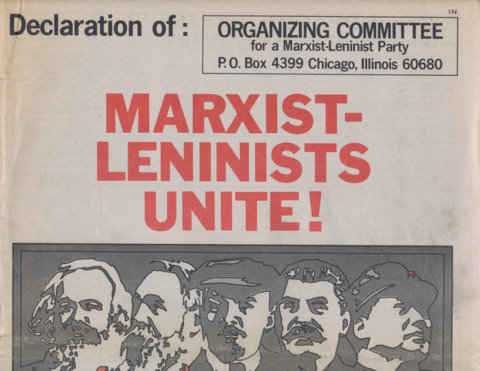
Call Editorial: Publication of ’Marxist-Leninists Unite!’
Marxist-Leninists Unite! Declaration of the Organizing Committee for a Marxist-Leninist Party
Unity Statement of the Buffalo Unity Collective
Tasks of Drafting New Communist Program [The Call, Vol. 5, No. 13, July 26, 1976]
Report from Organizing Committee
Party-building Speaking Tour Opens
Speaking Tour Calls for Communist Unity
M-L Fighting Union Joins Unity Trend
Unity Statement of Boston Unity Collective
Organizing Committee Intensifies Unity Efforts
Unity Statement of New York City Party Building Collective
Statement of the Organizing Committee. Rising Trend of Marxist-Leninist Unity
Statement by the Organizing Committee: First Draft of Party Program Prepared
Statement of Unity by the Communist Unity League of Vermont
OC Calls Second Unity Conference
Portland collective supports OC
Draft Program of the Communist Party (M-L)
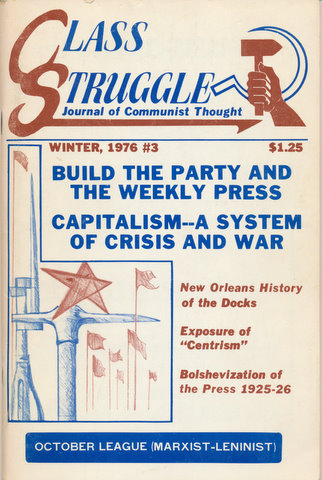
Commentary on Section 1 of the Draft Program: “Imperialism is Reaction All Along the Line”
Commentary on Section 3 of Draft Program: Imperialism – A System of Continuing Crisis
.htm">Commentary on the Draft Program of CP (M-L): War is Essential Feature of Imperialism
Program Upholds and Defends ’Three Worlds’ Concept
Commentary on the Draft Program of CP (M-L): National Struggle – In Essence a Class Struggle
Commentary on the Draft Program of CP (M-L): The Fight Against the Fascist Threat
Principles of Our New Party: The ’Three Do’s and Three Don’ts’
Commentary on the Draft Program of CP (M-L): The Direction of the Main Blow
Feeble Polemics by Guardian, RCP
Principle of the New Party: Both Centralism and Democracy
Commentary on the Draft Program of CP (M-L): Struggle for Puerto Rican Liberation
Part 1: Lenin’s Fight for unified vanguard party
Part 2: Lenin Exposes the Mensheviks
Part 3: Lenin leads the criticism of Paragraph 1 in Martov’s rules
Part 4: Lenin outlined basic principles of communist organization
Part 5: Lenin on the two methods of struggle
Part 6: Lenin waged class struggle inside party [The Call, Vol. 6, No. 6, February 14, 1977]
Welcome the Founding of the Communist Party (Marxist-Leninist)
Harry Haywood’s Speech at Congress: ’We Have Taken First Step on a Long March’
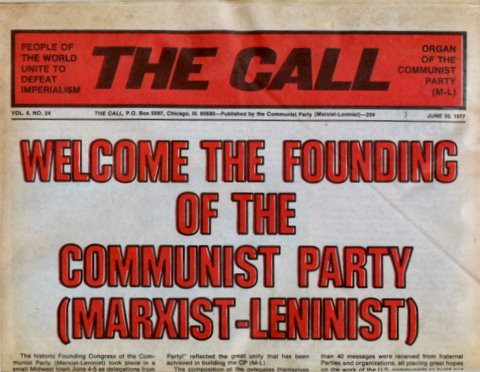
Documents from the Founding Congress of the Communist Party (Marxist-Leninist)
New Party’s Banner Unfurled in Struggle
International Welcome to New CP (M-L)
Amendments Strengthen Party’s Program
U.S. Communist Party (M-L) Founding Proclaimed [Peking Review]
The Call Launches New Expansion Drive
Revolutionary summer camp held in New York [The Call, Vol. 6, No. 30, August 1, 1977]
Chairman Hua Meets Delegation of Central Committee of U.S. Communist Party (Marxist-Leninist) [Peking Review, July 29, 1977]
CP(M-L) Delegation Meets with Chairman Hua
Toasts of Solidarity in Peking
U.S. Press Puzzled by CPML-China Meeting
Robert Williams Speaks in Chicago: ’Chairman Mao Was Our Brother’ Says Black Liberation Fighter
Communist League of Hawaii Rallies to CPML
A Letter to Our Readers on The Call’s Fifth Anniversary
Big crowds hear CPML leaders on China visit
Bay Area Communist Union greets CP ML
Editorial: The Road to Communist Unity
Behind RCP’s Attack on Our Unity Efforts
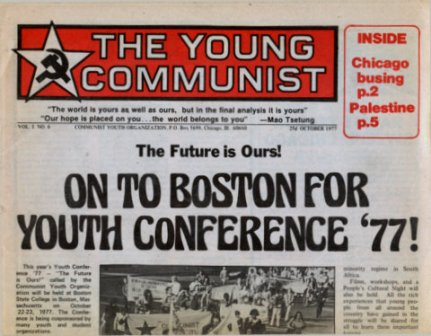
Youth Demand Jobs – OL initiates national campaign
Revolutionary Youth Get Organized [The Call, Vol. 4, No. 1, October 1975]
Internationalism Marks Red Youth Camp
As School Opens CYO in the Thick of Class Struggle
Plans for CYO Convention in High Gear [The Call, Vol. 5, No. 30, November 29, 1976]
1,000 support CYO at Iowa college
YWLL: No Alternative for Youth [The Call, Vol. 5, No. 31, December 6, 1976]
CYO Prepares for Year-End Convention
CYO – Year of Struggle and a Bright Future Ahead
CYO Convention Successful and Spirited
OL Chairman Speaks at CYO Convention: ’Our party must become a party of the youth’
CYO Convention Success: ’77 a year of decisiveness
CYO Fights for Jobs in Steel [The Call, Vol. 6, No. 5, February 7, 1977]
CYO Exposes Trotskyist ’Red Tide’
Conference to Unite Youth in Struggle [The Call, Vol. 6, No. 34, September 5, 1977]
People Get Ready for Youth Conference ’77
People hit back at racism and repression, National days of resistance to repression
Revolutionaries and the ’76 Elections
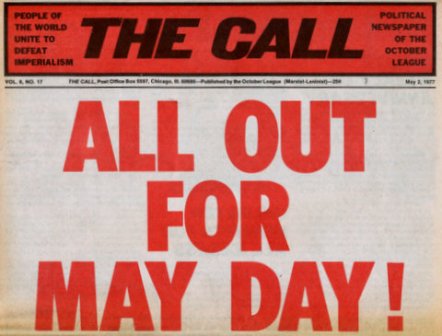
Economic Crisis Shows: Capitalism is a System of Crisis and War by Dan Burstein
International Women’s Day Takes Aim at Imperialism, Revisionism
Communists Sum-up Capitol Strike
A Communist View: Building Class Struggle Trade Unions [a series of articles from The Call]
OL’s Trade Union Pamphlet: A Distortion of Our History from the Workers Congress (M-L)
Which Road for Tyler’s Freedom? [The Call, Vol. 5, No. 15, August 9, 1976]
Strike Wave Shakes Union Sellouts
Mass Ties Deepen: SCEF Condemns 2 Superpowers
The Struggle to Free Gary Tyler
Call Editorial: Ford Appeases Brezhnev
Regional Autonomy for the Chicano People
Boycott of major union elections called: Fighting Our Two Enemies – Bosses and Bureaucrats
OL Campaign Hits Racism and Reformism in Steel Elections[The Call, Vol. 5, No. 34, December 27, 1976]
New Year’s Editorial: On to New Victories in 1977!
1976 in the Labor Movement: A Year of Activity and Growing Consciousness
Steel Union Election Feb. 8: Sadlowski & McBride Working for Bosses
Sadlowski No Alternative for Steel Workers
Mrs. Tyler Clarifies Her Views [The Call, Vol. 6, No. 5, February 7, 1977]
Liberals Provide No Alternative [The Call, Vol. 6, No. 6, February 14, 1977]
“Steering Steel Workers into Sadlowski”: RCP – Errand Boys For Liberal Misleaders
Lessons of Flint Sit-Down Strike: How the Union Was Built and Then Betrayed
Women’s Liberation: A Communist View
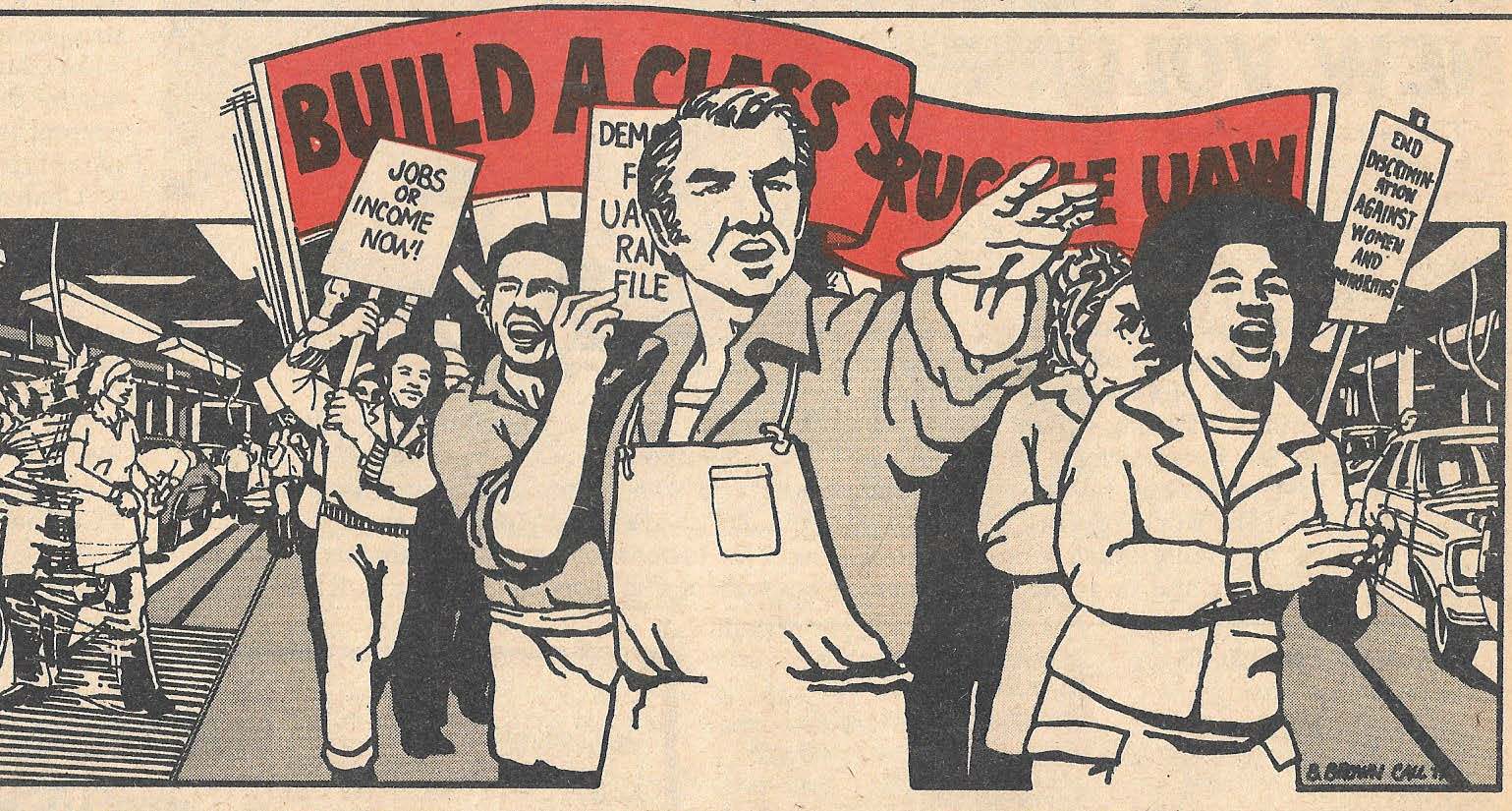
Build a Class Struggle U.A.W.: Phony Revolutionaries Exposed [The Call, Vol. 6, No. 15, April 18, 1977]
Communists Sum Up Work in LA. Meatcutters Strike
Labor Campaign – Good Start in Building Class Struggle Unions
Waging Class Struggle in the Trade Unions. A summary of the October League’s labor campaign by Ruth Gifford
Building the Factory Cell. A Party unit’s work sum-up by Mary Wexler
Questions and Answers: Why We Work in Reactionary Trade Unions
SCEF Calls ’Jobs or Income’ Conference
SCEF Conference a Rousing Success
NAM OL, and Gay Liberation from The Rag, September 8, 1975
Burning Issues: Gays and Sexism on the Left from The Great Speckled Bird, October 23, 1975
OL on Gays from The Great Speckled Bird, November 13, 1975
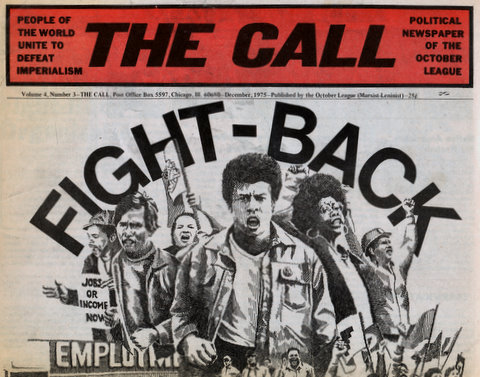
December 27-28 in Chicago: Plans Laid for National Fight-Back Organization
National Fight-Back Organization – Founding Conference [flyer]
Rely on the Workers to Build the Fight-Back
List of National Fight-Back Conference Endorsers
Workers meet in Chicago: National Fightback formed by Rusty Conroy
Fight-Back Conference: Party Building and the United Front by the Workers Congress (M-L)
Letters on the Fight-Back Conference from The Communist
’An Historic Event’: 1,300 at Fight-Back Conference
[Report on] National Fightback [Conference] by the Congress of Afrikan People
Fight Back Organization Maps Jobs Drive
National Fight-Back Organization Maps Plans
Fightback Meetings Sum-Up Year’s Work
Fightback Going Strong in New England
Report From China on Studying and Upholding the Dictatorship of the Proletariat by Dan Burstein
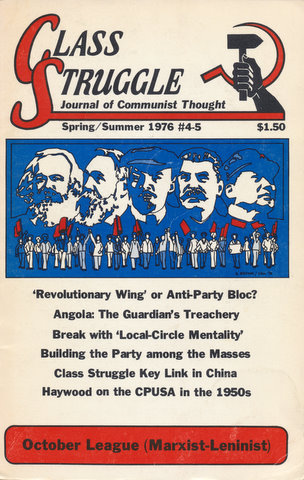
Class Struggle Key Link in Chinese Revolution
China Rallies Behind Party After Tien An Men Reactionary Incident
Press Hail Victories in China [The Call, Vol. 5, No. 2, May 10, 1976]
China’s Victory over Teng Hsiao-ping
China’s Continuing Cultural Revolution: Taking Class Struggle as the Key Link by Eileen Klehr
Editorial: Ten Years of Cultural Revolution
China Friendship Assn. Debates Priorities [The Call, Vol. 5, No. 17, August 30, 1976]
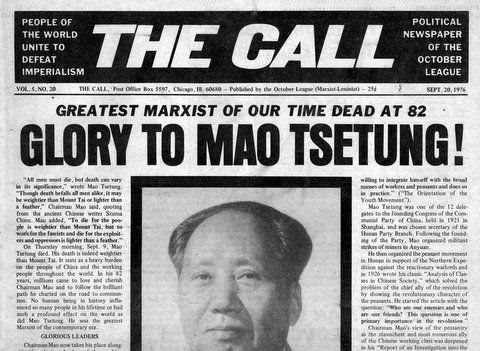
Greatest Marxist of Our Time Dead at 82: Glory to Mao Tsetung!
China Friendship Assoc. Builds Mass Outreach
Message From Chairman Klonsky of U.S. October League (M-L) [on the death of Mao] [Peking Review, September 30, 1976]
Speech by OL Chairman: ’The Greatest Communist of Our Time’
Klansmen attack Mao memorial [The Rag. October 10, 1976]
China Defends Legacy of Chairman Mao
The World is Being Turned ’Upside Down’. An outline of Chairman Mao’s revolutionary line on the international situation by Dan Burstein
’The class struggle is by no means over.’ Chairman Mao’s contribution to Marxism-Leninism on the class struggle under socialism by Eileen Klehr [from Class Struggle #6, Winter 1976-77]
The Masses Make History. An account of the struggle against Teng Hsiao-ping’s revisionist line in combatting natural disasters by David Crook
China Continues to Direct Main Blow at Soviet Union
Revolution and Production in China
Hua Kuo-feng Is Successor To Chairman Mao’s Great Cause
’Situation is Excellent’: China’s People’s Congress denounces ’gang of four’
World communists denounce ’gang of four’
Hua Kuo-feng sums up China’s struggle against ’gang of four’
World communists support Chairman Hua Kuo-feng
Chiang Ching’s Reactionary Line on the Woman Question
Hua Kuo-fend Analyzes Mao Tsetung’s Contributions. Lessons of Chairman Mao’s New Volume
Life in Socialist China: Workers run Taching oil field
Chinese Workers Follow Taching Model to Build Socialism
China Celebrates Victory Over “Gang of Four” by Michael Klonsky
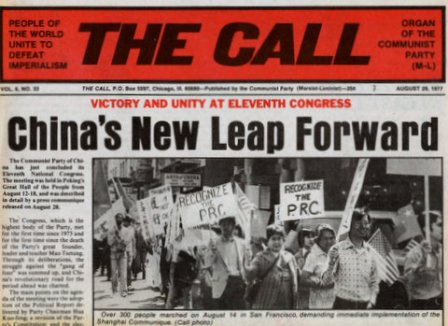
Victory and Unity at Eleventh Congress: China’s New Leap Forward
From Canadian Students in Peking: A Response to Wilfred Burchett
China’s New Leap Forward Is a Victory For Us All. Interview with Michael Klonsky
Chinese Journalists Report on Kampuchea
Democratic Kampuchea Rapidly Advancing Since Liberation
Cambodians Rebuild War-Ravaged Country
China Greets Kampuchean Leader: Pol Pot Says ’Situation is Excellent’ [The Call, Vol. 6, No. 39, October 10, 1977]
Chinese and Kampuchean Leaders Meet: ’Great Unbreakable Solidarity’
Pol Pot Tells the History of Kampuchean Revolution
Report from Europe – Part 1: War and Revolution on the Rise
Report from Europe – Part 2: Norway’s Communists Get Prepared
Report from Europe – Part 3: Sweden’s Communist Movement
Report from Europe – Part 4: Iceland Workers’ Movement on Rise
Report from Europe – Part 5: Interview with Jacques Jurquet French Marxist-Leninist Leader
Report from Europe – Part 6: French Marxist-Leninists Steeled in Battle Against Revisionism
Report from Europe – Part 7: Belgian Party on war and revolution
Report from Europe – Part 8: Superpowers Squeeze Luxemburg
Report from Europe Series Conclusion: Bright Future for Communist Movement
Letter to The Call: More on Iran Question
Expose Role of Soviet Splitters in Angola
Portugal Forum Sparks Sharp Debate
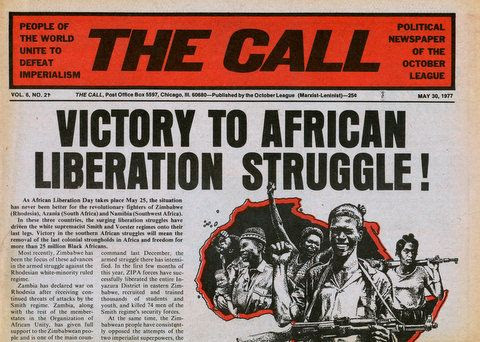
Angola’s Lesson: Fight Both Superpowers
Angola (2): The Call by William Gurley [the Guardian]
Conclusion of interview with OL Chairman
Polish Workers Face Repression [The Call, Vol. 5, No. 14, August 2, 1976]
Resistance Builds to New Soviet Tsars
Albania Mobilizes for Seventh Party Congress
OL message to Albania’s Party of Labor
Lesson of strategy and tactics: The Direction of the Main Blow
Angola fights Russian-Cuban occupation
China Continues to Direct Main Blow at Soviet Union
Albania Rejoices After Closing of Seventh Congress
Latin America Rebuffs Superpower Schemes
Cuba – Trojan Horse in Third World
East Europe Resists Soviet Union [The Call, Vol. 6, No. 6, February 14, 1977]
USSR Leading in Superpower War Race
Warnke Nomination Sparks Debate: ’Detente’ Fight Grows in Ruling Circles
Why is Castro in Africa? [The Call, Vol. 6, No. 12, March 28, 1977]
Invasion of Zaire by Soviet-Backed Troops
Soviet Union Steps Up Aggression in Ethiopia [The Call, Vol. 6, No. 19, May 16, 1977]
USSR Slanders China: Who Are the Real ’Warmongers’? [The Call, Vol. 6, No. 22, June 6, 1977]
Adultery, Crime and Gambling in Capitalist Soviet Union [The Call, Vol. 6, No. 22, June 20, 1977
New Constitution Covers Fascism in the USSR
USSR Denounces Carrillo: ’Eurocommunism’ – A Rift in the Revisionist Camp
’Détente is a Fraud’ Say White House Pickets
Angela Davis Autobiography: The Black Masses Make History, The Revisionists Distort It
75 Years of Struggle! The Life of Nanny Washburn
Unidos Bookstore Bombed Again–Support Needed
Joint Communiqué Issued by the October League and the Canadian Communist League
Joint Communiqué of CP (ML) and WCP (ML)
[Back to top]
The October League (M-L) on the International United Front and Iran by the Revolutionary Union
October League (M-L) Response to RU on the International United Front and Iran by the October League (M-L)
Letter to The Call: Disagrees with Article on Iran
Letter to The Call: More on Iran Question
On the Alliance of the October League (M-L) with the Shah of Iran by the Iran Report
Guardian Viewpoint: The Shah of Iran
One Step Behind Bourgeoisie: CPML Discovers Class Struggle in Iran by the Revolutionary Communist Party
CPML on Iran: Too Much Revolution is a Dangerous Thing by the Revolutionary Communist Party
[Back to top]
Important Struggles in Building the Revolutionary Communist Party,USA by Bill Klingel and Joanne Psihountas
Formation of RCP by the Workers Congress (M-L)
The Founding Congress of the RCP by the Revolutionary Workers Headquarters
Maoísmo ascendente y repressíon del FBI en Estados Unidos: 1968-1978 by Aaron J. Leonard and Conor A. Gallagher
Struggle in VVAW/WSO [Seize The Time, Vol. 1, No. 5, February 1975]
Oppose RU/RSB Thuggery! by Young Spartacus
R.C.P. – Vanguard or Chauvinist Sect?? by the August 29th Movement
Halt RSB Hooliganism! by Young Spartacus
’Revolution’ Article: An Unsolicited Confession by RCP by The Call
RCP: Hit for antigay-rights line by the Guardian
Polemics: RCP flails OL by William Gurley
RCP Drifts Rightward, Covers Up for Revisionists by the October League (Marxist-Leninist)
RCP Thugs Assault Call Sellers by The Call
Bible Belt Maoists Rant at “Deviant Sexual Behavior” by Young Spartacus
Former member speaks: ’RCP formed around bankrupt line’ from The Call
RCP Comes Out in Steel by the Marxist-Leninist Organizing Committee
Where is the RCP Going? by Young Spartacus
RCP Discovers ’Theory in its Own Right’ by Workers Viewpoint Organization
“Steering Steel Workers into Sadlowski”: RCP – Errand Boys For Liberal Misleaders by The Call
ALSC: RWC Paves Way for RCP Takeover by Workers Viewpoint Organization
RCP’s Paper Reveals Rapid Rightward Drift by The Call
RCP: Reversing Verdict on Soviet Social Imperialism is Total Treachery by Workers Viewpoint Organization
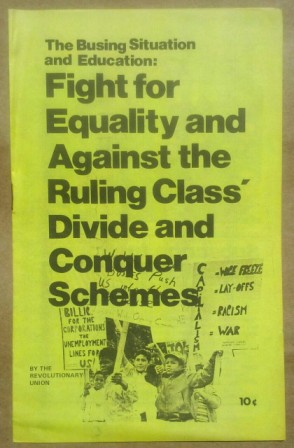
RCP Tells People of Zaire ’Don’t Fight’ by The Call
Practice Marxism Not Revisionism – Treachery of “Save the Fatherland” Propagated by R“CP” (R) [Bolshevik, Vol. 7, No. 4, June 1977]
Whitewashing enemies and slandering friends. An exposure of the RCP’s revisionist line on the international situation by Eileen Klehr [October League (m-L)]
RCP’s New Attack on Three Worlds by The Call
On RCP’s Anti-China Stand by The Call
RCP/RWC Attempt to Con Black Masses by the Marxist-Leninist Organizing Committee
U.S. Maoism: Peking Picks Its Flunkey by Young Spartacus
Look Who’s Marching Against Busing! by The Call
RCP’s “New” Stand on Busing: A Shameless Attack on Minority People by The Call
How RCP’s ’Theory of Equality’ Serves Soviet Social-Imperialism. A reply to ’Revolution’ on the international situation by Eileen Klehr [CP (M-L)]
RCP on the Split in the Working Class by the Marxist-Leninist Collective
RCP on the Split in the Working Class, Part 2 by the Marxist-Leninist Collective
The Syndicalist Fronts of the RCP by the Marxist-Leninist Organizing Committee
Despite RCP’s wishes situation in China remains excellent by The Call
The Role of the “RCP,USA” in the U.S. Marxist-Leninist Movement by the Central Organization of U.S. Marxist-Leninists
The Decline of the RCP: A Polemic by the Organization for Revolutionary Unity
Forward to the Party! Move to the New Period!
Why We Must Go From Old Period To New
Editorial: Working Class Assembles, Ruling Class Trembles
Superpowers Prepare for War; Masses Build for Revolution
1975 May Day Celebrations Reflect Advances and Tasks
RU Speech at NY May Day: Working Class is Freedom Bound!
CPUSA Holds National Convention: Sharpen Struggle Against Revisionism!
Forward to the Party! Struggle for the Party! Introduction
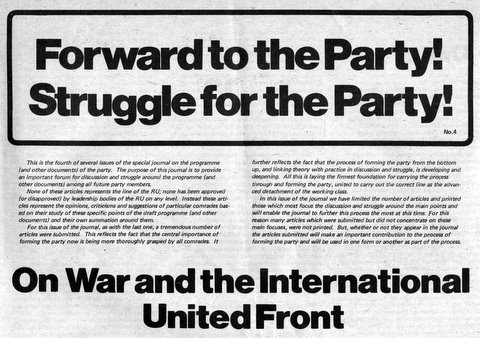
Build the Revolutionary Workers Movement!
Summing Up South African Coal Struggle
Class Stand Key In Boston Busing Struggle
Stand For and With the Workers – In Their Day to Day Struggles And In Making Revolution
On War and the International United Front
On Other Aspects of Building the Workers’ Movement
[Six articles] On Propaganda and Culture
Hawaii Revolutionary Organization: “Dump Baggage, Move to Party!”
* * *
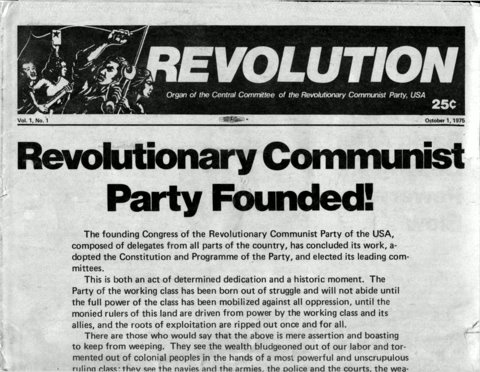
Revolutionary Communist Party Founded!
Party of the Working Class Formed!
Programme and Constitution of the Revolutionary Communist Party USA
The Working Class Movement and the Tasks of the Party by Bob Avakian
Across the Country Celebrations Mark Formation of Party
Statement from The RCP Central Committee
Our Class Will Free Itself and All Mankind by Bob Avakian
Class Analysis Key: On the World Situation And Revolutionary Struggle
RSB Now Student Group of Party
“We Won’t Scab and We Won’t Starve!”
Mass Line Is Key To Lead Masses In Making Revolution
Mass Line Is Key To Methods of Leading Struggle
The Day to Day Struggle and the Revolutionary Goal By Bob Avakian
Using Mass Line to Sum Up Struggle
* * *
Angola – Superpowers Behind Civil War
Soviet Union – As Capitalist As The U.S.
Ford’s China Trip Underlines War Danger
Angola Spotlights World Trends
Party Must Answer Questions of Masses On War
World War: The Correct Stand is a Class Question
We’ve Carried the Rich for 200 Years. Let’s Get Them Off Our Backs! demonstration flyer
UWOC Issues Nat’l Call: “Build the Fight for Jobs or Income! On to Philadelphia July 4th!”
We’ve Carried the Rich for 200 Years. Let’s Get Them Off Our Backs! by the July 4th Coalition
Forces Gather for July 4th Demo
Momentum Builds for July 4th Demo
200 Years Is Long Enough! The Development of Class Struggle in 200 Years of U.S. History
Opportunists Plan Rally: Dead End Approach To The Bicentennial
On the Slogan ’We Won’t Fight Another Rich Man’s War’
July Fourth Demonstrations Trying to Save Capitalism The Call
July 4 Protests Safe and Harmless The Call
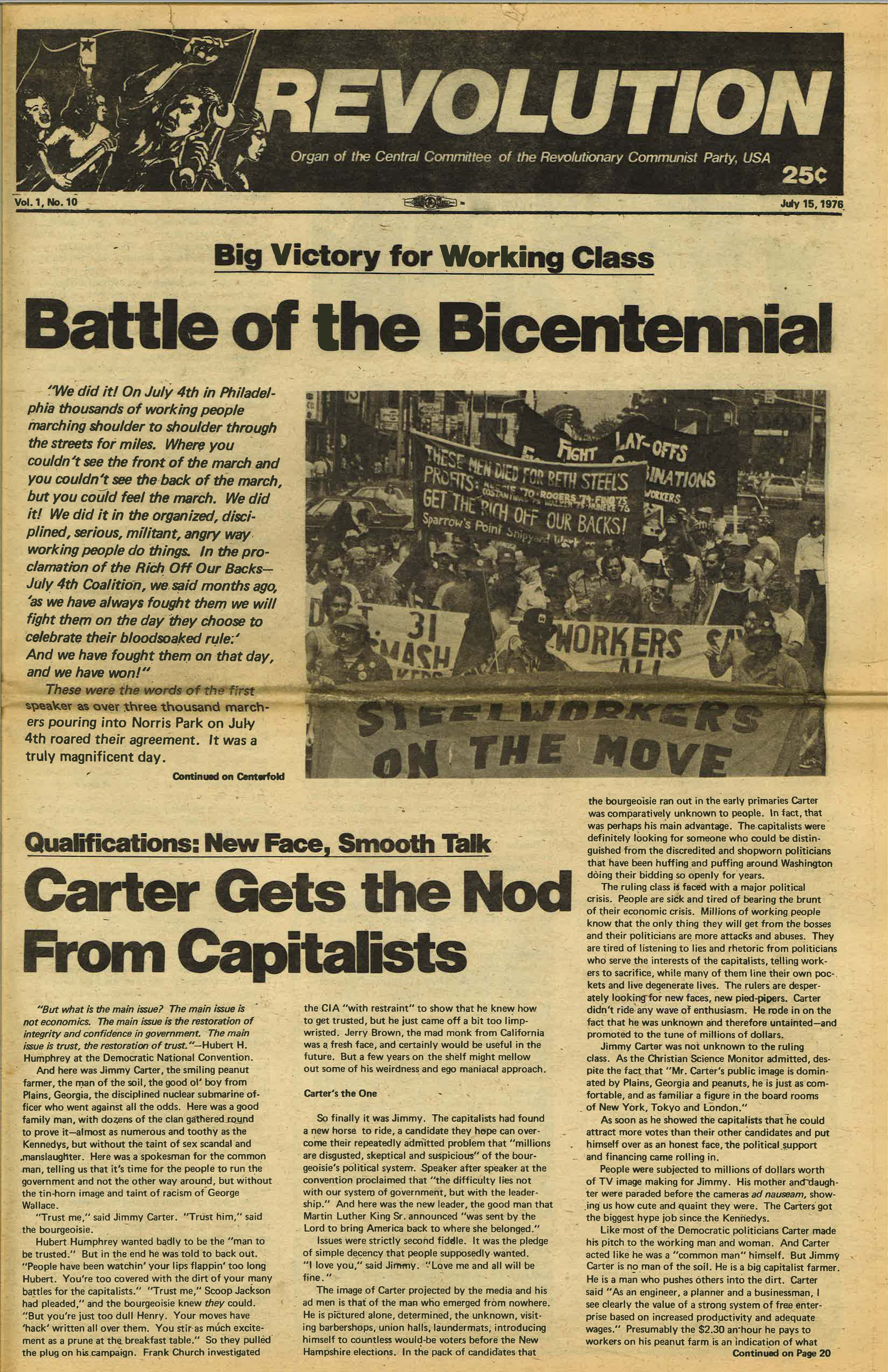
Big Victory for Working Class: Battle of the Bicentennial
July 4th Demonstration In Philadelphia: A Victory For The Working Class!
Party Speech at July 4th: ’We Make Society Run, Why Can’t We Run Society?’
Revolutionary Communist Party Speech July 4th by Bob Avakian
RCP draws 3500 to rally by the Guardian staff correspondent
Dead-End Rally Spares Enemy [Revolution, Vol. 1, No. 10, July 15, 1976]
Bicentennial: Fight Imperialism and Opportunism by the Workers Viewpoint Organization
Lessons of Class Struggle Around July 4th: Build on Advances Won in Battle
Call Flails at July 4th Demo: Pathetic Attack Exposes Class Role
RCP Helps Ruling Class “Celebrate” Bicentennial by the Workers Viewpoint Organization
Opportunists’ March Lets Rich Off The Hook
Some Lessons of July 4th: The Mass Line in Political Struggle
July 4, 1976 – “Battle Of The Bicentennial” by the Revolutionary Workers Headquarters
* * *
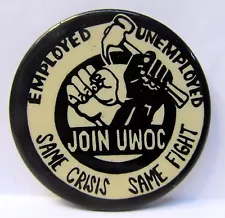
Auto and the Workers Movement. Learning from the Proud Past to Fight for a Brighter Future
Youth Meet After 4th, Discuss YCL Proposal
Strikers In Poland Rock Regime
Line on USSR, World Situation: Guardian Sows Confusion, Caves in to Imperialism
China’s Foreign Policy – An Outline compiled by Clark Kissinger
Elections 76: Capitalists’ Desperate Deceit vs. Workers’ Growing Struggle
Elections–Traps Set For Working People
CP and SWP Election Campaigns – Fresh Paint On ’Democracy’ Façade
Important Conference Planned by the RCP
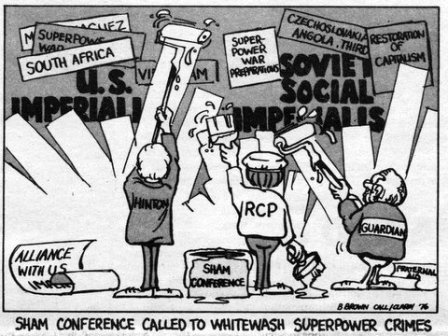
Nov. 13, New York City: Conference on Int’l Situation by the RCP
RCP, Guardian, Hinton “Debate”: 3-Ring Circus Protects Superpowers by The Call
Dogmatism: The Call, again from the Guardian
RCP’s Three-Ring Circus Adds Fourth Ring by The Call
OC statement on RCP’s opportunist conference by The Call
Birds of a Feather: Opportunists praise RCP conference by The Call
Conference Big Success: 2300 Meet On Int’l Situation by the RCP
Hundreds Meet on World Situation. Discuss Threat of World War by the RCP
Excerpts from Bob Avakian’s Conference Speech
RCP’s International Conference: Chorus Against China and Support for the Superpowers by The Call
Int’l Conf. Provokes OL, Guardian by the RCP
Letter Responds To Call Distortions by C. Clark Kissinger
Birds of a Feather: Opportunists Praise RCP Conference by The Call
Supporting Revisionism: RCP Takes Stand with ’Gang’ by The Call
O.L., Where Are You? by the RCP
500 Attend LA Conference by the RCP [Revolution, Vol. 2, No. 5, March 1977]
Editorial: Response to RCP’s Accusations by The Call
Int’l Conf. Provokes OL, Guardian by the RCP
A Final Word On The OL’s Cowardice by the RCP
International Conferences Conclude on West Coast by the RCP [Revolution, Vol. 2, No. 8, June 1977]
* * *
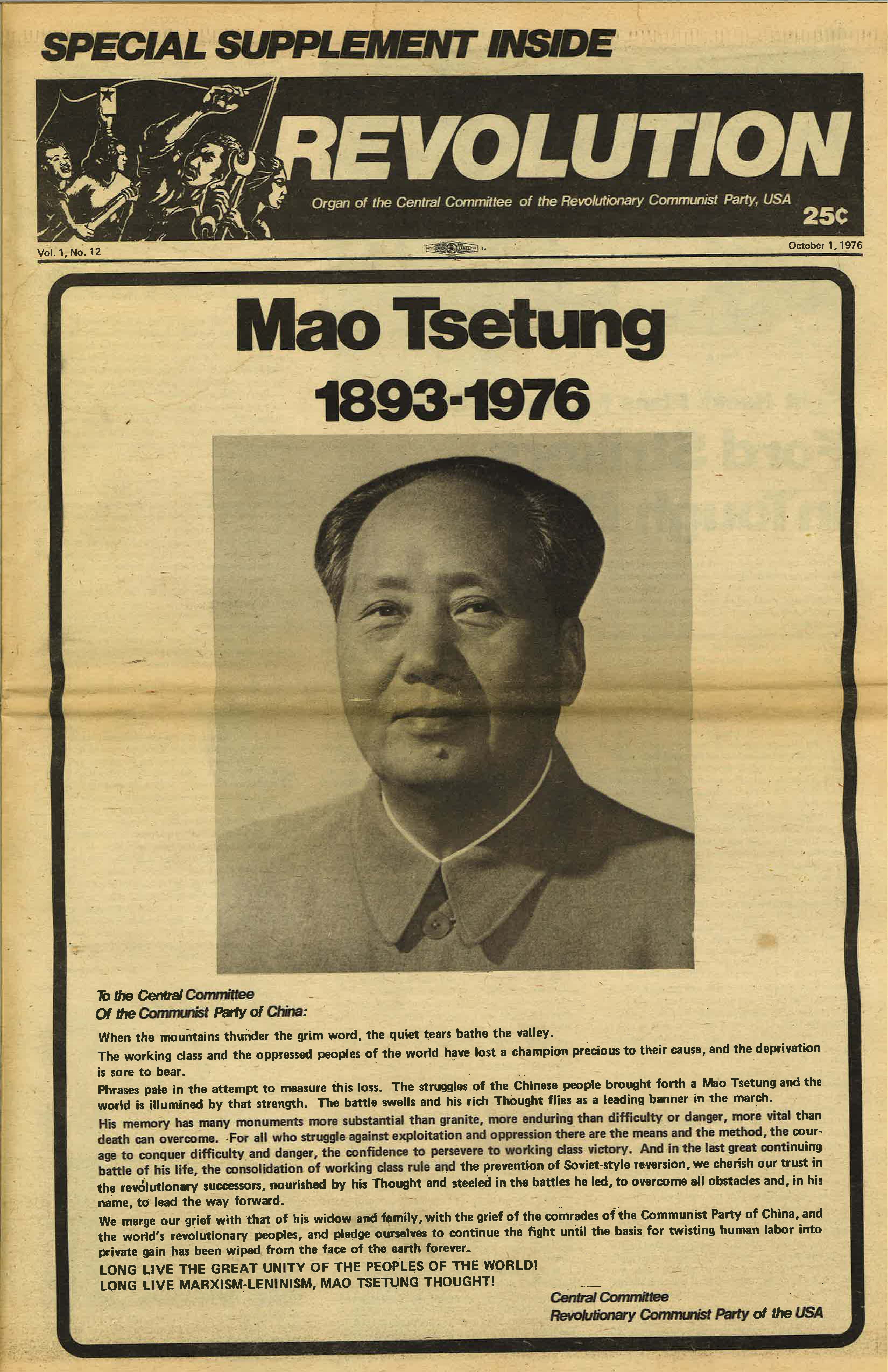
War and Revolution [articles from Revolution on the international situation]
Mao Tsetung, 1893-1976 [special supplement to The Worker newspapers]
Message From Central Committee of Revolutionary Communist Party of U.S.A. [on the death of Mao] [Peking Review, October 15, 1976]
We, the Working People of the World, Are Mao’s Successors by Bob Avakian
Revolution Will Continue in China
USCPFA Convention: Build Peoples’ Friendship Broadly
Message to the Party of Labor of Albania [Revolution, Vol. 2, No. 2, December 1976]
Theoretical Struggle Crucial Part of Working Class Movement
OL Bloodies Own Nose With Its “Main Blow”
There is No Bloodbath: Frenzied Attack on Cambodia
Steelworker Elections – Time To Dump Abel Machine, Elect Sadlowski
Sadlowski Election Battle – Steelworkers Shake Abel
Local Steelworkers Make Gains in Sadlowski Campaign
Rank & File Utilize Sadlowski Race
Sadlowski Defeated: Steel Workers Advance Despite Election Loss
Workers Viewpoint Organization – Theoretical Mishmash: Opportunism in its Own Right
Debunking Bourgeois Analysis: The Real Dynamics of the Arms Race
OL’s Draft ’Program’ Has Two Aspects: Trite – and Wrong
May Day, 1977. Statement by the Central Committee of the Revolutionary Communist Party, USA
May Day Celebrated in 24 Cities
Black Liberation: A Mighty Force
Cuba: The Evaporation of a Myth. From Anti-Imperialist Revolution to Pawn of Social-Imperialism
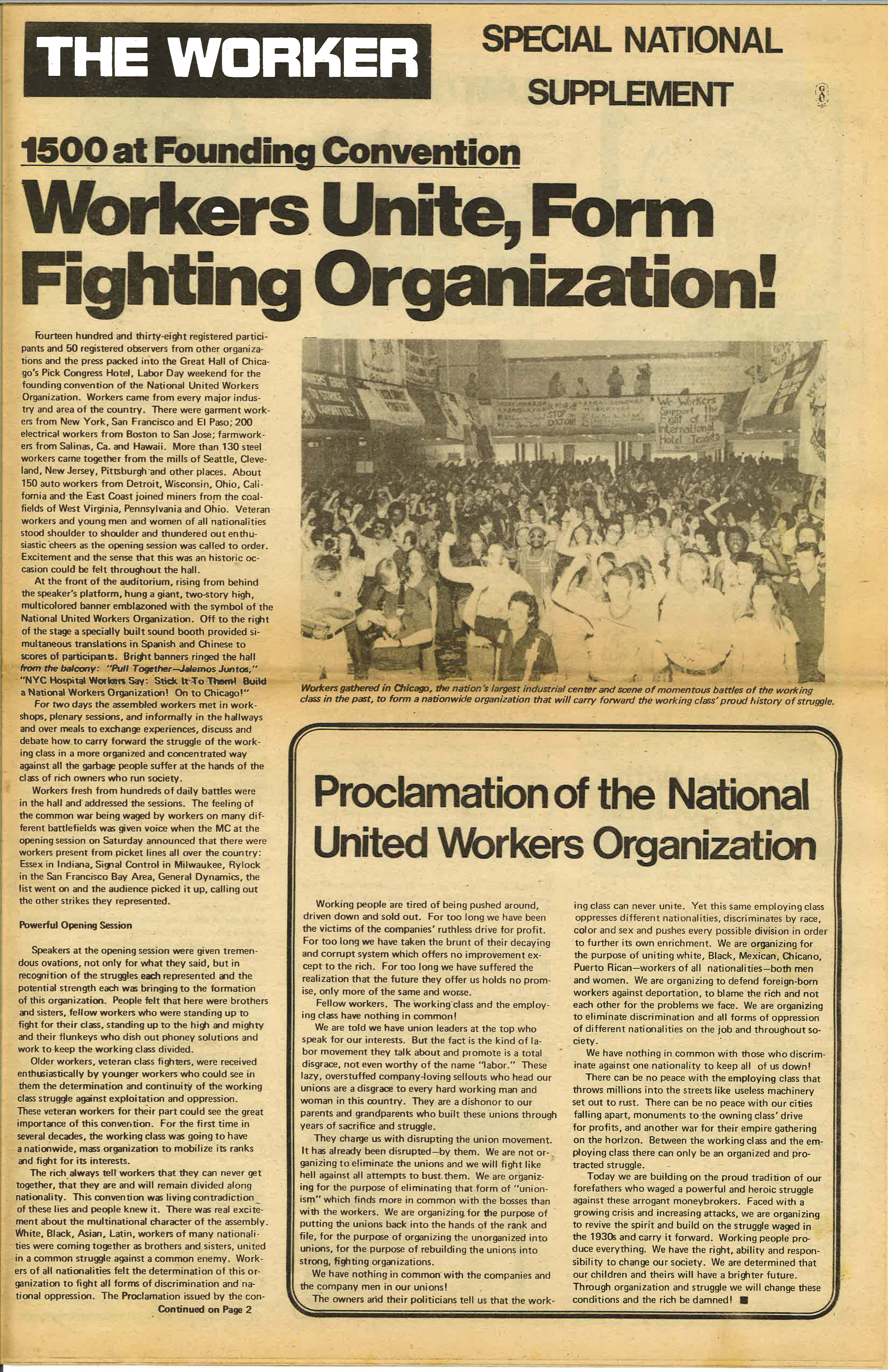
Call For a National Workers Organization
Workers Prepare Bold Step Forward
Plan for New Workers Group Picks Up Steam
A National Workers Organization: A Powerful Weapon for Our Class
The Worker Special National Supplement on the founding of the National United Workers Organization
NUWO: Dual-Unionism and Betrayal of the Party by the Marxist-Leninist Organizing Committee
Avakian & Co. on PL’s Road to Oblivion: Set Up Workerist-Economist Front Group at Chicago Meeting [on the NUWO] by the Spartacist League
Look Who’s Marching Against Busing! by the Communist Party (Marxist-Leninist)
Look Who’s Into Yellow Journalism!
NUWO Leaders Meet To Plan Strategy
NUWO Steering Committee Maps Plans
Campaign to Build a National United Workers Organization by the Revolutionary Workers Headquarters
* * *
The Foreign Imports Smokescreen A Steelworker pamphlet
On the Three Worlds And the international Situation
Two Superpowers: Equally Enemies of the World’s Peoples
The Task of Revolution [two articles reprinted from Revolution]
2nd National Conference: UWOC Convenes, Maps Battle Plans
Call Ducks U.S. Role in Horn of Africa
Miners Struggle at a Crossroads
Editorial: Repudiate the Call For Menshevik Unity!
Professionals Meet On Bakke Case
Plan Laid for a Young Communist Org. Militant Ybuth Meet, Map Road Ahead
Revolutionary Communist Youth Brigade Founded!
Revolutionary Communist Youth Brigade Formed
Communist Revolution: The Road To The Future, The Goal We Will Win by Bob Avakian
Minorities and Whites, Unite to Smash the Bakke Decision! by the Revolutionary Communist Youth Brigade
[Back to top]
In May 1976, the Guardian newspaper opened its pages to a discussion on China’s foreign policy (although Executive Editor Irwin Silber had been writing critical columns on the subjects since at least December 1975). This decision was primarily sparked by China’s stand on the Angola civil war. Here China and almost all the main anti-revisionist groups in the U.S. and around the world backed the FNLA and UNITA, which were also supported by the U.S., South Africa and Zaire, against the MPLA which had the support of the USSR and Cuba.
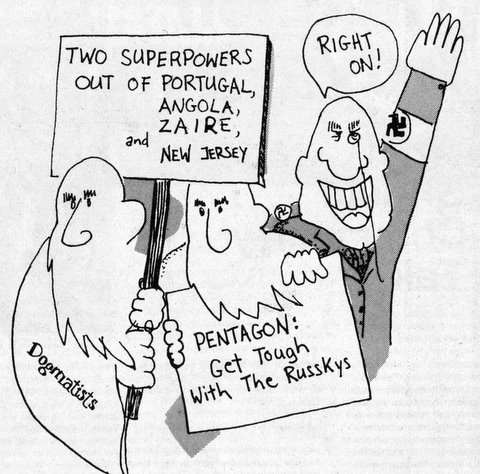
Prior to this point, the Guardian had generally approved of the positions taken by the Chinese government on international affairs. In this regard, it was part of a broader Pro-China current on the US left, which included the editors of the journal Monthly Review editors, Wilfred Burchett, Felix Greene, Annette Rubinstein, Shirley Graham DuBois, Han Suyin, and Anna Louise Strong. The Guardian had made a special effort to bring to the attention of the broad U.S. left events in China and favorable coverage of Chinese foreign policy.
Now, however, the Guardian argued that China’s Angola stand as an error: wrong on the nature of the national liberation struggle in Angola, a reflection a miss-assessment of the international situation, and the beginning of a Chinese de facto alliance with the United States against the Soviet Union, now perceived as the “more dangerous” of the two super-powers. But the Guardian did more than just criticize the Chinese; it also criticized New Communist Movement supporters of the Chinese position for “flunkeyism” and “class collaboration.”
Not content to simply present the paper’s position in print, Silber also went on a national speaking tour focusing on the issue of the international line of the U.S. left. The Guardian’s ability to take an openly critical stand on this issue was facilitated by the break, earlier in the year, between the Guardian and the October League (Marxist-Leninist) which resulted in the resignations of OL members – Renee Blakkan, Martin Nicolaus, Nancy Nikcevich and Rod Such – and the subsequent departure of Carl Davidson, who was also close to the October League at the time.
The Guardian’s new stand was severely criticized by much of the New Communist Movement which charged that it represented a “centrist” position that conciliated with modern revisionism and Soviet social imperialism. However, the willingness of the Guardian to openly criticize Chinese policy and the relationship between leading New Communist Movement groups and China, freed a number of smaller anti-revisionist organizations to begin to rethink other elements of anti-revisionist orthodoxy as well.
Unite the Many, Defeat the Few. China’s Revolutionary Line in Foreign Affairs by Jack A. Smith
Angola: National Liberation and the U.S. Left, 1974-76 by the Milwaukee Alliance
The Guardian “Respectfully Differs” with the U.S./South Africa/China Axis
Guardian Embarrassed by Peking Bloc With U.S. Imperialism. Criticizing Mao to Defend Maoism
Irwin Silber Fans the Flames of Eclecticism at Guardian Gala
Guardian Embarrassed by Peking Bloc with U.S. Imperialism
Behind the Guardian-OL Feud [Workers Vanguard, July 2, 1976]
Guardian Opens China Discussion by Dick Roberts [The Militant, September 10, 1976]
’...fan the flames’ by Irwin Silber
Guardian Viewpoint: The Shah of Iran
Guardian Covers Up Real Character of Social-Imperialism by the October League (Marxist-Leninist)
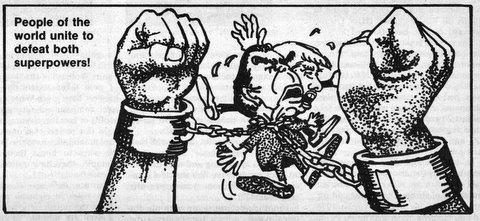
October League Responds to the Guardian: Strengthen Your Stand Against Revisionism
Long Live the Angolan People by the Communist Labor Party, USNA
Angola Fighting Fueled by U.S., USSR Control Bids by the Revolutionary Communist Party
’...fan the flames’ by Irwin Silber
Silber speaks on liberation fights
’...fan the flames’ by Irwin Silber
Presentation on the Angolan Civil War by the August 29th Movement
Angola: Neo-Colonialism vs. National Liberation Anti-Imperialists Must Take A Stand! by the Philadelphia Workers’ Organizing Committee
’...fan the flames’ by Irwin Silber
Angola Will Win! [Workers Viewpoint, Vol. 1, No. 1, March 1976]
Angola: For True Independence Superpowers Must Be Thrown Out!! by the Congress of Afrikan People
Victory to the Second Anti-Colonial War of the Angolan People! by the Central Organization of U.S. Marxist-Leninists
Oppose Soviet Aggression In Angola by I Wor Kuen
Guardian Viewpoint: China’s foreign policy
China’s foreign policy: A friend of China raises some questions by Wilfred Burchett
China’s World View by William Hinton
With Friends Like the Guardian China Needs No Enemies by the October League (M-L)
Using Hinton as straw man: The Guardian Slanders China by Resistencia Puertorriqueña
Hinton’s Folly: A ’Neutral’ U.S. Imperialism? by the October League (Marxist-Leninist)
On Angola: Guardian Fully Degenerated, No Longer in the Communist Movement by the Workers Viewpoint Organization
Chinese Foreign Policy – A Critical Analysis by by the Philadelphia Workers’ Organizing Committee
A Polemic Against the Guardian’s Revisionism by the Yenan Bookstore Collective
Guardian’s Break with Marxism by the October League (Marxist-Leninist)
Angola: The Guardian’s Treachery by Carl Davidson
’...fan the flames’ [reply to Carl Davidson] by Irwin Silber
Soviet Social Imperialism and the International Situation Today by I Wor Kuen
Angola: Struggle Against Imperialism and Opportunism Go Hand in Hand, Part 1 by the Marxist-Leninist Organizing Committee [Unite!, Vol. 2, No. 3, June-July 1976]
Angola: Struggle Against Imperialism and Opportunism Go Hand in Hand, Part 2 by the Marxist-Leninist Organizing Committee [Unite!, Vol. 2, No. 4, August-September 1976]
Line on USSR, World Situation: Guardian Sows Confusion, Caves in to Imperialism by the Revolutionary Communist Party
The Guardian’s “Russian Exceptionalism” and “socialism of a new type” by the J-Town Collective
Against the Revisionist Yellow Journalism of the “Guardian” (Part 1) by the Central Organization of U.S. Marxist-Leninists
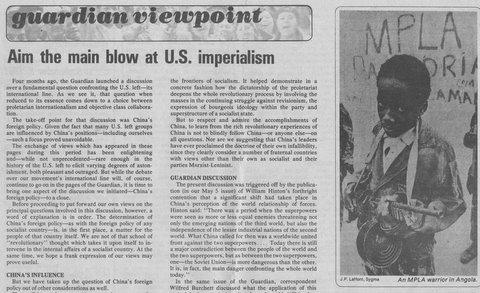
Guardian Viewpoint: Aim the main blow at U.S. Imperialism
From Canadian Students in Peking: A Response to Wilfred Burchett [from The Call]
Angola’s Revolutionary National War and the Struggle for Proletarian Internationalism by The Compass (Boston)
Proletarian Internationalism vs. Irwin Silber’s Revisionism
The Guardian’s Man in Havana: An Exposure of ’Centrism’ by Martin Nicolaus
Int’l Conf. Provokes OL, Guardian by the RCP
Guardian Backs Soviet Aggression in Zaire [from The Call]
Feeble Polemics by Guardian, RCP [from The Call]
The Soviet Union: Is it the Nazi Germany of Today? by the Communist Committee
[Back to top]
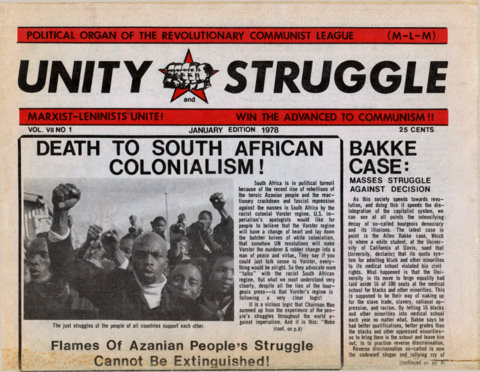
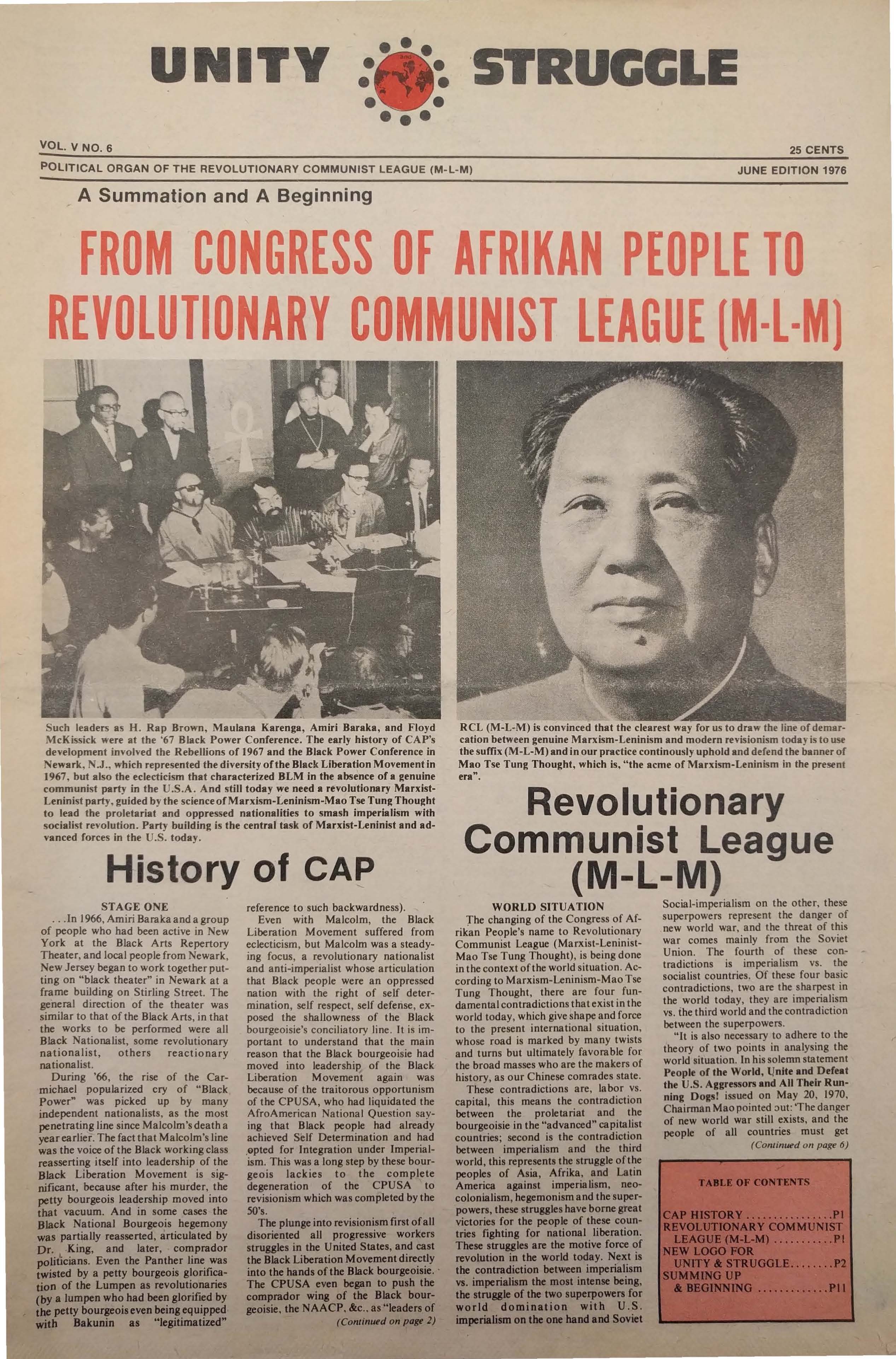
The Congress of Afrikan People (CAP) had its roots in the Black Arts movement in Newark, New Jersey in the mid-1960s, largely through the efforts of Amiri Baraka. By the late-1960s, under the influence of Malcolm X, Ron Karenga’s US organization and the example of the Black Panthers, the CAP became an explicitly political, Black nationalist organization, with a focus of community organizing and cultural politics. In 1970, at its Atlanta Convention, CAP became a national organization dedicated to building a Black Political Party, including involvement in electoral politics.
In the early 1970s, a growing struggle developed within the CAP between the Black nationalists and the emerging Marxist-Leninist forces, headed by Baraka. With the departure of Haki Madhubuti and Jitu Weusi, the Marxist-Leninist tendency in the organization was strengthened and in 1974-75, CAP took up the study of Marxism-Leninism-Mao Tse Tung Thought and, for a brief period, worked closely with the October League (Marxist-Leninist).
In February, 1976 the organization changed its name to the Revolutionary Communist League (M-L-M). Three years later, the group merged with the League of Revolutionary Struggle (Marxist-Leninist), which had been formed in 1978 through a merger between I Wor Kuen and the August 29th Movement.
African American Intellectuals and Black Cultural Nationalism Between 1965 and 1975: The Case of Amiri Baraka by Toulgui Ladi
History of the Congress of Afrikan People
The Congress of African People. Baraka, Brother Mao, and the Year of ’74 by Robeson Taj P. Frazier
’Hard Facts’: Amiri Baraka and Marxism-Leninism in the 1970s by David Grundy
“Unity and Struggle” – History of the Revolutionary Communist League (M-L-M)
Reflections on Amiri Baraka, Oct. 7, 1934–Jan. 9, 2014 by David Hungerford
Response to RCL by the League for Proletarian Revolution (M-L)
Cheap Shots are not Ideological Struggle by the League for Proletarian Revolution (M-L)
Revolutionary Communist League (Marxist-Leninist-Mao Tse Tung Thought)
PRRWO & RWL: Not a “Revolutionary Wing”, But a Dangerous Duo!
Revolutionary Communist League on the Afro American National Question
RCL’s Position on Party Building (Part 1)
RCL Editorial [on the CPML and party building]
RCL’s Position on Party Building (Part 2)
[Back to top]
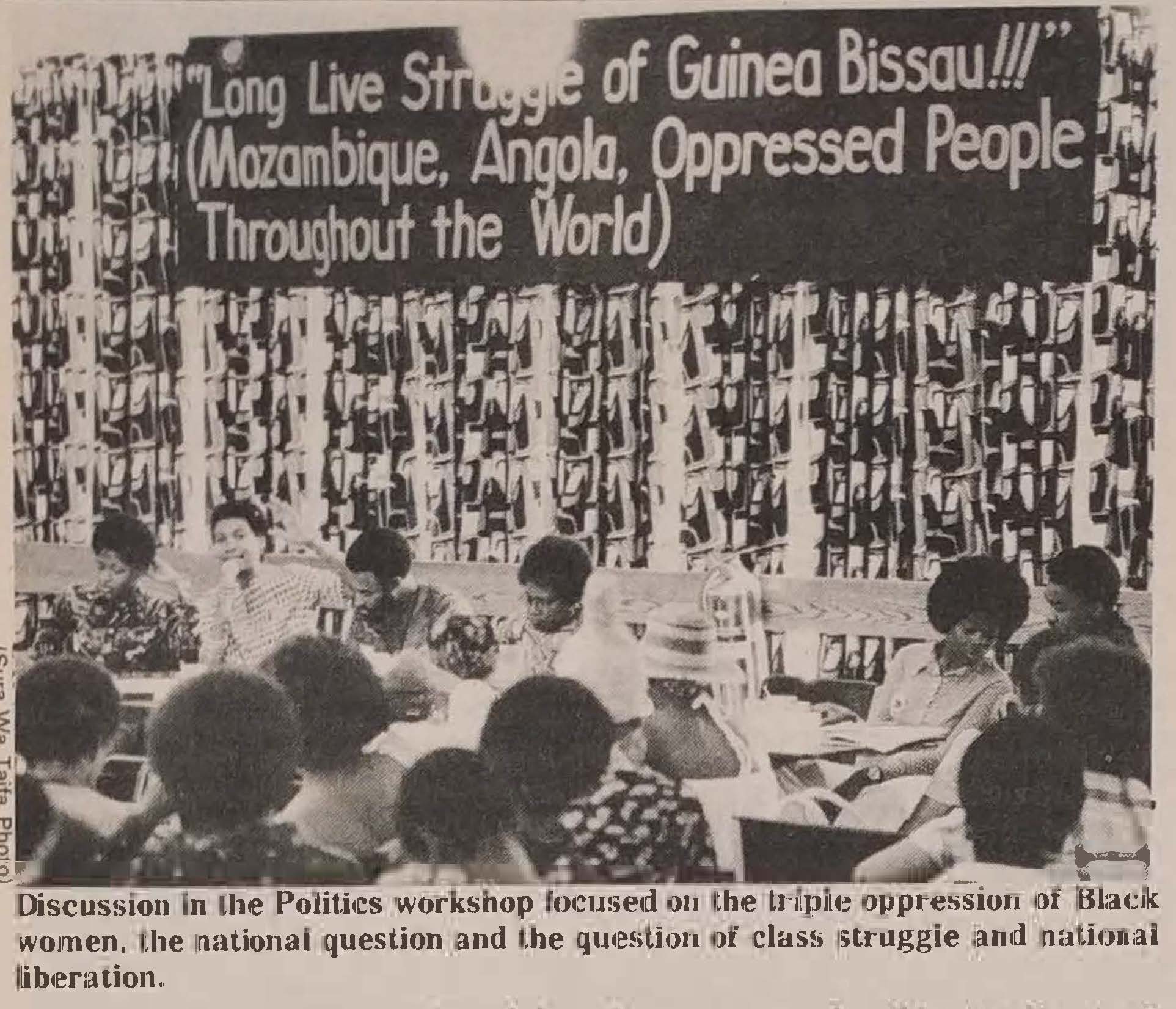
The Black Women’s United Front (BWUF) was a pioneering initiative to raise consciousness within Black radical organizations and the broader left about black women’s intersecting oppression. Sponsored by activists from a number of New Communist Movement organizations, it sought to promote the unification of Black working class women to play a leading role in the Black Liberation Movement and ultimately, to create a revolutionary multi-national women’s front “aimed at the destruction of monopoly capitalism.”
The idea for the initiative was germinated at an All-Afrikan Women’s Conference in Newark, New Jersey in July 1974 organized by the Congress of Afrikan People (CAP), which brought together several hundred participants. By the end of the conference, as Ashley Farmer explains: “attendees were in “unanimous agreement that [they] should put forth an anti-capitalist, anti-imperialist, and anti- neo-colonialist position.“ This became the ideological and organizational basis of the BWUF.”
The founding conference of the BWUF was held in Detroit on January 25-26, 1975. Some 650 activists were in attendance, including people from CAP, the Black Workers Congress, the October League (M-L), the Youth Organization for Black Unity (YOBU), and the National Welfare Rights Organization. The conference resolved to form a broad united front “rooted in the working masses of women” and dedicated to the “abolition of every possibility of oppression & exploitation.”
Local chapters of the BWUF carried out activities on a variety of issues including welfare rights, employment and defense of Black women political prisoners such as Joan Little, Dessie X. Woods and Cheryl S. Todd. According to Farmer, they were also urged to “carry on political education to raise the consciousness of women within the Black Liberation Movement” by “hold[ing] forums to wage ideological discussion and struggle”, [and] “build[ing] coalitions with other groups involved in the struggle aimed at the destruction of the system.” As part of the latter effort, the BWUF organized a conference on International Women’s Day 1975 in New York City with the goal of advancing the project of a Revolutionary Multi-National Women’s front.
Unfortunately, like a number of similar initiatives of the New Communist Movement in this period, the BWUF’s ability to develop into a broader formation was fatally undermined by its becoming entangled in the sectarian party-building priorities of participating Marxist-Leninists. This problem can be seen in an article on the multi-national women’s conference in the CAP newspaper, Unity & Struggle, which states:
The Multi-National Woman’s Conference is a…. move toward building the Marxist-Leninist Party in this country that is needed at this time in the face of rising contradictions and a heightening of the degree of preparedness of the working class with only revisionists, petty-bourgeois splitters and other various opportunists calling themselves parties. What is needed is a genuine Marxist-Leninist Party…This conference is a step in building this new party…“
Black Women to Meet at Rutgers. Nationalism & Socialism on Agenda by Frances M. Beal [Triple Jeopardy, Vol. 3, No. 5, Summer 1974]
Afrikan Women Unite... to Struggle!!! [Unity & Struggle, Vol. 3, No. 8, August 1974]
Letter on the Black Women’s United Front by the Black Workers Congress Western New York District Committee
Report on Black Women’s United Front Meeting [Unity & Struggle, Vol. 3, No. 13, December 1974]
Black Women’s United Front January 25 – Detroit. CAP Line Begins to Form: Black Liberation is a Struggle for Socialism! [Unity & Struggle, Vol. 4, No. 2, January 1975]
Black Women’s United Front and National Black Assembly Meetings Analyzed by Amiri Baraka
Black Women Meet to Forge United Front [The Call, Vol. 3, No. 5, February 1975]
We Did It! Black Women’s United Front
United Front Hits Triple Oppression of Black Women
Progress Report: Black Women’s United Front Conference, January 1975 by the Black Workers Congress Western New York District Committee
Black Women’s United Front Meets in Detroit [Unity & Struggle, Vol. 4, No. 5, April 1975]
Black Women’s United Front to Meet in Atlanta October 25 [Unity & Struggle, Vol. 4, No. 13, October 1975]
Black Women’s United Front [Unity & Struggle, Vol. 4, No. 14, October 1975]
Black Women’s United Front – Forward with the Struggle! [Unity & Struggle, Vol. 4, No. 15, November 1975]
The Black Women’s United Front Calls for a Multi-National Women’s Conference in New York Saturday March 6th in Line with an International Women's Day Demonstration March 7th [Unity & Struggle, Vol. 5, No. 2, February 1976]
International Women’s Day Takes Aim at Imperialism, Revisionism by the October League (Marxist-Leninist)
Multi-National Women’s Conference [Unity & Struggle, Vol. 5, No. 5, May 1976]
[Back to top]
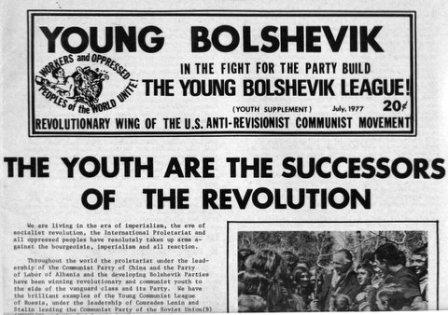
The Revolutionary Wing was a short-lived party building initiative which began in the fall of 1975. The name was derived from a claim that there were two “wings” of the U.S. communist movement, one opportunist, and one revolutionary. The Revolutionary Wing was formed in November 1975 when the August 29th Movement (ATM) and the Puerto Rican Revolutionary Workers Organization (PRRWO) proposed to the Workers Viewpoint Organization (WVO) the formation of a joint Party Building Commission (PBC). The basis of unity of the proposed commission was seven points:
(1) Party Building is the central task of communists.
(2) Political line is the key link.
(3) Right opportunism is the main danger in the workers and communist movements.
(4) Marxist-Leninists unite.
(5) Win the advanced to communism.
(6) Factory nuclei are the basic form of organization.
(7) The right of self-determination for the Afro-American nation.
In addition, the PBC was to carry out joint theoretical work around party building, the domestic situation, the national question, trade union work, the international situation, the history of the communist and workers’ movements in the U.S., and on the program of the party. The PBC was also to organize joint political education for the organizations and joint leadership training conferences.
The formation of the Wing led to a series of joint forums around the country on the issue of party building conducted by PRRWO, ATM and WVO, joined by several additional groups, namely the Revolutionary Workers League (RWL) and another somewhat mysterious group which claimed origins in the Black Workers Congress – the Revolutionary Bloc (although Resistencia Puertorriqueña questioned its existence). At one time, PRRWO asserted that there were also other “honest” elements close to the Revolutionary Wing. These were listed as Resistencia Puertorriqueña and El Comité.
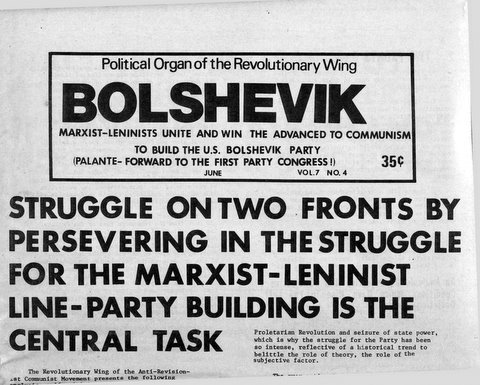
The Revolutionary Wing did not hold together long. By March 1976 it had fallen apart: WVO and ATM departed amid bitter recriminations, with WVO taking a significant number of RWL cadre with it. Resistencia Puertorriqueña and El Comité refused to join. The Revolutionary Bloc, if it ever in fact existed, disappeared. Meanwhile PRRWO and the RWL drew closer together while, at the same time, undergoing a series of violent internal splits and purges, before the greatly reduced remnants officially merged as the Leninist Core of the Revolutionary Wing and announced their intention of forming a “U.S. Bolshevik Party.”
WVO-PRRWO Hold Joint Forum on Party Building [Palante, Vol. 1, No. 12, December 1975-January 1976]
PRRWO Holds Forum in S.F. by the August 29th Movement
Party Building Forums Reflect Rising Party Spirit across the U.S. by the Puerto Rican Revolutionary Workers Organization
’Revolutionary Wing’ or Anti-Party Bloc? by Sherman Miller
The “Wing”: How Not to Unite Marxist-Leninists by the Marxist-Leninist Organizing Committee
Expose RWL’s ’Left’ Opportunism on the International Situation by the Workers Viewpoint Organization [Workers Viewpoint, Vol. 1, No. 3, Special Supplement, June 1976]
RWL: Building the Party on Bourgeois Ideology. A call to struggle against ’left’ opportunism by the Communist Workers Committee (M-L)
Party Spirit or Circle Spirit? Expose RWL/PRRWO’s Menshevism on the Organizational Question by the Workers Viewpoint Organization
An Open Letter to a District and all Revolutionary Workers League Comrades by the Bolshevik Organizing Collective
Our Disagreements with the PRRWO–a preliminary statement by former PRRWO members and supporters
The Puerto Rican Revolutionary Workers Organization and the Revolutionary Wing by Former PRRWO Cadres
Lessons from the Degeneration of the Puerto Rican Revolutionary Workers Organization by I Wor Kuen
The Puerto Rican Revolutionary Workers Organization, Workers Viewpoint Organization and the Revolutionary Wing by I Wor Kuen
Some Criticisms of Workers Viewpoint Organization on Party Building by I Wor Kuen
’Revolutionary Wing’ in Shambles by the October League (Marxist-Leninist)
RWL and OL: Two Wings of Same Bird by the Committee for Scientific Socialism (M-L)
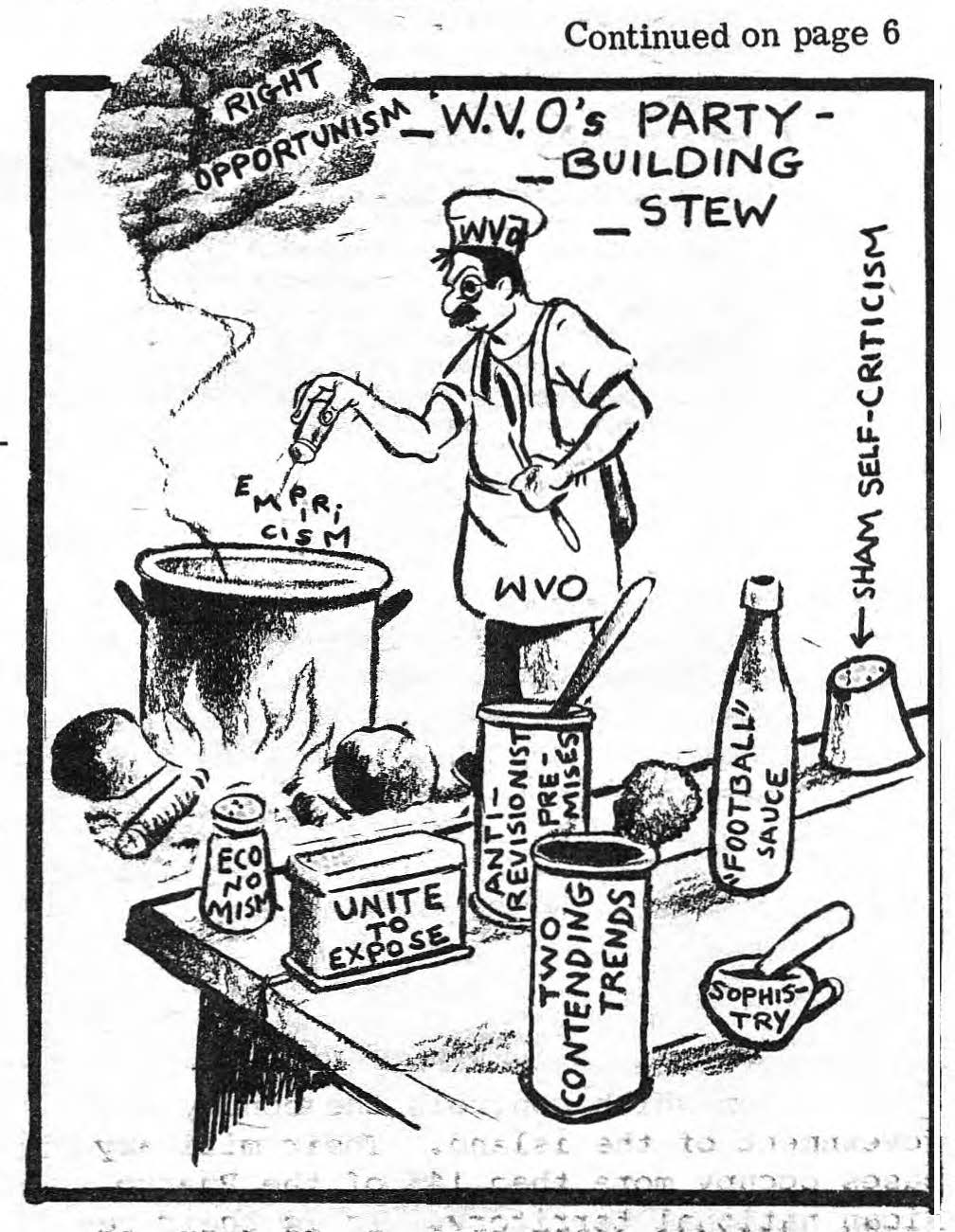
RWL/ALSC Appendix by the Committee for Scientific Socialism (M-L)
Wreckers Cripple African Liberation Support Committee from The Call
Splits and Purges as ’Wing’ Grows More Isolated by the October League (Marxist-Leninist)
The “Wing”: ’Stuck in a Hole’ by the Workers Congress (Marxist-Leninist)
PRRWO & RWL: Not a “Revolutionary Wing”, But a Dangerous Duo! by the Revolutionary Communist League (M-L-M)
Uniting a Bankrupt Trend: The Anti-Party Opposition Bloc from The Call
Forge the Vanguard Party – Grasp the Key Link by the Marxist-Leninist Organizing Committee
Two Roads to Party Building by the Bolshevik Organizing Collective/Communist Workers Committee (M-L)
Presentation on Party Building: Expose the Anarcho-Socialism of PRRWO/RWL! by the Union for Working Class Emancipation
WVO: Undaunted Dogma from Puffed-Up Charlatans by Owen Natha [RCP]
WVO’s Opportunism in Theory and Practice by John B. Tyler [RCP]
Behind WVO’s ’Silence’ on China and the ’Gang of Four’ by The Call
Palante! Siempre Palante!, Interview with Richie Perez
[Back to top]
In Boston – Revolutionary Storm Assaults Racists and Reformists [Palante, January 1975]
Against Terrorism For Proletarian Revolution [Palante, February 1975]
Struggle Against Opportunism Continues at Philadelphia Forum [Palante, February 1975]
Two Lines on Trade Union Work: An Analysis of April 26th [Palante, June 4, 1975]
Mayday Rallies Reflect Growing Consciousness of the Masses and the Struggles Within the Communist Movement [Palante, June 4, 1975]
Practice Marxism Not Revisionism [Palante, June 4, 1975]
“Anti-Sovietism” – Worst Poison in the Revolutionary Movement? A Reply to PSP [Palante, July 9, 1975]
“CP” USA Convention Shows Why We Must Build a Genuine Communist Party! [Palante, August 10, 1975]
Expose Havana Conference: Social-Imperialist Scheme to Leech Off Puerto Rico’s Struggle [Palante, September 10, 1975]
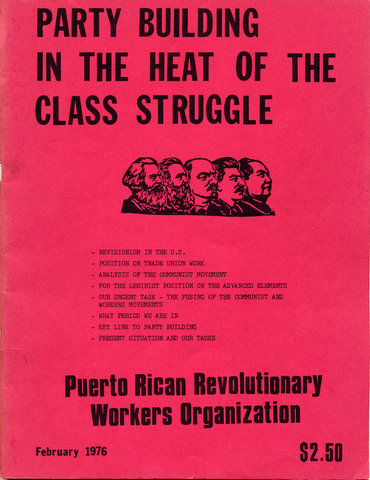
Party Building in the Heat of the Class Struggle – a Theoretical Presentation
Report on Student Conference, Dec. 13 1975
The October League Forms a “Communist” Youth Organization–Another Sham Attempt!
Bourgeois Terrorism Paves Way for Fascism
Party Building in the Heat of the Class Struggle
No Tea Party in Boston – The Struggle for the Party Intensifies
PRRWO Presentation in Boston: Expose the Anti-theoretical Revisionist Premises of WVO
Expose the Menshevik Line, Purge Our Ranks, On To Party-Building
Editorial: More on OL’s (Menshevik-Liberal) Call for the Party
Editorial: Mensheviks Are Objectively Agents of the Bourgeoisie
[Back to top]
RWL Presentation in Boston: Defeat OL's (Menshevik-Liberal) Call for the Party (Palante, Vol. 6, No. 3 (March-April 1976))
Forward to the U.S. Bolshevik Party
Steeled in Struggle – History of the Two Line Struggle in the RWL
Party Building and the Woman Question
Superpowers Out of Angola. Self-Determination for the Angolan Masses!!
[Back to top]
Our Central Task: Building a New Communist Party
Historic Alamosa Conference: Reformism or Revolution!
Struggle for Party is Struggle for Revolution – Current state of our movement [part I]
PRRWO-RWL: ’Hurling Threats and Insults in Not Fighting’ [part II]
Editorial: The Revolutionary Cause and Our Tasks
WVO Proclaims Itself General Staff
W.V.O. Kicked Out Of Chicago Forum: National Movements – Main Allies of the Working Class
The Struggle Against Left Opportunism – League for Proletarian Revolution
[Back to top]
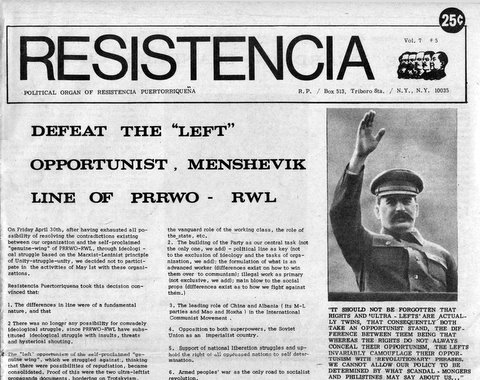
Our Views on the Communist Movement in the United States
Defeat the “Left” Opportunist, Menshevik Line of PRRWO-RWL
W.V.O.’s Forum in Los Angeles Backfires
Actively Take Part in the Struggle for Party Building
Caricature of a Vanguard [on WVO] [Resistance, Vol. 7, No. 7, n.d.]
WVO’s “Unite to Expose”: A policy of class collaboration
Comradely Polemics with ATM-ML: The Present Situation & Our Tasks
Exchange with a Resistance reader on the LPR (M-L)’s ATM Polemics [Resistance, Vol. 8, Nos. 3-4, April 1977]
ATM Consolidates Right Line: Right Opportunism is the Main Danger! [Resistance, Vol. 8, Nos. 3-4, April 1977]
WVO: from “Unite to Expose” to “Hide to Expose”
N.L.S.S.C. Defeats Liquidators
Panama: Against a Social Chauvinist Trend
[Back to top]
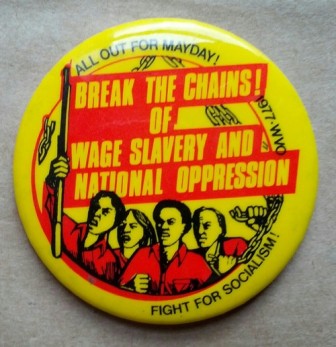
The October League: A Most Dangerous Revisionist Trend in U.S. Communist Movement
PRRWO: Anarcho-Socialism U.S.A. Expose PRRWO’s Hustlerism!
Slipping and Sliding: October League, the Most Dangerous Revisionist Trend in the Communist Movement and Their Call for the Party [Workers Viewpoint Journal #4, n.d.]
Philistinism of the PRRWO & RWL Exposed!
Celebrate Int’l Working Women’s Day!
On Angola: Guardian Fully Degenerated, No Longer in the Communist Movement
Dying Screams of the PRRWO/RWL Clique and Responding Echoes from Assorted Opportunists
October League’s Organizing Committee Forums: ’Unity Trend’ Hangs Itself!
Build ALSC into a Mass Fighting Organization Workers Viewpoint Organization Position Paper submitted to ALSC National Conference 8/76
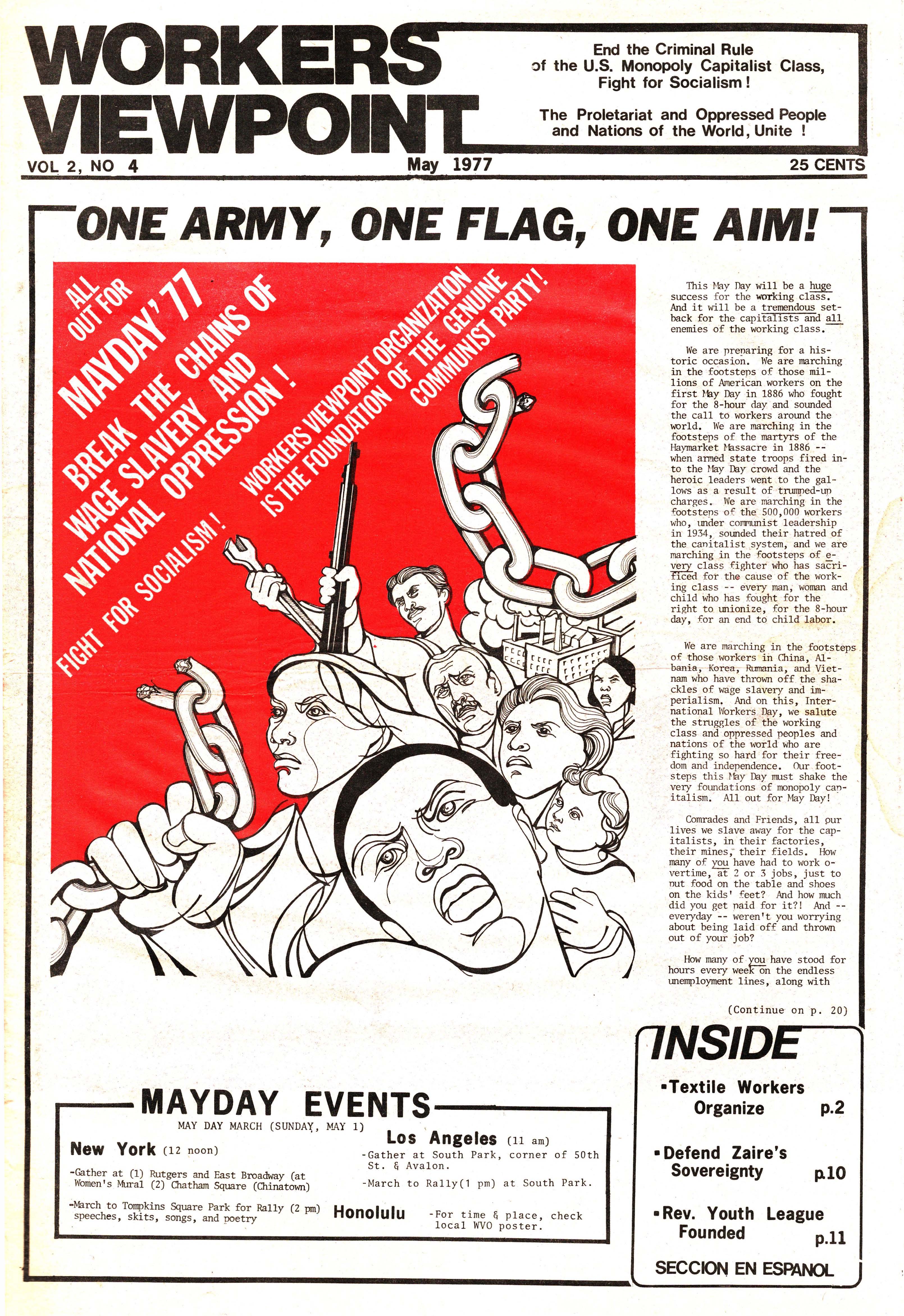
Harriet Tubman-Nat Turner Collective (ML) Liquidating itself to the WVO
Nicholaus vs OL: A Menshevik’s Criticism of Menshevism
Strategy and Tactics: OL & RCP Revise Marxism on the International Situation
RCP Discovers ’Theory in its Own Right’
October League’s Organizing Committee Doomed from the Start
Bolshevik Workers Organization (ML) Strikes Circle Spirit Severe Blow – Liquidating Itself to WVO
No Triumph for ’Roots’: Glorious Afro-American History Will Not Serve Capitalism
The October League – Revisionist to the Bone. Touched to Their Soul by the Bourgeoisie
ALSC: RWC Paves Way for RCP Takeover
RCP: Reversing Verdict on Soviet Social Imperialism is Total Treachery
Formation of the Genuine Communist Party is Single Greatest Step Towards Fusion!
The Organization for Bolshevik Unity (OBU-ML) Defeats Centrism and Prepares to Liquidate to the WVO!
Auto workers on the move against capitalism! [WVO’s Auto Bulletin #5]
Lessons in Revolutionary Leadership from IWWD
Rebuild ALSC by Correcting Methods of Leadership
Defend Zaire’s Sovereignty! Soviet Social Imperialists Back Invasion
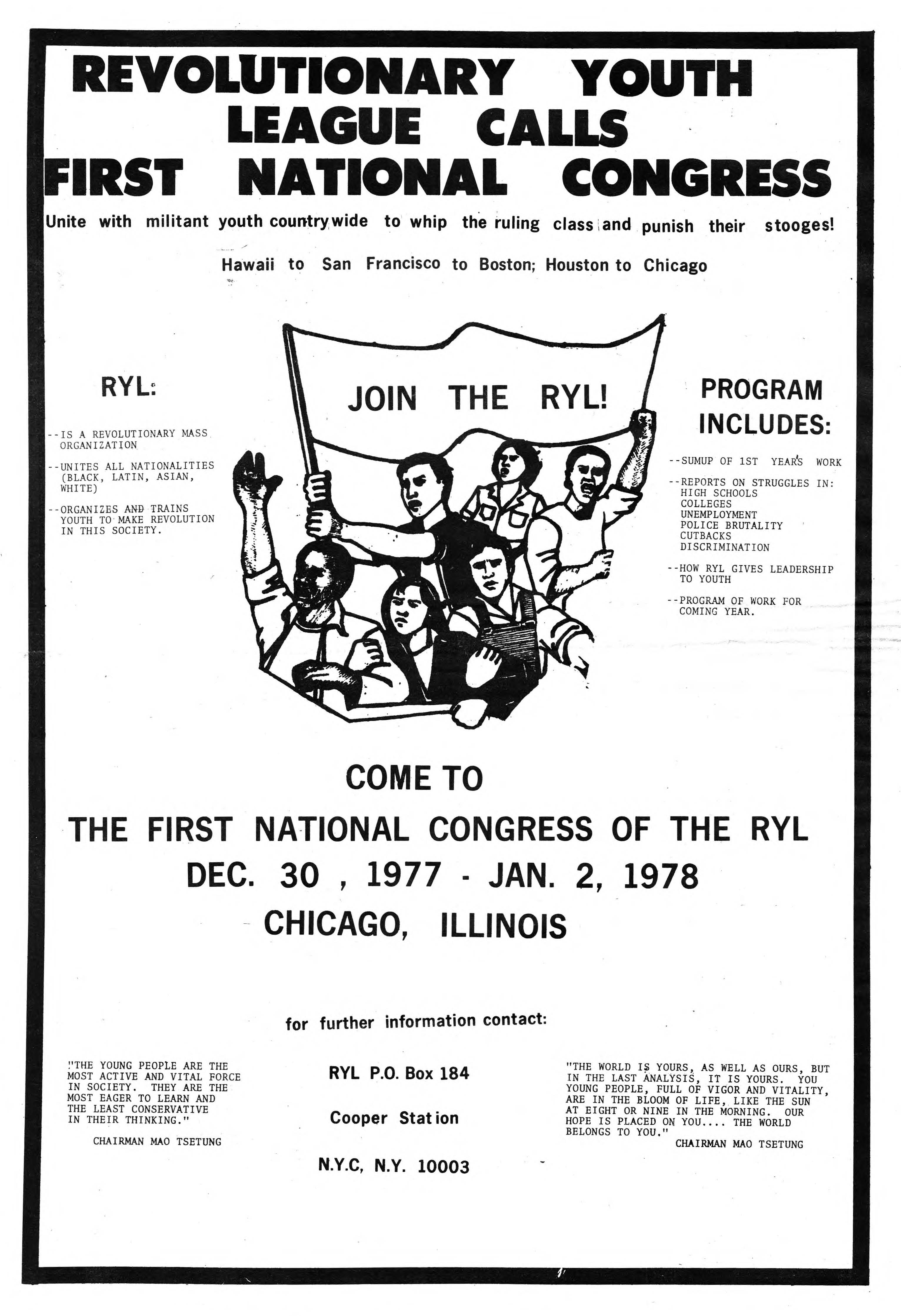
N.Y. May Day: 1000 Strong, Workers March Led by WVO: Major Speech from Central Committee of WVO
Soviet Social Imperialism: Enemy of the Arab and World’s Peoples [Workers Viewpoint,, Vol. 2, No. 6, July 1977]
Karl Marx – Proletarian Revolutionary
Background: Imperialism and War [Workers Viewpoint, Vol. 2, No. 6, July 1977]
African Liberation Support Committee Holds Victorious African Liberation Day
ALSC – Forward to National Conference! [from Workers Viewpoint Supplement, July 1977]
Brief History of ALSC’s Program of Work [1977]
Grasp Lessons of Historic May Day 1977
Elvis – Shake, Rattle and Roll to Pacify the Workers
Women Hold Up Half the Sky [on abortion, the workingclass' love of children, hedonism and stable man-woman relationships]
African Liberation Support Committee Holds Successful National Conference
Broad Horizons–Blitz Campaigns: The Trade Union Education League
Blackout Sheds Light on RCP’s Chauvinism
WVO Holds Nationwide Commemoration For Chairman Mao
Chairman Mao, Live Like Him, Dare to Struggle, Dare to Win! [WVO speech at Mao Commemoration, September 10, 1977]
Lessons of Tasks of the Youth Leagues: Proletarian Revolution Must Defeat Intellectual ’Itch’
Minimum Wage – Small Change [Workers Viewpoint, Vol. 2, No. 9, October 1977]
Workers Viewpoint [newspaper]
[Back to top]
ATM – Traitors to the Proletariat – Mensheviks to the Bone!
Statement of Principles of Revolutionary Wing
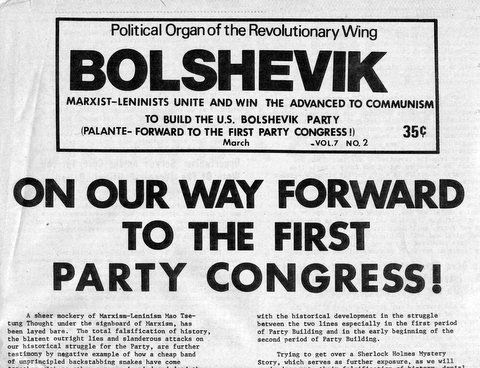
Leninist Core of the Revolutionary Wing Holds 1st Plenum
Propaganda the Chief Form of Activity (Speech Delivered at the First Plenum of Leninist Core of the Revolutionary Wing)
In the Fight for the Party Build the Young Bolshevik League
On Our Way Forward To the First Party Congress!
Practice Marxism Not Revisionism – Treachery of “Save the Fatherland” Propagated by R“CP” (R) [Bolshevik, Vol. 7, No. 4, June 1977]
Revolutionary Book of Poetry by the Leninist Core to Found U.S. Bolshevik Party
More Conspiracies More Intrigue, Getting Together? [Bolshevik, Vol. 8, No. 3, August-September 1978]
Young Bolshevik, July 1977
A World To Gain, Vol. 1, No. 1, January 1978 [newspaper of the Bay area branch of the Leninist Core]
[Back to top]
Early in 1975 the Black Workers Congress underwent a serious split, resulting in the demise of that organization. Out of the collapse, four groups seem to have emerged: the Workers Congress (Marxist-Leninist), the Revolutionary Workers Congress, the Marxist-Leninist Organizing Committee and the Revolutionary Bloc.
The Revolutionary Workers Congress, which was the name the former leadership of the BWC adopted for their group after the split, briefly issuing a newspaper called Movin’ On! In late 1977, the organization dissolved, with some of its members joining the Revolutionary Communist Party.
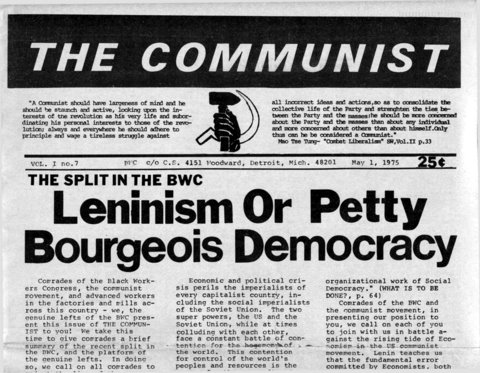
The Workers Congress (Marxist-Leninist), centered in Detroit, played an active part in national party-building debates, putting forward the Iskra principle as its party-building program through its newspaper The Communist. A number of smaller groups and collectives around the country participated in this effort, submitting articles for publication in the paper. In 1976, the Workers Congress underwent a split, centered in the New York District. This resulted in the formation of Red Dawn
The Marxist-Leninist Organizing Committee, based in San Francisco also threw itself into the party building process. Initially, it distinguished itself from other groups by declaring that “the theoretical form of class struggle” was “the chief form of class struggle in this period,” calling for joint theoretical work with other communist organizations and as well as collaboration maintaining, deepening and broadening work within the spontaneous mass movements. It published a theoretical journal Communist Line and a newspaper Unite! In 1978, the MLOC became the Communist Party USA (Marxist-Leninist).
The Revolutionary Bloc was another former faction in the BWC. While briefly touted by the Puerto Rican Revolutionary Workers Organization and the Revolutionary Workers League as a component of the Revolutionary Wing, its post-BWC existence is somewhat mysterious. It appears to have issued only one document – a resignation from the BWC – and Resistencia Puertorriqueña even questioned its existence, post-BWC.
The Crisis in the BWC: Leninism or Petty Bourgeois Democracy by Donald Williams
Central Committee document on ’unfolding the two-line struggle throughout the entire organization’
Document on Security during two-line struggle
Characteristics of the Ultra-Left Line
Where Do Correct Ideas Come From? (A Critique of the Bay Area District Position on the 2-line Struggle in the BWC, 1974-1975)
Sum-Up of the San Jose Unit in the Two-Line Struggle
To All CC Members: Role of IC/CC; Some Theoretical and Ideological Issues by BW
Letter to Central Committee Members and Districts on the financial crisis in the BWC
Don Williams’ ’Self-Criticism’
Two-Line Struggle in the B.W.C. by the Black Workers Congress
Public Letter on Don Williams by the Black Workers Congress
The Split in the BWC. Leninism or Petty Bourgeois Democracy by the Workers Congress (M-L)
Economism and the Attack on “Leftism” by the Workers Congress (M-L)
Two Line Struggle in the B.W.C., part 3 by the Revolutionary Workers Congress
Propaganda, Agitation, and Winning over the Vanguard: Response to the Workers Congress by the August 29th Movement
Western Yarn Strike Ends, Class Struggle Continues by the August 29th Movement
Polemic with ATM: Factory Propaganda and Agitation by the Workers Congress (M-L)
The Split in the Workers Congress (M-L) by former members of the NY District [from Red Dawn, #1] [April 1978]
“More Than Enough Material...” A Letter to the Proletarian Unity League by the Workers Congress (M-L)
On the “Effectiveness” of the Capitalist Restoration Thesis: A Reply to the Workers Congress by the Proletarian Unity League
The Split in the BWC. Leninism or Petty Bourgeois Democracy
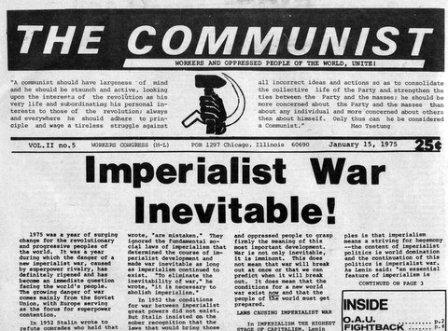
Name Change – Workers Congress
Unity Conference Resolutions [adopted at the founding meeting of the Workers Congress] [Red Dawn, No. 1, April 1978]
Economism and the Attack on “Leftism”
Unite to Build an Iskra-Type Organ
Bolshevize the Ranks: Forward on the Woman Question
OL’s Call for the Party: Our Response
Fight-Back Conference: Party Building and the United Front
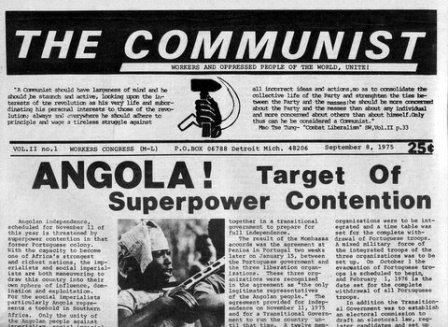
From the Central Committee: A Self-Criticism
Announcement [Expulsion of Don Williams]
Errors of CPUSA: Plant Organizing in the 1940’s
Trade Union Democracy and Our Tasks
WCML Remarks at [Mao] Memorial
OC Draft Program: Proletarian Internationalism or Social-Chauvinism
OL’s Trade Union Pamphlet: A Distortion of Our History
RCP Rewrites History of National Liaison Committee
The Split in the Workers’ Congress (M-L): Statement of the Former Members of the New York District, Part 1: The Abandonment of the ISKRA Plan [Red Dawn, No. 1, April 1978]
The Split in the Workers’ Congress (M-L): Statement of the Former Members of the New York District, Part 2: In Defense of Democratic Centralism [Red Dawn, No. 1, April 1978]
Never Forget Class Struggle! [Red Dawn, No. 1, April 1978]
Letter of Resignation from the W.C. by former members of the political standing committee [Red Dawn, No. 1, April 1978]
[Back to top]
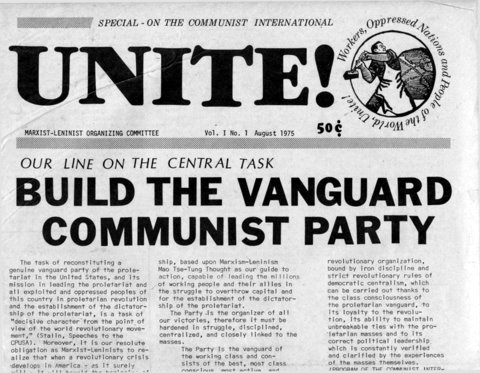
MLOC’s Tactics of Splittism: ’Plan For a Joint Program’ by the October League (Marxist-Leninist)
Smash Scholasticism and Bolshevize Our Ranks! Expose the Petty-Bourgeois Careerism of MLOC! by the Committee for Scientific Socialism (M-L)
MLOC: Intriguing and Conspiring for a Revisionist Clique – Statement by the Bolshevik Organizing Collective/Communist Workers Committee (M-L) by Workers Viewpoint
MLOC’S “CREDO” PROGRAM: Concentrate a Superior Force to Destroy Genuine Marxist-Leninists One by One by Workers Viewpoint
“Take the Money and Run!” by the Workers Viewpoint Organization [Workers Viewpoint, Vol. 1, No. 7, November 1976]
Our Line on the Central Task: Build the Vanguard Communist Party
Editorial: Smash the Old – Build the New
Revolution – Main Trend in World Today
Against Opportunism! Uphold the Historic Mission of the Proletariat!
Report from the Central Committee: The Future Belongs to the Working Class
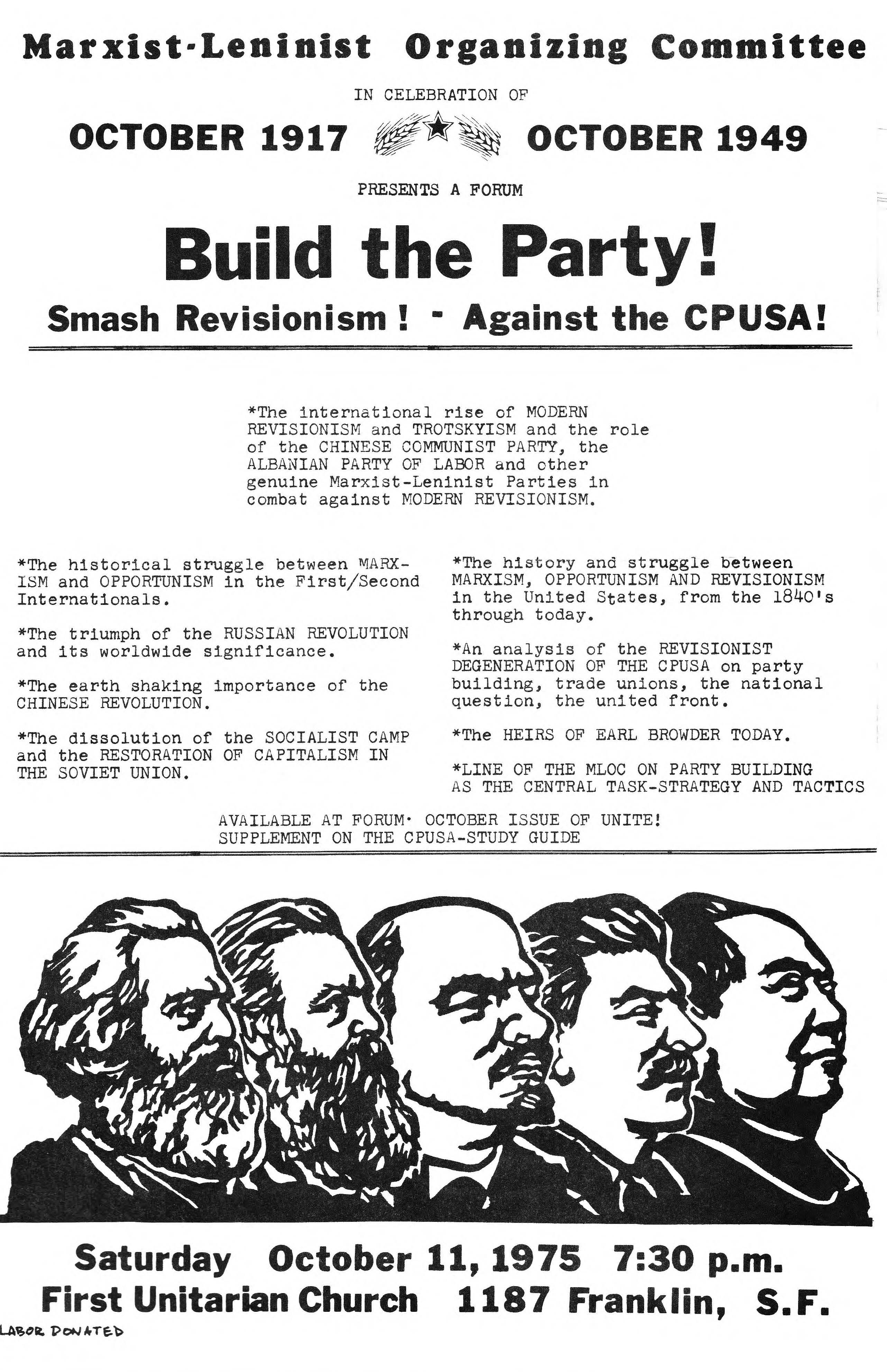
The October League (M-L). What Are Our Differences, What is The Basis Of These Differences?
The Struggle for the Right of Self-Determination: Criticism/Self-Criticism On The National Question
Superpowers, Out of Angola! Position of the C.C. of the Marxist-Leninist Organizing Committee
Marxist Study Guide on the CPUSA
Draft Theses: The Woman Question
The General Crisis of Capitalism and Proletarian Revolution
Class Struggle Sharpens in China
The Struggle for Marxist-Leninist Unity
The “Wing”: How Not to Unite Marxist-Leninists
Angola: Struggle Against Imperialism and Opportunism Go Hand in Hand, Part 1 Unite!, Vol. 2, No. 3, June-July 1976
Call for Joint Work on the Party Program Unite!, Vol. 2, No. 3, June-July 1976
CPUSA – Revisionist Stronghold in the U.S.A. Unite!, Vol. 2, No. 3, June-July 1976
The O.L. on Party Building: A “Partial Modification” of Unprincipled Unity [from Communist Line, No. 9, August 1976]
Angola: Struggle Against Imperialism and Opportunism Go Hand in Hand, Part 2 Unite!, Vol. 2, No. 4, August-September 1976
Toward a Position on the Chicano National Question
In Commemoration of Mao Tsetung
Forge the Vanguard Party – Grasp the Key Link
How the Philadelphia Workers’ Organizing Committee Renders the CPUSA More Profound
Build The United Front Against The Two Superpowers
Struggle in Steel: Class Warfare in United Steel Workers Union
CLP-CPUSA Unity [Unite!, Vol. 2, No. 6, December 1976-January 1977]
Fidel Castro’s troops continue to kill and maim the people in Angola
Report from the Central Committee: Trotskyism Exposed!
Elections No Solution for Steelworkers [Unite!, Vol. 3, No. 1, February 1977]
An Open Letter to the October League
To Our Readers [Unite!, Vol. 3, No. 2, March 1977]
No Peace in Steel [Unite!, Vol. 3, No. 2, March 1977]
Smash the Campaign of Slander Against the Great Stalin! [Unite!, Vol. 3, No. 2, March 1977]
CPUSA’s Job Program: working overtime for the bourgeoisie
Cruise Missle: U.S. Ups Ante in Imperialist War!
Editorial: Communist Party (ML)... A Social Prop of the Bourgeoisie
RCP/RWC Attempt to Con Black Masses
In Defense of Marxism-Leninism on the International Situation
Theory of the “Three Worlds” Opposes Marxism-Leninism
In Memory of Mao Tsetung... Dare to Struggle, Dare to Win!
Prepare the Conditions for the Formation of the Party!
Genuine Unity Rests on Principle
Tito Remains a Traitor to the Working Class
The RCP’s National United Workers Organization. NUWO: Dual-Unionism and Betrayal of the Party
Revolution Will Surely Triumph! On the International Situation
The Menace of Fascism Will Be Smashed by the Mighty Fist of the Proletariat!
The Syndicalist Fronts of the RCP
Terrorism: A False Road to Socialism
Yugoslavia is Not a Socialist Country!
Documents of the First Congress of the MLOC
[Back to top]
Two Line Struggle in the B.W.C., part 3
Détente: A Cover for Superpower Contention
ALSC: RWC Paves Way for RCP Takeover by the Workers Viewpoint Organization
RCP/RWC Attempt to Con Black Masses by the Marxist-Leninist Organizing Committee
[Back to top]
Statement of Resignation from the BWC
[Back to top]
In early 1977 ABC broadcast the ’Roots’ mini-series based on Alex Haley’s book about his family history, from Africa, through slavery and in the post-slavery years. The mini-series was watched by an estimated 140 million viewers total (more than half of the U.S. 1977 population) – the largest viewership for any type of television series in US history.
’Roots’ drew the critical attention of US Marxist-Leninists, in particular the October League (M-L) and the Revolutionary Communist Party, which exchanged sharp polemics over their different interpretations of its significance. The wider debate touched not only on African-American history and the freedom struggle, but broader questions of racism and anti-racism in the mass media, and how Marxist-Leninists should analyze popular culture, literature and art.
A Century of Black Struggle: The Story of Jane Pittman by the October League (M-L) [The Call, Vol. 2, No. 8, May 1974]
Roots Shows Black Heritage. History of Struggle, Oppression by the Revolutionary Communist Party [The Worker for the Milwaukee Area and Wisconsin, Vol. 2, No. 5, February 1977]
’Roots’ TV Series – Which Class Does It Serve? by the October League (M-L)
Commentary: Roots by the Communist Labor Party [People’s Tribune, February 15, 1977]
No Triumph for ’Roots’: Glorious Afro-American History Will Not Serve Capitalism by the Workers Viewpoint Organization
Criticism of “Roots” Article and Workers Viewpoint Organization Response
Millions Discuss, Debate Roots: Fans Hatred of Oppression by the Revolutionary Communist Party
Roots: the story of an American Family by Jim Griffin [Philadelphia Workers Organizing Committee]
’Roots’ – liquidating national struggle by the Workers Congress (M-L) [The Communist, Vol. 3, No. 4, March 1, 1977]
Roots Raises Questions: Slavery Then, Slavery Now by the Revolutionary Communist Party [The Worker for the Milwaukee Area and Wisconsin, Vol. 2, No. 6, March 1977]
Communist Party, USA, and RCP: Opportunists Uncritical of ’Roots’ by the October League (M-L)
’Roots’ by the Marxist-Leninist Collective [The Workers’ Press, Vol. 3, No. 3, March 1977]
Roots and the Role of Black Women by the October League (M-L)
Call Series Summed-up. Roots: ’Sugar Bullet’ on the Cultural Front by the October League (M-L)
ROOTS: Political Deception to Smash the Afro-American Struggle and Revive Dead Cultural Nationalism by the Central Organization of U.S. Marxist-Leninists
[Back to top]
Rigged Steel Election Overturned [The Call, Vol. 2, No. 3, December 1973]
Steelworkers' Union Elections Rigged [from The Call]
Steel Rank & File Denounces E.N.A. [from The Call]
Rank & File Charts Course in Steel [from The Call]
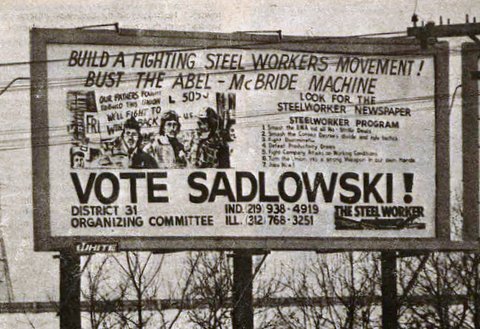
Letter to the Guardian: Two Rallies – Two Lines
Guardian Radical forum: What strategy for steelworkers’ no-strike fight?
Landslide Victory – Sadlowski Wins Victory [from The Call]
A View of Sadlowski’s Campaign [from The Call]
Steel Union Debate: How to Smash Abel Machine [from The Call]
Terror Hits Abel Opponents – Union Reformer Shot [from The Call]
Steel Convention: A Blow to Rank and File [from The Call]
Steel Workers Carry Struggle to Convention by the Revolutionary Communist Party
Editorial: Sadlowski for President The Steelworker, Vol. 1, No. 4 October 1976 [RCP paper]
Abel-Sadlowski – Steeled Racists by the Progressive Labor Party
Steelworker Elections – Time To Dump Abel Machine, Elect Sadlowski by the Revolutionary Communist Party
Sadlowski, an Inside-Out Abel by the August 29th Movement [Revolutionary Cause, Vol. 1, No. 10, November 1976]
Sadlowski Election Battle – Steelworkers Shake Abel by the Revolutionary Communist Party
Local Steelworkers Make Gains in Sadlowski Campaign by the Revolutionary Communist Party
Rank & File Utilize Sadlowski Race by the Revolutionary Communist Party
Boycott of major union elections called: Fighting Our Two Enemies – Bosses and Bureaucrats [from The Call]
Struggle in Steel: Class Warfare in United Steel Workers Union by the Marxist-Leninist Organizing Committee
RCP Comes Out in Steel by the Marxist-Leninist Organizing Committee
Steelworkers Elect Leadership by El Comite-MINP [from Obreros en Marcha, Vol. 2, No. 1, January 1977]
Steel Union Election Feb. 8: Sadlowski & McBride Working for Bosses [from The Call]
Rank & File Unionism Threatens Steel Bureaucracy by Anna Gold [The Organizer, December 1976-Janaury 1977]
Debate on Sadlowski by the Workers Congress (M-L)
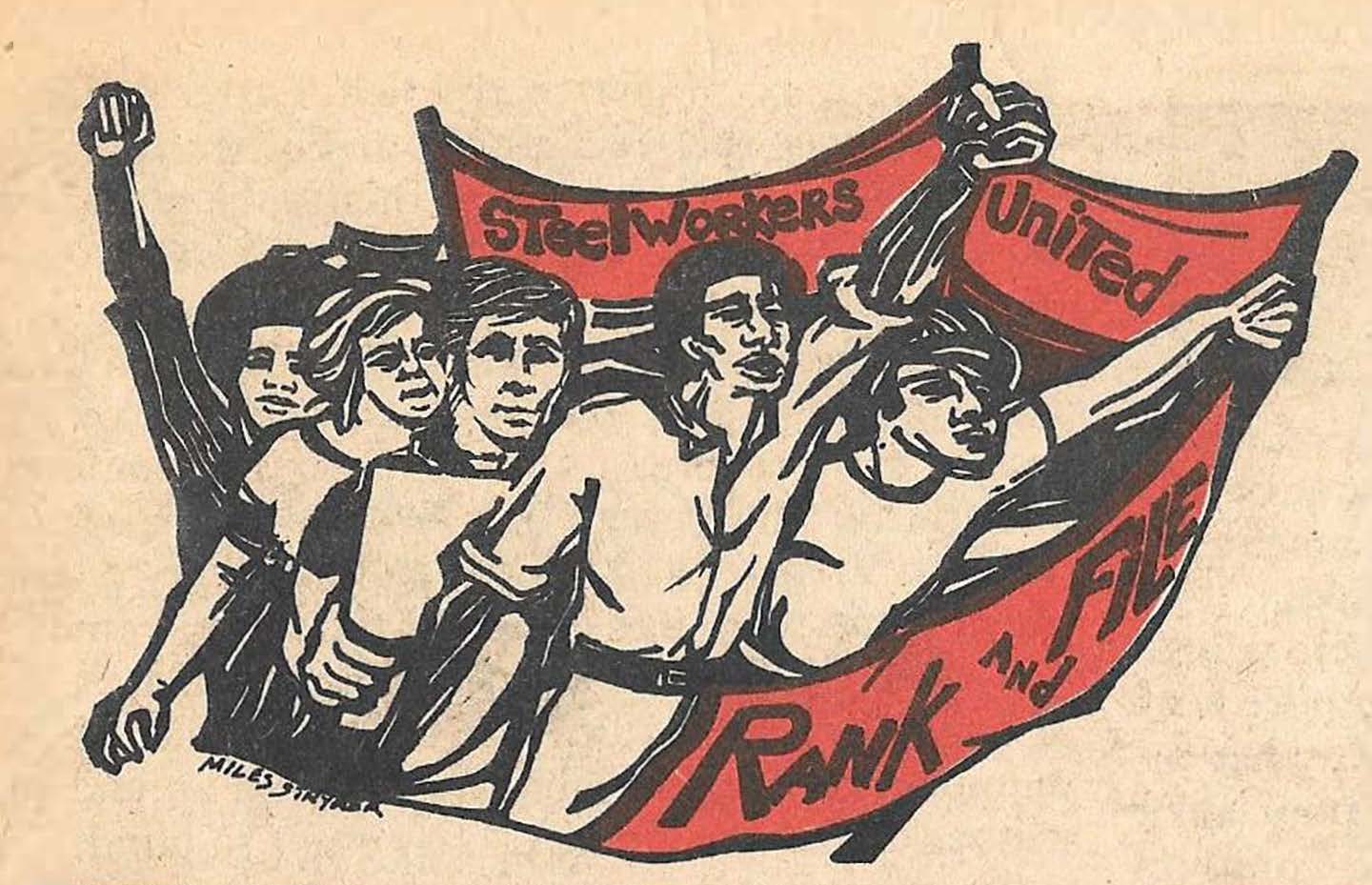
Centrists Jump on Sadlowski Bandwagon: Guardian Tails Liberal Trade Unionists [from The Call]
Sadlowski, McBride: Birds of a Feather.... Steelworkers Must Reject Them Both by the Progressive Labor Party
Sadlowski No Alternative for Steel Workers [from The Call]
Rank & File Advances in Steel Fight by the Revolutionary Communist Party
“Steering Steel Workers into Sadlowski”: RCP – Errand Boys For Liberal Misleaders [from The Call]
Maoist OL Somersaults Over Sadlowski by Workers Vanguard
Elections No Solution for Steelworkers by the Marxist-Leninist Organizing Committee [Unite!, Vol. 3, No. 1, February 1977]
No Peace in Steel by the Marxist-Leninist Organizing Committee [Unite!, Vol. 3, No. 2, March 1977]
Sadlowski Loses USW Election by Ben Fletcher [The Organizer, February-March 1977]
Sadlowski Defeated: Steel Workers Advance Despite Election Loss by the Revolutionary Communist Party
Forward from Sadlowski Campaign: Steel Demo Kicks Off Contract Fight by the Revolutionary Communist Party
Summing Up the Steel Election Battle by the Revolutionary Communist Party
Sadlowski Scabs on Wildcat [The Call, Vol. 6, No. 22, June 6, 1977]
RCP on the Split in the Working Class, Part 2 by the Marxist-Leninist Collective
Forging Correct Line in Steel by the Revolutionary Communist Party
Sadlowski Campaign: The Lessons Learned by the Marxist-Leninist Organizing Committee
Summing Up the CPML’s Experiences in Trade Union Work by Charles Costigan [of the CPML]
[Back to top]
CLP-CPUSA Unity by the Marxist-Leninist Organizing Committee [Unite!, Vol. 2, No. 6, December 1976-January 1977]
Vote Communist, Fight for Jobs with Peace
Electoral Struggle–A Step Forward
Communist Labor Party campaign newsletter [no date]
Committee to Elect General Baker [appeal letter]
Forum announcement [Put the Communist Labor Party on the Michigan Ballot]
Get the CLP on the Ballot flyer
Fascism: The Cost American Cannot Afford! [draft pamphlet]
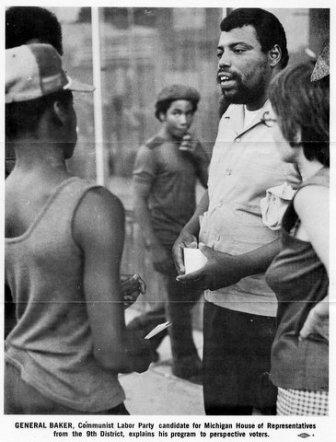
Communist Labor Party Campaign Newsletter [March 26, 1976]
25,000 Signatures: Victory for Working Class
Vote on August 3 For Communist Labor Party
Come to a Party! Committee to Elect General Baker Open House flyer
Communist Labor Party Campaign Newsletter [Vol. 1, No. 8]
General Baker–One Down, Two to Go!
Government Fraud in Primary Elections
CLP Electoral Campaign–Time for a Change
Communist Labor Party Campaign Newsletter [September 8, 1976]
Support Ford Strikers, Elect General Baker
“Control, Conflict, Change” Election Forum flyer
Special Election Issue of the People’s Tribune
New York Ballot Campaign: 5000 Signatures by Sept. 13!
CLP Challenged by Corrupt Opponent
New York elections: Crisis unresolved – what next?
[Back to top]
Afro-American People: Advance the Struggle Against Racial Discrimination and Violent Repression! by the Seattle Workers Movement under the leadership of the COUSML
Communists Resist Anti-busing Fascists at Louisville Factory
Mao Tsetung Thought Versus Opportunism
History of the Afro-American People's Struggle in Seattle by the Seattle Branch of COUSML
Soviet Social-Imperialism Intensifies Aggression in Angola
Victory to the Second Anti-Colonial War of the Angolan People!
MAO TSETUNG THOUGHT WILL SHINE FOREVER!
Special Issue of the Workers’ Advocate on the Situation in the U.S. Marxist-Leninist Movement
OL’s Theory of “Three Worlds” Denies Revolution and Apologizes for U.S. Neo-Colonialism
Flimsy Fraud, Desperate Gamble, Part 1
Flimsy Fraud, Desperate Gamble, Part 2
OL Social-Chauvinists Praise Sadat's "De Facto Recognition of Israel"
The Role of the “RCP,USA” in the U.S. Marxist-Leninist Movement
[Back to top]
Red China’s American Lobby: The U.S. China People’s Friendship Association, Part I , Part II, by Congressman Larry McDonald (1978)
U.S.-China People’s Friendship Association Formed in New York by the Communist League [People’s Tribune, Vol. 3, No. 10, November-December 1971]
China Friendship Assoc. Holds Founding Meeting by the October League (M-L) [The Call, Vol. 3, No. 1, October 1974]
The Struggle Within: A Critique of the Role of the Revolutionary Union within the USCPFA by the U.S.-China Peoples Friendship Association of Detroit
Open Letter To US-China People’s Friendship Association by the Communist Labor Party
China Friendship Assn. Debates Priorities by the October League (M-L) [The Call, Vol. 5, No. 17, August 30, 1976]
China Friendship Assoc. Builds Mass Outreach by the October League (M-L)
USCPFA Convention: Build Peoples’ Friendship Broadly by the Revolutionary Communist Party
New China Magazine – Pluses and Minuses by the October League (M-L) [The Call, Vol. 6, No. 24, July 4, 1977]
US-China Friendship Association Faces New Tasks by the October League (M-L) [The Call, Vol. 6, No. 33, August 29, 1977]
After year of advances: 5th USCPFA convention set for San Francisco by the Communist Party (M-L)
RCP’s Plan to Wreck China Friendship Assoc. by the Conmmunist Party (M-L)
USCPFA reaffirms support for People’s China by the Conmmunist Party (M-L)
U.S.-China People’s Friendship Assoc. Holds Successful 5th Annual Convention by the League of Revolutionary Struggle
Struggle Over “Gang of 5” Hits USCPFA by the Revolutionary Communist Party
RCP Makes Anti-China Stand Public by The New Voice
USCPFA Slides Toward Oblivion by the Revolutionary Communist Party
U.S.-China convention plans broad outreach by the Communist Party (M-L) [The Call, Vol. 8, No. 35, September 17, 1979]
USCPFA holds first national convention since normalization by the League of Revolutionary Struggle
[Back to top]